



The Southwest Jewelry Guide
Everything we know about Southwest and Native American jewelry — techniques, stones, forms, history, and the people who made the craft — researched from our reference library and cited to the actual book and page. This guide grows continuously as our library grows.

How we source this guide. Every factual claim in these pages is verified against a physical reference library of more than forty books and primary sources, and cited to the book and page that records it. We strive for accuracy, and this information is continuously updated with new information from the artists, their families, and the community. If you know something we should — or see something we got wrong — tell us. That correction becomes part of the record.
👋Welcome
Who we are and how this guide is sourced.
Our founder, Mateo James, is of Spanish, Welsh and Indigenous Native American descent. He grew up in Aztec, New Mexico, on the edge of the Navajo Nation, and does not claim a Yaqui tribal affiliation.
📜Southwest Jewelry History
From ancient trade to today, era by era.
-
THOUSANDS OF YEARS AGO
Ancient Beginnings
For thousands of years before metal, Indigenous peoples of the Southwest created jewelry from turquoise, shell, stone, bone, and plant fiber — establishing the region’s earliest design language.
Read more about Ancient Beginnings
Source: Lowry (2010), p. 78
-
LATE 1500s
Spanish Contact
The Spanish brought silver, coins, metalworking tools, and new techniques into the Southwest — adding metal to the material palette.
Read more about Spanish Contact
Source: Schiffer (2008), p. 5 (Spanish accounts of Southwestern turquoise use)
-
1700s–1800s
Mexican Influence
Mexican vaqueros and saddle makers introduced ornate silver horse gear and conchos — early metal adornment forms that shaped the region’s aesthetic.
-
1850s
Birth of Silversmithing in the Southwest
Navajo artisans learned metalworking from Mexican smiths, becoming the first Native silversmiths in the Southwest and setting the foundation of a new regional art form.
Read more about the birth of silversmithing in the Southwest
Source: Bahti (2007), p. 8 (Atsidi Sani, 1850s)
-
LATE 1800s
Stone + Silver Fusion
Techniques spread across tribes — Zuni and Hopi each contributed distinct aesthetics — while turquoise (prized for millennia) began to be set into metal.
Read more about stone and silver fusion
Source: Bahti (2007), p. 11 (Zuni by 1872; Hopi 1898)
-
1880s–1930s
Railroads + Commercial Growth
The Santa Fe Railway and Fred Harvey Company connected Southwestern makers to national travelers — launching a wider Southwest jewelry marketplace that employed Native and non-Native craftsmen and designers.
Read more about railroads and commercial growth
Source: Bahti (2007), p. 12 (“railroad jewelry”)
-
1950s–1970s
The Regional “Southwest Styles” Take Shape
Tourism, lost-wax casting, and studio workshops led to a blended regional identity — where Native artists, Hispanic silversmiths, western ranchers and cowboy rodeo met through trading posts and family-run shops, contributing to what became distinctively known as Southwest.
Read more about the regional Southwest styles
Source: Bahti (2007), p. 12 (regional styles by the 1940s)
-
1980s–TODAY
Modern Southwest Jewelry
Today the Southwest style continues to mix cultures, ideas, techniques, and technologies — honoring Native roots while celebrating a shared regional art form that keeps evolving through both tradition and innovation.
Shops, Trading Posts & Guilds
🌙The Squash Blossom
The necklace and the naja at its center.
🛡️Authenticity & the Law
Buy with confidence: what the law says and how to spot fakes.
✍️The Artist's Signature
Hallmarks and the makers behind them.
A hallmark match is a lead, not proof. Several artists can share the same initials, some artists changed their marks over their careers, and marks can be copied. Check a match against the piece's style, materials and age, and ask the seller for a written receipt naming the artist.
🤝Culture & Respect
Cultural etiquette for buying, wearing and giving.
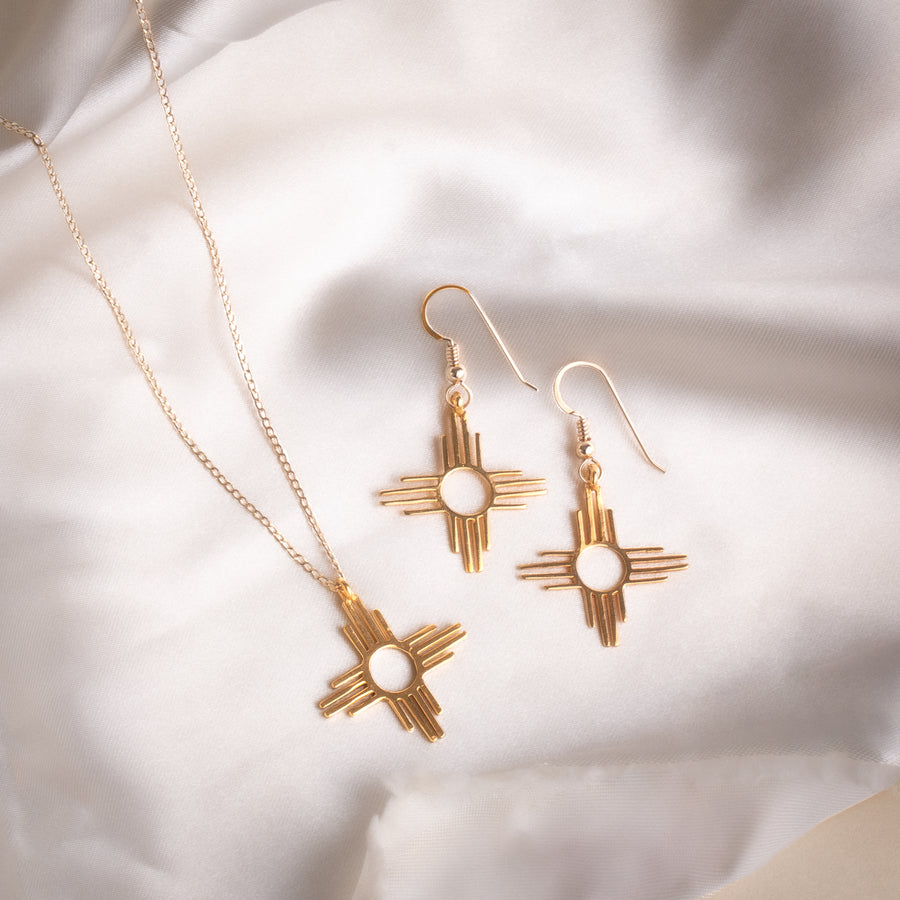
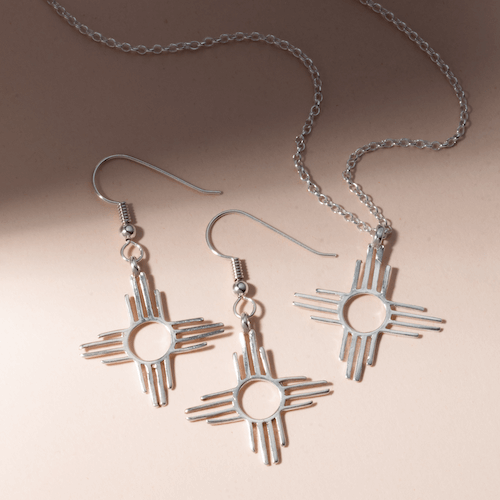
We keep these traditions, but we don't own them. Our artists can speak for themselves, but they don't speak for entire nations. We don't make ceremonial items. We use the Zia sun symbol with written permission from the Pueblo of Zia.
Every tribe is different, and beliefs can be unique to a tribe, a clan or even a family. Please take the cultural points in this guide as general information. If you are a tribal member yourself, seek the guidance of your elders or tribal leaders. This guide is not the final authority.
Some of what we have been taught is sacred. It isn't ours to share, so we keep it private out of respect. Some knowledge is earned only through years of apprenticeship. When we don't know what a design means, we say so. We never guess, and meanings differ from one pueblo or nation to the next.
Our guide covers cultural etiquette nation by nation, for anyone buying, wearing or giving Southwest jewelry.
🏜️Common Cultural Styles
How Navajo, Zuni, Hopi and Pueblo work differ.
🔨How It's Made
Techniques from the bench: stamping, casting, inlay and more.
💎Stones of the Southwest
Turquoise and the stones set beside it.
⛏️The Turquoise Mines
Where the stone comes from, mine by mine.
🪙Metals
Sterling, coin silver and caring for them.
☀️Symbols
Common designs and where they come from.
❓Secret Questions
What to ask before you buy.
The artist and tribe
- Is this piece Native American made? Who is the artist, and what is their tribal affiliation?
- Do you have any jewelry that is imported?
- Is this piece Native made, Southwest jewelry, or imported?
- Does this piece have the artist's signature hallmark?
Handmade or handcrafted
- How did they make this piece?
- Did they cast these components? Did they roll their own plate? Did they draw their own wire, or buy it from a store? Did they cut their own stones?
- Can they show photos or proof of their process?
- Were these stones cut by hand?
The stones
- Is the stone natural, stabilized, or dyed?
- Where was it mined or sourced?
- Do its appearance and price reflect authenticity?
The mine
- Can the seller name the mine?
- Does the pattern match its origin?
- Are treatments openly disclosed?
The metal
- Does the silver tarnish naturally? (A good sign.)
- Is gold karat or plating clearly marked by a hallmark?
- Is it plated or vermeil?
Casting
- What casting method was used to make this piece?
- Does the maker control their casting process in-house?
- Can the seller describe how the mold was created?
Questions from the T.Skies pocket guide by Mateo James.
Get it in writing
The Indian Arts and Crafts Board recommends a written receipt that includes:
- the artist's name and Tribal affiliation
- the mine the turquoise came from
- whether the turquoise is natural, stabilized or treated
- where the stone was purchased
- the price
- the date
- the business address
IACB turquoise brochure, p. 1.
📚Glossary & Library
The words and the books behind this guide.
🌱Giving Back
How buying here supports artists.
From the T.Skies Journal
From the Library: Chambless & Ryan, Turquoise in America, Part One (2021)
2021 primary source. Anything described as current here describes 2021, not today.
Chambless & Ryan (2021) describe the two paths the market for American Indian jewelry took:
“Craft was defined as the careful handmade design and production of a piece by one artist, whereas curio was a commercial endeavor using techniques to mass produce items not associated with any one individual.”
— Chambless & Ryan (2021), p. 179 [1]
On the turn toward matrix stone, Chambless & Ryan (2021) note:
“The Southwest Turquoise Company had promoted the beauty of the full range from blue to green, especially the matrix they referred to as "cobweb" in their 1908 catalog”
— Chambless & Ryan (2021), p. 178 [1]
Chambless & Ryan (2021) tie the two markets back to the mines:
“Turquoise was a key component in the design of both curio and craft jewelry, and the demand from this growing market determined in large part the direction of turquoise mining and production following The Great American Turquoise Rush.”
— Chambless & Ryan (2021), p. 180 [1]
Sources
- Chambless, Philip, and Mike Ryan II. Turquoise in America, Part One: The Great American Turquoise Rush, 1890–1910. Revised first edition. Callais Press, 2021. Cited by printed page. Statements describe conditions as of 2021.
- Lowry, Joe Dan, and Joe P. Lowry. Turquoise: The World Story of a Fascinating Gemstone. Layton, UT: Gibbs Smith, 2010. Cited by printed page. Statements describe conditions as of 2010.
- Schiffer, Nancy N. Turquoise Jewelry. Revised 4th ed. Atglen, PA: Schiffer Publishing, 2008. Cited by printed page. Statements describe conditions as of 2008.
- Bahti, Mark. Silver + Stone: Profiles of American Indian Jewelers. Tucson: Rio Nuevo Publishers, 2007. Cited by printed page. Statements describe conditions as of 2007.