



Coral in Southwest Jewelry: The Red That Crossed an Ocean
Coral is the Southwest's great imported stone — Mediterranean red coral, carried along trade routes into a landscape with no ocean, where Navajo and Pueblo lapidaries made it their own. The books document red coral firmly in the Navajo palette[1], and native lapidarists working coral across the region[2].


Coral in the Masters' Hands
The documented roster of coral workers spans every tradition and era: Preston Monongye[3], Alice Quam of the great Zuni cluster tradition[4], Larry Golsh and Duane Maktima[5], Harry H. Begay[6], Vernon C. Haskie[7], and the Long family of Santo Domingo[8]. The record even preserves working detail as fine as Leo Poblano's repairs to pitted coral[9] — the kind of bench-level fact only the books carry.
Coral reached the Southwest long before the trading posts did. Bedinger, citing Carlson and Woodward, dates red and pink coral beads worn in the Southwest to 1750 — a century before the first Navajo silverwork. What arrived that early was beads. Workable raw coral is a much later story: apart from one lot of coral trees the trader C. G. Wallace procured in 1938, no uncut coral was available at Zuni until 1951, when the writer Neumann finally got raw trees from wholesalers. It was expensive then and it still is — Bedinger’s sources put it at about the cost of turquoise, with one advantage a lapidary notices immediately: unlike turquoise, coral carries no matrix, so almost none of the material is wasted in the cutting.
Reading Coral
Collectors weigh: color (the deep ox-blood reds command the most), whether it's natural or dyed (bamboo coral dyed red is common in modern imports — depth and translucency differ), and the cut. Coral pairs most famously with turquoise — the red-and-blue signature of classic Zuni and Navajo work. See cluster work and the turquoise guide for its usual companions.
A note on accuracy. We strive for accuracy, and this page is continuously updated with new information from the artists, their families, and the community. Corrections welcome.
From the Library: Branson, Turquoise: The Gem of the Centuries (1975)
1975 primary source. Anything described as current here describes 1975, not today.
Captioning an old Mediterranean coral necklace finished with a double jacla, Branson (1975) noted:
“The coral is cut and drilled in Italy, not by the Indians.”
— Branson (1975), p. 10
From the Library: Bedinger, Indian Silver (1973)
1973 primary source. Anything described as current here describes 1973, not today.
According to Bedinger (1973, pp. 187-188), apart from a single lot of coral trees that the Zuni trader C. G. Wallace obtained in 1938, uncut coral did not reach Zuni lapidaries until 1951, when the writer Neumann, whom she cites, finally got raw trees from wholesalers. [13]
According to Bedinger (1973, p. 188), pink ("angel skin") and white coral were introduced later, and Zuni cutters treated coral like turquoise, cutting it into various shapes, with no matrix to waste as there is in turquoise. [13] Schiffer (1996, p. 98) also captioned six coral necklaces “ranging from light to dark showing the variations in color of natural coral,” adding: “Other varieties of coral can be white or black, as well.” [18]
From the Library: Frank, Indian Silver Jewelry of the Southwest (1990)
1990 primary source. Anything described as current here describes 1990, not today.
According to Frank (1990, p. 108, Fig. 127), a thick dark red coral necklace of the early 1900s carried two blue turquoise stones in serrated bezels and a white shell pendant; turquoise earbobs like these were often worn as necklace pendants or tied onto chunk turquoise necklaces. [14]
From the Library: Turnbaugh, Indian Jewelry of the American Southwest (2007)
2007 primary source. Anything described as current here describes 2007, not today.
Turnbaugh (2007, p. 32, caption) described a test for coral: a drop of lemon juice placed on an inconspicuous spot will make genuine coral effervesce, or bubble slightly. The same caption noted that the Mediterranean coral in two Southwest necklaces had probably been drilled and polished in Italy before export, then hand-assembled by Southwest Native jewelers. [15]
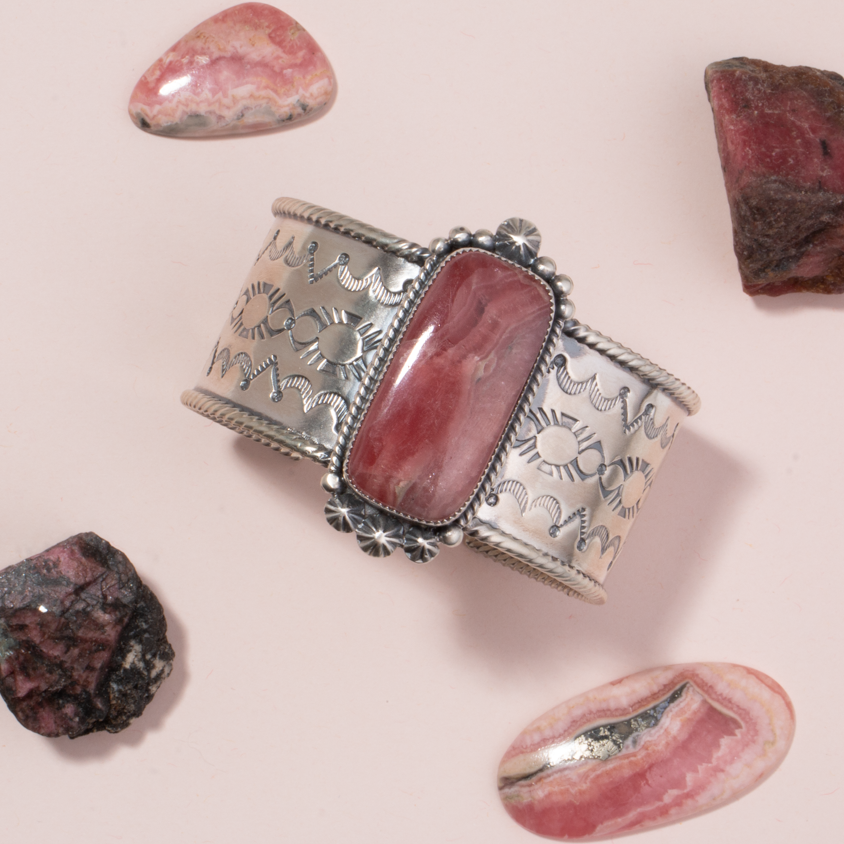
According to Turnbaugh (2007, p. 83, caption), red Mediterranean coral had been a very popular material among Native craftsmen since its first modern-day importation to Zuni in 1936; it could be shaped for silverwork, as in a "shadowbox" applique cuff, or drilled and worn in strands. [15]
From the Library: Bassman, The Beauty of Navajo Jewelry (1997)
1997 primary source. Anything described as current here describes 1997, not today.
Bassman (1997, p. 48) named coral by trade shade, salmon, angel and oxblood, in the inlay of a 14-karat gold bracelet by Jesse Monongye. [16]
From the Library: Stacey, Turquoise Blue Book and Indian Jewelry Digest (1975)
1975 primary source. Anything described as current here describes 1975, not today.
David L. Neumann, a Santa Fe dealer whose El Palacio article the 1975 Turquoise Blue Book reprinted, on calibrated stones American cutters would not make:
“They also may be had in coral, cut in Italy. This accounts in some degree for the increasing use of coral in Navajo jewelry.”
— Stacey (1975), p. 68 [17]
These are outside observers’ records from 1975; the nations themselves are the authority on their own beliefs and practices.
The 1975 Turquoise Blue Book, drawing on the coral expert Basilio Liverino:
“The reason for the premium value set on coral used in pawn jewelry is the hand drilling and meticulous hand craftsmanship used to work the material.”
— Stacey (1975), p. 88 [17]
On what sets coral's price, per the 1975 account:
“Color determines the price of coral with Angel Skin, a pale pink, being the most valuable.”
— Stacey (1975), p. 88 [17]
On what coral is, the 1975 account recorded:
“For centuries, science classified coral as either vegetable or mineral, but in 1720 the Frenchman, Peyssonel, proved that the delicate, brightly-colored branches were the calcareous skeletal remains of thousands of minute sea animals.”
— Stacey (1975), p. 88 [17]
On coral as status, the 1975 Turquoise Blue Book recorded:
“With Navajo women, strands of coral beads are a symbol of success and social prominence... the standard being a minimum of ten strands at the time of the woman's thirtieth birthday.”
— Stacey (1975), p. 88 [17]
From the Library: Baxter, Encyclopedia of Native American Jewelry (2000)
2000 primary source. Anything described as current here describes 2000, not today.
Baxter, in her 2000 encyclopedia, dated regular access to coral:
“However, in terms of jewelry production, native lapidarists gained only limited access to coral during the 1930s; it was not until the late 1950s, when traders and wholesalers made concerted efforts to import quantities, that this material became available on a regular basis.”
— Baxter (2000), p. 38 [19]
According to Baxter (2000, p. 38), the most numerous examples of jewelry combining coral and turquoise, in beads and metalwork alike, were made from the 1950s through the 1970s. [19]
Baxter (2000) on a common substitute:
“In fact, the use of red shell has grown greatly since the 1940s as an alternative means of fulfilling the native taste for coral.”
— Baxter (2000), p. 38 [19]
From the Library: Woodward, A Brief History of Navajo Silversmithing (1946)
1946 primary source. Anything described as current here describes 1946, not today.
Woodward (1946) quoted an 1858 report from the Laguna Negra skirmish, where a Zuni scout with U.S. troops took from a Navajo woman what the reporter listed as
“a silver belt worth $50 or $75—also $100 or $200 worth of coral necklace, precious stones, and other articles greatly prized by the Indians and only possessed by the rich.”
— Woodward (1946), p. 18 [20]
Lieutenant John G. Bourke, at Fort Defiance in April 1881, wrote of Navajo silver necklaces, as Woodward (1946) quoted his journal:
“They make it into fantastic necklaces which contest the supremacy of their affections with chalchiuitl and red coral, the latter brought into the country during the Mexican domination”
— Woodward (1946), p. 61 [20]
Field Notes by Mateo James
The Turnbaughs date coral's first modern arrival at Zuni to 1936, while Bedinger records one lot of coral trees in 1938 and no uncut coral until 1951. Bedinger speaks of uncut trees and the Turnbaughs of importation in general, and neither book reconciles the dates, so I show both.
This page follows Bedinger, who cites Carlson and Woodward for coral beads worn in the Southwest by 1750. In the 1946 edition of Woodward's bulletin, the coral passages we found are dated 1858 and 1881, and it gives no 1750 date for coral. I show both.
Questions
Where does the coral in Southwest jewelry come from?
It's imported: Mediterranean red coral, carried along trade routes into a landscape with no ocean, where Navajo and Pueblo lapidaries made it their own.
When did coral reach the Southwest?
Bedinger, citing Carlson and Woodward, dates red and pink coral beads worn in the Southwest to 1750, a century before the first Navajo silverwork. Raw coral came much later: apart from one lot C. G. Wallace procured in 1938, no uncut coral was available at Zuni until 1951.
What do collectors look for in coral?
Color (the deep ox-blood reds command the most), whether it's natural or dyed (bamboo coral dyed red is common in modern imports), and the cut.
Is coral expensive?
Bedinger's sources put it at about the cost of turquoise. Unlike turquoise, coral carries no matrix, so almost none of the material is wasted in the cutting.
Sources
- Navajo Silver: A Brief History of Navajo Silversmithing, p. 69
- Encyclopedia of Native American Jewelry, p. 88
- Tanner & Koonce, Ray Manley's Portraits and Turquoise, pp. 77-78
- Encyclopedia, p. 196
- Encyclopedia, pp. 112, 154
- Hougart, Native American and Southwestern Silver Hallmarks (5th ed.), p. 107
- Hougart 5e, p. 196
- Encyclopedia, p. 144
- Encyclopedia, p. 188
- Bedinger, Indian Silver, p. 187
- Bedinger, Indian Silver, p. 188
- Branson, Oscar T. Turquoise: The Gem of the Centuries. Santa Fe: Treasure Chest Publications, 1975. Cited by printed page. Statements describe conditions as of 1975.
- Bedinger, Margery. Indian Silver: Navajo and Pueblo Jewelers. Albuquerque: University of New Mexico Press, 1973. Cited by printed page. Statements describe conditions as of 1973.
- Frank, Larry, with the assistance of Millard J. Holbrook II. Indian Silver Jewelry of the Southwest, 1868-1930. Atglen, PA: Schiffer Publishing, 1990. First published 1978 by New York Graphic Society. Cited by printed page. Statements describe conditions as of 1990.
- Turnbaugh, William A., and Sarah Peabody Turnbaugh. Indian Jewelry of the American Southwest. Foreword by Barry M. Goldwater. Atglen, PA: Schiffer Publishing, 2007 (copyright 1996 and 2007; first published 1988). ISBN 0-7643-2577-9. Cited by printed page. Statements describe conditions as of 2007.
- Bassman, Theda. The Beauty of Navajo Jewelry. Photography by Gene Balzer. Walnut, California: Kiva Publishing, 1997. Cited by printed page. Statements describe conditions as of 1997.
- Stacey, Joseph, ed. Turquoise Blue Book and Indian Jewelry Digest. Arizona Highways Collectors Series. Phoenix: Arizona Highways (Arizona Department of Transportation), 1975. Cited by printed page. Statements describe conditions as of 1975.
- Schiffer, Peter N. Indian Jewelry on the Market. Text and photography by Peter N. Schiffer. Atglen, PA: Schiffer Publishing Ltd., 1996. Cited by printed page. Statements describe conditions as of 1996.
- Baxter, Paula A., with Allison Bird-Romero. Encyclopedia of Native American Jewelry: A Guide to History, People, and Terms. Phoenix: Oryx Press, 2000. Cited by printed page. Statements describe conditions as of 2000.
- Woodward, Arthur. A Brief History of Navajo Silversmithing. With field notes by Richard Van Valkenburgh. Museum of Northern Arizona Bulletin 14, 2d ed. Flagstaff: Northern Arizona Society of Science and Art, December 1946 (first edition 1938). Cited by printed page. Statements describe conditions as of 1946.
← Back to the Southwest Jewelry Guide · Spiny Oyster: the Other Red


