



Native Made
Our Gallery: independent artists, named and credited
T.Skies' gallery features jewelry from two sources:
- Our own artists who, in addition to their team work, design and sell their own personal pieces. We give them shelf space, and the work is theirs.
- Independent local artists whose work we buy and resell.
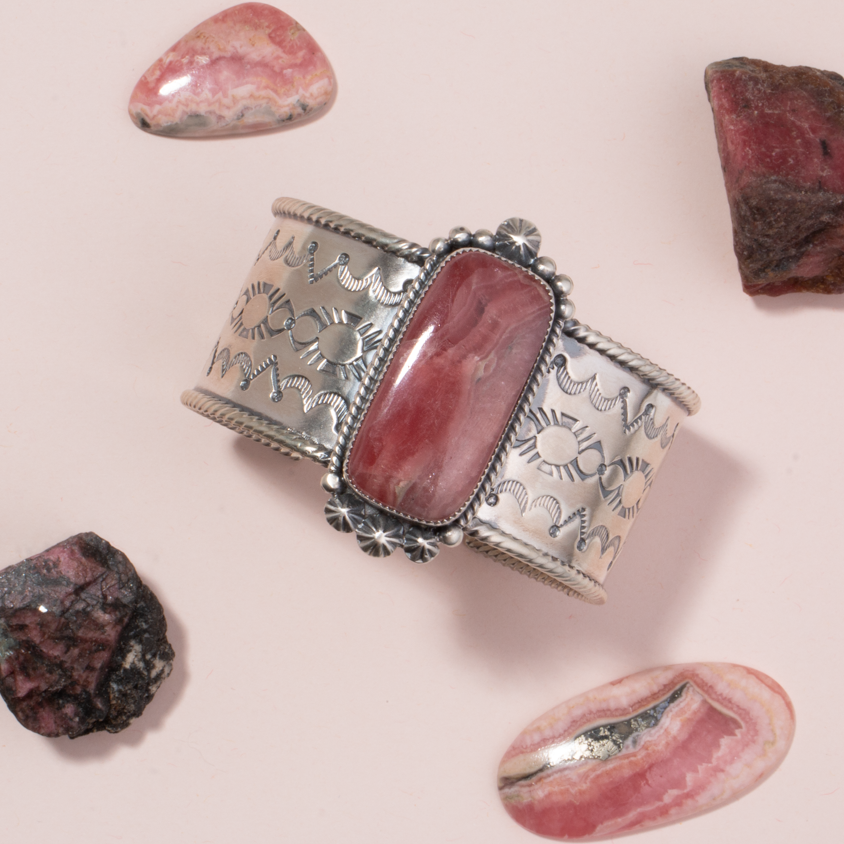
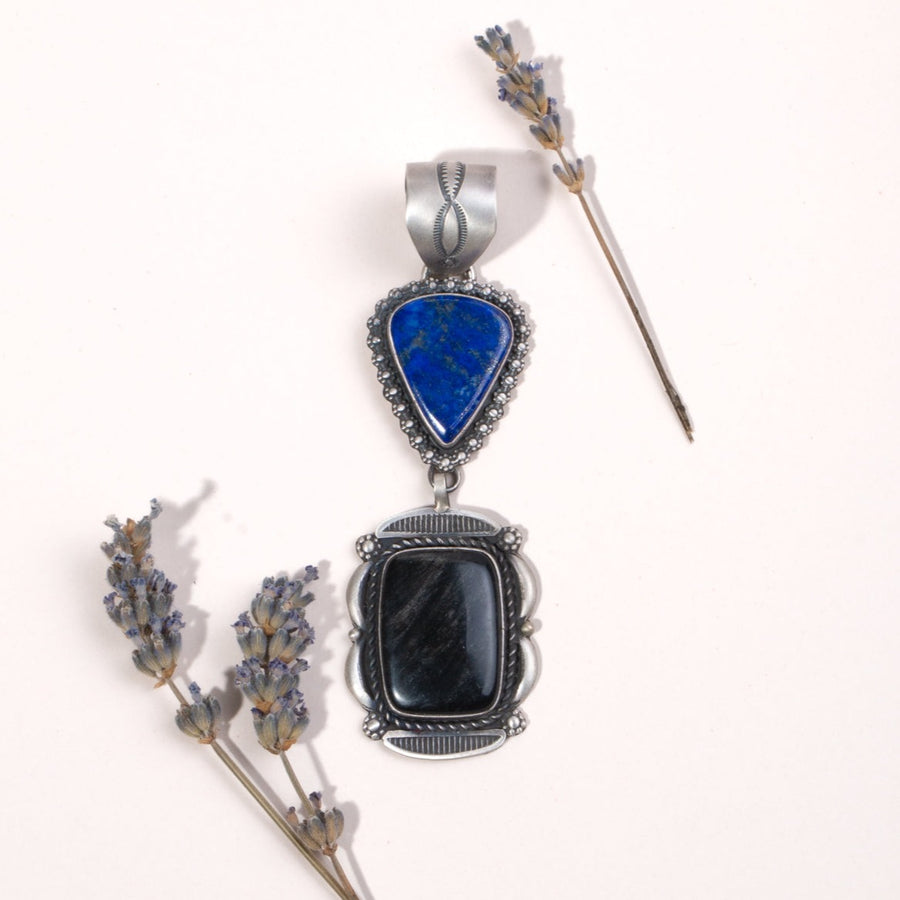
Every gallery piece is stamped with the maker's name or hallmark. We list each gallery piece with the artist's name and tribal affiliation (with their permission). When you buy from our gallery, you know exactly who made what you're taking home. (On collaboration pieces that bear both the artist's hallmark and the TSKIES hallmark, the listing will say so.) If you want to know more about an artist — their training, their tradition, the symbolism in a specific piece — ask. We can usually connect you.
We do this because authentic Native American art deserves proper attribution. The maker, the tradition, the tribe — those matter. We list them so they're not lost.
A note on "Native American–made"
When you see something labeled "Native American–made," it tells you one specific thing: the maker is an enrolled member of a recognized tribe. It does not tell you which tribe, which family, which tradition the piece comes from. A piece by a Navajo silversmith is not the same as a piece by a Zuni inlay artist or a Hopi overlay artist — each tradition has its own history, technique, and meaning.
If a specific tradition matters to you, ask about the individual artist's affiliation and where their work fits in their tribe's tradition. We're happy to help with the research.
We choose not to market jewelry by the color of someone's skin.
That's the simplest way to say what makes T.Skies different.
Most of our jewelers are Navajo. We have makers from other tribes too. We have makers of European, Mexican, and Spanish descent. They all work side-by-side in our Albuquerque workshop, and every signature T.Skies piece is the work of many hands — designers, silversmiths, stone-setters, polishers — each contributing to a piece before it leaves our door.
We could lean on our jewelers' heritage to market our jewelry. Plenty of brands do. We don't, and we won't. We don't believe jewelry should be sold based on the race, ethnicity, or tribal affiliation of the hands that touched it. Our pieces are made well, designed thoughtfully, and built from real .925 sterling silver. That's what we want them to be valued for.
The legal framework, for the careful reader
The Indian Arts and Crafts Act of 1990 is a federal truth-in-advertising law. It makes it a crime to falsely market goods as "Indian made," "Native American made," or made by a specific tribe when they are not. The law exists to protect authentic Native American artists from fraudulent representation in the marketplace.
We comply with this law proactively. Our signature line is never marketed as Native American–made because our pieces are not made by one artist — it's a team effort, and we don't believe in labeling our signature jewelry by our team's ethnicity with a blanket term like Native American. Even though most of the team is Native American, we are of mixed tribes and races. If you are interested in a specific artist or tribal affiliation, we do market jewelry as Native American on an artist-by-artist basis. Our gallery pieces are marketed by individual maker and tribal affiliation because that's what's accurate for each piece.
If you'd like to verify authenticity of any Native American jewelry — from us or from anyone else — useful resources include:
- Indian Arts and Crafts Board (Department of the Interior): https://www.doi.gov/iacb
- Heard Museum (Phoenix): https://heard.org
- Eight Northern Indian Pueblos Council: https://www.enipc.org
Buying directly from the artist, or from a seller who names the maker and their nation, is the simplest way to know who made a piece. Our staff is happy to point you in the right direction.
Many hands, one workshop
When you buy a T.Skies signature piece, you're buying something a team made together. We can't honestly tell you which person cut the stone, which person did the final polish, which person packed it. It would be misleading to attribute that piece to any single maker's heritage. Our craftspeople are individuals with their own stories — but the work they do together is a collective effort, and that's how we describe it.
You don't have to take our word for it. We post live video from our Albuquerque workshop constantly across our social media — you can see exactly who is making our pieces and how. The workshop is real, the people are real, and the work is on camera.
Different from the independent artists in the gallery, every signature T.Skies piece is stamped with the TSKIES hallmark. That mark tells you it came from our collective workshop — many hands and tribal affiliations working together. From time to time we collaborate directly with an individual artist on a piece; in those cases you'll see both the artist's hallmark and the TSKIES hallmark on the work, and we don't hide either contribution.
What "Southwest-inspired" means
Our signature line is Southwest-inspired. The Southwest's design vocabulary — squash blossom necklaces, naja pendants, concha belts, turquoise paired with hand-stamped silver — grew out of centuries of cultural blending between Spanish, Indigenous, and Mexican peoples. That shared history shaped jewelry-making in this region, and we work within it.
We don't claim our signature pieces are Native American–made. We don't claim our designs represent any specific tribe's protected work. We do design and handcraft them in Albuquerque, in .925 sterling silver, with care.
About our founder
T.Skies was founded by Mateo James. Mateo is of Native American, Spanish, and European descent. His grandmother was Spanish + Yaqui — she gave him the name Mateo — but he grew up in Navajo country, not in the Yaqui tradition. Out of respect for the Yaqui people and the traditions he didn't grow up in, Mateo does not claim Yaqui tribal affiliation. He describes himself as "of Spanish and Indigenous descent" — accurate to his lineage without overclaiming.
T.Skies operates with the same posture: name what we are honestly, decline what we aren't.
Frequently Asked Questions
Where can I buy authentic Native American jewelry from T.Skies?
Three places: in person at our Albuquerque shop at 8106 Menaul Blvd NE, at our gallery inside the Albuquerque International Sunport, or online in our Gallery Jewelry collection. Each gallery piece is stamped with the maker's name or hallmark and listed with the artist's tribal affiliation. Some are made by our own artists who sell personal work alongside their team contributions; others we buy from independent local Native American artists.
Is T.Skies signature jewelry Native American–made?
No. Our signature line is Southwest-inspired and made by our team in Albuquerque. We don't market it as Native American–made because it's a collective product, not the work of a single Native American artist.
But most of your jewelers are Native American, right?
Yes — most of our jewelers are Navajo, with a few other tribal affiliations. But we choose not to market jewelry based on the color of someone's skin or their tribal heritage. Our pieces are valued for design and craftsmanship; our jewelers are valued for who they are personally, not as a marketing label.
Just because something is "Native American–made," is it from a specific tribe?
No. The "Native American–made" label only confirms the maker is an enrolled member of a recognized tribe — not which tribe, family, or tradition. Always ask about the individual artist's affiliation if a specific tradition matters to you.
What's the difference between Native American–inspired and Native American–made?
"Inspired" means the design draws from Southwest cultural traditions. "Made" is a legally protected term under the Indian Arts and Crafts Act of 1990, reserved for items made by enrolled members of recognized tribes. We use each carefully and only when accurate.
Is your founder Native American?
Mateo James is of Native American, Spanish, and European descent. His grandmother was Spanish + Yaqui, but Mateo grew up in Navajo country and was not raised in the Yaqui tradition. He does not claim Yaqui tribal affiliation out of respect, since he didn't grow up in it.
Where can I learn more about authentic Native American art?
Good starting points are the Indian Arts and Crafts Board, the Heard Museum, and the Eight Northern Indian Pueblos Council.
From the T.Skies Journal