



Turquoise Rings
Turquoise rings in sterling silver: single stones in hand-built bezels, inlay bands, and adjustable rings. Some are made by Navajo silversmiths and sold under the artist's name and hallmark; many are T.Skies designs. Ask about any stone and we'll tell you how it was treated, if at all.
















What you'll find here
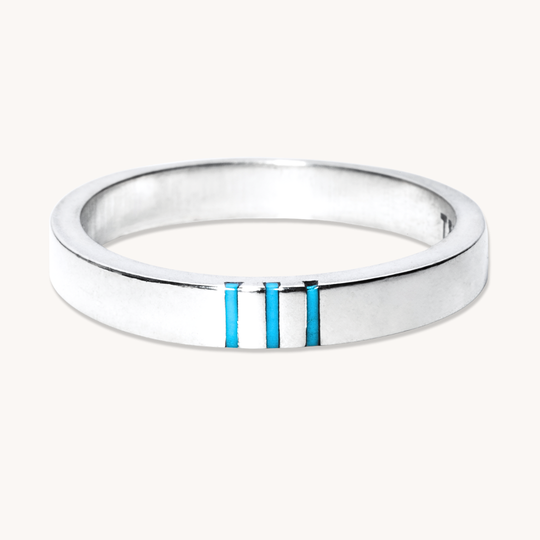
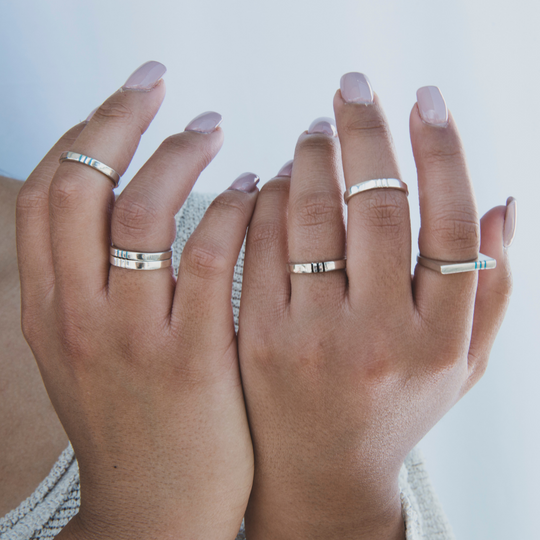
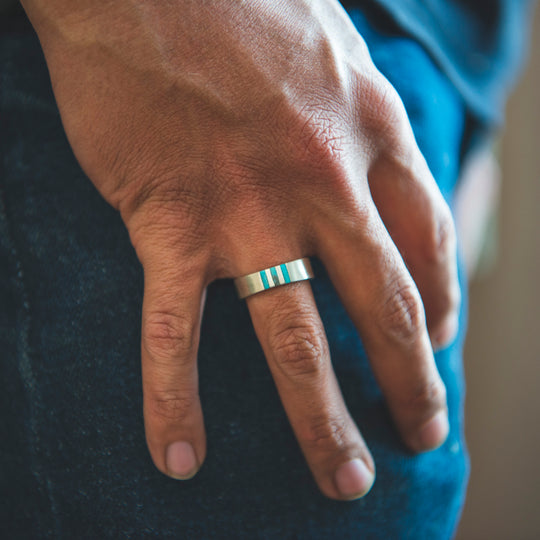
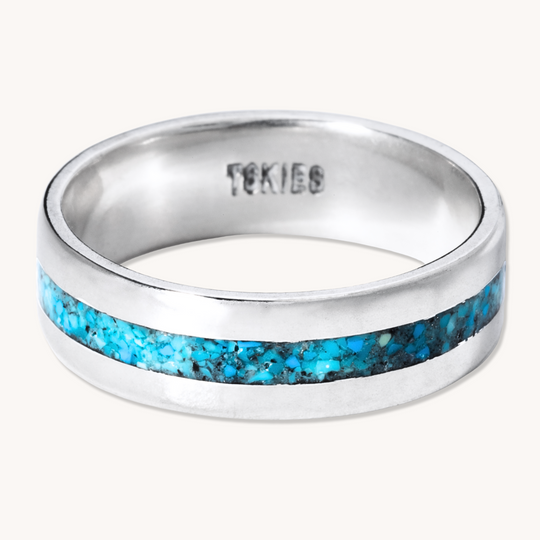
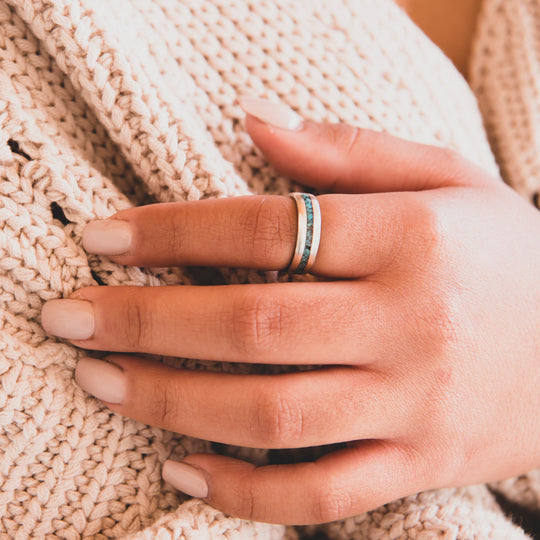
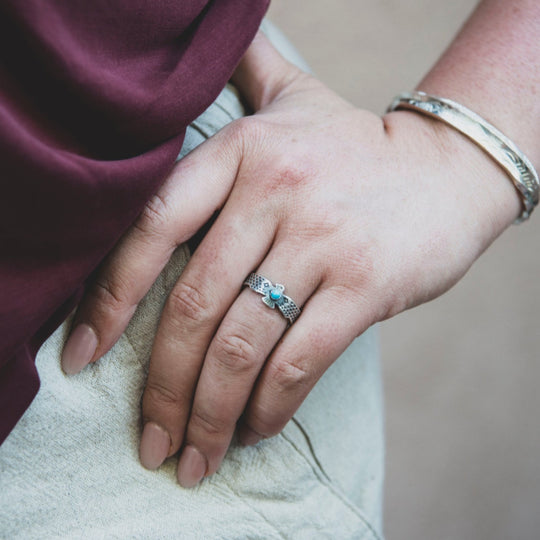
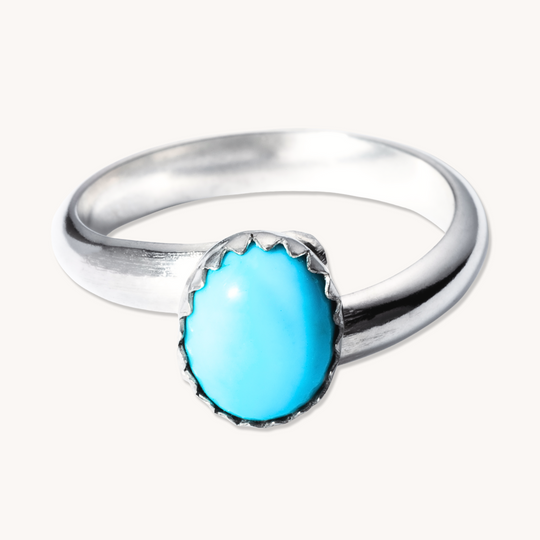
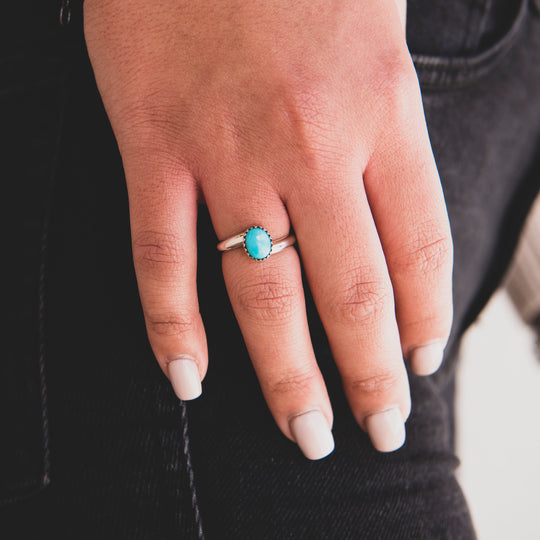
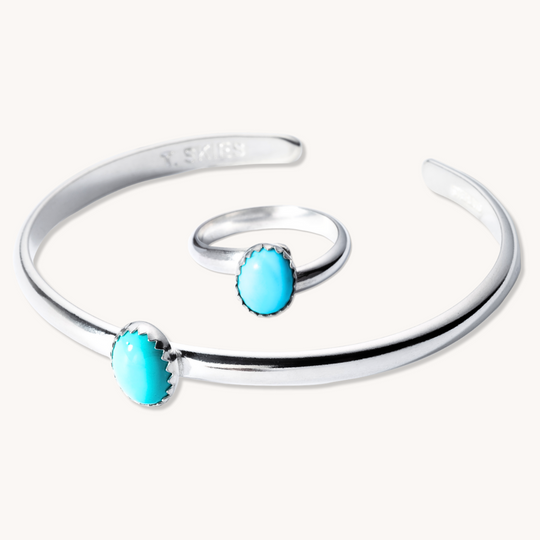
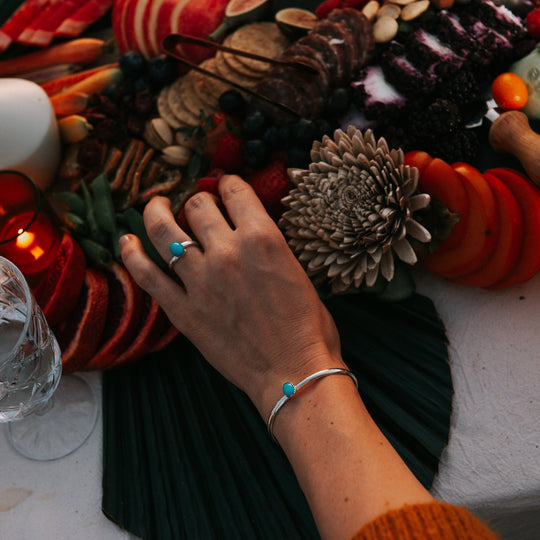
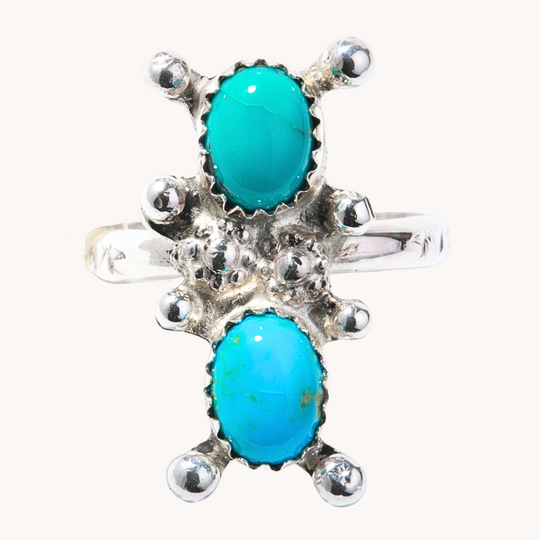
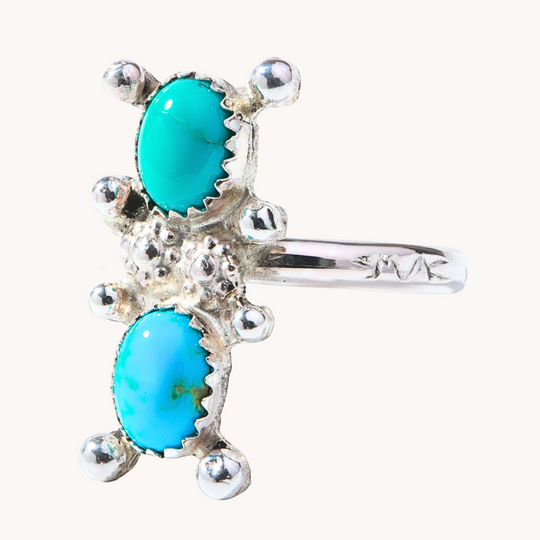
Most of these rings set one turquoise stone in a bezel, the thin wall of silver that holds the stone, and then finish the border by hand. The border is where you can see the smith's work: file-work notches, a saw-pierced edge, twisted wire, or a triangular cut. A few rings are bands instead, with turquoise inlaid flush into the silver rather than raised in a bezel. The adjustable rings open slightly at the back, so one ring can fit across a few sizes.
Who made them
Some of these rings are made by Navajo silversmiths and sold under their names and hallmarks: Philbert Secatero, Devin Edison and Geneva Ramone. Each listing names the artist. Most of the others are T.Skies designs, made in our Albuquerque workshop and labeled as ours. Native-made vs. T.Skies designs.
A short history
Rings were among the first things Navajo smiths made. They needed little metal and were easy to work: flat bands of thin silver, decorated with incised lines and simple die work (Bedinger 1973, p. 86). Setting turquoise came later. Bedinger records rival claims to the first stone-set ring, one dated about 1878, and notes that stone setting spread quickly but became popular only around 1900 (Bedinger 1973, p. 48). Baxter and Bird-Romero describe how bezels for one or more stones joined the Southwestern repertoire by 1890, and how a set turquoise soon became "the hallmark of an Indian-made ring" (Baxter 2000, p. 152). By 1910 the Franciscan Fathers recorded twelve Navajo words for different kinds of ring (Bedinger 1973, p. 86). For the full story, read our turquoise ring buyer's guide.
Choosing and fitting a turquoise ring
Turquoise is a soft stone, about 5 to 6 on the Mohs scale, and naturally porous. A ring takes more knocks than any other piece, so a bezel with a solid border protects the stone better than an exposed edge. Take it off for dishes, lotion and cleaning products. Find your size on our ring sizing chart. For an adjustable ring, use the adjustable ring sizing chart, and adjust it gently at the back, never across the stone.
The stone
Each listing names the stone. Inlay bands in our own lines use chip inlay, made from the cut-offs of our own turquoise work and set flush with the silver; see inlay. To trace a stone to its mine, browse the turquoise mines of the Southwest, or read turquoise terms explained.
More turquoise: All turquoise jewelry · Necklaces · Bracelets · Earrings · How to tell real turquoise · Our silversmiths
Turquoise Rings: Common Questions
Are these turquoise rings Native American made?
Some are, by name: the rings by Philbert Secatero, Devin Edison and Geneva Ramone are sold under the artist's name and hallmark. Our signature rings are labeled as T.Skies designs, and we don't sell them as Native American jewelry because our pieces are not made by one artist — it's a team effort, and we don't believe in labeling our signature jewelry by our team's ethnicity with a blanket term like Native American. Even though most of the team is Native American, we are of mixed tribes and races. If you are interested in a specific artist or tribal affiliation, we do market jewelry as Native American on an artist-by-artist basis. Every Native American piece, made by a named Native artist, comes with a Certificate of Authenticity.
How do I find my ring size?
Use our ring sizing chart. Adjustable rings have their own adjustable sizing chart.
Is turquoise strong enough for a ring I wear every day?
Turquoise is soft, 5 to 6 on the Mohs scale, and porous, so treat it gently. Take it off for washing up and cleaning, and keep it away from lotions and oils. A raised bezel border protects the stone's edge.
Is the turquoise treated?
Ask about any stone and we'll tell you how it was treated, if at all. Our turquoise terms explain what Natural, Stabilized and Enhanced mean.