


Turquoise Rings: A Buyer's Guide
A genuine turquoise ring pairs sterling silver with a stone whose treatment the seller discloses. Under the FTC's jewelry guides, failing to disclose that a gemstone has been treated is deceptive where the treatment isn't permanent, creates special care requirements, or significantly affects the stone's value.[2] What the guides do not do is require the seller to prove which mine it came from[2] — that part is yours to ask for, in writing.[3]
What's the best turquoise ring for everyday wear in handmade sterling silver?
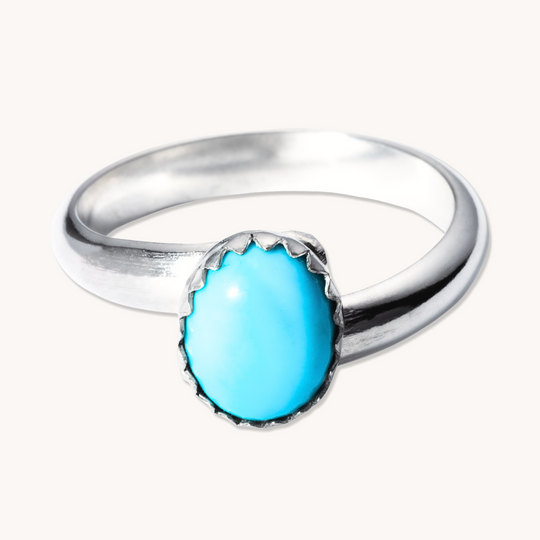
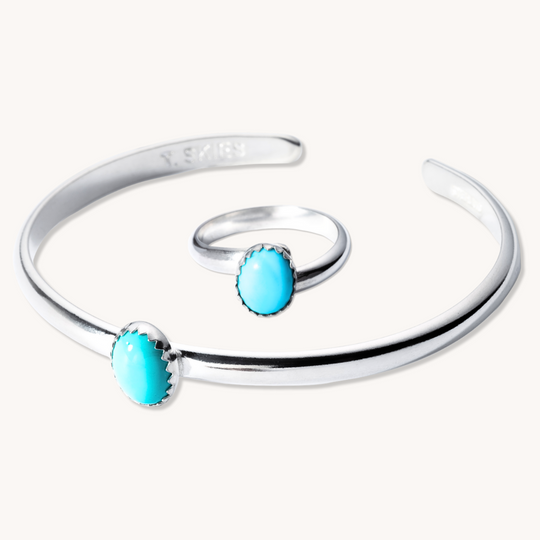
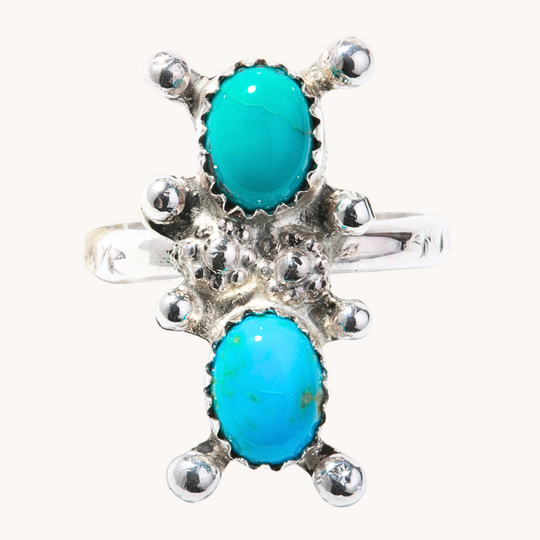
For daily wear the metal is the easy half: sterling, the alloy the Southwest trade works in.[1] The stone is where the questions are. Ask whether the turquoise is natural or stabilized. Turquoise runs a modest 5–6 on the Mohs hardness scale and is naturally porous[5], so resin-stabilized stone is often the sturdier, more honest choice for a ring worn every day — not a lesser one, provided it's disclosed as stabilized.[2]

Buying for daily wear
- Ask “natural or stabilized,” not just “is it real.” Both are genuine turquoise; only one is disclosed honestly by every seller.[2]
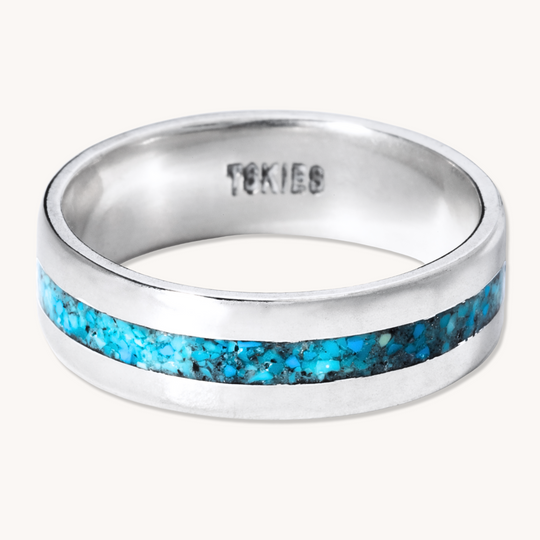
- Look for the fineness mark. STERLING is the ring standard — a band in fine silver is soft enough to flex and mark with ordinary wear.
- A simple bezel setting is generally easier to inspect, clean, and resize than channel or cluster work — ask your jeweler to assess the specific setting before resizing.
Where can I buy genuine Navajo-made turquoise rings online?
Buy from a seller who names both the artist and the artist's nation — Diné (Navajo), Zuni, Hopi, or another Pueblo nation — rather than a blanket “Native American” label, and who backs that claim with a written guarantee naming the seller, and describing the grade, source, and condition of the stone.[3] A hallmark helps only so far, and the two kinds of stamp promise different things — the next section reads them. Read the product page itself, not the collection it's filed under. Our Silversmith Directory documents 680+ Native silversmiths as a reference for identifying names and marks — it's a research tool, not a per-product credit index, and a piece appearing in our catalog isn't itself a claim that it traces to a specific name there. Where a listing names its maker on the product page, that's a real, checkable credit; where it doesn't, ask the seller directly before you buy — including us.
Silver quality and what the hallmark actually tells you
Three silver standards matter to a ring, and only one of them belongs in the band. Fine silver is the pure metal, .999[1] — and silver is alloyed with copper precisely to make it harder[1], so a band without that copper is soft enough to flex and mark under ordinary wear. Where fine silver does earn its place is bezel wire: there the softness is the point, because it burnishes down over a stone without fighting back. Sterling is that alloy — .925 silver, the balance copper[1] — and it is what the Southwest trade has worked in since sterling sheet and wire became widely available around 1935.[1] Coin silver, the older standard at roughly .900[1], still turns up in early pieces; the gap between the two is real to a refiner and effectively invisible to the eye. Bedinger records the substitution alongside improved soldering and finishing, sterling being the metal that “takes a more beautiful finish.”[4]
A hallmark can tell you two different things, and it is worth knowing which. A fineness stamp claims the alloy and nothing else — STERLING or .925 asserts at least 925/1,000ths silver and nothing about who made the piece.[2] A maker's mark claims the person who made it.[6] Neither one verifies the other, so ask about both. Read them with our Hallmark Index before you rely on either.

What are the best sterling silver stacking rings with genuine turquoise?
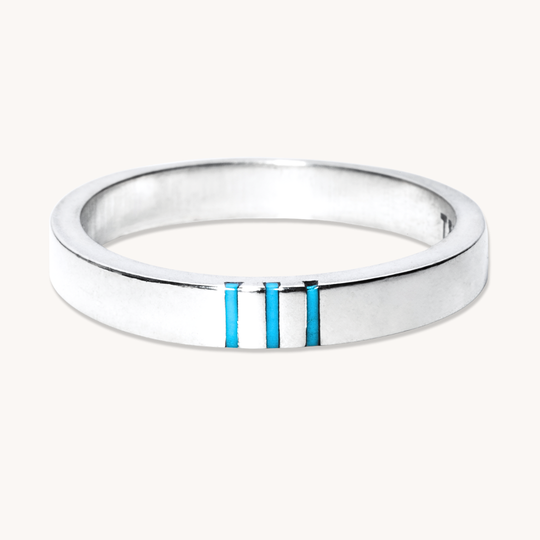
Ring-stacking — wearing several slim bands together — isn't a form we can trace in the historical Southwest silversmithing record; treat it as a contemporary styling choice built from traditional materials and technique, not a period-specific practice. What does carry over from tradition is the metal and the making: sterling silver[1], hand-fabricated rather than mass-cast, set with disclosed, genuine turquoise.[2] Shop our rings collection for pieces sized to stack, each credited to its maker.

Where the stone comes from — and why it's worth asking
Where a stone was mined is the single biggest driver of its value — classic-mine turquoise brings more than visually similar material from lesser-known ground.[3] That gap is exactly why substitution happens: Mexican turquoise has been sold as Kingman turquoise since before the 1970s, and Mexican and Chinese material has moved by the ton under classic American mine names — Morenci, Sleeping Beauty, Lander Blue, Lone Mountain.[3] Kingman itself, one of the most recognizable “looks” in American turquoise alongside Sleeping Beauty[3], is a mine where a great deal of the output is treated[7] — a reminder that a familiar name is no promise of untreated stone. Federal law backs the buyer here: misrepresenting a stone's origin, or failing to disclose a treatment that isn't permanent or that affects value, is a deceptive trade practice.[2] What the law does not do is require a seller to prove the mine — the guides add no affirmative duty to document it.[2] The remedy is the one collectors have used for decades: ask for a written guarantee — seller's name, address, phone number, and date, plus the stone's grade, source, and condition.[3] For the full mine-by-mine picture, see our Turquoise Mines guide, and for a hands-on test of the stone itself, our guide on how to tell real turquoise.

Sizing and care
A turquoise ring asks more of a resizing jeweler than a plain band does. Bezel-set stones can generally be resized without disturbing the setting; channel-set and cluster work carry more risk, since sizing works the metal around the stone itself — ask your jeweler to assess the specific setting before committing.
Turquoise is a hydrated copper aluminum phosphate mineral, soft (5–6 Mohs) and porous[5], which is the whole story behind how to care for it: a soft, barely damp cloth, no ultrasonic cleaner, no steam, no chemical polish anywhere near the stone. Stones vary: some are more porous and absorbent than others, and the chalkier, softer ones are the ones that take up oils and shift colour with wear, where a dense, high-grade stone largely resists it.[5] A blue stone gradually turning green over years of wear is that absorption at work — a characteristic of the material rather than a fault in the making. The silver half of the ring just tarnishes: a dark, even patina on an older piece is generally worth preserving rather than polishing out, while active, uneven tarnish on a newer piece responds to a dry polishing cloth worked carefully around the stone, never a chemical polish.[4]
A note on accuracy. We strive for accuracy, and this page is continuously updated with new information from the artists, their families, and the community. If you can correct or deepen anything here, tell us — corrections are welcomed and credited.
From the Library: Bedinger, Indian Silver (1973)
1973 primary source. Anything described as current here describes 1973, not today.
Bedinger (1973) quotes the ethnologist Matilda Coxe Stevenson's claim:
“"The first setting of turquoise in silver occurred about 1880 done by a Navajo, in a ring, which he presented to the writer."”
— Bedinger (1973), p. 48 [4]
According to Bedinger (1973, p. 48), there were several claimants: Grey Moustache and Long Moustache credited Atsidi Chon with the first setting, turquoise in a ring, about 1878, while Van Valkenburgh credited Chon's pupil Slender-Maker-of-Silver with the first turquoise ring, made for Chee Dodge; stone-setting spread quickly but did not become popular until around 1900. [4]
Bedinger (1973, p. 47) explains the technical step involved: a stone is held by a bezel, a narrow strip of silver that grips it tightly and is soldered to the ring, a delicate process requiring a controllable source of heat. [4]
Bedinger (1973) on how old stones differ from modern ones:
“The early smiths polished stones by rubbing them on sandstone, producing a soft luster that blends with the patina that wear gives to silver (the glassy turquoise of modern pieces is polished by machine).”
— Bedinger (1973), p. 49 [4]
Bedinger (1973, p. 49) adds that some old stones have holes bored in them, occasionally closed with a tiny silver pin, because they were formerly beads or eardrops, and that old stones help in dating pieces. [4]
According to Bedinger (1973, p. 86), finger rings, which needed little metal and were easy to make, were among the first things Navajo smiths made: flat bands, sometimes copper but usually thin silver, decorated by incising and simple die work. After stone setting was learned, the band narrowed and split into prongs on either side of the plate. [4]
Bedinger (1973) quotes the army officer John G. Bourke on Navajo taste in the early 1880s:
“Finger rings of silver are very much in esteem.”
— Bedinger (1973), p. 86 [4]
According to Bedinger (1973, p. 86), the Franciscan Fathers found rings more popular than bracelets in 1910, recording twelve Navajo words for different kinds of ring; ten years later an unset ring was rare, and the stone was turquoise. [4]
According to Bedinger (1973, p. 88), stones set flat and level with the bezel were common, while high-domed stones rising well above the band were a style made about 1900. [4]
Bedinger (1973) added a warning for ring buyers:
“A thin turquoise may appear thick and heavy because it lies on a layer of cardboard. Thus a wide bezel may not necessarily denote a deep stone.”
— Bedinger (1973), p. 89 [4]
From the Library: Frank, Indian Silver Jewelry of the Southwest (1990)
1990 primary source. Anything described as current here describes 1990, not today.
Frank (1990, Fig. 34, p. 40) warned ring collectors about dates:
“Most rings with stones attributed to the period 1880-1900 were actually made in the early 1900s or later.”
— Frank (1990), p. 40 [8]
According to Frank (1990, p. 40, Fig. 34), even by 1900 many silversmiths had not mastered setting turquoise in silver, with crudely cut stones and crudely made bezels, and a ring James Mooney collected in 1894 while it was still being made showed the order of work: it still lacked its stone, its stamped design and its smoothing and polishing. [8]
According to Frank (1990, p. 42, Fig. 37), fifteen rings collected before 1893 had no turquoise at all; thin silver, rocker-engraved, stamped and filed designs and simple solder work at the ends placed them in 1870-1893, and they showed an affinity with Plains Indian silver though made in the Southwest. [8]
According to Frank (1990, p. 43, Fig. 38), "sculptured" rings made before 1893, only one with a stone, were crudely soldered, which to him showed that soldering was not mastered until the first decade of the twentieth century. [8]
According to Frank (1990, p. 79, Fig. 87), eight much-worn rings set with dark green stones dated from the early 1900s, most with thick, crude bezels, many of them serrated; only a square ring belonged to the 1920s. [8]
According to Frank (1990, p. 80, Fig. 88), engraving on a plain silver ring would suggest an early piece, but its thick seal-like top placed it about 1900. Among turquoise rings he dated soldered bars to the early 1900s, and a large plate with a central oval stone and an oval twisted-wire setting to the 1920s. [8]
According to Frank (1990, p. 144, Fig. 176), of six early turquoise rings the earliest styles dated around 1895, including one set with an earbob, and the others were made about fifteen years later. [8]
From the Library: Lowry, Turquoise Unearthed: An Illustrated Guide (2002)
2002 primary source. Anything described as current here describes 2002, not today.
Lowry (2002) on glued stones:
“Alternatively, stones may be mounted with glue. However, this is an inferior method because glue has a tendency to deteriorate over time and stones may eventually fall out of their settings.”
— Lowry (2002), p. 29 [9]
From the Library: Adair, The Navajo and Pueblo Silversmiths (1944)
1944 primary source. Anything described as current here describes 1944, not today.
Writing in 1944 about the tourist rings of his day, Adair warned:
“Often the stone is not genuine turquoise at all, but malachite, or synthetic turquoise, or a very cheap grade of turquoise, dyed darker.”
— Adair (1944), p. 50 [10]
From the Library: Baxter, Encyclopedia of Native American Jewelry (2000)
2000 primary source. Anything described as current here describes 2000, not today.
Baxter (2000) dated the stone-set ring:
“Bezels were constructed to take the setting of one or more stones; this became part of the jewelry-making repertoire of Southwestern native artisans by 1890. The setting of turquoise or other semiprecious stones soon became the hallmark of an Indian-made ring.”
— Baxter (2000), p. 152 [11]
On the market, Baxter (2000) added:
“However, a market for handmade, high-quality rings has steadily developed since the 1970s.”
— Baxter (2000), p. 152 [11]
From the Library: Woodward, A Brief History of Navajo Silversmithing (1946)
1946 primary source. Anything described as current here describes 1946, not today.
Woodward (1946) quoted Matilda Coxe Stevenson's claim about the first turquoise setting:
“The first setting of turquoise in silver occurred about 1880. It was done by a Navaho in a ring which he presented to the writer.”
— Woodward (1946), p. 30 [12]
According to Woodward (1946, p. 30-31), the first turquoise in Navajo rings was set the same way as the glass-paste jewels of the trade rings sold to the tribes in the early 1800s, with a series of tiny triangular prongs. [12]
Woodward (1946) questioned Stevenson's claim to have received the first turquoise-set ring:
“one cannot help but query how did she know it was the first time this had been done?”
— Woodward (1946), p. 57 [12]
His verdict, Woodward (1946):
“Her testimony is interesting and indicative of an early use of turquoise and silver by the Navajo but not conclusive.”
— Woodward (1946), p. 57 [12]
These are statements recorded by outside writers in 1855-1946, and Navajo elders' recollections as Richard Van Valkenburgh and Mary Russell F. Colton wrote them down; the Diné are the authority on their own history.
Sam Tilden, born 1869, told Van Valkenburgh, as printed in Woodward (1946):
“Red and yellow garnets were set in silver before turquoise was used.”
— Woodward (1946), p. 66 [12]
On the first Navajo to set turquoise he knew of, Woodward (1946):
“Big Whiskers was the first Navajo known to me to set turquoise into silver.”
— Woodward (1946), p. 67 [12]
And on raised stones, Woodward (1946):
“Stones rising above the setting came in about 1900 when I had been smithing ten years.”
— Woodward (1946), p. 67 [12]
Van Valkenburgh's list, printed in Woodward (1946), gives Long Mustache a similar claim:
“Said to have been the first to use garnets and turquoise (in the late 1880's).”
— Woodward (1946), p. 65 [12]
Field Notes by Mateo James
Bedinger passes on Stevenson's report of a first turquoise setting about 1880. Frank, working from dated Smithsonian rings, holds that most set rings given to 1880-1900 were made in the early 1900s or later. The two can both stand, a first setting early and a slow spread after it, so I show both.
Sources
- Turnbaugh, William A., and Sarah Peabody Turnbaugh. Indian Jewelry of the American Southwest. Schiffer, Atglen PA, © 1996 and 2007.
- Federal Trade Commission. Guides for the Jewelry, Precious Metals, and Pewter Industries, 16 C.F.R. §§ 23.1, 23.24.
- Lowry, Joe Dan, and Joe P. Lowry. Turquoise: The World Story of a Fascinating Gemstone. 1st ed. Gibbs Smith, 2010.
- Bedinger, Margery. Indian Silver: Navajo and Pueblo Jewelers. University of New Mexico Press, 1973.
- Rosnek, Carl, and Joseph Stacey. Skystone and Silver: The Collector's Book of Southwest Indian Jewelry. Prentice-Hall, 1976.
- Hougart, Bille. Native American and Southwestern Silver Hallmarks. 5th ed. 2022.
- Schiffer, Nancy N. Turquoise Jewelry. Schiffer Publishing, 1996.
- Frank, Larry, with the assistance of Millard J. Holbrook II. Indian Silver Jewelry of the Southwest, 1868-1930. Atglen, PA: Schiffer Publishing, 1990. First published 1978 by New York Graphic Society. Cited by printed page. Statements describe conditions as of 1990.
- Lowry, Joe Dan, and Joe P. Lowry. Turquoise Unearthed: An Illustrated Guide. Photography by Mark Nohl. Tucson, AZ: Rio Nuevo Publishers, 2002. Cited by printed page. Statements describe conditions as of 2002.
- Adair, John. The Navajo and Pueblo Silversmiths. The Civilization of the American Indian Series. Norman: University of Oklahoma Press, 1944. Cited by printed page. Statements describe conditions as of 1944.
- Baxter, Paula A., with Allison Bird-Romero. Encyclopedia of Native American Jewelry: A Guide to History, People, and Terms. Phoenix: Oryx Press, 2000. Cited by printed page. Statements describe conditions as of 2000.
- Woodward, Arthur. A Brief History of Navajo Silversmithing. With field notes by Richard Van Valkenburgh. Museum of Northern Arizona Bulletin 14, 2d ed. Flagstaff: Northern Arizona Society of Science and Art, December 1946 (first edition 1938). Cited by printed page. Statements describe conditions as of 1946.
Related Entries
← The Southwest Jewelry Guide · Turquoise Mines · How to Tell If Turquoise Is Real · Native American Hallmarks · The Native Silversmith Directory
Ready to look rather than read? Our turquoise rings live in the collection, sized and ready to wear — or browse the wider rings collection for silver-only pieces and other stone pairings.