


Men's Turquoise Rings and Cuffs: Five Myths, and What the Books Say

A man shopping for a turquoise ring or cuff meets a lot of confident advice, and much of it is wrong. Turquoise is said to be women’s jewelry, stabilized stone is said to be fake, a heavy ring is said to be a good one, and a “925” stamp is said to be enough on its own. This guide takes five of those myths in turn and answers each from the history books and the federal rules. When you know what you’re after, our men’s jewelry, turquoise rings and turquoise bracelets are the place to start, and you can ask us about any piece before you buy.
Myth 1: turquoise and silver are women’s jewelry
In the Southwest, men were wearing silver and turquoise from the start. John Adair, whose 1944 study The Navajo and Pueblo Silversmiths is still the standard history, quotes an army officer, Lieutenant Bourke, describing a Navajo man at the agency in 1881 wearing “large silver hoops in his ears, a necklace of silver balls the size of small cherries, a baldric and belt as above described, silver buttons down the outside seam of his leggings from knee to ankle …”
By Adair’s own day the silver hoops had gone, and turquoise had taken their place. He writes that the old silver earrings were “discarded or melted down” once turquoise came into the reservation in quantity, and that “All of the men who wear earrings now wear turquoise ones.”
Men wore rings too, though few at first. Clara Lee Tanner, writing in Arizona Highways in 1954, noted that before 1880 “a fellow was lucky to have a single plain silver ring.” Our older post, some fun history on male jewelry, covers men’s jewelry in Europe. In the Southwest, the history of silver and turquoise starts with men.
A short history of the turquoise ring
The first rings had no stone at all. Adair: “As one would expect, the first rings were merely bands of plain metal with no design work whatsoever. Then these bands were marked with designs, first by the awl, and later by dies.” Marsha Lund’s 1976 history agrees: “Rings began as simple silver bands. Occasionally copper was used, but most of them were thin silver which were first insised with a file and later also stamped with fairly uncomplicated designs.”
The first turquoise set in Navajo silver may have been set in a ring. Adair recorded the memories of an older Navajo silversmith, Grey Moustache, who learned the craft around 1878. He remembered his brother-in-law, the smith Atsidi Chon: “He was the first silversmith to set turquoise in silver. The first piece that he set was in a ring.” He added: “This ring had just one stone in it. At that time the only rings that the Navajo had were of silver with some designs filed into the metal.” Adair’s own dating fits that memory: “About 1880 the first turquoise was set in rings, and such sets were held to the ring by a very high, rudely-made bezel.”
The form that followed is still the one most men’s rings are built on. Adair describes small silver balls, called raindrops, set beside the stone, and a band that was either a single strip or “three or more prongs which converged at the back to form one band.” He adds that “This type of ring, which was developed at an early date, has always been the most popular form,” and that “Rings were also made by the cast method, but they have never been as popular as those which were wrought.”
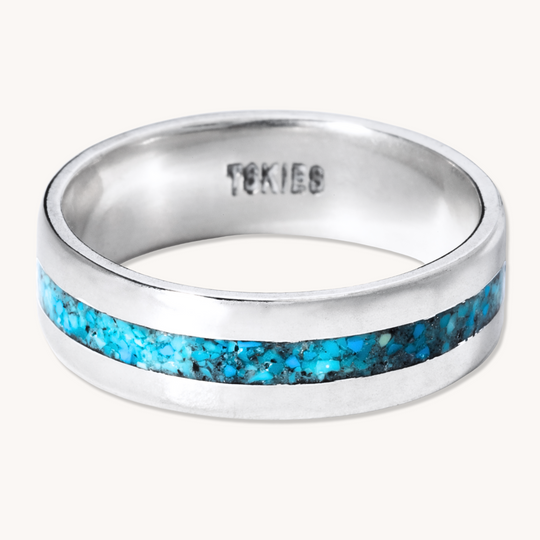
Before turquoise was plentiful, other stones went into rings. In Adair’s list: “Malachite, cannel coal, garnets, all of which are found on the reservation, and even bits of glass.” Once turquoise was easy to get, smiths set “three and four stones” in a row, or “one large stone was surrounded by a circle of smaller ones.” Single stone, row or cluster, those are still the three basic layouts on a turquoise ring. For stones set close together, see our pages on cluster work and inlay, and for the ring itself, our turquoise ring buyer’s guide.
The ketoh: the man’s wrist piece
If there is one piece of Southwest silver that belongs to men by history, it is the ketoh, or bow guard. It began as leather armor. Adair: “Navajo men used to wear a leather strap or ketoh around their wrists to protect them from the snap of the bowstring.” Tanner described how it changed once silver arrived: “The first silver additions, which appeared early in the history of this craft, were simple bands of metal fastened directly to the leather strap. Designs were stamped or impressed with the cold chisel.”
It was made for the wearer, not for the market. In Tanner’s words, “The ketoh or wrist band is the one item, in addition to the bridle, which the Navajo produced for himself and which has not found favor in the eyes of his buying public.” She also thought it carried some of the best work: “it is in the bow guard that some of the finest of Navajo designing has been expressed.” Grey Moustache remembered casting ketohs in stone molds, and trading them at Zuni “for a necklace of shell beads.”
A ketoh is a silver plate on a leather band, not a bracelet. If a listing calls a wide silver cuff a “bow guard,” ask whether it is mounted on leather.
Myth 2: a heavier ring is always a better ring
Weight tells you something, but not everything. Adair explains why thin rings became common. Rings sold to visitors more than any other piece except bracelets, and “Because the tourists want cheap souvenirs, and care little for quality of design and workmanship, the traders and dealers in silver have encouraged the Navajo to make rings light and flimsy, with sets of a poor grade of stone.” He adds that the stone in those rings was often “not genuine turquoise at all, but malachite, or synthetic turquoise, or a very cheap grade of turquoise, dyed darker.”
So a thin, light ring with a bright stone deserves a closer look. A heavy one isn’t automatically good, though. A wide band is easy to make heavy and still badly finished. Check three things instead. First, the bezel: the silver collar around the stone should sit tight all the way round, with no gap, glue or movement when you press it gently. Second, the inside of the band, which should be as cleanly finished as the outside. Third, the stamping, which should be crisp and deliberate. Men’s rings take knocks, so a sound setting matters more than the scale.
Not every ring is what it seems in the hand, either. Adair describes a then-modern style, used for settings of petrified wood, with a broad front that “has the appearance of being made of solid silver; actually it is hollow on each side of the stone, and is composed of two separate pieces of silver with a space between.” That isn’t a fault in itself, but it’s a reason to ask how a ring was built rather than judge it in the hand.
Myth 3: stabilized turquoise is fake turquoise
It isn’t, and for a ring worn every day it is often the sensible choice. The U.S. Indian Arts and Crafts Board puts the right question plainly: “Most consumers will ask if the turquoise is ‘real,’ but the question to ask is if it is ‘natural’ turquoise.” Its consumer brochure gives the working definitions:
- Stabilized: “turquoise combined with colorless resins (plastics) under a vacuum or pressure to harden the stone and darken the color.” It is real turquoise, and the trade depends on it, because “when retrieved from the earth, approximately 85% of the turquoise is too soft to cut or polish.”
- Blocked: “chips and fragments are mixed with epoxy to form blocks for cutting.”
- Dyed: “a pigment is added to deepen the stone’s color or create a ‘matrix’ design within a treated stone.”
Field Notes by Mateo James: how we use these words. At T.Skies we sort turquoise into three groups. Natural turquoise is as it comes out of the earth, with nothing added except the water or mineral oil used while cutting. Treated turquoise has something added, and we label it stabilized (clear resin that locks in the stone's own color and integrity), enhanced (dyed, hardened, or both), or stabilized enhanced. Upcycled and manufactured material (composite, chip inlay, reconstituted, block) is made from turquoise pieces or powder bound together, and it is its own category. The IACB's definitions, quoted above, say stabilizing also darkens the color, and keep “enhanced” for one patented color process; our labels draw the line at whether dye or a hardening process changed the stone. Whatever the label, a treated stone should be disclosed as treated: the FTC Jewelry Guides (16 CFR §23.24) require it whenever a treatment isn't permanent, needs special care, or significantly affects the stone's value.
Stabilized stone isn’t the problem. Not being told is. Ask which one you’re looking at, and get the answer in writing. Our guides to spotting fake turquoise and turquoise color and value go further, and Kingman vs. Sleeping Beauty compares two of the best-known mines.
Myth 4: a “925” stamp settles it
A 925 stamp is a claim, and the law sets what it has to mean. The GIA doesn’t govern that. Under the Federal Trade Commission’s jewelry guides, it is misleading to use “Sterling Silver,” “Sterling” or “Ster.” to describe “all or part of an industry product unless it is at least 925/1,000ths pure silver.” The quality mark is also supposed to come with a name. Under the National Stamping Act, as the FTC guides summarize it, whoever puts a silver quality mark on a piece “shall apply to the article the trademark or name of such person.” A ring stamped “925” with no name or hallmark beside it is worth a question.
No sniff test or kitchen trick replaces that. If you want to know what a piece is made of, ask the seller and get it on the receipt. For the older silver standard you will meet on vintage pieces, see coin silver vs. sterling. To read the maker’s mark, see Native American hallmarks. Be aware that a hallmark tells you who made a piece, not how well. Marsha Lund wrote in 1976 that “much of the excellent jewelry produced in the Navajo and Zuni styles was not signed, and some very sub-standard work was.”
“Handmade” has a legal meaning too. The FTC calls it deceptive to claim a product is handmade “unless the entire shaping and forming of such product from raw materials and its finishing and decoration were accomplished by hand labor.” Our guide to handmade vs. handcrafted jewelry explains where that line falls.
Myth 5: every stamped design has a fixed meaning
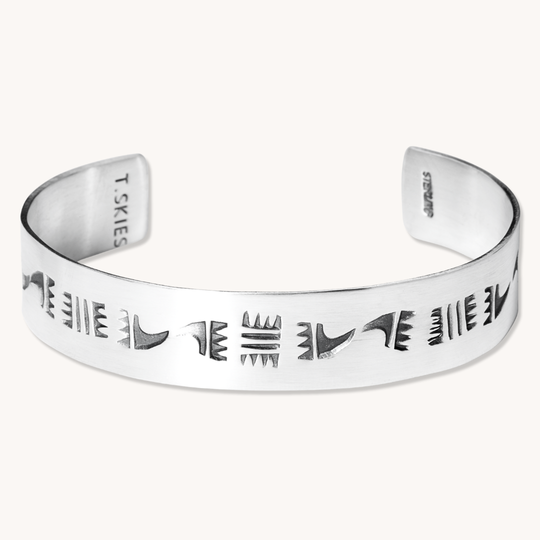
Stampwork on men’s rings and cuffs has a real history. It just isn’t the one printed on many gift cards. Adair traces the dies to Mexico: “Now, with the stamps which bore designs derived from Mexican leather stamps, curvilinear patterns were applied to the metal.” Larry Frank gives the order in which the decorative techniques appeared: “The major decorative techniques developed in this order: filing, rocker-engraving, chisel-marking, repoussé, stamping, and embossing.” He cautions that the techniques overlapped. Our page on stampwork tells that story in full.
The printed meanings are a different matter. The Encyclopedia of Native American Jewelry is direct: “Non-Indians were responsible for the intentional invention and enlargement of ‘Indian’ symbols; for example, industrial stamps using obvious images such as arrows, feathers, and thunderbirds.” Choose a stamped design because you like how it looks and how it was made. Be wary of a meaning that comes on a card.
Choosing a ring, a cuff or a bolo
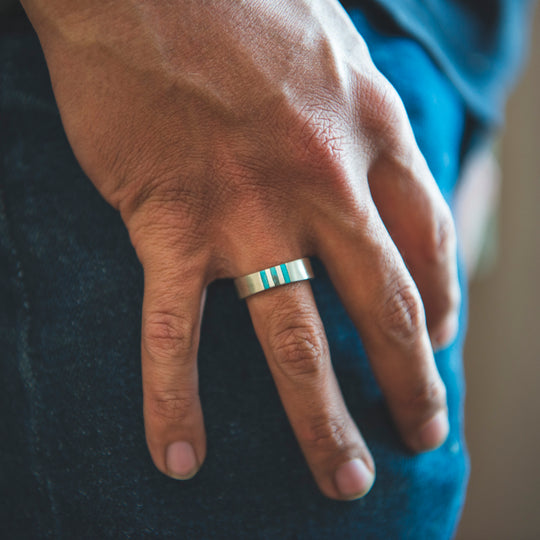
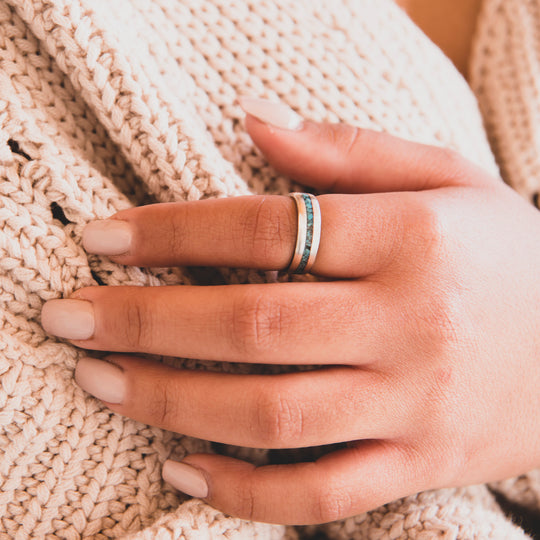
Rings. Decide on the layout first: a single stone, a row, or a cluster. Then pick the width. A wide band covers more of the finger than a thin one, so try it on before you settle on a size, or ask us to check the size against the piece you want. Some of our men’s rings are adjustable, which is useful if you are between sizes. Find your size on our ring sizing chart, and for more on choosing one, see how to choose a silver and turquoise ring. Bend an adjustable band only at the back, a little at a time, and never across the stone. Silver bends and turquoise doesn’t, and Adair noted at the anvil that “Pounding hardens the metal, but if the silver is pounded when it is too cold, it will harden unevenly and will crack.”
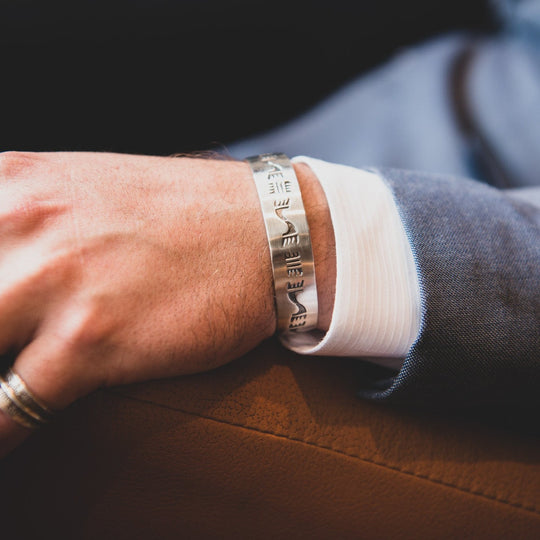
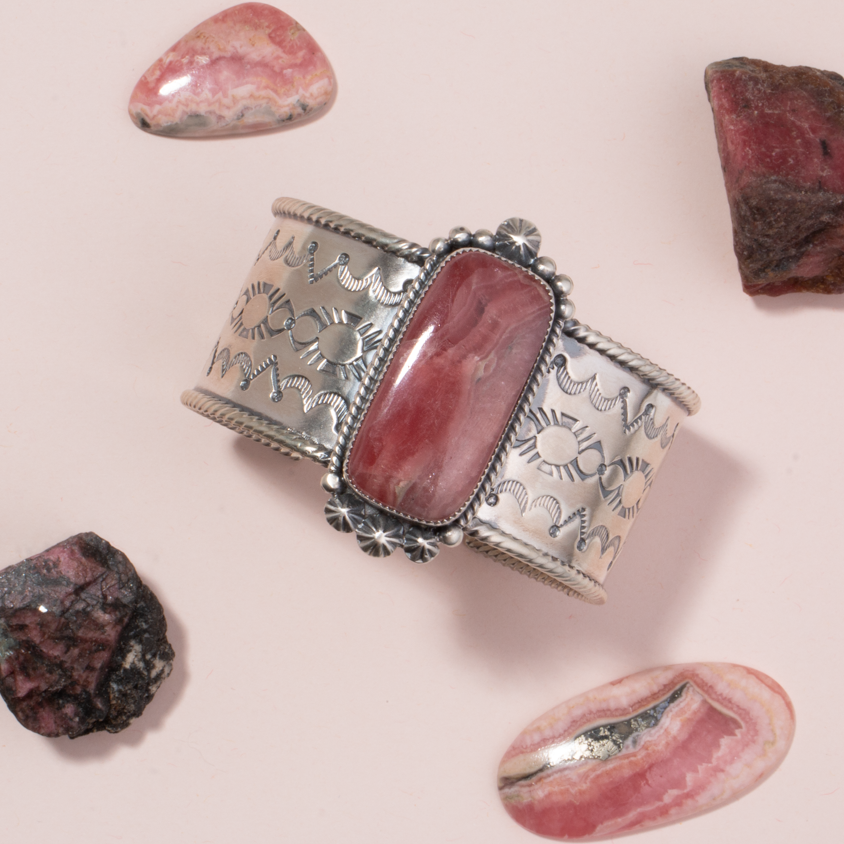
Cuffs. The first Navajo bracelets were, in Adair’s words, “lengths of round, heavy metal wire bent to fit the wrist,” and in our view the cuff is still the easiest piece of silver for a man to wear every day. Measure your wrist with a flexible tape or a strip of paper, then match the number to our bracelet sizing guide. Our cuffs are made with a gap of about 1 to 1.5 inches, so they can be adjusted a little. Slide a cuff on sideways over the narrow part of the wrist, never over the hand. Our guide to choosing a Southwest bracelet covers cast, wrought and wire cuffs in detail. Adair’s line on bracelets is worth keeping in mind: “The often repeated statement that no two pieces of Navajo silver are exactly alike is especially true of the bracelet.”
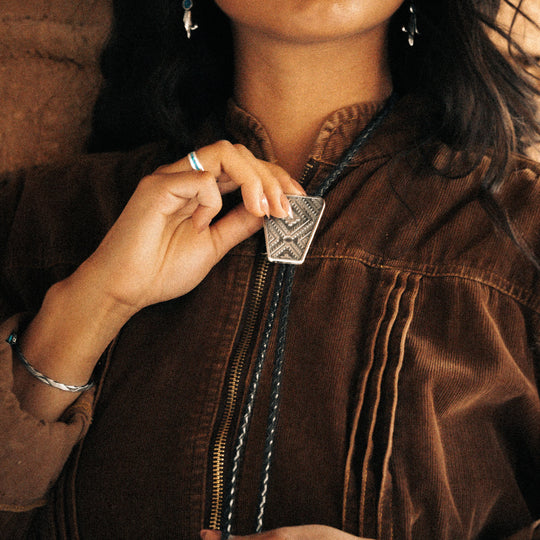
Bolo ties. We carry bolo ties as well. Our reference library doesn’t cover their history, so we won’t guess at it here. The same checks apply, though: the silver mark, the name beside it, and what the stone is.
“Native American” on a men’s piece: what the label claims
“Native American,” “Navajo,” “Zuni” or “Hopi” on a listing is a claim about who made the piece. It says nothing about the style. The Indian Arts and Crafts Board explains the federal law: under the Indian Arts and Crafts Act, “it is illegal to offer or display for sale, or sell, any art or craft product in a manner that falsely suggests it is Indian produced, an Indian product, or the product of a particular Indian Tribe.” The stone is a separate question, since “the use of materials, such as turquoise, in the production of Indian art or craftwork is not within the scope of the Act.”
What protects you is the receipt. The Board advises buyers to “request a written receipt that includes all the vital information about your purchase,” including the “name of artist and their Tribal affiliation,” the “name of the mine from which the turquoise was extracted,” and “whether the turquoise is natural, stabilized, or treated.”
Here is how we label our own men’s pieces. Most of them are T.Skies house designs by Mateo James, and we don’t call them Navajo or Native American. When a piece is made by a named Native artist, the listing names that artist, and only their work carries their nation. Our wide men’s adjustable turquoise rings, for example, are hallmarked by Philbert Secatero, a Navajo silversmith whose hallmarked work we carry, and they are listed under his name. Read more in our guide to authentic Native American jewelry.
Care
A ring sits where soap, lotion and knocks land, so take it off to wash your hands, work with tools, swim or shower. The Encyclopedia of Native American Jewelry recommends cleaning silver “with a jeweler’s rouge polishing cloth because liquid polishes can remove oxidation that should remain in place.” Polish the raised surfaces, leave the dark recesses alone, and keep liquid polishes and dips away from the stone. More in our jewelry care guide.
Choosing with confidence
Men wore Southwest silver and turquoise from the start, and the ketoh was made for them. Judge a ring by its setting and finish, not only its weight. Ask whether the stone is natural, stabilized or treated. Look for the sterling mark and the name beside it. Size a cuff by the gap and a wide ring by trying it on. If a label says Navajo or Native American, ask who the artist is, and get every answer on your receipt. When you’re ready, start with our men’s jewelry, turquoise rings or turquoise bracelets. If nothing on the shelf fits your hand or your idea, a custom piece is another route. Custom commissions are paused until January.
Related reading
- Turquoise rings: a buyer’s guide
- Stampwork: the first language of Navajo silver
- How to choose an authentic Southwest bracelet
- Some fun history on male jewelry
Frequently asked questions
Is turquoise jewelry for men?
Historically, yes. In the Southwest, men wore silver and turquoise from the start. Adair wrote that “All of the men who wear earrings now wear turquoise ones” (The Navajo and Pueblo Silversmiths, 1944, p. 49). The ketoh, or bow guard, was a man’s wrist piece: “Navajo men used to wear a leather strap or ketoh around their wrists to protect them from the snap of the bowstring” (p. 34).
Is stabilized turquoise real turquoise?
Yes. Stabilized turquoise is “turquoise combined with colorless resins (plastics) under a vacuum or pressure to harden the stone and darken the color” (Indian Arts and Crafts Board, turquoise brochure, p. 2). Blocked stone, made when “chips and fragments are mixed with epoxy,” is a different thing (p. 2).
What does the 925 stamp inside my ring mean?
That the maker claims the silver is sterling. Under FTC rules, “Sterling” may only describe metal that is “at least 925/1,000ths pure silver” (16 CFR § 23.5(b)(2)), and under the National Stamping Act whoever applies the quality mark “shall apply to the article the trademark or name of such person” (Note 2 to § 23.10).
Why are some turquoise rings so light?
Partly because of the tourist trade. Adair wrote that dealers “encouraged the Navajo to make rings light and flimsy, with sets of a poor grade of stone” (The Navajo and Pueblo Silversmiths, 1944, p. 50). Judge a ring by the bezel, the finish inside the band and the stone, not by weight alone.
How should a men’s cuff fit?
Measure your wrist and match it to our bracelet sizing chart. Our cuffs are made with a 1 to 1.5 inch gap so they can be adjusted a little (T.Skies bracelet sizing guide). Adjust gently at the ends and never across a stone, because “Pounding hardens the metal, but if the silver is pounded when it is too cold, it will harden unevenly and will crack” (Adair, 1944, p. 58).
Sources
- John Adair. The Navajo and Pueblo Silversmiths. 1944, pp. 9, 34, 36, 37, 49, 50, 58. (p. 49 quotes Lieutenant Bourke, 1881.)
- Marsha Mayer Lund. Indian Jewelry: Fact and Fantasy. 1976, pp. 44, 114.
- Clara Lee Tanner. “Navajo Silver Craft,” Arizona Highways, August 1954, pp. 30–31.
- Larry Frank with Millard J. Holbrook II. Indian Silver Jewelry of the Southwest, 1868–1930. 1978, p. 11.
- Paula A. Baxter with Allison Bird-Romero. Encyclopedia of Native American Jewelry. 2000, pp. xlii, 160.
- U.S. Department of the Interior, Indian Arts and Crafts Board, with Joe Dan Lowry (Turquoise Museum). Indian Arts and Crafts Act turquoise consumer brochure (GPO gpo58769). n.d., pp. 1–2.
- Federal Trade Commission. Guides for the Jewelry, Precious Metals, and Pewter Industries, 16 CFR § 23.2(a), § 23.5(b)(2), and Note 2 to § 23.10.
- T.Skies. “Bracelet Sizing Guide,” tskies.com/pages/how-to-choose-your-bracelet-size (accessed September 23, 2026).