


What Is Stabilized Turquoise?
Stabilized turquoise is turquoise that has been filled with clear resin so it holds together. There's nothing wrong with that, as long as it's called what it is. Here is what the process does, what it doesn't do, and what to ask.
The terms, in plain words
- Natural: as it comes out of the earth. Nothing added except the water or mineral oil used while cutting.
-
Treated: anything else that's added (oil, wax, resin or any other additive, cooked or soaked in). Aligned with the IACB. Treated stone is one of:
- Stabilized: clear resin locks in and protects the stone's own color and integrity.
- Enhanced: the stone is changed: dyed (color added), hardened (e.g. the Zachery silica process), or both.
- Stabilized Enhanced: stabilized and also dyed or hardened.
- A stone can carry more than one label; we list every one that applies.
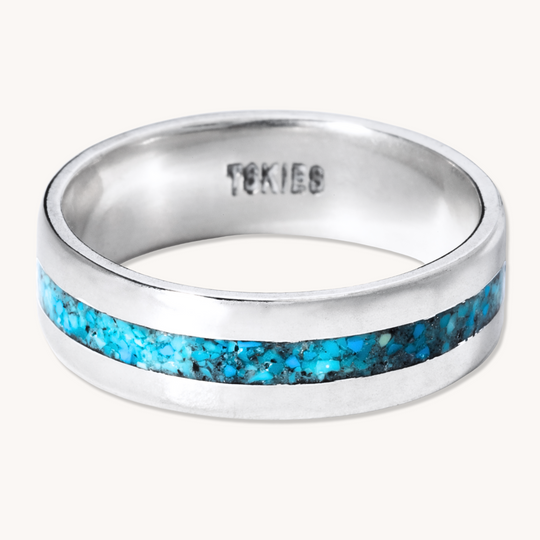
Upcycled & manufactured (composite, chip inlay, reconstituted, block) is a separate group: material made from turquoise, or from turquoise and other stone, rather than cut from a single stone. None of it is natural turquoise. For stone bound with "any amount of filler or binder," the FTC says a name like "composite [gemstone name]" must disclose clearly that the product "[d]oes not have the same characteristics as the named stone" and "requires special care."[5]
For the whole vocabulary, see What Do These Confusing Turquoise Terms Mean?. For dye and the Zachery process, see What Is Enhanced Turquoise?.
Why so much turquoise is stabilized
Turquoise is mostly soft. The Indian Arts and Crafts Board's brochure says that "approximately 85% of the turquoise is too soft to cut or polish," and that about 15% of the world's supply is natural turquoise.[1] Russell Twiford III, who has treated turquoise since the early 1970s, puts natural even lower, at "less than 1 percent" of mine yield, though he says plainly that he doesn't know the exact percentages.[3] Either way, without stabilizing, most turquoise would never reach a bench.
How it's done
The stone has to be dry first. The Lowrys describe the rest: sorted, dry chalk or low-grade turquoise goes into a sealed container with a polymer resin, and the reaction develops "enough heat, pressure, and/or vacuum needed to penetrate to the chalk's core."[2] They name the three methods: "simple soaking, vacuum impregnation, and high-pressure impregnation."[2]
Every stabilizer keeps a private recipe. The Lowrys call it "his or her own recipe for temperatures and ingredients."[2]
Clear shot and color shot
There are two kinds, and the difference is the whole point of our labels.
"Clear shot stabilized turquoise refers to processes that use clear resins with no added color dyes." (Lowry 2010, p. 203)[2]
"Color shot stabilized turquoise is when a color dye or pigment is included in the process to give the turquoise added color. The color shot process is not as stable as the clear shot process as the dyes may break down in time with exposure to heat, foreign substances, and wear." (Lowry 2010, p. 203)[2]
Clear shot is what we call stabilized. Color shot has dye in it, so we call it stabilized enhanced.
Field Notes by Mateo James: how we use these words. At T.Skies we sort turquoise into three groups. Natural turquoise is as it comes out of the earth, with nothing added except the water or mineral oil used while cutting. Treated turquoise has something added, and we label it stabilized (clear resin that locks in the stone's own color and integrity), enhanced (dyed, hardened, or both), or stabilized enhanced. Upcycled and manufactured material (composite, chip inlay, reconstituted, block) is made from turquoise pieces or powder bound together, and it is its own category. The Lowrys, quoted above, call both clear shot and color shot "stabilized"; our labels call color shot stabilized enhanced, because dye was added. Whatever the label, a treated stone should be disclosed as treated: the FTC Jewelry Guides (16 CFR §23.24) require it whenever a treatment isn't permanent, needs special care, or significantly affects the stone's value.[5]
Does clear resin change the color?
Yes, it changes how the color looks, and we'd rather say so than have you find out. The Lowrys are blunt about it. They call it "one of the marketing misnomers" that clear shot stabilizing "does not change the color of the turquoise it treats," because "the index of refraction is changed and thereby the color perceived."[2]
What clear resin doesn't do is add color. Marty Colbaugh, whose family has stabilized turquoise for generations, explains it with a glass of water poured on dry concrete: "It will show the true color of the concrete because those water molecules are filling up all the tiny spaces in the concrete and changing the way the light shows the color. It's the same with turquoise."[3] Ron Alexander, who developed a treatment of his own, says the same from the bench: "The color's already there but you're changing the way the light plays on the stone and reflects the color."[3]
That is why our definition says clear resin protects the stone's own color. The color reads deeper because the pores are filled. Nothing was added to make it bluer. When something was, the stone is enhanced.
And clear resin does make the stone firmer; every source we have says so. When our labels say hardened, they mean an added hardening process such as Zachery's silica treatment, not the resin that every stabilized stone already has.
Good stabilizing and bad
Done well, it lasts. The Lowrys write that the color gained "will not change even if it comes in contact with body oils, hairsprays, or lotions," and that "most oils and detergents cannot penetrate the turquoise's structure."[2]
Done badly, it shows. Without full penetration, "the center of the turquoise structure will remain whitish in color"; stone that wasn't dried can crack or form open pockets; and excess water "can also cause uneven colors, white spots, or even bizarre colors."[2] Ron Alexander adds that resin cured at the wrong temperature shrinks, which "will show up as white striations in your stone."[3] And the Lowrys are clear: "Stabilizing a turquoise does not generally hide or fix cracks that were previously within the turquoise's structure."[2]
Where it started
The Lowrys trace American stabilizing to the 1950s and '60s, "on the sunporch of an unknown old man's home, which was located on a hillside above Globe, Arizona," where Leonard Hardy and others were introduced to "soak treating" turquoise.[2] Hardy's early "old treat" used dye. It was later replaced by polyester formulations that filled the chalk "without the use of dyes," and the epoxy-bonding system that began with Hardy "has been continued, modified, and improved today by many people, including the generations of the Colbaugh family."[2]
Twiford remembers the commercial boom: "In the early 70s, there was a new thing called stabilized turquoise being produced by L. W. Hardy in Kingman, and it was all the craze."[3]
Is stabilized turquoise worth less?
Than natural turquoise, yes. Ryan and Chambless put it plainly: "Turquoise treatment creates a two-tier market, with treated stone selling for a fraction of natural."[3] Is it worthless? That's a view, and it's worth reading in full. Lois Sherr Dubin wrote in 1999:
"As many of the stones are soft, porous, and pale, they are often injected with plastic resins and dyes to produce intensely colored, 'stabilized' turquoise. Beads and jewelry crafted from stabilized stones have little worth." (Dubin 1999, p. 473)[4]
Notice what she's describing: resin and dye, producing intense color. That's what we'd call stabilized enhanced. Her judgment is a fair warning about dyed stone sold as something better. We don't think it describes a good clear-shot stone, honestly labeled and well set. The price should follow the label, and the label should be on the receipt.
Secret Questions
- Is it natural, stabilized, enhanced, or stabilized enhanced?
- If stabilized: clear shot or color shot?
- Will you write the treatment on my receipt?
Sources
- Indian Arts and Crafts Board. Turquoise (consumer brochure), 2010, p. 2.
- Lowry, Joe Dan, and Joe P. Lowry. Turquoise: The World Story of a Fascinating Gemstone. 2010, pp. 179, 197, 198, 199, 202–203, 203.
- Ryan, Mike, II, and Philip Chambless. Turquoise in America, Part Two: 1910–1990. Callais Press, 2020: authors, p. 278; Colbaugh, pp. 278–279; Ron Alexander, pp. 279, 280; Russell Twiford III, p. 280.
- Dubin, Lois Sherr. North American Indian Jewelry and Adornment. 1999, p. 473.
- Federal Trade Commission, Guides for the Jewelry, Precious Metals, and Pewter Industries, 16 CFR §23.24, "Disclosure of treatments to gemstones"; 16 CFR §23.25(d).