


What Do These Confusing Turquoise Terms Mean?
Natural, stabilized, enhanced, composite, block. A turquoise seller can use every one of these words on one table, and they don't always mean the same thing from one table to the next. Here is how we use them, in three groups: natural stone, treated stone, and material made from turquoise rather than cut from it. Every label that applies belongs with the stone. It is the one thing a stone can't tell you about itself.
The terms, in plain words
- Natural: as it comes out of the earth. Nothing added except the water or mineral oil used while cutting.
-
Treated: anything else that's added (oil, wax, resin or any other additive, cooked or soaked in). Aligned with the IACB. Treated stone is one of:
- Stabilized: clear resin locks in and protects the stone's own color and integrity.
- Enhanced: the stone is changed: dyed (color added), hardened (e.g. the Zachery silica process), or both.
- Stabilized Enhanced: stabilized and also dyed or hardened.
- A stone can carry more than one label; we list every one that applies.
Upcycled & manufactured. Material made from turquoise, or from turquoise and other stone, rather than cut from a single stone. None of it is natural turquoise.
- Upcycled: scrap that has never been used before (cut-offs and clippings from the bench) moved up into usable material. Composite and chip inlay are both upcycled.
- Recycled: stone that was used before, in a finished piece, and is being used again. It is not the same thing as upcycled.
- Composite: turquoise or other stone scrap compressed together, often into a design, so the leftovers get used. Spiny oyster scrap mixed with turquoise makes a spiny/turquoise composite. Composite does not have the same characteristics as solid turquoise and needs special care.[10]
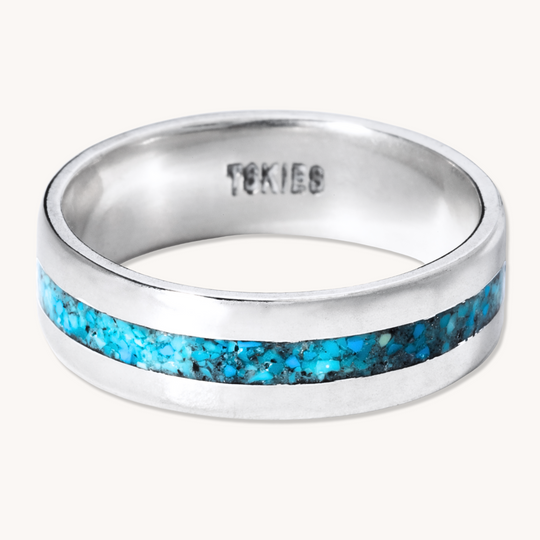
- Chip inlay: scrap ground into chips and set into the piece. Chips set in epoxy do not have the same characteristics as solid stone and need special care.
- Reconstituted: ground all the way to powder and re-formed. In composite you can still see the pieces; in reconstituted stone you can't. It does not have the same characteristics as solid turquoise and needs special care.
- Block: a manufactured block made for cutting. It can be chips and fragments bound with epoxy, or resin and plastic with little or no turquoise in it at all; that kind is really an imitation, not turquoise. Either way it does not have the same characteristics as solid turquoise and needs special care.
Our usage, and where the books differ
Field Notes by Mateo James: how we use these words. At T.Skies we sort turquoise into three groups. Natural turquoise is as it comes out of the earth, with nothing added except the water or mineral oil used while cutting. Treated turquoise has something added, and we label it stabilized (clear resin that locks in the stone's own color and integrity), enhanced (dyed, hardened, or both), or stabilized enhanced. Upcycled and manufactured material (composite, chip inlay, reconstituted, block) is made from turquoise pieces or powder bound together, and it is its own category. The IACB's definitions, quoted below, say stabilizing also darkens the color, and keep 'enhanced' for one patented color process; our labels draw the line at whether dye or a hardening process changed the stone. Whatever the label, a treated stone should be disclosed as treated: the FTC Jewelry Guides (16 CFR §23.24) require it whenever a treatment isn't permanent, needs special care, or significantly affects the stone's value.[8]
From the bench. Inlay throws off scrap: the corner cut away to fit a stone to its channel, the sliver that won't make a second piece. We save every leftover from our inlay work and either grind it into chip inlay or press it into composite. That is what we mean by upcycled. The turquoise was never used before; it was simply too small to set on its own.
There is no single rulebook for turquoise vocabulary. The federal Indian Arts and Crafts Board has one list. The trade has several. Some books use "enhanced" for any treatment at all. So this is our usage, stated plainly, with the sources beside it.
Here is where the books see it differently, and we'd rather show you than hide it. The IACB counts darker color as part of what stabilizing does: stabilized is
"turquoise combined with colorless resins (plastics) under a vacuum or pressure to harden the stone and darken the color"[1]
For "enhanced" the IACB keeps a narrower meaning than ours: "a patented process to darken the color of low or medium grade turquoise to imitate a higher grade color."[1]
Joe Dan Lowry goes further. He calls it "one of the marketing misnomers" that clear-resin stabilizing "does not change the color of the turquoise it treats," because "[t]he index of refraction is changed and thereby the color perceived."[2] Russell Twiford III, who has been involved in treating turquoise since the early 1970s, puts a number on it: "Stabilizing can deepen the color five to ten times over the natural color."[3]
We don't dispute any of that. Clear resin adds no colorant, but filling the pores changes how light moves through the stone, so the color reads deeper. Ron Alexander, who developed his own treatment, describes the same effect from the other side: "The color's already there but you're changing the way the light plays on the stone …"[4] That is why our definition says the resin protects the stone's own color rather than claiming nothing about it changes. Nothing was added to make it bluer. When something was, the stone is Enhanced.
The other words you'll meet
Clear shot / color shot. Trade names for two kinds of stabilizing. Lowry defines clear shot as stabilizing "that use[s] clear resins with no added color dyes," and color shot as stabilizing where "a color dye or pigment is included in the process to give the turquoise added color."[2] In our terms, clear shot is Stabilized. Color shot is Stabilized Enhanced.
Oiled or waxed. The oldest treatment there is. The IACB counts a stone as treated when it has been "soaked or cooked in oil or wax to darken the color."[1] Lowry describes home "kitchen treats" in which low- or medium-grade stone sits in cooking oil or mineral oil, or is heated with paraffin, to look like a higher grade.[5] Mineral oil used as a coolant on the saw is not this. In our terms, oil or wax worked in to darken the stone is Enhanced.
Dyed. The IACB: "a pigment is added to deepen the stone's color or create a 'matrix' design within a treated stone."[1] A dyed stone is Enhanced in our terms, whatever else has been done to it.
Dyed matrix, filled pits, backing. Lapidaries sometimes darken the matrix of a natural stone with dye, or fill small pits in its surface. Lowry notes that the trade has traditionally accepted both as natural because the turquoise's own color is unchanged, and that each should still be disclosed to the buyer.[11] Our line is stricter: dyed matrix or a colored pit fill makes a stone Enhanced; a clear-resin pit fill makes it Stabilized. Backing is different. It is a layer on the back of a thin stone, not a change to the stone, and Ryan and Chambless note that "most in the trade do not consider natural turquoise that has been backed to be treated."[12] We call it what it is: backed.
Enhanced (the Zachery process). In the trade, "enhanced" has a narrow, older meaning as well as the loose one: the patented process developed by James E. Zachery, which Lowry says "takes medium-grade (not chalk or low-grade) turquoise and treats it into a high-grade color-looking turquoise."[2] Twiford describes it as "just stabilizing with silica."[3] We call it Enhanced (hardened). Our full note on it: What Is Enhanced Turquoise?
Block, composite and reconstituted (what the books say). The IACB defines blocked turquoise as "chips and fragments are mixed with epoxy to form blocks for cutting."[1] Russell Twiford III, who makes block material, warns that it "can be anything from dyed plastic to pulverized various minerals to actual turquoise," and says his own company's description calls it "imitation stone."[3] That range is why we keep block, composite and reconstituted in their own group, apart from treated stone. Block with no turquoise in it is an imitation. More: What Is Block Turquoise?
Mohave (also spelled Mojave). A manufactured composite sold from the Kingman area. In our terms it is Upcycled & manufactured, not natural and not treated.
Imitation. Not turquoise, however blue. Lowry's point is that an imitation does not begin with any actual turquoise at all: glass, ceramic, plastic, or a white mineral such as howlite or magnesite dyed to the color.[6] No label in our list applies, because there is no turquoise to label. The FTC says a stone name can describe an imitation only when "imitation" or "simulated" comes right before it, as plainly as the name itself.[10] More: How to Spot Fake Turquoise Jewelry
What the law says
Three lines of the FTC's Jewelry Guides sit under every term on this page.
- Treatments must be disclosed. It is "unfair or deceptive to fail to disclose that a gemstone has been treated" when the treatment isn't permanent, creates special care requirements, or has "a significant effect on the stone's value." When you can buy a piece without seeing it in person, as online, the disclosure belongs "in the solicitation for, or description of, the product."[8]
- Made isn't natural. It is "unfair or deceptive to use the word 'real,' 'genuine,' 'natural,' 'precious,' 'semi-precious,' or similar terms to describe any industry product that is manufactured or produced artificially."[9]
- Composite needs its qualifier. For stone bound with "any amount of filler or binder," a name like "composite [gemstone name]" must disclose clearly that the product "[d]oes not have the same characteristics as the named stone" and "requires special care."[10]
Why the labels matter
Price. Ryan and Chambless put it simply: "Turquoise treatment creates a two-tier market, with treated stone selling for a fraction of natural."[7] Treated turquoise has an honest place. The IACB puts the reason plainly: "approximately 85% of the turquoise is too soft to cut or polish" as it comes from the earth,[1] and Ryan and Chambless call treatment "a welcome part of the process."[7] The problem is only ever a treated stone sold as something it isn't. A label is only honest when it is the full list.
Read next
- What Is Natural Turquoise?
- What Is Enhanced Turquoise?
- What Is Stabilized Turquoise?
- How to Tell Real Turquoise
Sources
- Indian Arts and Crafts Board, U.S. Department of the Interior (2010), turquoise consumer brochure, p. 2.
- Joe Dan Lowry and Joe P. Lowry, Turquoise: The World Story of a Fascinating Gemstone (2010), p. 203.
- Russell Twiford III, interviewed in Ryan and Chambless, Turquoise in America, Part Two (2020), pp. 279, 281.
- Ron Alexander, interviewed in Ryan and Chambless (2020), p. 279.
- Lowry and Lowry (2010), p. 197.
- Lowry and Lowry (2010), pp. 206, 209.
- Ryan and Chambless (2020), pp. 277–278.
- Federal Trade Commission, Guides for the Jewelry, Precious Metals, and Pewter Industries, 16 CFR §23.24, "Disclosure of treatments to gemstones," and its Note.
- 16 CFR §23.27, "Misuse of the words 'real,' 'genuine,' 'natural,' 'precious,' etc."
- 16 CFR §23.25(b) and (d).
- Lowry and Lowry (2010), p. 169.
- Ryan and Chambless (2020), p. 279.