


What is Block Turquoise?
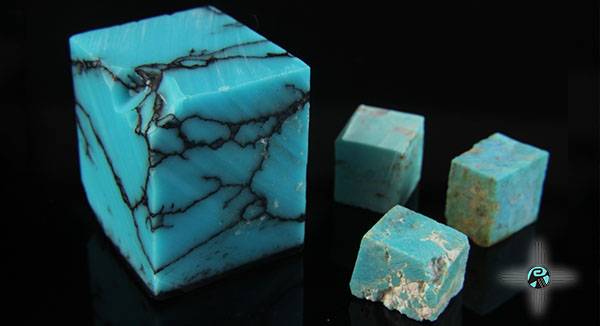
You may have heard this term block turquoise before when shopping for turquoise jewelry. If you are interested in buying turquoise jewelry, then it’s a good idea to know what it means! You must know what questions to ask. Did you know you shouldn’t ask the question “Is that real turquoise?” Because some dealers and artists will say that block is real turquoise. Well it does have a little real turquoise in it sometimes, so the question you might have to ask is “Is that block turquoise?”
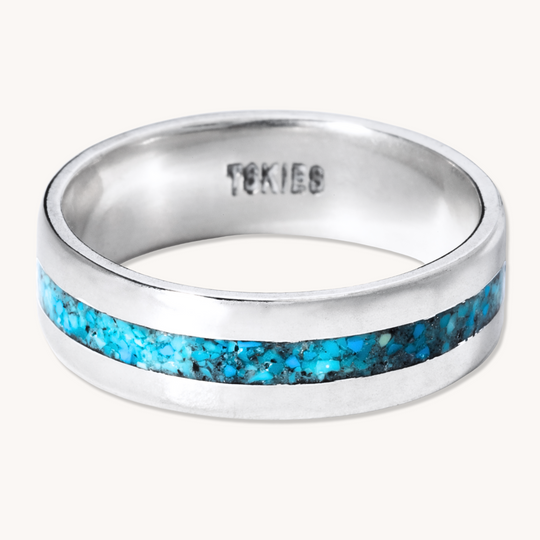
What exactly is block turquoise? Block turquoise is either completely synthetic or reconstituted turquoise that is cut and sold in cubic blocks. So why to people call it turquoise? The synthetic stuff should absolutely not be called turquoise because it is just dyed plastic. The reason people get away with it is because turquoise is officially the name of a color. The reconstituted turquoise on the other hand does have some turquoise in it. Stones that are too small or too low quality to even be enhanced or stabilized are used to make this kind of turquoise. The stones are turned into a powder, the powder is then mixed with plastics and resins and compressed. Then they are molded and dried. When dry, the mass is cut into blocks. This is why when you ask if this is real turquoise, some unethical dealers will say yes.
This type of turquoise is really cheap and easy to work with. Blocks can be easily cut up and shaped to an artists desire. Some artists can do beautiful things with block turquoise, however if you truly want a valuable piece of jewelry stick to the natural and stabilized stones!

Pressed Turquoise in 1915
1915 primary source. Anything described as current here describes 1915, not today.
Writing in 1915, Pogue described how the best imitations of his day were made:
“The most perfect substitutes for turquois, however, are prepared by mixing precipitated hydrated phosphate of aluminum with copper phosphate and subjecting the whole while damp to hydraulic pressure for a considerable period.”
— Pogue (1915), p. 131
Pogue (1915) dated them:
“During the last quarter of the nineteenth century turquoises fabricated in the manner described have come upon the market in considerable numbers, particularly in Europe.”
— Pogue (1915), p. 132
From the Library: Lowry, Turquoise: The World Story of a Fascinating Gemstone (2010)
2010 primary source. Anything described as current here describes 2010, not today.
Lowry (2010) defined blocked turquoise:
“Small crumbs, tiny pieces, cracked, and other miscellaneous pieces of turquoise can all be combined and compressed into one solid block.”
— Lowry (2010), p. 206 [2]
He added (Lowry, 2010):
“These blocks can then be stabilized or treated to add hardness and color.”
— Lowry (2010), p. 206 [2]
From the Library: Turnbaugh, Indian Jewelry of the American Southwest (2007)
2007 primary source. Anything described as current here describes 2007, not today.
As of the late 1980s, William and Sarah Turnbaugh (2007) reported:
“Reconstituted turquoise or block turquoise has been made since the 1930's, and the technologies used today are so complex that it is often almost impossible to tell whether a stone is natural or reconstituted.”
— Turnbaugh (2007), p. 33 [3]
They added, of that era's block material (Turnbaugh 2007):
“Spiderweb matrix in turquoise is often created today in block form.”
— Turnbaugh (2007), p. 33 [3]
From the Library: Wright, Hopi Silver (2003)
2003 primary source. Anything described as current here describes 2003, not today.
As of the 2003 edition, Wright (2003) defined the block stones that supply stores around the Hopi reservation sold alongside tools:
“Block stones are pulverized stones of various types, combined with a binder and put under pressure to form a hard block.”
— Wright (2003), p. 29 [4]
According to Wright (2003, p. 29), the same stores that carried every tool a silversmith might want also carried stabilized turquoise, meaning stones enhanced by various methods, and turquoise and other stones in blocks to be shaped as the maker wished. [4]
From the Library: Ryan & Chambless, Turquoise in America Part Two: 1910–1990 (2020)
2020 primary source. Anything described as current here describes 2020, not today.
Ron Alexander recalled, in an interview published by Ryan & Chambless (2020, p. 260), that John Yates, a maker of reconstituted and block turquoise, made imitation spiderweb block by wetting calcium carbonate, alumina and other chemicals, rolling the mix inside tires into little beads, coating them with a black material, and setting the lot in a mold with epoxy. [5]
Russell Twiford III, whose firm makes block material, told Ryan & Chambless (2020):
“Block material can be anything from dyed plastic to pulverized various minerals to actual turquoise.”
— Ryan & Chambless (2020), p. 281 [5]
Russell Twiford III told Ryan & Chambless (2020, p. 281) that compressed block frees cutters from the small sizes most turquoise comes in and stays consistent in colour year after year, but that some buyers have made jewelry from it and sold it as stabilized turquoise. [5]
Twiford told Ryan & Chambless (2020) how his firm labels it:
“Our description on ours says imitation stone.”
— Ryan & Chambless (2020), p. 281 [5]
From the Library: Baxter, Encyclopedia of Native American Jewelry (2000)
2000 primary source. Anything described as current here describes 2000, not today.
According to Baxter (2000, p. 76), plastic "block," also called "cake," was by then one of the most common substitutes for turquoise on the market, and many pieces, especially heishi, were made from it and simulated to look genuine, down to imitation "matrix" markings. [6]
Field Notes by Mateo James
Our article describes synthetic block as dyed plastic. When Pogue used the words 'synthetic turquois' in 1915, he meant something different: a pressed compound of aluminum and copper phosphates that came close to real turquoise in color, hardness and chemistry. The same word has covered different materials in different eras, so I'm noting both uses here.
How we use these words. At T.Skies we sort turquoise into three groups. Natural turquoise is as it comes out of the earth, with nothing added except the water or mineral oil used while cutting. Treated turquoise has something added, and we label it stabilized (clear resin that locks in the stone's own color and integrity), enhanced (dyed, hardened, or both), or stabilized enhanced. Upcycled and manufactured material (composite, chip inlay, reconstituted, block) is made from turquoise pieces or powder bound together, and it is its own category. Wright (2003), quoted above, uses "enhanced" to describe stabilized stones; in our terms stabilized and enhanced are two different labels under treated. Whatever the label, a treated stone should be disclosed as treated: the FTC Jewelry Guides (16 CFR §23.24) require it whenever a treatment isn't permanent, needs special care, or significantly affects the stone's value.
Sources
- Pogue, Joseph E. The Turquois: A Study of Its History, Mineralogy, Geology, Ethnology, Archaeology, Mythology, Folklore, and Technology. Memoirs of the National Academy of Sciences, Vol. XII, Part II, Third Memoir. Washington, 1915. Public domain. Cited by printed page. Statements describe conditions as of 1915.
- Lowry, Joe Dan, and Joe P. Lowry. Turquoise: The World Story of a Fascinating Gemstone. Layton, UT: Gibbs Smith, 2010. Cited by printed page. Statements describe conditions as of 2010.
- Turnbaugh, William A., and Sarah Peabody Turnbaugh. Indian Jewelry of the American Southwest. Foreword by Barry M. Goldwater. Atglen, PA: Schiffer Publishing, 2007 (copyright 1996 and 2007; first published 1988). ISBN 0-7643-2577-9. Cited by printed page. Statements describe conditions as of 2007.
- Wright, Margaret Nickelson. Hopi Silver: The History and Hallmarks of Hopi Silversmithing. Revised edition. Albuquerque: University of New Mexico Press, 2003. Originally published by Northland Publishing. Cited by printed page. Statements describe conditions as of 2003.
- Ryan, Mike, II, and Philip Chambless. Turquoise in America, Part Two: 1910–1990. Callais Press, 2020. Cited by printed page. Statements describe conditions as of 2020.
- Baxter, Paula A., with Allison Bird-Romero. Encyclopedia of Native American Jewelry: A Guide to History, People, and Terms. Phoenix: Oryx Press, 2000. Cited by printed page. Statements describe conditions as of 2000.