



Stampwork: The First Language of Navajo Silver
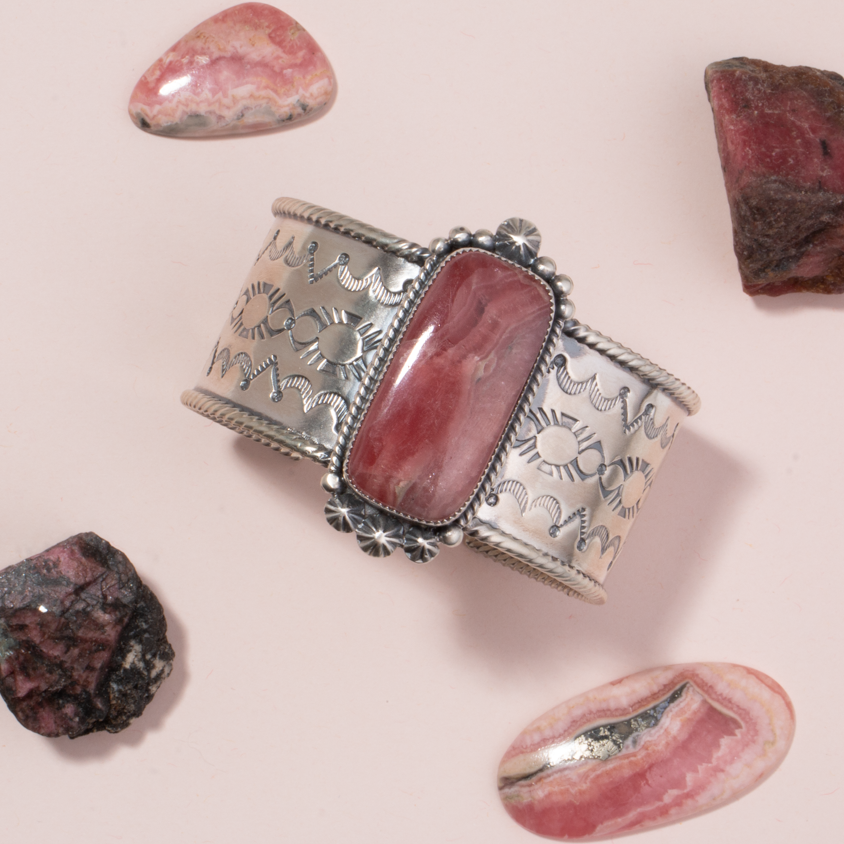
Stampwork is decoration struck into silver one blow at a time, with small dies the early Navajo smiths cut from worn-out files and scrap iron. [1][10] Most of the books trace the designs to Mexican leatherwork, and they part on who handed the tools over, the leatherworker or the blacksmith, and on whether designed stamps came in by the mid-1870s or only in the late 1880s. [19][9][10][16] This page sets the published record side by side, every line tied to a book and a page.
KEY POINTS
- Woodward (1946) thought it “fairly safe to assume” the first Navajo dies were Mexican leather punches, and Bedinger (1973) says the idea of punching designs came from Mexican leather tooling. Holbrook, in Frank (1990), agreed the designs match and gave the credit to the Mexican blacksmith who made the leatherworkers’ stamps. [19][9][10]
- Adair (1944) found no stamped silver in Matthews’ report of 1880–81 and concluded that stamp-making began in the latter part of the 1880s; his table dates the first designed dies to about 1885. Holbrook had no doubt other stamps were in use by 1885. [16][10]
- A die was small, usually 1/8 to 1/4 inch, and carried one design element; the pattern came from repeating and combining them. Smiths forged them from old files, scrap iron and broken tools, and a few, like John Six, cut dies to sell to other smiths. [9][10][14][16]
- From the dies of six smiths and two Indian-school shops in the late 1930s, Adair sorted four basic shapes: crescents, triangles, rayed circles and long narrow designs. The crescent was by far the most common. [16]
- Hand-struck marks read sharp, deep and a little uneven, and can push through to a shadow inside the band; machine-pressed marks are shallow and fuzzy. June (2013) cautions that harder coin silver tends to resist the shadow. [17][20]

Where the stamps came from
The trail runs back to a saddle. Writing in 1938, in a book whose second edition appeared in 1946, Arthur Woodward set the stamped leather of early nineteenth-century Mexican saddles beside Navajo silver and found the repeated elements identical, and from that he judged it fairly safe to assume the first Navajo dies were Mexican leather punches. [19] Bedinger (1973) puts it as plainly: the idea of punching designs came to the Navajos from Mexican leather tooling, and the dies they carved copied the leatherworkers’ stamps, not the plateros’, at first and for a long time after. [9] Adair (1944) states it without a hedge: the smiths copied the designs Mexican leatherworkers stamped on saddles, and learned from them to file those designs into the ends of old scrap iron. [1] He saw the evidence twice. A rare belt carried a pattern stamped into its leather that matched the stamps on its silver, and in a Mexican leather shop in Los Angeles in the late 1930s he found punches identical to the silversmiths’. [16]
Holbrook, writing in Frank (1990), accepted the match and moved the credit. The whole range of first-phase stamp designs appears on nineteenth-century Mexican leatherwork, he argued, but it was the Mexican blacksmith, the man who made the leatherworker’s stamps, who taught Navajo smiths to make them. [10] The Turnbaughs (2007) picture a Spanish Colonial style iron horse bit carrying punch, chisel, file and stamp work, all of which passed into early Native silver. [11] Adair added a caution of his own: all the Mexican silver he had seen was etched with an awl, not struck with a die. [16]
The first punches may be older than the dies. Red Woman, born in 1833, told of smiths at Fort Sumner who cut small pieces of pipe across the middle and punched copper with them after looking at Mexican decoration. [9] By the time the Navajos left the Bosque in 1868, Bedinger counts crude stamping among the skills they carried home. [9]
When stamping began
The earliest decoration was graved, not stamped. Bedinger names graving as the first technique, a scratch with a sharpened file that deepened into incised lines and then engraving. [9] When Washington Matthews watched two smiths decorate a powder charger for his 1883 report, the round marks were struck with the rounded shank of a file and the other figures pushed in with its point. [21] Reading his report, Adair (1944) found not a single piece of silver marked with stamps, and in Ben Wittick’s photograph of Slender Maker of Silver, taken about 1885, only punches, files and cold chisels. [16]
The books do not agree on a date for designed dies. Bedinger thought some smiths probably made them by the mid-1870s, though carving stamps was probably uncommon before the 1890s. [9] Adair allowed the late 1870s as possible, called stamps uncommon in 1881, and concluded that stamp-making must have begun in the latter part of the 1880s; silver collected by a Durango resident before 1890 included bracelets with stamped designs, some of the die-work elaborate. [16] Holbrook had no doubt other stamps were in use by 1885. [10] Bedinger and Bassman both credit the tools the traders supplied, and Bedinger singles out the fine files. [9][13] Adair ties the stamps to the same files, since a die is cut with them, [3] and while fine files were rare the first stamped silver carried only one or two dies. [16]
Making the dies
A stamp usually began as a section of worn-out file. Frank (1990) describes it forged hot on the anvil, cooled slowly so the smith could file the design into its end, then hardened in water and tempered to a golden yellow, so it would neither bend nor split under the hammer. [10] Bedinger gives the size, usually 1/8 to 1/4 inch square, and the rule that each die carried one element. [9] A later account, in the 1975 Turquoise Blue Book, lists the stock: discarded files, drills and broken tools, with blunted chisels and nail sets as keystones. [14] Baxter (2000) adds scrap iron from old railroad track and wagon or automobile parts. [18]
Some smiths cut dies for others. Adair names John Six as one who cut dies for other smiths to buy, and records his prices, repeated in Wright (2003): $1.50 for a big die and fifty cents for the smallest. [16][12] At the Hubbell post at Ganado, Don Lorenzo later brought in steel dies, and many smiths kept making their own. [9][15] By the end of the Early Harvey era in 1920, June (2013) writes, commercial dies and stamps had flooded the silver tool market. [20]


The two plates above come from a 1912 English manual quoting the medieval monk Theophilus, and show the same idea in another tradition. They are a comparison, not a source for Navajo practice.
The vocabulary of a die
Adair sorted the late-1930s dies into four types, and the crescent outnumbered the rest by far. [16] He also describes small curved stamps combined with each other to build a larger curving design. [4] No die is a design by itself. The pattern comes from repeating a few elements in combinations and sizes, which is how a concha border gets its rhythm. [9][14] Bedinger’s phrase for it is that the Navajo smith “draws” with stamps, sinking the surface and letting oxidation darken the lines. [9] Watching Tom Burnsides stamp a bracelet border in 1938, Adair saw him space each strike by eye, with every mark looking equidistant from the next. [16]
One early mark was printed by the file itself. Frank describes the end-of-a-file stamp, occasionally seen on work of about 1880 to 1900: a red-hot or annealed blank struck against a file face, so the file’s teeth printed onto the punch. [10]
Arrows, whirling logs and the tourist trade
Some stamps came from the buyers. Adair (1944) dates the arrow as a motif introduced by white people about 1895 and then struck with an iron die, [2] and he names it and a generalized bird, both brought in by traders, as the most popular naturalistic designs. [16] An informant told him that smiths put designs on silver for white buyers that they would not put on jewelry for other Navajos. [16] The Turnbaughs picture early twentieth-century Harvey House bracelets stamped with arrows, snakes and suns that looked “Indian” to tourists. [11] The whirling log, June notes, could be built from a cross-stamped die and an L-shaped tool, as early as the late 1880s. [20]
Woodward’s warning stands over all of it: once the patterns are traced to Mexican leather, translating them into native symbols is only rationalizing. [19] He also allowed that Navajo smiths had combined the elements in designs of their own. [19]
Zuni, Hopi and the Rio Grande pueblos
At Zuni the die never took hold. Lanyade told Adair that before the Navajo smith came, Zuni copper and brass workers filed their designs, and no one in the village had seen a design stamped into metal. [16] By the late 1930s Zuni smiths bought most of their dies from Navajo smiths, Adair writes, because turquoise was the decoration that mattered, and to the Zuni a die was just another tool, where a Navajo smith was as proud of his dies as of his silver. [16] Hopi stamps, by Bedinger’s account, were not Navajo borrowings: they carried Hopi spirals, frets and terraced clouds, some taken from pottery. [9] At the Santa Fe Indian School, Wilfred Jones, a Navajo teacher, helped students cut steel dies for birds and flowers adapted from Santo Domingo pottery designs. [9]
Makers of the stamp
One name runs through the later books. Baxter (2000) counts Ambrose Roanhorse a major figure in the revival of “classical” Navajo silver from the 1930s to the 1950s, best known for his stamped work, and the teacher of many important Navajo smiths at the Santa Fe Indian School and later at Fort Wingate. [5] The Turnbaughs’ caption, which dates him 1904–1982: “Roanhorse used hand-made dies and also embossed, chased, and filed his forms.” [11] Hougart records the inspector’s side of his work: at the Santa Fe Indian School he helped Chapman examine silver for the Indian Arts and Crafts Board’s stamp. [5]
At Hopi the stamps were already in the smiths’ kits when the Museum of Northern Arizona’s silver project began. Virgil Hubert, the museum’s assistant curator of art, drew designs that called for filing, stamping, cut-out and appliqué, and Mrs. Colton wrote that, wherever possible, the designs used the stamps the smiths already owned. [6] At Bacavi, Morris Robinson tempered only the outer shell of his dies, because a die tempered too hard broke under the hammer. [12] Every die in the surviving kit of the early Hopi smith Duwakuku was handmade from old files or cold chisels. [12]
The tools outlast their makers. Writing in 2000, Baxter found native artists prizing the older stamps they inherited as much as the ones they cut themselves. [18] Bedinger’s line on bracelets is the collector’s: “Rarely if ever does one find two Navajo bracelets alike,” except, she added, the commercial pieces stamped out by machinery. [7] As of the late 1980s, the Turnbaughs (2007) reported that few smiths still worked with handmade tools, most preferring power equipment. [11]

Hand-stamped or machine-stamped?
The test is in the depth. Lund (1976) describes hand stamping as sharp and clear, with small slips where a die landed unevenly and slight changes in spacing, because the smith placed each strike by eye; machine stamping looks fuzzy and shallow, as if mashed in. [17] June (2013) adds the back of the piece. Hand-pounding often drives a stamp through to a mirror-shadow inside the shank, and machine-pressed designs lack the force to make one. [20] June’s caution matters as much as the test: coin silver is harder and tends to resist the shadow. [20] By 2000, Baxter wrote, hand stamping was a hallmark of fine-art and revival-style work, while much other stamping came from production-line die tools or machines. [18]

Field Notes by Mateo James
Bedinger traces Navajo stamping to Mexican leather tooling, while Holbrook agrees the designs match the leatherwork but credits the Mexican blacksmith who made those stamps as the teacher. They also differ on timing: Bedinger doubts carved stamps were common before the 1890s, and Holbrook has no doubt other stamps were in use by 1885. I record both readings rather than choose between them.
Bedinger traces the first Navajo dies to Mexican leather stamps, while the Turnbaughs point to the decoration on Mexican iron horse bits. The two may describe different things, the die designs versus the tool techniques, so I show both.
I notice two dating differences on stamps. Bedinger puts the first designed stamps as early as the mid-1870s, while Adair allowed only the late 1870s as possible and wrote that Matthews' report showed stamps were not common in 1881. Holbrook's chronology, in Frank, starts arrow and swastika stamps in 1900, where Adair's 1944 table of dates says about 1895. I show both as printed.
This page, following Bedinger, says Red Woman told Woodward about the first punches. In Woodward's 1946 edition her statement is one of the field notes Richard Van Valkenburgh gathered from Navajo informants, and the link to Mexican saddle leather is Woodward's own inference in his note. I show the statement as printed.
This page dates whirling-log and arrow stamps to 1900-1930 in Holbrook's chronology and to about 1895 in Adair. June, writing in 2013, says the whirling log built from a cross-shaped die and an L-shaped tool appeared as early as the late 1880s. I show the three dates as printed and have not chosen between them.
I notice that Matthews’ own key to his workshop plate, at the top of this page, names the tool by the old horseshoe as a doming die, not a stamp: “a piece of an old horse-shoe may be seen in which a few matrices have been worked, and, beside it, the die used in connection with the matrices.” The only die he describes is that round-pointed bolt for “metallic hemispheres for beads and buttons.”[21] Adair, reading the same report, found no silver in it marked with stamps.[16] The caption follows Matthews’ key.
From the Library
What 14 reference books say about Navajo and Pueblo stampwork, grouped by topic. Every passage names its book and page; full references are under Sources.
Each topic opens closed. The passages are the books’ own words or close summaries of them, and each names its book and printed page.
Where the stamps came from: Mexican leather, iron and the Bosque16 passages · 5 books
The leather-stamp trail, the blacksmith counter-argument, and the first punches at Fort Sumner.
According to Bedinger (1973, p. 10), the Navajo elder Red Woman told Woodward that at Fort Sumner smiths flattened copper by pounding and, after looking at Mexican decoration (probably the tooling on leather saddles), cut small pieces of pipe across the middle and punched the copper with them, later mixing the punch marks, dashes and dots into patterns. [9]
Bedinger (1973) quotes an account of the Bosque Redondo ration tickets, which she counts as another skill the Navajos learned there:
“Stamped metal slips were next issued, but the clever Navaho craftsmen made dies and again forged them.”
Bedinger (1973), p. 11 AS OF 1973 [9]
Bedinger (1973, p. 10) sums up what the Navajos had learned by the time they left the Bosque in 1868: cutting wire, flattening it by pounding, engraving with an awl or cold chisel, stamping simple designs with crude dies, twisting wire, and the use of heat for pounding, melting and casting. [9]
Bedinger (1973) independently traces stamping to leather:
“The idea of making designs by punching came to the Navajos from the tooling of leather by the Mexicans.”
Bedinger (1973), p. 23 AS OF 1973 [9]
Bedinger (1973) on where the die patterns came from:
“At first and for many years the dies the Navajos carved were copied from stamps used by Mexican leather-workers; not, as one might expect, from the plateros.”
Bedinger (1973), p. 43 AS OF 1973 [9]
According to Frank (1990, p. 19), the entire range of first phase stamp designs also appears on nineteenth-century Mexican leatherwork, but Holbrook argued that it was the Mexican blacksmith, who made the leatherworker's stamps, who taught Navajo (Diné) smiths to make them. Apart from a few designs traders introduced about 1900, notably the swastika (whirling-log) and arrow, he found the stamps still limited to the original Mexican inventory as of the late 1970s. [10]
According to Frank (1990, p. 167, Fig. 205), a Mexican iron cinch buckle, the kind of ironwork Mexican smiths made for their own use and for trade in the eighteenth and nineteenth centuries, carried stamped, filed and scalloped edges like the borders of Navajo silver conchas; he wrote that the tools and techniques it shows passed from Mexican blacksmiths to the Navajo in the 1850s. [10]
According to Turnbaugh (2007, p. 15, caption), 19th-century Mexican blacksmiths taught Navajo (Diné) smiths to make iron horse bits and to work silver, and every hand-forged technique on a Spanish Colonial iron bit they picture (punch work, chisel work, file work and stamping) passed into early Native silverwork. [11]
Writing in 1938, Woodward (1946) compared the stamped leather of Mexican saddles with Navajo silver:
“The repeated elements found on the Mexican saddle leather of the early 19th century are identical with those encountered upon the general run of Navajo silver jewelry.”
Woodward (1946), p. 13 AS OF 1946 [19]
From that he drew his conclusion, Woodward (1946):
“Hence it seems fairly safe to assume that the first dies used by the Navajos were in reality Mexican leather punches.”
Woodward (1946), p. 13 AS OF 1946 [19]
Woodward's (1946) note on her statement drew the leather conclusion himself:
“However, by a process of elimination, it would seem that the patterns thus copied were found on Mexican leather work, principally upon the saddle trappings.”
Woodward (1946), p. 68 AS OF 1946 [19]
In the late 1930s Adair (1944) found the same tools still in leatherworkers' hands:
“In a Mexican leather shop in Los Angeles, I saw many punches identical with those used by the silversmiths.”
Adair (1944), p. 21 AS OF 1944 [16]
According to Adair (1944, p. 32), one rare belt had a pattern stamped into the leather around the edge of the concha, which showed plainly that the Navajo silver stamps matched the Mexican leather stamps. [16]
Adair (1944) added a caution about where die-stamping on silver came from:
“All of the Mexican silver that I have seen is etched with an awl, and not stamped with a die.”
Adair (1944), p. 181 AS OF 1944 [16]
Adair (1944) explained why the earliest decoration ran in straight lines:
“These patterns were largely rectilinear because of the nature of the tools. Now, with the stamps which bore designs derived from Mexican leather stamps, curvilinear patterns were applied to the metal.”
Adair (1944), p. 37 AS OF 1944 [16]
According to Bedinger (1973, p. 109), many stamped designs were copied from Mexican horse gear modeled on Spanish leatherwork, and Adair's analysis sorted the common stamped motifs into four basic types: the crescent, the triangle, the circle (often with rays), and long, narrow designs with parallel edges. Smiths varied them by size and by combining dies with punched holes or short cold-chisel lines. [9]
When stamping began: the 1870s–1890s evidence15 passages · 6 books
Reports, photographs and recollections that date the first stamps, and why the books disagree.
According to Bedinger (1973, p. 23), the first Navajo decoration was graving: at first a mere scratching with a sharpened file, then incising with deeper lines, then engraving with a special tool; filing away the metal was practiced at least as early as the 1880s. [9]
According to Bedinger (1973, p. 43), some smiths probably made designed stamps as early as the mid-1870s, but carving stamps was probably not common until the 1890s; even in 1904 G. W. James described Navajo bracelets decorated by chasing and graving, an example of the lag between parts of the reservation. [9]
Holbrook, writing in Frank (1990), dated the arrival of true stamps:
“There is evidence that some of the earliest decorative stamping was done with only a cold chisel, but by 1885 there is no doubt that other stamps were being used.”
Frank (1990), p. 16 AS OF 1990 [10]
According to Frank (1990, p. 16), most old photographs are not detailed enough to show stamped designs, which led some people to conclude that stamping was not used in the 1880s; Holbrook argued that the pieces worn in photographs of that period are the same kinds that, examined in museums, carry very competent stampwork. [10]
Reading Washington Matthews' report of 1880-81, Adair (1944) noticed what was missing:
“There is not a single piece of silver described or illustrated in this report which is marked with stamps.”
Adair (1944), p. 20 AS OF 1944 [16]
Of the silver in Ben Wittick's photograph of Slender Maker of Silver, taken about 1885, Adair (1944) wrote:
“On none of it is there any evidence of die-work; all of the designs have been applied with simple punches, files, and cold chisels.”
Adair (1944), p. 24 AS OF 1944 [16]
According to Adair (1944, p. 24), Navajo smiths may possibly have made such stamps as early as the late 1870s, but Matthews' report showed they were not common in 1881; stamps were certainly being made by 1890, since bracelets collected near Durango, Colorado, before that year carry elaborate die-work. [16]
Adair's (1944) conclusion:
“the art of stamp-making must have originated sometime during the latter part of the 1880's.”
Adair (1944), p. 25 AS OF 1944 [16]
Why the first stamped silver was simple, in Adair (1944):
“At first the stamped silver was quite simple in its decoration, being marked with only one or two dies. This was because fine files, which are essential to the making of these stamps, were rare.”
Adair (1944), p. 21 AS OF 1944 [16]
According to Adair (1944, p. 193), dies bearing designs were first made about 1885, and arrows and swastikas were being stamped on silver by about 1895. [16]
These are statements recorded by outside writers in 1855-1946, and Navajo elders' recollections as Richard Van Valkenburgh and Mary Russell F. Colton wrote them down; the Diné are the authority on their own history.
Red Woman, born 1833, described the first punches to Van Valkenburgh; in Woodward (1946) her statement dates the finer stamping:
“The more beautiful work with pretty punch marks came in when I was a grandmother (about 1870-1875).”
Woodward (1946), p. 67 AS OF 1946 [19]
Matthews (1883) watched the decoration of a powder charger, struck and engraved without any stamp. To make the round indentations on its handle,
“one smith held the article on the anvil while the other applied the point of the shank of a file—previously rounded—and struck the file with a hammer. The other figures were made with the sharpened point of a file, pushed forward with a zigzag motion of the hand.”
Matthews (1883), p. 177 AS OF 1883 [21]
Bedinger (1973) credits the trading posts' fine files for the change:
“Fine files unlocked the gate to a vastly extended field of decoration.”
Bedinger (1973), p. 42 AS OF 1973 [9]
Writing in 1997 about the years around 1880 to 1890, Bassman tied the refinement of Navajo stamping to the traders:
“The traders were supplying tools for the silversmiths at about the same time, and so the jewelry became more refined, especially with the stamps which were used to press the designs into the silver.”
Bassman (1997), p. 6 AS OF 1997 [13]
According to Adair (1944, p. 31), conchas grew more complicated in the 1880s, when metal stamps came into use; a sunburst of straight cold-chisel lines was sometimes raised in relief by striking the silver between a male and a female die. [16]
Making the dies12 passages · 7 books
What the dies were cut from, how they were tempered, and where the commercial ones came from.
According to Frank (1990, p. 16), stamps and cold chisels were made the same way, usually from a section of a worn-out file: forged hot on the anvil, cooled slowly so the smith could file in the design, then hardened in water and tempered to a golden-yellow color so the tool would neither bend nor split when struck. [10]
Bedinger (1973, p. 44) describes the dies: usually 1/8 to 1/4 inch square, cut from any scrap steel whose temper had been drawn by heating, with the design left in relief by chiseling or filing; a negative die was made by striking a positive die into the heated end of another steel rod, and each stamp carried a single design element that the smith combined with others. [9]
Bedinger (1973) on the size of a smith's kit:
“A collection of dies, perhaps a hundred or more, became an important part of the equipment of the silversmith.”
Bedinger (1973), p. 44 AS OF 1973 [9]
Bedinger (1973) adds, of the trader at Ganado:
“Don Lorenzo later imported steel dies, but many smiths continued to create their own.”
Bedinger (1973), p. 23 AS OF 1973 [9]
Lois Essary Jacka, writing in 1995, on the first stamps and the steel dies that followed:
“The first stamps were made by cutting a piece of pipe in half to make the imprint of a semicircle. Don Lorenzo brought steel dies, or stamps, to Hubbell Trading Post later, but many smiths still made their own.”
Jacka (1995), p. 22 AS OF 1995 [15]
And on the tools they were made from, in 1975:
“Discarded files, drills, broken tools, any form of workable steel is used. Blunted chisels and nail sets are keystone tools.”
Stacey (1975), p. 50 AS OF 1975 [14]
The 1975 Turquoise Blue Book on the dies:
“Each die is basically simple and small — no one a complete design in itself. Designs, borders and patterns are worked up from several of the units.”
Stacey (1975), p. 50 AS OF 1975 [14]
Baxter (2000) on the first dies:
“The first native silversmiths created their dies for stampwork from scrap iron and other discarded metal, salvaging these from pieces of old railroad track or from wagon or automobile parts.”
Baxter (2000), p. 167 AS OF 2000 [18]
June (2013) on where the first stamps came from:
“Tool and die specialists filed the heads of discarded steel bolts and shanks into varying patterns and shapes.”
June (2013), p. 32 AS OF 2013 [20]
June (2013, p. 32) added that imported figural stamps were expensive but sought after, and that single-stamp symbols were slow to develop among silversmiths, probably because of the limits of hand files, but became available from industrial stamp and die makers. [20]
Turnbaugh (2007, p. 43, caption) illustrated a Navajo (Diné) concha stamp of ca. 1910-1925: a hand-wrought iron set of a male punch and a female die, used together with a sheet of silver to raise an oval sunburst plate for a concha. [11]
Turnbaugh (2007, p. 47, caption) showed how Navajo silver buttons were made: a wad cutter punched a button blank out of silver, and the blank was then embossed with one or more dies of the smith's choosing, which is how many stamped button designs came about. [11]
Die makers: John Six and the Hopi smiths' kits5 passages · 2 books
The smiths who cut dies for others, what they charged, and two Hopi kits.
Wright (2003) quotes John Adair on how the Navajo die-maker John Six cut and tempered his dies:
“The designs are cut into the ends of the pieces of scrap iron with extremely fine files, and then the dies are tempered by heating and sudden cooling in water, so that the design will hold up under the strain of hammering.”
Wright (2003), p. 28 AS OF 2003 [12]
According to Wright (2003, p. 28), John Six was paid a dollar and a half for a large die and fifty cents for the smallest size. [12]
According to Wright (2003, p. 28), the Hopi smith Morris Robinson of Bacavi tempered only the outside layer, or shell, of his dies, because dies tempered too hard became brittle and broke off under the hammer. [12]
According to Wright (2003, p. 29), every die in the surviving tool kit of the early Hopi smith Duwakuku (d. 1956) was handmade from old files or cold chisels, his female bead stamp was reworked from a scrap of iron, and his ingot mold was cut from a piece of high-lime sandstone. [12]
Adair (1944) on the die-makers of that era:
“There are certain smiths, like John Six, who have developed a skill in the making of these stamps, and they make a specialty of selling them to other smiths.”
Adair (1944), p. 103 AS OF 1944 [16]
The stamp vocabulary: crescents, triangles, circles and the end-of-a-file14 passages · 4 books
The basic shapes, how a few dies build a pattern, and the marks of a steady hand.
From the dies of six smiths and two Indian-school shops in the late 1930s, Adair (1944) sorted the stamps:
“These types are: the crescent; the triangle (with or without a base); the circle, with lines radiating from the center; and long narrow designs with parallel edges.”
Adair (1944), p. 103 AS OF 1944 [16]
Adair (1944) added:
“Of these basic types the crescent is by far the most common.”
Adair (1944), p. 103 AS OF 1944 [16]
According to Bedinger (1973, p. 107), the Navajo smith had only a few basic stamp designs, used in many combinations and several sizes; repeating a stamp or group of stamps created the rhythm seen in borders, and the border of the classic concha is a good example. [9]
According to Bedinger (1973, p. 106), Navajo work emphasizes symmetry and the center: the Navajo smith worked from the center outward toward the ends, while the Zuni smith worked from the ends toward the center. [9]
According to Bedinger (1973, p. 109), long double curves suited repoussé, with their edges brought out by chiseling, and rayed designs, often accented by a turquoise, commonly formed the centerpiece of conchas, ketohs and band bracelets. [9]
Bedinger (1973) compared the two approaches:
“One might say the Navajo "draws" his patterns with stamps, depressing the surface and counting on oxidation to emphasize the lines.”
Bedinger (1973), p. 204 AS OF 1973 [9]
Bedinger (1973, p. 109) passed on Miller's 1930 test for a genuine Navajo design: simple dies, with the effect built up by repetition. [9]
Bedinger (1973) quotes Charles Lummis's first-hand description of Navajo bracelet bands, still
“ornamented with a file, but the prettiest are figured by countless punches with a little die.”
Bedinger (1973), p. 92 AS OF 1973 [9]
According to Frank (1990, p. 17), a variation seen on stampwork of about 1880-1900 was made by striking the end of a red-hot or annealed stamp blank against the face of a file, which left the file's teeth on the punch and produced the so-called end-of-a-file design. [10]
Frank (1990, Fig. 236, p. 187) traced one stamp to another job on the bench:
“The circles are made by the same tool used to punch the border holes through first phase conchas.”
Frank (1990), p. 187 AS OF 1990 [10]
Frank (1990, p. 153, Fig. 187) treated four stark petals divided by a vertical bar as an early trait on a ketoh of about 1880, against stamped, chisel-stamped and repoussé four-petal ketohs of the 1890s and about 1915. [10]
Lois Essary Jacka, writing in 1995:
“Closely spaced, fine, uniform lines meticulously stamped into silver or gold are referred to as chiselwork.”
Jacka (1995), p. 56 AS OF 1995 [15]
Watching Tom Burnsides stamp a bracelet border in 1938, Adair (1944) wrote:
“He had not marked the places, but was simply judging the correct distance with his eye, and it was amazing to see that each mark looked exactly equidistant from the next.”
Adair (1944), p. 59 AS OF 1944 [16]
On stamping a cast ketoh, Adair (1944) explained the stakes:
“once the metal has been stamped, a mistake can not be corrected, and the ketoh has to be melted and a new one made.”
Adair (1944), p. 66 AS OF 1944 [16]
Reading the stamps to date a piece9 passages · 4 books
Holbrook’s chronology and the clues June reads in the shape and crowding of stamps.
According to Frank (1990, p. 205), Holbrook's Chronology of Techniques dates chisel stamping to 1868-1880, the end-of-a-file stamp to 1880-1900, repoussé to 1880-1915, stamps with leatherworkers' designs to 1880 onward, and swastika (whirling-log) and arrow stamps to 1900-1930. For buttons, plain domes run 1875-1900 and stamped and domed buttons from 1900 onward. [10]
June (2013) offered a dating clue from the shape of the dies:
“These elongated dies dominated the Classic Era (pre-1930), but seem to fade away in the Baroque Era.”
June (2013), p. 122 AS OF 2013 [20]
June (2013, p. 122) described a "baroque" phase from the 1930s, when crowded stamp fields and new dies with birds, animals and plants replaced the restraint of Classic work. [20]
On the tool market, June (2013) wrote:
“By the end of the Early Harvey era (1920), commercial dies and stamps flooded the silver tool market.”
June (2013), p. 122 AS OF 2013 [20]
According to Bedinger (1973, p. 53), the early solid-plaque silver bowguards (ketohs) were decorated only with simple patterns struck with a cold chisel, a file or simple stamps; embossing and fuller die work came later. [9]
On how decoration built up over time, Turnbaugh (2007, p. 24) wrote:
“The bold, plain silverwork of this early jewelry occasionally was decorated with simple engraved, stamped, filed, or chiselwork designs formed with hand-made tools. More complicated silverworking techniques such as applique came later.”
Turnbaugh (2007), p. 24 [11]
According to Turnbaugh (2007, p. 25, caption), an early Navajo- or Zuni-style bracelet of about 1880-1900 carried simple chiselwork and stamped designs including "end-of-file" decoration. [11]
Frank (1990, Fig. 212, p. 171) described a bowguard of circa 1875:
“The guard has been mostly cold-chiseled with one stamp mark.”
Frank (1990), p. 171 AS OF 1990 [10]
According to Frank (1990, p. 183, Fig. 229), on a headstall of circa 1875 the filed and chiseled sunbursts were made on separate silver plates and riveted onto the conchas, an early technique used in place of solder; its rocker-engraving showed Plains influence, and its thin silver was typical of the old styles. [10]
Dated pieces in the museum record, 1870s–1920s18 passages · 2 books
Bracelets, ketohs, conchas and canteens with collection dates, mostly from Frank’s captions.
According to Frank (1990, p. 36, Fig. 29), four Smithsonian bracelets made circa 1900 were relatively heavy; most carried deep stamp work, one had stamped primitive arrow forms at the center, and two also showed file work. [10]
According to Frank (1990, p. 37, Fig. 30), a busily stamped bracelet with no history probably dated to the early 1890s, while another bracelet in the same group was cast and then decorated with a cold chisel. [10]
According to Frank (1990, p. 42, Fig. 37), among fifteen rings collected before 1893 the large top center ring showed stamp work of the "end-of-a-file" variety. [10]
According to Frank (1990, p. 53, Fig. 50), a wide ketoh of circa 1890, bought for the 1893 World's Columbian Exposition, combined stamped floral patterns with rocker-engraved internal designs among filed columns, which he found unusually complex for that period. [10]
Frank (1990, Fig. 55, p. 57), on bracelets Edward E. Ayer collected in 1895:
“Five silver bracelets, including one pair, show the complexity of stamped work on silver nearing the turn of the century.”
Frank (1990), p. 57 AS OF 1990 [10]
Frank (1990, Fig. 70, p. 67) names an early stamp type on a tobacco canteen Ayer collected in 1895:
“The canteen stamping clearly shows the "end-of-a-file" type design, which is another early trait.”
Frank (1990), p. 67 AS OF 1990 [10]
According to Frank (1990, p. 68, Fig. 72), a plain stamped ring collected at Sichomovi (Hopi) in 1911 showed stamping more advanced than some of the plain rocker-engraved rings collected before 1893. [10]
According to Frank (1990, p. 80, Fig. 89), a filed and stamped bracelet accessioned in 1905 gave a good early date, around 1900 or earlier; its filed edges were worn and the spaces between its thick chiseled grooves worn smooth. Notched plain bangles of about 1895 showed early stamped crescents and circles, and he found early bracelet stamp work and shape similar to early silver earrings. [10]
Frank (1990, Fig. 86, p. 78), describing plain, flat scalloped earrings of about 1890 that were simply stamped and punched, noted:
“Both the Navajos and the Zunis wore earrings of this type.”
Frank (1990), p. 78 AS OF 1990 [10]
According to Frank (1990, p. 92, Fig. 105), a first phase concha belt of about 1870-1880 had round stamped conchas whose diamond slots were cut with a cold chisel, and a stamped buckle patterned like the conchas at a smaller size. [10]
Frank (1990, Fig. 107, p. 93) described the look that marks the earliest belts:
“The sparse decoration on first phase concha belts leaves exposed a wide expanse of rich plain silver.”
Frank (1990), p. 93 AS OF 1990 [10]
Frank (1990, Fig. 156, p. 130) read the date of an early repoussé bracelet from its workmanship:
“Its crude bezel and simple repoussé forms speak for a date in the 1890s.”
Frank (1990), p. 130 AS OF 1990 [10]
According to Frank (1990, p. 136, Fig. 165), three repoussé ketohs showed the petal motif growing more elaborate over time: the least involved about 1910, an intermediate one about 1915, and the most baroque, with an extra lateral projection of tiny stamped circles, about 1920. [10]
According to Frank (1990, p. 140, Fig. 170), a group of domed and repoussé silver bracelets of about 1900 represented an early style of stamping that used stones sparingly, with only one primitively set green turquoise among them. [10]
According to Frank (1990, p. 151, Fig. 184), animal motifs in early silver were usually made as stamp work, and a cow's head could occasionally appear on a ketoh, but a naturalistic deer's head mounted on a bracelet of about 1900 was extremely rare. [10]
Schiffer (2008, p. 31) illustrated a Navajo bracelet of circa 1915 set with low-end Castle Dome turquoise and worked with handmade die stamps and hand-rolled sterling silver. [8]
Schiffer (2008, p. 30) also illustrated a Cerrillos turquoise bracelet with a stamped serrated bezel dated circa 1915-19. [8]
Schiffer (2008, p. 46) illustrated a Navajo concha belt of eighteen-gauge sterling silver worked with fine stamping dies, dated circa early 1900s. [8]
Arrows, swastikas and designs for tourists8 passages · 4 books
The motifs traders brought in, the Harvey House stamps, and Woodward’s warning about symbols.
According to Adair (1944, p. 22), the arrow was introduced as a design motif by white people about 1895 and was then stamped on silver with an iron die. [16]
Adair (1944) noted that reservation smiths used very few naturalistic designs:
“Of these the arrow and a generalized bird design, which were originally introduced by the traders, are the most popular.”
Adair (1944), p. 104 AS OF 1944 [16]
One of Adair's informants told him, as Adair (1944) recorded:
“Silversmiths stamp designs on the silver which they sell to the white man that they wouldn't put on the jewelry if they were selling it to other Navajo.”
Adair (1944), p. 96 AS OF 1944 [16]
Of the tourist era, Turnbaugh (2007, p. 27, caption) noted:
“These early 20th century Harvey House style bracelets are decorated with innovative die stamping including arrows, snakes, and suns that looked "Indian" and readily appealed to tourists.”
Turnbaugh (2007), p. 27 [11]
Turnbaugh (2007, p. 84, caption) describes a silver "eagle" or "thunderbird" pin decorated with a busy array of stampwork, some chiselwork and repoussé embossing, a tourist-era piece probably dating to the late 1920s. [11]
According to June (2013, p. 32), the whirling-log pattern could be built from a straight die cross-stamped like a Greek cross and finished with an L-shaped tool, and it appeared as early as the late 1880s. [20]
Woodward (1946), having traced the die patterns to Mexican leatherwork, warned in 1938 against reading them as symbols:
“Hence, to attempt a translation of the meaning of these varied design elements in terms of native symbols is but to rationalize.”
Woodward (1946), p. 28 AS OF 1946 [19]
He allowed for the smiths' own combinations, Woodward (1946):
“I do not say that the Navajo craftsmen have not combined these same elements in designs of their own.”
Woodward (1946), p. 28 AS OF 1946 [19]
Hand-stamped or machine-stamped?7 passages · 3 books
Depth, slips, spacing and the shadow inside the band, with June’s caution on coin silver.
According to Lund (1976, p. 127), hand-stamped work shows sharp, clear impressions, small slips where a die was struck unevenly, and slight variations in spacing because the smith moved the die by eye, while machine-stamped marks look fuzzy and shallow, as if mashed into the metal. [17]
June (2013) on reading the depth of stamping:
“Hand-pounded die and stamp marks are typically deep and varied.”
June (2013), p. 131 AS OF 2013 [20]
June (2013, p. 131) explained that the force of hand-pounding often pushed individual stamp patterns through the silver, leaving a mirror-shadow on the back of the shank that patina can enhance. [20]
And on machine work, June (2013) wrote:
“Machine-pressed designs and symbols are shallow, lacking the force to produce such reverse-stamp images.”
June (2013), p. 131 AS OF 2013 [20]
June (2013) added a caution that keeps this from being a simple test:
“Coin silver, on the other hand, is harder, so it tends to resist image-tooling shadows.”
June (2013), p. 131 AS OF 2013 [20]
June (2013), writing on vintage bracelets, named the trace a hand stamp leaves on the inside of the plate:
“Stamp shadows are hand-stamping transfers through the silver and apparent inside the plate indicates handmade.”
June (2013), p. 133 AS OF 2013 [20]
According to Baxter (2000, p. 167), hand stamping was by then a hallmark of both fine-art and revival-style jewelry-making, but much other stamping was done by production-line die tools or machines. [18]
Plains, Zuni, Hopi and the Rio Grande pueblos11 passages · 3 books
Who borrowed stamping from whom, and why the die never took hold at Zuni.
According to Frank (1990, p. 22), Holbrook thought it quite likely, though he had no firm evidence, that Plains peoples learned to stamp metal from the Navajo (Diné): Plains stamps carried the same designs, and no Plains stamped metalwork appears until after Navajo smiths were using the technique, starting around 1880. [10]
Frank (1990), for all the Plains borrowing he documented, suggested one exchange ran the other way:
“It is quite possible that in one case the Plains people borrowed from the Navajos the technique of applying stamps on metalwork.”
Frank (1990), p. 29 AS OF 1990 [10]
Lanyade told Adair (1944) how Zuni metalworkers decorated their pieces before the Navajo smith arrived:
“Those men in the village that made jewelry of copper and brass filed on the designs. We had never seen designs stamped on to a piece of metal.”
Adair (1944), p. 123 AS OF 1944 [16]
According to Adair (1944, p. 143), the Zuni smith Okweene Neese made some of his own dies but, like other Zuni smiths of the late 1930s, bought many from Navajo smiths. [16]
Adair (1944) explained why Zuni smiths of his day used stamps so little:
“Turquoise is the decorative element in Zuñi silver, and for this reason die-work has never gained favor. Those dies that are used are obtained, for the most part, from the Navajo smiths.”
Adair (1944), p. 152 AS OF 1944 [16]
He contrasted the two attitudes to the die, in Adair's (1944) words:
“The Navajo smith is just as proud of his collection of dies as he is of the silver he makes. To the Zuñi, the die is just another tool.”
Adair (1944), p. 152 AS OF 1944 [16]
According to Adair (1944, p. 181), Valencenio's use of dies on silver was a departure from the usual Mexican and Spanish way of decorating silver, and Adair thought he might have learned it from a Navajo or taken up his leather stamps after seeing Navajo silver. [16]
According to Bedinger (1973, p. 169), the Spanish-born saddle maker Valencenio used the same designs to decorate silver as to stamp leather, with the leather patterns larger and deeper. He showed Diego Ramos a carved wooden leather stamp of the kind used in Spain in his youth, when iron and steel were hard to get. [9]
Bedinger (1973) recorded how Santo Domingo (Kewa) silver gained stamped designs of its own:
“Chapman drew adaptations of the distinctive designs on Santo Domingo pottery, and Wilfred Jones, a Navajo who taught silversmithing at the Santa Fe Indian School, helped his students to make steel dies for these designs, which represented birds and flowers.”
Bedinger (1973), p. 173 AS OF 1973 [9]
Bedinger (1973, p. 173) added that the bird designs made striking lapel pins and also suited buttons and flat bracelets, that the work sold well and a distinct Santo Domingo style developed, and that the same designs were used in overlay work beginning just before World War II. [9]
According to Bedinger (1973, p. 206), Hopi stamps were not borrowed from the Navajos but carried Hopi decorations such as spirals, frets, terraced clouds and stylized bird heads and wings, some adapted from pottery designs. [9]
Later stampwork and named makers6 passages · 3 books
Roanhorse, ranger sets and later pieces, and what had changed by the late 1980s.
Of Ambrose Roanhorse (1904-1982), Turnbaugh (2007, p. 79, caption) wrote:
“Roanhorse used hand-made dies and also embossed, chased, and filed his forms.”
Turnbaugh (2007), p. 79 [11]
Bassman (1997, p. 58) labeled one bola tie by an unknown maker as traditional Navajo stampwork in a concha design, with a shadow box around the stone. [13]
Bassman (1997, p. 62) gave ranger belt buckles, three- and four-piece buckle sets, their own section, including stamped silver sets by Thomas Curtis and Patrick Taylor. [13]
Bassman (1997) described a repoussé and stamped bow guard:
“Repoussé and stamped silver ketoh with hawk's tails on the side and six dimes on each side dating from 1926-1945.”
Bassman (1997), p. 63 AS OF 1997 [13]
As of 2000, Baxter wrote of the tools:
“Much native-made silver is decorated by stamping, and native artists prize older tools that they have inherited as much as those stamps that they create themselves.”
Baxter (2000), p. 167 AS OF 2000 [18]
As of the late 1980s, Turnbaugh (2007, p. 43) reported that sheet silver and wire were the materials most used and that few smiths still worked with handmade tools, most preferring power equipment. [11]
Frequently asked questions
Where did Navajo stampwork come from?
Most of the books on this page trace it to Mexican leather stamps: Woodward (1946) thought it fairly safe to assume the first Navajo dies were leather punches, and Bedinger (1973) says the idea of punching came from Mexican leather tooling. Holbrook, in Frank (1990), agreed the designs match but credited the Mexican blacksmith who made those stamps as the teacher.
When did Navajo smiths start using stamps?
Adair (1944) found no stamped silver in Matthews’ report of 1880–81, dated the first designed dies to about 1885, and concluded stamp-making began in the latter part of the 1880s. Bedinger (1973) thought some smiths made designed stamps by the mid-1870s, though they were probably not common until the 1890s.
What were the first dies made from?
Frank (1990) describes stamps cut from sections of worn-out files, forged, filed, hardened and tempered. Baxter (2000) adds scrap iron from railroad track and wagon or automobile parts, and the 1975 Turquoise Blue Book lists discarded files, drills and broken tools.
How can you tell hand stamping from machine stamping?
Lund (1976) describes hand stamping as sharp, with small slips and uneven spacing, and machine stamping as fuzzy and shallow. June (2013) adds that hand-pounding often leaves a shadow of the stamp inside the band, which machine pressing lacks the force to make, but that harder coin silver tends to resist the shadow.
Did Zuni smiths use stamps?
Not much, by Adair’s account in 1944. Turquoise was the decoration Zuni silver was built around, so die-work never gained favor, and the dies Zuni smiths did use came mostly from Navajo smiths.
A note on accuracy. We strive for accuracy, and this page is continuously updated with new information from the artists, their families, and the community. Corrections welcome.
Sources
- Adair, The Navajo and Pueblo Silversmiths, p. 21
- Adair, p. 22
- Adair, p. 24
- Adair, pp. 26–27
- Encyclopedia of Native American Jewelry, pp. 152–153; Hougart, Native American and Southwestern Silver Hallmarks (5th ed.), p. 12
- Wright, Hopi Silver, p. 32
- Bedinger, Indian Silver, p. 91
- Schiffer, Nancy N. Turquoise Jewelry. Revised 4th ed. Atglen, PA: Schiffer Publishing, 2008. Cited by printed page. Statements describe conditions as of 2008.
- Bedinger, Margery. Indian Silver: Navajo and Pueblo Jewelers. Albuquerque: University of New Mexico Press, 1973. Cited by printed page. Statements describe conditions as of 1973.
- Frank, Larry, with the assistance of Millard J. Holbrook II. Indian Silver Jewelry of the Southwest, 1868-1930. Atglen, PA: Schiffer Publishing, 1990. First published 1978 by New York Graphic Society. Cited by printed page. Statements describe conditions as of 1990.
- Turnbaugh, William A., and Sarah Peabody Turnbaugh. Indian Jewelry of the American Southwest. Foreword by Barry M. Goldwater. Atglen, PA: Schiffer Publishing, 2007 (copyright 1996 and 2007; first published 1988). ISBN 0-7643-2577-9. Cited by printed page.
- Wright, Margaret Nickelson. Hopi Silver: The History and Hallmarks of Hopi Silversmithing. Revised edition. Albuquerque: University of New Mexico Press, 2003. Originally published by Northland Publishing. Cited by printed page. Statements describe conditions as of 2003.
- Bassman, Theda. The Beauty of Navajo Jewelry. Photography by Gene Balzer. Walnut, California: Kiva Publishing, 1997. Cited by printed page. Statements describe conditions as of 1997.
- Stacey, Joseph, ed. Turquoise Blue Book and Indian Jewelry Digest. Arizona Highways Collectors Series. Phoenix: Arizona Highways (Arizona Department of Transportation), 1975. Cited by printed page. Statements describe conditions as of 1975.
- Jacka, Lois Essary. Navajo Jewelry: A Legacy of Silver and Stone. Photographs by Jerry Jacka. Flagstaff: Northland Publishing, 1995. Cited by printed page. Statements describe conditions as of 1995.
- Adair, John. The Navajo and Pueblo Silversmiths. The Civilization of the American Indian Series. Norman: University of Oklahoma Press, 1944. Cited by printed page. Statements describe conditions as of 1944.
- Lund, Marsha Mayer. Indian Jewelry: Fact and Fantasy. Boulder, CO: Paladin Press, 1976. Cited by printed page. Statements describe conditions as of 1976.
- Baxter, Paula A., with Allison Bird-Romero. Encyclopedia of Native American Jewelry: A Guide to History, People, and Terms. Phoenix: Oryx Press, 2000. Cited by printed page. Statements describe conditions as of 2000.
- Woodward, Arthur. A Brief History of Navajo Silversmithing. With field notes by Richard Van Valkenburgh. Museum of Northern Arizona Bulletin 14, 2d ed. Flagstaff: Northern Arizona Society of Science and Art, December 1946 (first edition 1938). Cited by printed page. Statements describe conditions as of 1946.
- June, Dennis. Fred Harvey Jewelry 1900–1955. Atglen, PA: Schiffer Publishing, 2013. Cited by printed page. Statements describe conditions as of 2013.
- Matthews, Washington. “Navajo Silversmiths.” In Second Annual Report of the Bureau of Ethnology to the Secretary of the Smithsonian Institution, 1880–81, pp. 167–178, plates XVI–XX. Washington: Government Printing Office, 1883. Cited by printed page. Statements describe conditions as of 1883.
Related
- Inlay
- Cluster Work
- Hopi Overlay
- Needlepoint & Petit Point
- The Fred Harvey Era
- The Teaching Tree
- Hopi Silversmith Lineages
- The Trading Posts
- The Squash Blossom Necklace & the Naja
- Ambrose Roanhorse
- The Beauty of Native American Stamp Work Jewelry
From the T.Skies Journal