



The Fred Harvey Era: When the Railroad Met the Silversmith
Fred Harvey jewelry is the name collectors now give the lightweight tourist silver that the Fred Harvey Company bought and sold along the Santa Fe Railway. Mark Bahti notes that it "could more accurately be called 'railroad jewelry,'" reflecting the origin of its market (Bahti 2007, p. 12), and Dennis June credits Herman Schweizer for "the early souvenir jewelry that today is called 'Fred Harvey jewelry'" (June 2013, p. 31). The Fred Harvey era runs from 1899, when the jewelry "was born," to about 1955 (June 2013, p. 95). The company itself was in business from 1876 to 1968 (Baxter 2000, p. 56). Chambless & Ryan give 1875 for its start (Chambless & Ryan 2021, p. 179), and Hougart records its purchase by the AMFAC Corporation in 1968 (Hougart 2022, p. 358).
The Indian Department
The engine of the era was the company's Indian Department, managed by Herman Schweizer. Legend has it, June writes, that Schweizer began by buying jewelry from local Indians and reselling it in his off hours to travelers around the Harvey restaurant where he first worked. Fred Harvey brought him into management, and Harvey's daughter Minnie chose him to work alongside her husband in the Indian Department (June 2013, pp. 30–31). His standing instruction was to "make it lighter, less expensive" (June 2013, p. 122). He did not hire the smiths himself. He commissioned the work from local traders, who passed lighter silver and stones to Navajo smiths working on a piecework consignment basis (Baxter 2000, p. 57). The company also steered the forms, encouraging pins, earrings and pendants closer to conventional European American jewelry than to what Native people wore (Baxter 2000, p. 57).


What the Era Means to Collectors
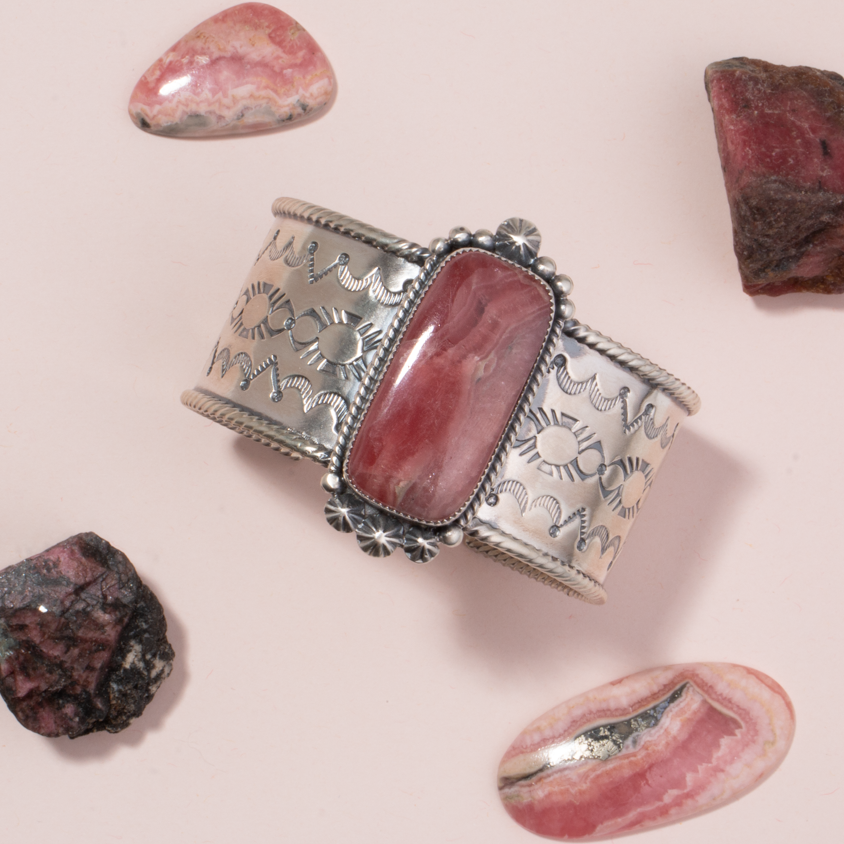
"Fred Harvey era" now names a whole collecting category. June gives the genre a lifespan of about 1900 to 1955 and finds it in three forms: an authentic version, a souvenir version and a hybrid of the two (June 2013, p. 12). Thunderbirds, arrows and whirling logs (an era symbol later abandoned) recur on its stamped cuffs and pins, but the symbol set was largely made for the trade. Baxter describes the stamped "symbols" as "mostly designed by Schweizer's staff and only vaguely related to actual native motifs" (Baxter 2000, p. 57), and June writes that "most of the Fred Harvey-style symbolism is not Indian at all" (June 2013, p. 144). Schweizer turned a thunderbird pictograph he saw at the Abó ruins into the company's logo, which it copyrighted in 1909 (Baxter 2000, p. 174; June 2013, p. 14).
The genre outgrew the company. Arrow Novelty, in New York, began making silver Indian-design jewelry in 1919 with non-Indian workers, and June calls it "a main player in the Harvey jewelry phenomenon" (June 2013, p. 82). Baxter lists Arrow Novelty and Goldfarb, both of New York City, among the curio makers (Baxter 2000, p. 175). Neither book says the Harvey Company bought from them.
So the honest distinctions matter: some pieces were Native-made for the tourist trade, others were commercial production, and weight, construction and marks tell the story. The company's own marks include a script "Fred Harvey" on silver plate, copper or an applied tag, and the stamps UITA 4 and U.S. NAVAJO 4 (Hougart 2022, p. 358). Fred Harvey Co. advertising in 1938 described "the chief requisite for genuine Indian Silver Jewelry" as "the product of a single artisan, from the melting of the silver to completion of the finished article" (Hougart 2022, p. 358). That is the company's own claim, and no mark proves who made a given piece. Our stampwork guide covers reading the stamps, the hallmark index covers the makers, and the trading posts covers the supply chain the Harvey company sat atop.
A note on accuracy. We strive for accuracy, and this page is continuously updated with new information from the artists, their families, and the community. Corrections welcome.
From the Library: Chambless & Ryan, Turquoise in America, Part One (2021)
2021 primary source. Anything described as current here describes 2021, not today.
Chambless & Ryan (2021) describe the tourist trade the railroads created:
“With the rise of tourism, demand grew for souvenirs, or curios, to which the Harvey organization and others responded with Indian-style jewelry, some handmade by American Indians and some mass-produced by Mexican workers.”
— Chambless & Ryan (2021), p. 142 [1]
As Chambless & Ryan (2021) frame what followed:
“In the twentieth century, the story of turquoise will be closely tied to the evolution of American Indian jewelry from curio, to craft, to fine art.”
— Chambless & Ryan (2021), p. 142 [1]
According to Chambless & Ryan (2021, p. 141), the Southwest Turquoise Company of Los Angeles aimed at the new tourist market. Its List of Specimens booklet from about 1908 offered travelers a turquoise nugget from its own mines as a souvenir of the West. [1]
Chambless & Ryan (2021) date the Indian Department:
“In 1901, Harvey's daughter Minnie and her husband J.F. Huckel created the Indian Department headed by Herman Schweizer.”
— Chambless & Ryan (2021), p. 179 [1]
According to Chambless & Ryan (2021, p. 179), when Fred Harvey died in 1901 the Harvey Company was a western institution with 15 hotels and 47 restaurants in 12 states. [1]
Chambless & Ryan (2021), citing Lidchi, record what Huckel told Schweizer by 1932:
“We handle genuine it is true, but we handle phony as well.”
— Chambless & Ryan (2021), p. 179 [1]
According to Chambless & Ryan (2021, p. 179), much of Harvey's older, finer stock was the heavy Navajo style from unredeemed pawn or from artists contracted by traders, but in response to tourist demand for lighter, cheaper jewelry the company contracted for mass-produced look-alikes often not made by Native Americans. [1]
From the Library: Lowry, Turquoise: The World Story of a Fascinating Gemstone (2010)
2010 primary source. Anything described as current here describes 2010, not today.
According to Lowry (2010, p. 91), Fred Harvey began in the mid-1870s with food and overnight rooms for train passengers, and later marketed turquoise Indian jewelry to travelers and guests at his hotels. [2]
From the Library: Bedinger, Indian Silver (1973)
1973 primary source. Anything described as current here describes 1973, not today.
According to Bedinger (1973, p. 51), the Santa Fe Railroad's passenger department was quick to see tourists as a source of income, and in 1903 it published G. A. Dorsey's The Indians of the Southwest, which described Navajo smiths turning Mexican money into beads, rosettes, buckles, earrings, bracelets and rings. Bedinger dated the start of the craft's commercialization to 1899. [3]
According to Bedinger (1973, p. 91), the exception to the rule that no two Navajo bracelets are alike was the commercial work stamped out by machine and labeled "Indian made" because an Indian had operated the press. [3]
According to Bedinger (1973, p. 82), the Navajos called the swastika design "whirling logs"; it appeared on Navajo blankets and was stamped on their silver at least as early as 1906. [3]
According to Bedinger (1973, p. 112), in the year from July 1905 to July 1906 about sixty thousand swastikas, some made by Native smiths and some not, were sold to tourists in New Mexico as genuine Indian articles, at an average of forty cents each. The design went out of use with World War I. [3]
According to Bedinger (1973, p. 108), drawing on the historian Arthur Woodward, the story then current was that Santa Fe railroad surveyors had copied a bird figure from polychrome pictographs near Scholle, New Mexico; the railroad adopted it as a trademark, curio shops along the line began selling silver copies, and the name "Thunderbird" was attached largely through ignorance. [3]
Bedinger (1973, p. 109) could not confirm the story, but she reported that a prehistoric pictograph of that bird form, painted in blue-gray and white, did appear among other figures on overhanging rocks beside the road to Abó, not far from Scholle. [3]
According to Bedinger (1973, p. 107), arrows and swastikas were among the first signs of outside influence on Navajo silver; traders persuaded smiths to use them, and early representational decoration was rare, usually appearing when a piece was made to a white customer's order. [3]
Bedinger (1973) described the idea behind Harvey tourist silver:
“So he conceived the idea of providing metal and stones ready for setting and having the smiths make them to his order in thin, lightweight pieces.”
— Bedinger (1973), p. 115 [3]
According to Bedinger (1973, p. 116; see also p. 115), Schweizer first tried the scheme at the trading post in Thoreau, New Mexico, then extended it to Sheep Springs, Smith Lake and Mariano Lake. Smiths were paid by the ounce for rings, bracelets and beads made from silver and stones the traders supplied, and the pieces were sold on Santa Fe trains and in the stations along the route. [3]
According to Bedinger (1973, p. 115), before these orders the only Navajo jewelry available to tourists had been dead pawn that traders turned in to the big mercantile houses in the railroad towns. [3]
According to Bedinger (1973, p. 116), in 1910 a Denver firm began manufacturing "Indian" jewelry by mass production and undersold the traders, while dealers in Santa Fe and Albuquerque opened small shops employing Native smiths, mostly Pueblo, so the work could be labeled "Indian Made." She also recorded, from a 1940 personal communication, that Japanese makers stamped goods "Reservation Made" after a town they had named Reservation. [3]
For collectors dating a piece, Bedinger (1973, p. 116) listed what changed in commercial silver: the metal was thinned, losing its three-dimensional quality; stamped devices such as crossed arrows, swastikas, owls and Indian heads multiplied; chisel and file ornament disappeared; and cast work almost vanished, because smiths paid by the ounce used the quickest methods. [3]
According to Bedinger (1973, p. 117), turquoise also changed: where Navajo smiths had used it sparingly in fairly large pieces as the focus of a design, commercial work used small, often ill-matched or inferior stones, and machine-made pieces were sometimes in debased metal set with imitation turquoise. [3]
According to Bedinger (1973, p. 118), in the 1920s and 1930s smiths also made cigarette boxes, ashtrays, watch bracelets, letter openers and table silver for tourists, and some shops had Native workers do no more than operate a press holding a single die. [3] Jacka (1995, p. 25) also lists the items made strictly for tourists: "ashtrays, watch bracelets, letter openers, cigarette holders, and utensils." [9]
According to Bedinger (1973, p. 120), Secretary of the Interior Harold Ickes ordered that only handmade Indian jewelry be sold in the national parks and monuments. Congress created the Indian Arts and Crafts Board on August 27, 1935, its five members were appointed in 1936, and voluntary standards for Indian silverwork were drawn up in February 1937, with a government stamp for pieces that met them. [3]
According to Bedinger (1973, p. 120), René d'Harnoncourt reported in 1943 that the standards had raised the output of fine silver but that judging each piece individually made the stamp hard to apply, so it was little used. [3]
According to Bedinger (1973, p. 151), in the 1920s, as automobiles carried ever more tourists, demand for Native souvenirs outran even factory output, and traders turned to Zuni. Before 1920 Zuni smiths had made silver for themselves and their own people; traders first bought that jewelry and then had smiths make pieces for the tourist trade. [3]
According to Bedinger (1973, p. 152), drawing on Adair, in 1920 no more than eight Zuni smiths made silver in quantity, while by 1938 there were ninety, not counting ten Navajo smiths working there. During World War II the government restricted silver sales to non-Native jewelers but exempted Native smiths, and Zuni silver income soared. [3]
From the Library: Frank, Indian Silver Jewelry of the Southwest (1990)
1990 primary source. Anything described as current here describes 1990, not today.
According to Frank (1990, p. 7), after the turn of the century the Fred Harvey hotel chain began to promote the making and sale of Indian jewelry to tourists, a development that took some twenty years to become widespread; at first, he wrote, the remote smiths were not yet affected by the cheaper silversmithing material traders supplied. [4]
Frank (1990) dated the end of the first phase to the tourist market:
“In the transitional period, from about 1900 to 1930, the tourist market finally dominated the production of jewelry and brought an end to first phase jewelry-making.”
— Frank (1990), p. 7 [4]
According to Frank (1990, p. 7), by the 1920s smiths were designing jewelry mainly for non-Indian buyers, and by 1930 the second phase of Southwest jewelry, with manufactured material, modern techniques and ornate new designs, was firmly established; he called 1930 a relatively arbitrary dividing date. [4]
According to Frank (1990, p. 22), in 1899 Herman Schweizer, then in charge of the Fred Harvey Curio Department, conceived the idea of lightweight silver and turquoise jewelry for tourists, farming out precut turquoise and thin sheet silver to smiths around Thoreau, Sheep Springs, Smith Lake and Mariano Lake. [4]
Holbrook, writing in Frank (1990), on the first result:
“The first "light" jewelry, which consisted mostly of rings and bracelets, was immediately popular with the tourists.”
— Frank (1990), p. 22 [4]
According to Frank (1990, p. 22), precut turquoise, machine-drawn wire, commercial solder and flux, machine-rolled sheet silver, saws, files, sandpaper and the blowtorch soon changed the craft, yet the transitional phase lasted until 1930: some smiths and whole areas kept making simple, heavy first phase work for thirty years, so new tools and materials are not an easy dating test. [4]
Holbrook, writing in Frank (1990), named economics as the greatest force of change:
“When the Indian people themselves started wearing the new, lighter silver with machine-cut stones, first phase work was no longer salable and its production ceased.”
— Frank (1990), p. 24 [4]
As of the late 1970s, Frank (1990, p. 30) reported that the Heard Museum in Phoenix, Arizona, held a large part of the Fred Harvey jewelry collected in the first half of the twentieth century, alongside its own collection. [4]
According to Frank (1990, p. 68, Fig. 72), Herman Schweizer, chief buyer for the Fred Harvey Company, collected two rings in 1930: one with thick bezels around three oval stones, the other with a large turquoise in a bezel with stamped sides. [4]
Frank (1990, Fig. 119, p. 102) records a Harvey purchase and what it cost in its day:
“This one-of-a-kind round bowguard was collected by Herman Schweizer of the Fred Harvey Company and purchased in 1906 for one dollar.”
— Frank (1990), p. 102 [4]
According to Frank (1990, p. 104, Fig. 122), belts now in the Heard Museum's Fred Harvey Fine Arts Collection carry purchase records from the reservation trade: one of about 1890 was bought from the Frazier Trading Post in 1946, and one of about 1900 from Willis Martin at Two Gray Hills in 1925. [4]
According to Frank (1990, p. 105, Fig. 124), early-1900s bracelets in the same collection were bought at Rockpoint Trading Post in 1925 and from Garcia at Chinle, Arizona, in 1926; he thought some of them might be Zuni. [4]
On a stamped motif collectors meet often, Frank (1990, Fig. 124, p. 105) wrote:
“Arrow designs originate around 1900, the date of this bracelet, and continue to be used through the 1930s when they were increasingly employed and tourist oriented.”
— Frank (1990), p. 105 [4]
According to Frank (1990, p. 106, Fig. 125), a bracelet of about 1920-1930 with a central concha-style disk, wire-effect patterns, stamping and narrow wrist bands was most probably a tourist piece. [4]
According to Frank (1990, p. 189, Fig. 238), bracelets made after Fred Harvey began furnishing manufactured silver to the silversmiths had thinner silver and scalloped edges, and a flower-petal motif turned overly ornate; he dated one such bracelet circa 1905, beside a heavier early bracelet with serrated bezels of around 1890. [4]
From the Library: Turnbaugh, Indian Jewelry of the American Southwest (2007)
2007 primary source. Anything described as current here describes 2007, not today.
According to Turnbaugh (2007, p. 25, caption), railroads brought tourists to the Southwest around 1900, tourists drew Native vendors to the railroad stops, and that outlet shaped the commercial growth of silversmithing, weaving, basketry and pottery in the early 20th century. [5]
According to Turnbaugh (2007, p. 26, caption), Fred Harvey founded Hopi House on the South Rim of the Grand Canyon in about 1905 as a recreation of a Hopi pueblo, designed for him by the architect Mary Colter, and it was still selling jewelry when they wrote in the late 1980s. [5]
According to Turnbaugh (2007, p. 27, caption), early 20th-century firms such as the Fred Harvey Company, Maisel and Sun-Bell, which made inexpensive jewelry, are credited with keeping non-Native buyers interested in Native jewelry through the Great Depression; their pieces had some handwork but were mostly machine-made, and as of the late 1980s companies like Bell were still making low-cost sterling and turquoise jewelry. [5]
Turnbaugh (2007, p. 27, caption) set the tourist-era curios of the early 1900s against the work made for Native wearers:
“This jewelry is much lighter in weight and less expensive than that made non-commercially for native use.”
— Turnbaugh (2007), p. 27 [5]
William and Sarah Turnbaugh (Turnbaugh 2007) gave the same turn at Zuni:
“Until about 1920, the Zuni fashioned jewelry primarily for themselves and other native peoples. But by about 1930, the Zuni were creating much of their jewelry for tourists.”
— Turnbaugh (2007), p. 53 [5]
According to Turnbaugh (2007, p. 53), within another ten years jewelry making had become a major means of earning income at Zuni. [5]
Of a silver "eagle" or "thunderbird" pin with stampwork, chiselwork and repoussé, Turnbaugh (2007, p. 84, caption) wrote:
“The tourist-era piece dates probably to the late 1920's.”
— Turnbaugh (2007), p. 84 [5]
From the Library: Wright, Hopi Silver (2003)
2003 primary source. Anything described as current here describes 2003, not today.
According to Wright (2003, p. 6), the first Hopi smiths made jewelry only for Hopi use; when they worked for commercial outlets, economic demand changed both the type of silver and the design, and a smith asked for many inexpensive bracelets in a short time could not work as carefully as one making a few bow guards and concha belts a year. [6]
Wright (2003) on what tourist demand did to design:
“Too, the requests from tourists and traders for "Indian" designs, such as stylistic bows and arrows and thunderbirds, did not foster the use of the more subtle Indian approach to these objects, or others drawn from their own tradition.”
— Wright (2003), p. 6 [6]
According to Wright (2003, p. 10), Tawanimptewa, one of the Second Mesa men said to have learned from Yellow Light, did silversmithing at Grand Canyon Village for some years; one of his last silver pieces, a bow guard, was made around 1930. [6]
According to Wright (2003, p. 12), Tawahongniwa's son Rutherford toured the United States in 1935 and 1936 as the Hopi silversmith in W. Billingsley's troupe of Hopi dancers and demonstrators, appearing at fairs, exhibits and department stores from Canada to Florida. [6]
According to Wright (2003, p. 75), Homer Vance (Humiventewa), a Sun clan smith of Shipaulovi born in 1882 who began about 1920, worked at Grand Canyon for a year, as well as at other stores. [6]
From the Library: Ryan & Chambless, Turquoise in America Part Two: 1910–1990 (2020)
2020 primary source. Anything described as current here describes 2020, not today.
Ryan & Chambless (2020) quote John Adair's unpublished 1940 report for the Indian Arts and Crafts Board on how Harvey tourist silver began:
“They demanded lighter bracelets, beads, and rings and so Mr. Herman Schweizer, the head of the curio department of that Company, sent out to several trading posts Mexican pesos, and turquoise mined in Colorado and Nevada, which had been already ground and polished.”
— Ryan & Chambless (2020), p. 45 [7]
According to Ryan & Chambless (2020, p. 45), Adair called this the beginning of the practice of "farming out" silver and turquoise, soon copied by the Gallup mercantile companies; the authors conclude that the arrangement served as the model for the following decades and created the major demand for turquoise. [7]
According to Ryan & Chambless (2020, p. 45), Adair prepared that 1940 report for the Indian Arts and Crafts Board, which they write Congress established in 1936 in reaction to mass-produced jewelry often fraudulently represented as both Native American and handmade; the report was never published. [7]
According to Ryan & Chambless (2020, p. 40), buyers in the early curio market preferred lighter jewelry for comfort and lower price, and the Harvey Indian Department's entry into the curio trade increased both the supply of and the demand for it; this tourist-trade jewelry became known as Fred Harvey jewelry. [7]
According to Ryan & Chambless (2020, p. 40), when the Alvarado Hotel opened in Albuquerque in 1902, its Indian Room, designed by Mary Colter, became the star attraction for rail travelers. Schweizer had his friend Juan Lorenzo Hubbell, the trader at Ganado, recruit a local weaver, and for years Elle of Ganado worked at her loom in the Indian Room, perhaps the first Southwest tourist entertainment attraction. [7]
According to Ryan & Chambless (2020, p. 41), the crafts on display in the early Indian Room were mostly baskets, pottery and weaving; jewelry did not become a major factor in the market for several years. [7]
According to Ryan & Chambless (2020, p. 42), Dr. George A. Dorsey, curator of anthropology at Chicago's Field Columbian Museum, took a leave of absence to oversee the development of the new Harvey Indian Department from a residence in the Alvarado Hotel. [7]
Ryan & Chambless (2020) quote John Adair on Schweizer's 1899 arrangement at Thoreau:
“He asked the trader there to have Navajo smiths make jewelry lighter in weight than that which they made for their own use.”
— Ryan & Chambless (2020), p. 66 [7]
According to Ryan & Chambless (2020, p. 66), Adair wrote that Schweizer had asked a turquoise-mine owner in Nevada to cut stones into flat, square and oblong shapes; Adair did not name the source, but the authors suggest it was William Petry, cutting stones for George Simmons at the Crescent Peak Mine in 1899, and call it the first report of the contract work that became a model for producing jewelry in later periods. [7]
These are outside observers' records of the trade; the Navajo (Diné), Zuni and other nations are the authority on their own history.
According to Ryan & Chambless (2020, p. 103), the Santa Fe railroad hotels run by Fred Harvey served as retail outlets for Indian arts, and while weavings, pottery and baskets were most available at first, jewelry came to surpass them. [7]
According to Ryan & Chambless (2020, p. 106), Herman Schweizer, buyer for the Harvey Indian Department, asked traders for lighter-weight jewelry, preferably set with fine turquoise, to suit the tourist trade. [7]
Gene Waddell recalled, in an interview published by Ryan & Chambless (2020, p. 221), that from the 1980s the Fred Harvey Company, then owned by Amfac and later bought by Xanterra, was the biggest customer for the jewelry he bought from artists, through its buyer Jeff Ogg. [7]
From the Library: Lowry, Turquoise Unearthed: An Illustrated Guide (2002)
2002 primary source. Anything described as current here describes 2002, not today.
Lowry (2002) on the railroad:
“The arrival of the transcontinental Atchison, Topeka, and Santa Fe Railway in northern New Mexico and Arizona in the early 1880s helped spark interest in authentic, handcrafted silver and turquoise Indian jewelry.”
— Lowry (2002), p. 19 [8]
From the Library: Jacka, Navajo Jewelry: A Legacy of Silver and Stone (1995)
1995 primary source. Anything described as current here describes 1995, not today.
Lois Essary Jacka, writing in 1995, on the cheapest tourist jewelry:
“Much of the tourist jewelry was made of nickel and decorated with small imitation-turquoise stones. Many of these items, sometimes referred to as "Route 66" jewelry because of the proliferation of shops selling it along that highway, were stamped "nickel silver."”
— Jacka (1995), p. 25 [9]
Jacka (1995) quoted Carl Rosnek's Skystone and Silver on the symbol lists handed to tourists:
“A great deal of nonsense was written or rumored concerning the 'meaning' of these symbols—when in fact, with few exceptions, they had none for the Indians.”
— Jacka (1995), p. 25 [9]
From the Library: Adair, The Navajo and Pueblo Silversmiths (1944)
1944 primary source. Anything described as current here describes 1944, not today.
Writing in 1944, Adair (1944) dated the turn:
“The commercialization of the craft began in 1899 when the Fred Harvey Company first started to order silver made up expressly for white consumption.”
— Adair (1944), p. 25 [10]
Why the company changed course, in Adair (1944):
“Before that time, the Fred Harvey Company had bought pawned Navajo silver from the traders. It had proved to be too heavy for sale to the tourists, who wanted lighter jewelry which they could wear in the East.”
— Adair (1944), p. 25 [10]
Adair (1944) named the man and the year:
“In 1899 Mr. Herman Schweizer, who for many years has been in charge of the Harvey Company's curio department, asked a turquoise-mine owner in Nevada to cut stones into flat, square, and oblong shapes for Indian use.”
— Adair (1944), p. 25 [10]
Before that, according to Adair (1944), the only buyers outside the Native trade were soldiers:
“The only silver made for the white man before 1890 was a small amount which the soldiers at Fort Wingate ordered from the smiths.”
— Adair (1944), p. 25 [10]
Where the Harvey silver was sold, in Adair (1944):
“The Harvey Company sold great quantities of silver on the Santa Fé trains and in its hotels at the Grand Canyon and at Albuquerque.”
— Adair (1944), p. 27 [10]
How large it grew, as Adair (1944) put it:
“This commercialization, begun in a small way by the Harvey Company, grew to tremendous proportions in the middle of the 1920's; and the sale of silver to white people had a great effect on both the design and the economics of the craft.”
— Adair (1944), p. 26 [10]
And the first factory imitations, in Adair (1944):
“In 1910 a firm in Denver began to manufacture this imitation jewelry, using white labor. By mass production techniques the manufacturer was able to undersell the traders.”
— Adair (1944), p. 27 [10]
According to Adair (1944, p. 53), in the forty years before he wrote, traders and curio dealers had encouraged Navajo smiths to make souvenirs for tourists, including objects foreign to the craft such as boxes, ash trays, forks and spoons, and letter openers. [10]
To those who said the art died when it was commercialized, Adair (1944) answered:
“This is hardly a realistic manner of viewing the present situation. The craft has been commercialized over a long period of years, and the demand for such objects as Navajo-made silver boxes gives employment to many smiths.”
— Adair (1944), p. 53 [10]
According to Adair (1944, p. 61), when he showed Tom Burnsides' twelve-and-a-half-hour bracelet to a Gallup curio dealer in the late 1930s, the dealer admired it but said his own smiths could not work that way, because he had to fill wholesalers' orders and needed half a dozen bracelets from each in a day. [10]
Adair (1944) drew the conclusion for the tourist trade of his day:
“This is one of the reasons why much of the silver that is sold to the tourists is poor in quality.”
— Adair (1944), p. 61 [10]
According to Adair (1944, p. 61), smiths were then paid by the number of ounces they worked up into silver, so the more ounces per hour the better for them, as long as the piece was good enough for the traders to sell. [10]
Adair (1944) described what the tourist market did to Zuni design after about 1920:
“Much of his silver became the Indian's idea of the trader's idea of what the white man thought was Indian design.”
— Adair (1944), p. 135 [10]
Adair (1944) counted the change at Zuni:
“In 1938 there were ninety smiths in that pueblo, not counting ten Navajo smiths who worked there.”
— Adair (1944), p. 136 [10]
According to Adair (1944, p. 140), a Zuni correspondent traced an early silver Knife bird to a design on a Fred Harvey letterhead, and Mr. Schweizer of the Fred Harvey Company told Adair that the letterhead design had been copied from a reproduction in one of the Bureau of American Ethnology's Zuni reports. [10]
According to Adair (1944, p. 188), Pueblo smiths were numerous in the last two decades of the nineteenth century, fell off after 1900 as commercial Navajo silver became easy to get, and grew again from about 1920, when young men took up the craft without learning it from their pueblos' older smiths. [10]
Adair (1944) described the Pueblo bench-shop smith of about 1940:
“The silver which he makes is sold to the white man and is apt to be light in weight and stereotyped in design. For him the craft has become a full-time, factory worker's job.”
— Adair (1944), p. 189 [10]
According to Adair (1944, p. 204), by 1940 the bead-makers of the Smith Lake-Pinedale area were paid by the bead, up to eight cents for one more than half an inch across; most of their beads were extremely light, went all over the silver country, and were sold by the thousands each year at Zuni, where the traders had smiths assemble them into necklaces. [10]
From the Library: Baxter, Encyclopedia of Native American Jewelry (2000)
2000 primary source. Anything described as current here describes 2000, not today.
Baxter (2000) on where the tourist 'symbols' came from:
“pieces were made from lightweight silver (to make them easier to pack and carry) and stamped liberally with Indian “symbols” (which were mostly designed by Schweizer’s staff and only vaguely related to actual native motifs).”
— Baxter (2000), p. 57 [11]
Baxter (2000) on how the company advertised the look:
“Harvey Company “Detours” were also organized to various important natural attractions (including pueblos); the company had their female guides appropriately adorned in native silver and turquoise jewelry to help stimulate tourist appetites for these objects.”
— Baxter (2000), p. 57 [11]
According to Baxter (2000, p. 57), Schweizer also assembled a Fred Harvey Collection of more than 4,500 items of native arts, keeping good-quality Navajo silver made between 1875 and 1929 as benchmark examples; ironically, it retained little of the commercial tourist silver the company had inspired. As of 2000 the collection was at the Heard Museum in Phoenix. [11]
According to Baxter (2000, p. 78), shortly after 1910 the Denver firm H. H. Tammen began making imitation Indian jewelry by mass production, undercutting the handmade product, and from the 1920s through the 1950s such firms sold their lines in five-and-dime stores under evasive labels such as "Indian Style" and "Indian Maid." [11]
Baxter (2000) drew the line between those imitations and Harvey jewelry:
“Harvey pieces were in fact executed by Indian workers (operating through trader middlemen), based on specifications dictated by the company.”
— Baxter (2000), p. 79 [11]
According to Baxter (2000, p. 174), Herman Schweizer, the Fred Harvey Company's Indian arts buyer, saw a thunderbird pictograph at the Abo ruins near Mountainair, New Mexico, had its image made into a company logo for stationery and brochures, and the company eventually copyrighted its version in 1909. [11]
Baxter (2000) on how the motif became generic:
“The generic nature of this Southwest form of the thunderbird was solidified when jewelry-supply companies began producing commercial stamping dies with the figure.”
— Baxter (2000), p. 174 [11]
Baxter (2000, p. 175) listed some of the more active curio companies that made Indian jewelry and other goods in the decades before mid-century: H.H. Tammen (Denver and Providence), Arrow Novelty Company and Goldfarb (New York City), Pawnee Bill's (Oklahoma), Maisel and Sun Bell (New Mexico), Leroy Shane (Midwest) and Mayer's (Seattle). [11]
From the Library: Woodward, A Brief History of Navajo Silversmithing (1946)
1946 primary source. Anything described as current here describes 1946, not today.
Of the railroad 'Thunderbird' story, Woodward (1946) wrote in 1938:
“Whether this story is true I cannot say, but I can vouch for the fact that the prehistoric pictograph of this particular bird form painted in blue-gray and white does appear”
— Woodward (1946), p. 42 [15]
According to Woodward (1946, p. 42), he visited the rock art beside the road to Abó, not far from Scholle, with Frank Pinkley, Superintendent of Southwestern Monuments for the National Park Service, in November 1935, and sketched some of the figures. [15]
Woodward (1946) recorded his view of the bird design in 1938:
“This ornament is widely known as the "Thunderbird," in spite of the fact that the "Thunderbird" is an unknown factor in the mythology of the Southwest.”
— Woodward (1946), p. 40 [15]
This is a 1938 outside writer's view; the Pueblo and Navajo nations are the authority on their own beliefs.
From the Library: June, Fred Harvey Jewelry 1900–1955 (2013)
2013 primary source. Anything described as current here describes 2013, not today.
June (2013, p. 9) stressed that the Fred Harvey Company never produced any Indian jewelry of its own, nor the souvenir jewelry first known as "railroad jewelry." [12]
In his account, June (2013) placed the company in the middle of the trade instead:
“The Fred Harvey Company was, instead, souvenir jewelry's major advocate, facilitator, buyer and distributor.”
— June (2013), p. 9 [12]
June (2013, p. 6) noted that Fred Harvey the man died on February 9, 1901, about the time souvenir Southwest jewelry was born, and that he himself had little to do with the souvenir jewelry that later came to bear his name. [12]
Writing in 2013, June described where much of the early work was made:
“Much of the early-era Harvey jewelry was made in small, railroad town, job shops, typically by Indian silversmiths.”
— June (2013), p. 33 [12]
June (2013, p. 29) described the selling conditions: brief depot stops meant quick decisions for travelers in the railside curio shops, conductors loudly announced departures in Harvey's diners and stores, and silver bracelets became a favorite, easy purchase. [12]
June (2013) summed up why bracelets suited the trade:
“Railroad jewelry was small, cheap, easy to transport, useful and great as keepsakes.”
— June (2013), p. 29 [12]
According to June (2013, p. 30), visitors leaving the trains at Albuquerque were guided past the Indian Building beside the Alvarado Hotel, where the Harvey collection was displayed and Indian artisans demonstrated weaving and silversmithing. [12]
Writing in 2013, June credited a potter with opening the door at Hopi House:
“The famous potter Nampeyo was the first prominent Hopi to work for the Harvey company, by coiling clay pottery at the Grand Canyon's Hopi House gallery.”
— June (2013), p. 53 [12]
June (2013) on the Albuquerque depot:
“It offered an open invitation for Indian artisans to gather around the crowded entrance to this famous Indian Room.”
— June (2013), p. 53 [12]
According to June (2013, p. 55), Harvey side trips by horse and buggy began as early as 1892, and a separate Harvey company, Southwestern Indian Detours, was later formed to take rail travelers out to the pueblos, the Hopi mesas and the Grand Canyon. [12]
June (2013, p. 49) wrote that rail travel fell off in the Depression and revived in the mid-1930s with the Santa Fe's all-Pullman Super Chief, while individual Indian silversmiths, and the job shops of railroad towns such as Albuquerque and Gallup, struggled against the flood of souvenir jewelry. [12]
According to June (2013, p. 60), the first mass-producer of Indian-style jewelry was Frank F. Hurd of Denver, from about 1900, whose machine-made silver buttons and beads were sold to Indian buyers and became a staple of early silver necklaces. [12]
June (2013, p. 60), citing Jonathan Batkin's 2009 Wheelwright Museum exhibition catalog, wrote that by about 1908 the H. H. Tammen curio company of Denver, a maker of silver souvenir spoons since 1891, was producing Indian-style jewelry on Hurd's model. [12]
On dating the thunderbird stamp, June (2013) wrote:
“It was used intensely until the 1930s, when it seems to have faded in favor of newer, less redundant symbols, including the ever-more-popular arrows.”
— June (2013), p. 69 [12]
According to June (2013, p. 69), the whirling log was common on earlier Fred Harvey jewelry, faded as well, and disappeared abruptly with the onset of World War II. [12]
June (2013) cited an early sign of the whirling log's decline:
“As early as 1908, in a letter to Lorenzo Hubbell, Herman Schweizer requested Navajo weavers cease use of the symbol because they were "not selling well."”
— June (2013), p. 76 [12]
According to June (2013, p. 81), the souvenir maker Tammen promoted a dog design that was perhaps the source of the collectors' term "dog bracelet": die-stamped, the figure looks like a horse, but as a flat appliqué its short legs make it look like a dog. [12]
According to June (2013, p. 84), Silver Arrow of Kansas City, originally named Silver Products, was making silver Indian design jewelry in the 1940s; its marks included a long arrow with "Silver Products" above it and "coin silver" below, and a script "Silver Arrow" laid over a long arrow. [12]
Writing in 2013, June described what paved highways did to the Harvey trade:
“Any influence the Harvey Company had on Indian products began to evaporate when highways were paved with asphalt and cement.”
— June (2013), p. 99 [12]
According to June (2013, p. 99), highway traffic slowly shifted souvenir buying to roadside communities, out of Harvey hands, and Indian-themed stores multiplied in towns from Tulsa to Bakersfield, with northern New Mexico and Arizona at the center. [12]
These are one collector's identification clues for Fred Harvey-era jewelry, published in 2013; no single clue proves who made a piece.
June (2013, p. 104) classed the hybrid as part handmade and part machine-made, and as one form of souvenir jewelry: most hybrid bracelet shanks were pressed from sheet metal, and silversmiths then added tooling, sawing, soldering, stone setting and finishing. [12]
June (2013, p. 109) described the earliest hand-forged cuffs as made from a single silver dollar, finishing at around 30 grams and about 12 to 14 gauge. [12]
For the souvenir side, June (2013) gave these weights:
“Lighter weight, souvenir Harvey bracelets are typically around 15-18 grams, often as little as 12 grams, and sometimes as thin as 20 gauge.”
— June (2013), p. 109 [12]
According to June (2013, p. 112), many independent Indian silversmiths were supplied with bracelet shanks that already carried the dominant symbols, pressed in by machine; the smith added his own stamps along the edges and side panels and soldered on the components, a process June described, in quotation marks, as creating "Indian handmade." [12]
June (2013) on why the split-shank cuff he called the "pretty girl" caught on:
“"Pretty girl" bracelets were immediately popular, in part because of their delicate design but more significantly because they were more comfortable to wear.”
— June (2013), p. 113 [12]
June (2013, p. 118) divided the souvenir side of the genre into three overlapping periods, each defined by silver content, shank type, stone use, hallmarks and major events: an Early Harvey Period (1900-1920) of broad, flat-plate cuffs in coin silver; a Middle Harvey Period (1920-1935), when the split-plate "pretty girl" overtook the flat plate and hybrid jewelry flourished; and a Late Harvey Period (1935-1955), when sterling silver dominated. [12]
According to June (2013, p. 138), Herman Schweizer of the Indian Department was among the first to supply turquoise to silversmiths, importing Persian turquoise already cut as cabochons and buying thousands of precut American stones from Colorado and Nevada. [12]
June (2013) on how little grading mattered then:
“Quality characteristics we ascribe in present-day, such as density, color, depth, intensity and matrix, was not a concern in the early Harvey era.”
— June (2013), p. 138 [12]
June (2013, p. 143) used "authentic" for souvenir-style bracelets made entirely by hand by Indian silversmiths, and held that even a handmade Indian copy of a Fred Harvey bracelet should be described as such, separately from souvenir work. [12]
Writing in 2013, June (2013) ranked how often each kind turns up:
“Overall, the authentic souvenir bracelet is scarce when compared to the hybrid, and rare when compared to mass-produced.”
— June (2013), p. 143 [12]
June (2013) on where many hybrid bracelets began:
“Souvenir job shops contributed to the confusion by supplying independent silversmiths with shank blanks, usually with impressed symbols and designs.”
— June (2013), p. 148 [12]
According to June (2013, p. 152), by 1930 there were more than 600 known Indian silversmiths, mostly Navajo, and Gallup dealers were the main buyers of their handmade work. [12]
These describe the era as a whole. Whether any single piece is Native-made depends on its maker and its history, not on its style.
June (2013) also explained why the two kinds of jewelry are hard to separate from the start:
“In fact, the earliest souvenir specimens were authentic; that is, handmade by Indians. Traditional handmade Indian jewelry was produced alongside the souvenir jewelry, sometimes in the same job shop.”
— June (2013), p. 9 [12]
June (2013, p. 27) wrote that in the early twentieth century most job-shop silversmiths near the railroad depots of New Mexico and Arizona were Navajo, which is why he attributed most authentic, quality Fred Harvey jewelry to a Navajo origin; Pueblo smiths, the Zuni in particular, made inroads at the job shops by the end of the century's first quarter. [12]
June (2013) added a later development:
“Later in the Harvey jewelry era, Pueblo silversmiths were courted to live in various fitting or contrived locations along railroad and highway routes, "taking the product to the buyer," one expert suggests.”
— June (2013), p. 27 [12]
June (2013) cautioned that the genre was not all souvenir work:
“Cottage silversmiths also made Fred Harvey jewelry in profusion, so ample numbers of the earlier Harvey bracelets, not all lightweight, were fully Indian handmade and bear authentic status.”
— June (2013), p. 130 [12]
According to June (2013, p. 73), Maisel's was one of the early souvenir makers, starting up about 1905; he estimated one of its catalogs at about 1915-20. [12]
June (2013) on how that catalog worded its own goods:
“The first two words on this Maisel catalog cover are "Guaranteed Genuine," and in monotonous repetition every Maisel bracelet description begins with the phrase "Genuine coin silver, Indian made bracelet."”
— June (2013), p. 73 [12]
June (2013, p. 83) set two 1930 catalogs side by side, Tammen's and Arrow Novelty's: a nearly identical bracelet appeared in both under the same inventory number and at the same price, $54 a dozen, well below items the Maisel catalog sold as Indian-made. [12]
From the Library: Tryk, Santa Fe Indian Market (1993)
1993 primary source. Anything described as current here describes 1993, not today.
According to Tryk (1993, p. 69), the thin, hastily stamped tourist pieces carried "Indian" designs such as arrows, thunderbirds and steer heads, and some dealers even worked out an elaborate dictionary of what these symbols meant, to the amusement of many local Native people. [16]
Field Notes by Mateo James
This page dates the Harvey company's activity from 1876, while Chambless & Ryan put the first Harvey House in Kansas in 1875. The difference is one year, but it is a real disagreement between our sources. I tend to side with Chambless & Ryan.
Field Notes by Mateo James: Bedinger has Schweizer ordering silver from Navajo smiths in 1899, while Chambless & Ryan date the Indian Department he headed to 1901. The two dates may describe different things, his first orders and the formal department, but our sources don't say so, so I'm noting both.
Field Notes by Mateo James: Frank agrees with Bedinger on 1899 and calls Schweizer's unit the Curio Department, while Chambless and Ryan date the Indian Department he headed to 1901. The two names and dates may describe different stages of the same operation; I note it rather than resolve it.
Bedinger (1973, p. 120) dates the Indian Arts and Crafts Board to an act of Congress on August 27, 1935, with its five members appointed in 1936. Ryan & Chambless (2020, p. 45) write that Congress established the Board in 1936. I notice the two books give different years for its founding, so I show both here.
Chambless and Ryan date the Harvey Indian Department to 1901, while Adair, writing in 1944, has Herman Schweizer already ordering silver in 1899 as head of the company's curio department. Adair does not say when the department was formally created, so the two dates may describe different things. I give Adair's words beside theirs.
This page, following Baxter, says H. H. Tammen began mass-producing imitation Indian jewelry shortly after 1910. June, writing in 2013 and citing Jonathan Batkin's research, puts Tammen's Indian-style jewelry at about 1908. I show both dates and have not chosen between them.
Sources
- Chambless, Philip, and Mike Ryan II. Turquoise in America, Part One: The Great American Turquoise Rush, 1890–1910. Revised first edition. Callais Press, 2021. Cited by printed page. Statements describe conditions as of 2021.
- Lowry, Joe Dan, and Joe P. Lowry. Turquoise: The World Story of a Fascinating Gemstone. Layton, UT: Gibbs Smith, 2010. Cited by printed page. Statements describe conditions as of 2010.
- Bedinger, Margery. Indian Silver: Navajo and Pueblo Jewelers. Albuquerque: University of New Mexico Press, 1973. Cited by printed page. Statements describe conditions as of 1973.
- Frank, Larry, with the assistance of Millard J. Holbrook II. Indian Silver Jewelry of the Southwest, 1868-1930. Atglen, PA: Schiffer Publishing, 1990. First published 1978 by New York Graphic Society. Cited by printed page. Statements describe conditions as of 1990.
- Turnbaugh, William A., and Sarah Peabody Turnbaugh. Indian Jewelry of the American Southwest. Foreword by Barry M. Goldwater. Atglen, PA: Schiffer Publishing, 2007 (copyright 1996 and 2007; first published 1988). ISBN 0-7643-2577-9. Cited by printed page. Statements describe conditions as of 2007.
- Wright, Margaret Nickelson. Hopi Silver: The History and Hallmarks of Hopi Silversmithing. Revised edition. Albuquerque: University of New Mexico Press, 2003. Originally published by Northland Publishing. Cited by printed page. Statements describe conditions as of 2003.
- Ryan, Mike, II, and Philip Chambless. Turquoise in America, Part Two: 1910–1990. Callais Press, 2020. Cited by printed page. Statements describe conditions as of 2020.
- Lowry, Joe Dan, and Joe P. Lowry. Turquoise Unearthed: An Illustrated Guide. Photography by Mark Nohl. Tucson, AZ: Rio Nuevo Publishers, 2002. Cited by printed page. Statements describe conditions as of 2002.
- Jacka, Lois Essary. Navajo Jewelry: A Legacy of Silver and Stone. Photographs by Jerry Jacka. Flagstaff: Northland Publishing, 1995. Cited by printed page. Statements describe conditions as of 1995.
- Adair, John. The Navajo and Pueblo Silversmiths. The Civilization of the American Indian Series. Norman: University of Oklahoma Press, 1944. Cited by printed page. Statements describe conditions as of 1944.
- Baxter, Paula A., with Allison Bird-Romero. Encyclopedia of Native American Jewelry: A Guide to History, People, and Terms. Phoenix: Oryx Press, 2000. Cited by printed page. Statements describe conditions as of 2000.
- June, Dennis. Fred Harvey Jewelry 1900–1955. Atglen, PA: Schiffer Publishing, 2013. Cited by printed page. Statements describe conditions as of 2013.
- Bahti, Mark. Silver + Stone: Profiles of American Indian Jewelers. Tucson: Rio Nuevo Publishers, 2007. Cited by printed page. Statements describe conditions as of 2007.
- Hougart, Bille. Native American and Southwestern Silver Hallmarks: Silversmiths, Designers, Guilds and Traders. 5th edition. Washington, DC: BilleHougartBooks, 2022. Cited by printed page. Statements describe conditions as of 2022.
- Woodward, Arthur. A Brief History of Navajo Silversmithing. With field notes by Richard Van Valkenburgh. Museum of Northern Arizona Bulletin 14, 2d ed. Flagstaff: Northern Arizona Society of Science and Art, December 1946 (first edition 1938). Cited by printed page. Statements describe conditions as of 1946.
- Tryk, Sheila. Santa Fe Indian Market: Showcase of Native American Art. Photography by Mark Nohl; introduction by Allan Houser. Santa Fe, NM: Tierra Publications, in cooperation with SWAIA (Southwestern Association on Indian Affairs), 1993. Cited by printed page. Statements describe conditions as of 1993.