



Hopi Overlay: The Technique That Became a Tradition
Of all the Southwest's silverwork techniques, Hopi overlay has one of the best-documented origin stories — a deliberate creation, taught through a school, that became the signature of a nation's silverwork within a single generation. Because the books record it so well, we can tell the story with citations at every step.
The Founders
Two names anchor the story. Fred Kabotie — the celebrated Hopi painter — is documented working in overlay[1,2], and as a teacher: the books record him teaching Hopi veterans[3], his son Michael Kabotie[4], Jerry Whagado[5], and Charles Loloma[6], who would go on to become one of the most famous Native jewelers of the twentieth century.
Paul Saufkie carried the silversmith's side. The books record him teaching the veterans' program[7], the Hopi Silver Craft Guild[8], Victor Coochwytewa[9], and his son Lawrence Saufkie[10]. Wright's Hopi Silver preserves his working methods in detail — down to oxidizing the background silver and his use of silver solder[11], the steps that give overlay its signature dark-on-bright contrast.
A Craft Taught, Not Just Made
Overlay spread the way Southwest silverwork has always spread — by teaching. The veterans' classes and the Hopi Silver Craft Guild[7,8] made the technique a shared inheritance rather than one family's secret, and the shop Hopicrafts continued the pattern, with the books recording it teaching a further generation of smiths[12]. The full lineage story is in The Teaching Tree.

Documented Practitioners
Among the makers the books record working in overlay: Lawrence Saufkie[13], Michael Kabotie[14], Roy Talahaftewa[15], Mercy Coochwikvi[16], and Lamar Barehand[17] — many with pages in our silversmith directory.
For how overlay sits alongside Navajo and Zuni work, see the three great traditions.
The Technique Today
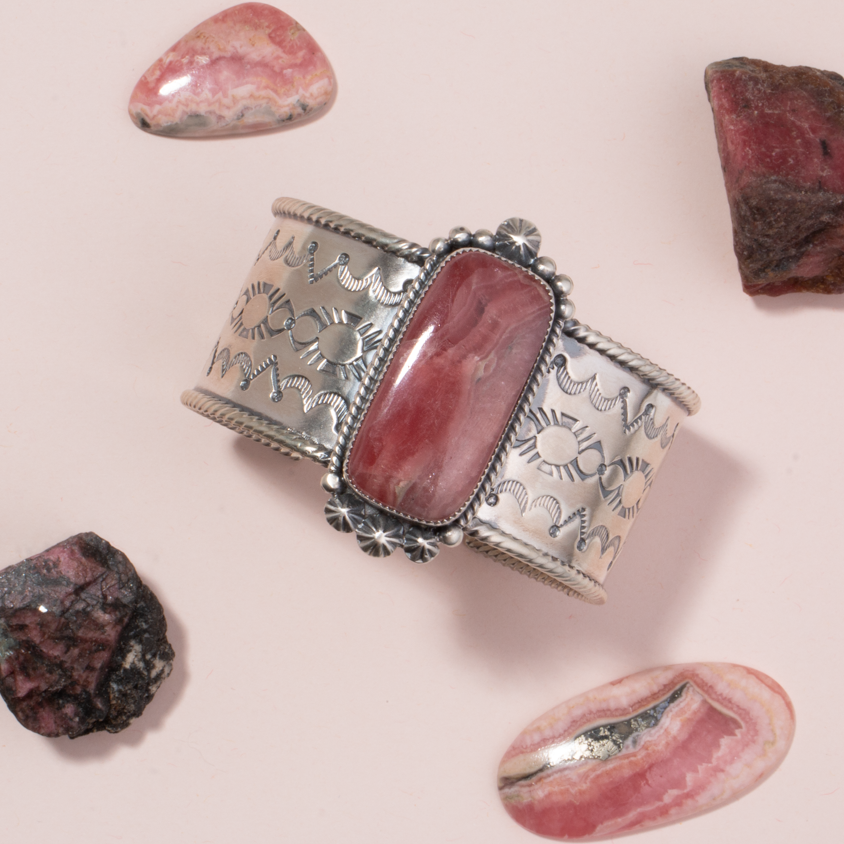
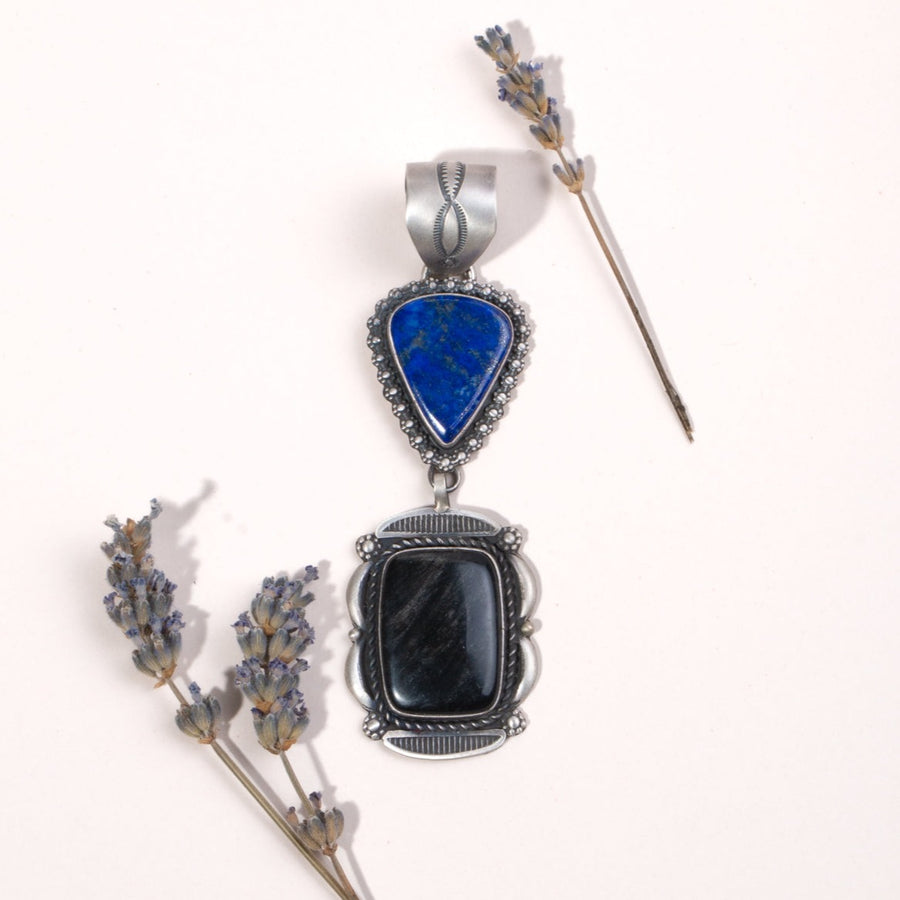
Overlay is a living technique. These contemporary pieces from the T.Skies studio use the same two-layer, oxidized-background method — shown here as technique examples from our own bench, not as Hopi-made work unless individually attributed.


A note on accuracy. We strive for accuracy, and this page is continuously updated with new information from the artists, their families, and the community. Corrections and additions are welcome.
From the Library: Bedinger, Indian Silver (1973)
1973 primary source. Anything described as current here describes 1973, not today.
Bedinger (1973) dated the first organized push toward Hopi designs in silver to the Museum of Northern Arizona:
“In the fall of 1938 Mrs. Colton devised a scheme to induce the smiths to use their tribal designs.”
— Bedinger (1973), p. 160 [18]
According to Bedinger (1973, p. 160), the museum had its curator Virgil Hubert draw bracelets, brooches, necklaces and rings using overlay technique and Hopi designs taken from pottery and basketry. Each Hopi smith received one drawing and an order for a piece. The finished pieces were shown at the museum as models. The smiths Saufkie and Kabotie took notable interest and became leading artists, but she recorded that the craft in general languished until after World War II. [18]
Bedinger (1973, p. 160) noted that the first silver the Hopis made followed Zuni and Navajo work and could not be told apart from it. It showed none of the later, distinctly Hopi traits, and casting was rare. [18]
According to Bedinger (1973, p. 202), the Hopi renewal began in the summer of 1946, when the painter and Oraibi High School art teacher Fred Kabotie organized an exhibit of Hopi crafts at Shongopovi that impressed Willard B. Beatty, the Indian Service's Director of Education, who saw that the new G.I. Bill could fund silversmithing classes for Hopi veterans. [18]
According to Bedinger (1973, p. 202), the first class met in a Quonset hut from February 1947 with thirteen men, soon nineteen; Paul Saufkie taught technique, Fred Kabotie was Art Director and Business Manager, students learned on copper before silver, casting and overlay were both taught, and the class graduated in January 1949, followed at once by another. [18]
Writing in 1973, Bedinger recorded the Guild's founding mark:
“The graduates organized the Hopi Silvercraft Guild, Bert Puhuey Estewa, president, and selected the Hopi sun shield as their trademark.”
— Bedinger (1973), p. 202 [18]
According to Bedinger (1973, p. 203), individual Guild smiths identified their own work with a clan symbol such as a bird, pipe, butterfly, bear, tobacco leaf or cloud, and (p. 209) many Guild pieces carried a personal mark in addition to the sun shield, so a Guild piece can often be traced to its maker. [18]
Bedinger (1973) put the specialty plainly:
“Overlay is a Hopi specialty.”
— Bedinger (1973), p. 203 [18]
According to Bedinger (1973, p. 203), an overlay piece began with a silver sheet, often textured where it would show; from a second sheet of the same size and shape the smith cut an openwork design and soldered it on top (p. 204), then darkened the whole with a potassium sulfide solution and polished the top surfaces, leaving the recesses dark. [18]
Bedinger (1973) named the difference from appliqué:
“Appliqué does not give this contrast, which is one difference between the two.”
— Bedinger (1973), p. 204 [18]
According to Bedinger (1973, p. 204), hints of overlay go back to an 1884 observation of Pueblo smiths soldering relief designs onto bracelets, but contemporary overlay dated from 1938, when the Museum of Northern Arizona brought the technique to the attention of smiths and buyers, after which its use spread. [18]
Bedinger (1973) described the trait she saw as the Hopi hallmark:
“One prominent characteristic of Hopi patterns is asymmetrical (or occult) balance, which provides a startling contrast to the static centering of Navajo and Zuni creations.”
— Bedinger (1973), p. 206 [18]
According to Bedinger (1973, p. 207), Mimbres animal designs appeared in Hopi silver after 1950, and (p. 208) the naja was never used in Hopi work, and pomegranates were not seen. [18]
From the Library: Frank, Indian Silver Jewelry of the Southwest (1990)
1990 primary source. Anything described as current here describes 1990, not today.
Frank (1990, Fig. 166, p. 137) singled out a pre-overlay Hopi piece:
“Early Hopi Pueblo silver work is rare and this bracelet, shown in two views, is quite unique in its own right.”
— Frank (1990), p. 137 [19]
According to Frank (1990, p. 137), that bracelet of about 1900 carried a chisel-stamped and rocker-engraved wolf above a row of petroglyph-like men and women (the men marked by a feather), with a chisel-stamped tomahawk and rainclouds on the sides. [19]
From the Library: Turnbaugh, Indian Jewelry of the American Southwest (2007)
2007 primary source. Anything described as current here describes 2007, not today.
Turnbaugh (2007, p. 45, caption) illustrated Navajo (Diné) overlay jewelry in a "wedding basket design," ca. 1970-1985, made as bolo ties, rings, bracelets, earrings, pendants, buttons and squash blossom necklaces. Copper was combined with the silver overlay to make the red band of the wedding basket; the style sold widely to tourists in the 1970s and was popular again by the mid-1980s. [20]
William and Sarah Turnbaugh (Turnbaugh 2007) described the Hopi style's origins:
“Not until the 1930's did a distinctive Hopi tribal style begin to emerge, and it developed only with non-native encouragement.”
— Turnbaugh (2007), p. 61 [20]
They defined the technique (Turnbaugh 2007):
“In overlay, two sheets of silver are soldered together after cutting out designs in the top layer so that the under layer is visible.”
— Turnbaugh (2007), p. 62 [20]
As of the late 1980s, the Turnbaughs (Turnbaugh 2007) gave a way to tell Hopi overlay from others:
“Some Navajo and Rio Grande puebloan smiths also create silver overlay, but they generally use a plain, untextured black underlayer.”
— Turnbaugh (2007), p. 62 [20]
On finish, Turnbaugh (2007) noted:
“Hopi silversmiths often buff their finished jewelry pieces with steel wool which gives the silver a matte or satin finish.”
— Turnbaugh (2007), p. 62 [20]
Captioning Hopi overlay jewelry, Turnbaugh (2007, p. 61, caption) said the designs were taken from nature and from prehistoric and historic native pottery, basketry and textiles. [20]
Writing in the late 1980s, William and Sarah Turnbaugh (Turnbaugh 2007) warned buyers:
“The mechanized technique of spin-casting recently has been used to mass-produce less expensive imitations of Hopi silver overlay. Buyers should take care to distinguish the real, handmade overlay from machine-made look-alikes.”
— Turnbaugh (2007), p. 62 [20]
As of the late 1980s, Turnbaugh (2007) described the Guild:
“The Hopi Silvercraft Guild, founded in 1949, provides both a workshop and a commercial outlet for silversmiths, thus encouraging and supporting their artistic development.”
— Turnbaugh (2007), p. 62 [20]
Turnbaugh (2007) described a second pueblo overlay tradition at Santo Domingo (Kewa), where bird and flower designs from the pueblo's pottery had moved into silver early in the 20th century:
“In the early 1940's, some Santo Domingos began to create these designs in silver overlay also.”
— Turnbaugh (2007), p. 67 [20]
Turnbaugh (2007, p. 67, caption) illustrated a ca. 1970s sterling overlay "storyteller" ring by Santo Domingo (Kewa) silversmith Vidal Aragon, who began making overlay in the 1940s; its seasonal scene shows deer, trees and a mountain lion. [20]
As of the late 1980s, Turnbaugh (2007, p. 65, caption) noted that Taos Pueblo, New Mexico, produced a small amount of overlay jewelry. [20]
As of the late 1980s, the Turnbaughs (2007, p. 72) reported a shift at Hopi:
“Some Hopi silversmiths now create sandcast jewelry more frequently than overlay pieces.”
— Turnbaugh (2007), p. 72 [20]
Describing a Hopi overlay pin set with turquoise, ca. 1985, Turnbaugh (2007, p. 73, caption) noted:
“Few Hopi silversmiths use turquoise or other stones as accents in their jewelry. Instead, most prefer to work with the silver alone.”
— Turnbaugh (2007), p. 73 [20]
Describing three Hopi overlay pins, ca. 1985, Turnbaugh (2007, p. 85, caption) summarized the method:
“Hopi silversmiths have used tiny jigsaws to cut out the naturalistic and stylized designs in the top layer of silver. After blackening the surface of a second sheet of silver, they have soldered together the two silver layers.”
— Turnbaugh (2007), p. 85 [20]
And on the finish, Turnbaugh (2007, p. 85, caption):
“In Hopi overlay, the blackened background is textured with distinctive stampwork.”
— Turnbaugh (2007), p. 85 [20]
From the Library: Wright, Hopi Silver (2003)
2003 primary source. Anything described as current here describes 2003, not today.
In a letter of December 5, 1938 to Kenneth Chapman, quoted by Wright (2003), Mary-Russell Ferrell Colton set out the Museum of Northern Arizona's aim:
“There is only one way to make Hopi silversmithing worthwhile, it must be different from any other Indian silversmithing. They must produce Hopi silver, not Navajo, Pueblo, or Zuñi.”
— Wright (2003), p. 31 [21]
According to Wright (2003, p. 32), the museum's Virgil Hubert drew designs that called for filing, stamping, cut-out and appliqué, and found the basketry and pottery designs suited appliqué especially well. He told Wright in an interview that, contrary to some accounts, he did not make any of the designs up into jewelry himself. [21]
According to Wright (2003, p. 35), several smiths made acceptable pieces for the 1939 Hopi Craftsman Show, but the Indian Arts and Crafts Board's requirement of slug silver and hand-polished turquoise, with the silver hand-hammered to thickness and no sheet allowed, was a difficulty for full-time smiths and their employers. [21]
According to Wright (2003, p. 36), Paul Saufkie made several of the suggested designs very successfully, Randall Honwisioma and Washington Talayumptewa also completed suitable pieces, and Morris Robinson had become interested by December 1941. [21]
According to Wright (2003, p. 38), the war left the museum short-handed and short of gasoline: it held a Hopi Craftsman Show in 1942 and then none until the summer of 1947, and for those five years the silver project could not continue. [21]
Wright (2003) described how overlay grew out of appliqué once the veterans' classes began working with the museum's designs:
“While this was used somewhat, soon "the piece that was left" became the design, originating the jewelry technique so widely used now and called "overlay."”
— Wright (2003), p. 40 [21]
Writing of overlay as it stood by her revised edition, Wright (2003) gave a dating clue:
“This overlay method has changed very little from past years, except for the present consistent use of matting in the design. In 1949 the matting was seldom done though texturing was used as a major part of the design.”
— Wright (2003), p. 42 [21]
According to Wright (2003, p. 43), pieces from the veterans' class were first sold at the Department of the Interior's Indian Craft Shop in Washington, D.C., in December 1948, and the first complete display was offered for sale at the museum's Hopi Craftsman Exhibit in July 1949. [21]
According to Wright (2003, p. 48), Hopicrafts, the Sekaquaptewa brothers' shop at Kykotsmovi, made texturing of the matte black background a basic part of the design from the beginning, generally following the pattern of the overlay, and gave the final polish with steel wool for a satin rather than a bright finish. Its designs also brought in Hohokam figures and animal and human figures in motion. [21]
According to Wright (2003, p. 48), some Hopicrafts pieces were not made by one smith but by several, each man performing one set operation, which caused hard feelings for a time. [21]
Wright (2003) described overlay as a change of medium rather than a new art:
“Hopi overlay silverwork is simply a transfer of these traditional artistic expressions to another medium, silver.”
— Wright (2003), p. 52 [21]
According to Wright (2003, p. 52), most Hopi silverwork was designed for its appearance rather than to tell a specific story: elements such as warrior marks, hair whorls, clouds and falling rain, feathers and whirlwinds were combined for a pleasing effect, and a smith might give a design a personal meaning. [21]
According to Wright (2003, p. 53), Hopi smiths also drew on prehistoric Mimbres designs, early Hohokam figures from central Arizona, petroglyphs from northern Arizona and, extensively, the designs on prehistoric Anasazi potsherds found near the villages; Katharine Bartlett of the Museum of Northern Arizona reported that in the 1950s the silver designs were so close to the sherds that the pottery type could be named. [21]
Wright (2003) drew the distinction that makes each overlay piece the smith's own composition:
“None of the many designs are traditional for use on silver as they are on basketry, weaving, and other crafts.”
— Wright (2003), p. 53 [21]
According to Wright (2003, p. 57), as of the 2003 edition few old-style concha belts were being made by Hopi silversmiths, who instead made belts from various kinds of medallions, and the bola tie had become a major Hopi form made for sale. [21]
According to Wright (2003, p. 61), about fifty years before her revised text a buyer of Hopi jewelry had two choices, 'Navajo style' or the first Hopi overlay made by returned World War II veterans; by the time of the 2003 edition there was overlay in many styles, gold work, stone and shell, and precious gems including diamonds and rubies. [21]
According to Wright (2003, p. 62), Charles Loloma and Preston Monongye set an example of 'new Indian' or 'new Hopi' jewelry that freed younger smiths from the strictures of a traditional craft while remaining inherently Hopi. [21]
Of the Hopi Silvercraft Guild's sun stamp, Wright (2003) observed:
“Each smith has his own Guild stamp. Consequently, none are exactly alike, as is shown in the few illustrated here.”
— Wright (2003), p. 113 [21]
According to Wright (2003, p. 113), Hopicrafts, the Hopi silver shop owned by Wayne and Emory Sekaquaptewa, began in Phoenix under the name Hopi Enterprises before its workshop moved to Kykotsmovi; its mark was listed from 1962 to 1983. [21]
Wright (2003, p. 113) listed Kopavi International of Sedona, a non-Indian-owned business begun in 1976 that commissioned Hopi silversmiths to make silver and gold jewelry of their own design and to the owner's suggestions, and that used a bell mark on pieces made during the 1976 Bicentennial. [21]
According to Wright (2003, p. 113), shop marks also appeared on Hopi work from Honani Crafts, a Second Mesa shop at the Winslow crossroads that employed several smiths in 1988, and from Shades of the West, a Scottsdale shop that put its mark on jewelry made by Indian craftsmen in its shop. [21]
Wright (2003, p. 113) also listed a Charles Loloma Studio mark, from 1996, used on reproductions of Charles Loloma's work. [21]
A mark can also date a piece: according to Wright (2003, p. 101), Lucion Koinva lost his rattle mark and began using his initials in 1995. [21]
According to Wright (2003, p. 114), the book closes with an Index of Hallmarks by Type that sorts Hopi marks by the picture they show, starting with animals and animal tracks, and gives the listing page for each smith's row. [21]
Wright (2003, p. 120) gives letter marks their own Initials section, which runs from p. 120 to p. 123 of the index. [21]
According to Wright (2003, p. 133), matting is both the black background of Hopi overlay silver and the process of texturing that background with a small chisel or die, and the design is traced onto the overlay piece from a cut-out metal pattern, the template. [21]
According to Wright (2003, p. 78), many of the men who began silverwork in the 1948 G.I. Bill classes did very little afterwards, and the listing gives about 1951 as the end of work for several of them. [21]
According to Wright (2003, p. 81), Willard Nuvayaouma gave his first cousin Vernon Mansfield his tools and mark to use about 1967, because Vernon had lost his own mark, and Vernon started using a new one in 1970. [21]
According to Wright (2003, p. 82), Patrick Lomawaima lost his Snowflake mark of 1965 and began using a Cloud mark in 1967, and Gracilda Saufkie broke her first mark in 1971 and used a new one from 1972. [21]
From the Library: Bassman, The Beauty of Hopi Jewelry (1993)
1993 primary source. Anything described as current here describes 1993, not today.
Writing in 1993, Bassman described how Hopi overlay was made:
“It is made by cutting a design out of one piece of silver and soldering it onto a plain sheet of silver. The design is then oxidized with liver of sulfate to produce beautiful shadows and shading.”
— Bassman (1993), p. 1 [22]
Schiffer (1996, p. 11) also described the two layers: “In this style, silver sheets with cut-out designs are overlaid on separate silver sheets with chemically darkened surfaces below the cut-outs.” [25]
According to Bassman (1993, p. 1), Hopi jewelry at first resembled Navajo jewelry; in 1947 Paul Saufkie and Fred Kabotie persuaded the federal government to fund programs training Hopi veterans of World War II to make overlay jewelry. [22]
As of 1993, Bassman (1993, p. 2) reported that gold and precious and semiprecious stones were becoming more common, but that most Hopi jewelry was still all sterling silver, and that the number of women jewelry makers was growing although most silversmiths were still men. [22]
Under the heading 'Something Different,' Bassman (1993, p. 38) pictured Hopi work outside flat overlay: cast bracelets made in 1991 by Raymond Sequaptewa and Robert Lomadapki, and 1984 earrings set in cherrywood by Marvin Lomahaftewa and in cottonwood by Marcus Lomayestewa. [22]
Bassman (1993, p. 48) gave Hopi gold work its own section of plates, headed '14-Carat Gold on Silver and 18-Carat Gold,' with pieces dated 1990 to 1992 by makers including Watson Honanie, Victor Coochwytewa, John Coochyumptewa, Andrew Saufkie, Jason Takala and Sonwai. [22]
Describing two 1991 reversible pendants by John Coochyumptewa, Bassman (1993, p. 50) noted a gold moon over a village scene and, on a bear-paw side, gold set on the pad of the paw. [22]
From the Library: Stacey, Turquoise Blue Book and Indian Jewelry Digest (1975)
1975 primary source. Anything described as current here describes 1975, not today.
Jerry D. Jacka, writing in the 1975 Turquoise Blue Book:
“Around 1938, due to encouragement - primarily by the Museum of Northern Arizona, the Hopi began to develop a style of their own. This was done by combining pottery designs with the overlay process.”
— Stacey (1975), p. 79 [23]
Jacka (1975) on how it is made:
“This type of jewelry is produced by "sweating" or soldering, two pieces of silver together. The top piece contains a design element which is meticulously cut out of silver.”
— Stacey (1975), p. 79 [23]
From the Library: Jacka, Navajo Jewelry: A Legacy of Silver and Stone (1995)
1995 primary source. Anything described as current here describes 1995, not today.
Lois Essary Jacka, writing in 1995:
“Although the overlay technique was originated in the late 1930s by Hopi silversmiths Paul Saufkie and Fred Kabotie, many Navajos today have become very skilled at this method.”
— Jacka (1995), p. 70 [24]
From the Library: Schiffer, Indian Jewelry on the Market (1996)
1996 primary source. Anything described as current here describes 1996, not today.
As of 1996, Schiffer (1996, p. 11) reported that Hopi silver jewelry was made in smaller quantities than Navajo or Zuni work. [25]
Schiffer (1996) traced one familiar overlay figure to rock art:
“A figure of an old man with a flute or a cane known as Kokopelli derives from ancient rock drawings (petroglyphs).”
— Schiffer (1996), p. 11 [25]
From the Library: Adair, The Navajo and Pueblo Silversmiths (1944)
1944 primary source. Anything described as current here describes 1944, not today.
Before overlay, Adair (1944) traced Hopi silver to one man:
“The first Hopi to learn the craft of silversmithing was a man by the name of Sikyatala, who lived at Sichomovi, on First Mesa.”
— Adair (1944), p. 173 [26]
According to Adair (1944, p. 176), in the late 1930s there were about twelve Hopi smiths on the reservation (three at Moenkopi, five at Hotevilla, one at Bakavi, two at Shongopovi and one at Sichomovi), and none lived by the craft: they worked part time in winter, when there was no work in the fields. [26]
Writing of Hopi silver as it stood about 1938 to 1940, Adair (1944) found one design of its own:
“There is only one design element that distinguishes Hopi-made silver from that made by these neighboring tribes. That design is the butterfly, which is frequently seen on rings, bracelets, and bow-guards.”
— Adair (1944), p. 177 [26]
According to Adair (1944, p. 177), the butterfly was usually formed of turquoise and coral cut to shape for the wings and body and set on the silver. [26]
From the Library: Lund, Indian Jewelry: Fact and Fantasy (1976)
1976 primary source. Anything described as current here describes 1976, not today.
As of 1976, Lund (1976) expected Hopi overlay to be the next style in demand, and warned:
“Already there are Mexican copies of the distinctive Overlay designs, and the buyer would be wise to acquaint himself with Hopi silverwork before it, too, moves to the crest of the mania wave.”
— Lund (1976), p. 73 [27]
From the Library: Baxter, Encyclopedia of Native American Jewelry (2000)
2000 primary source. Anything described as current here describes 2000, not today.
Baxter (2000) on the result of the Hopi Silver Project:
“The resultant product was a cleanly wrought silver piece, known as Hopi overlay, which was considered “modern” in its neat, simplified lines.”
— Baxter (2000), p. 72 [28]
Baxter (2000) on how far it spread:
“By the late 1950s, the Hopi overlay style had become part of the jewelry-making repertoire of most Indian school arts programs.”
— Baxter (2000), p. 72 [28]
Baxter (2000) traced how the method spread beyond Hopi:
“The overlay technique began to be demonstrated in arts courses at Indian schools by the late 1950s.”
— Baxter (2000), p. 127 [28]
Writing in 2000, Baxter observed:
“While still strongly associated with Hopi jewelry design, this technique is widely popular with native jewelry-makers of all backgrounds, including Navajo artists.”
— Baxter (2000), p. 127 [28]
Field Notes by Mateo James
Bedinger describes the first Hopi silver as indistinguishable from Zuni and Navajo work. Frank, writing a few years later, shows one Hopi bracelet of about 1900 with pictorial designs that he called unique. The two may not disagree: Bedinger speaks of the general run of early work and Frank of a rare exception, so I show both.
Bedinger has Virgil Hubert drawing the 1938 museum designs in overlay, and dates contemporary overlay to 1938. Wright lists his designs as filing, stamping, cut-out and appliqué, and has overlay taking shape later, when the piece left over after cutting became the design. Both tie the technique to the museum's project; they differ on whether the 1938 designs were already overlay, so I show both.
I notice Lois Essary Jacka, writing in 1995, credited the origin of overlay in the late 1930s to Paul Saufkie and Fred Kabotie themselves, while Bedinger (1973) and Wright (2003) above tie its 1938 beginning to the Museum of Northern Arizona's effort, with the two men recorded as teachers of the later veterans' classes. I have set her account beside theirs.
I notice a small difference here. Bedinger (1973) says the first Hopi silver could not be told apart from Zuni and Navajo work, while Adair (1944, p. 177), writing from his own late-1930s fieldwork, agrees that Hopi silver followed Navajo and Zuni patterns but names one design that set it apart, a butterfly of cut turquoise and coral. Bedinger may mean the earliest pieces and Adair the silver of his own day, so I show both.
Sources
- Pardue, Contemporary Southwestern Jewelry, p. 30
- Baxter, Encyclopedia of Native American Jewelry, p. 143
- Encyclopedia, p. 143
- Hougart, Native American and Southwestern Silver Hallmarks (5th ed.), p. 227
- Hougart 5e, p. 396
- Encyclopedia, pp. 143, 150
- Tanner & Koonce, Ray Manley's Portraits and Turquoise of Southwest Indians, p. 75
- Hougart 5e, p. 70
- Wright, Hopi Silver, p. 57
- Wright, p. 53
- Wright, p. 36
- Wright, pp. 89, 93–94
- Manley, p. 80; Bedinger, Indian Silver, p. 207
- Wright, p. 68; Pardue, p. 30
- Hougart 5e, p. 365
- Hougart 5e, p. 151
- Hougart 5e, pp. 47, 100
- Bedinger, Margery. Indian Silver: Navajo and Pueblo Jewelers. Albuquerque: University of New Mexico Press, 1973. Cited by printed page. Statements describe conditions as of 1973.
- Frank, Larry, with the assistance of Millard J. Holbrook II. Indian Silver Jewelry of the Southwest, 1868-1930. Atglen, PA: Schiffer Publishing, 1990. First published 1978 by New York Graphic Society. Cited by printed page. Statements describe conditions as of 1990.
- Turnbaugh, William A., and Sarah Peabody Turnbaugh. Indian Jewelry of the American Southwest. Foreword by Barry M. Goldwater. Atglen, PA: Schiffer Publishing, 2007 (copyright 1996 and 2007; first published 1988). ISBN 0-7643-2577-9. Cited by printed page. Statements describe conditions as of 2007.
- Wright, Margaret Nickelson. Hopi Silver: The History and Hallmarks of Hopi Silversmithing. Revised edition. Albuquerque: University of New Mexico Press, 2003. Originally published by Northland Publishing. Cited by printed page. Statements describe conditions as of 2003.
- Bassman, Theda. The Beauty of Hopi Jewelry. Photography by Gene Balzer. Walnut, California: Kiva Publishing, 1993. Cited by printed page. Statements describe conditions as of 1993.
- Stacey, Joseph, ed. Turquoise Blue Book and Indian Jewelry Digest. Arizona Highways Collectors Series. Phoenix: Arizona Highways (Arizona Department of Transportation), 1975. Cited by printed page. Statements describe conditions as of 1975.
- Jacka, Lois Essary. Navajo Jewelry: A Legacy of Silver and Stone. Photographs by Jerry Jacka. Flagstaff: Northland Publishing, 1995. Cited by printed page. Statements describe conditions as of 1995.
- Schiffer, Peter N. Indian Jewelry on the Market. Text and photography by Peter N. Schiffer. Atglen, PA: Schiffer Publishing Ltd., 1996. Cited by printed page. Statements describe conditions as of 1996.
- Adair, John. The Navajo and Pueblo Silversmiths. The Civilization of the American Indian Series. Norman: University of Oklahoma Press, 1944. Cited by printed page. Statements describe conditions as of 1944.
- Lund, Marsha Mayer. Indian Jewelry: Fact and Fantasy. Boulder, CO: Paladin Press, 1976. Cited by printed page. Statements describe conditions as of 1976.
- Baxter, Paula A., with Allison Bird-Romero. Encyclopedia of Native American Jewelry: A Guide to History, People, and Terms. Phoenix: Oryx Press, 2000. Cited by printed page. Statements describe conditions as of 2000.