



Navajo, Zuni & Hopi Jewelry — How to Tell the Three Styles Apart
The short answer, up top: Navajo, Zuni, and Hopi are three distinct Native nations with three distinct signature techniques, and once you know the signature you can usually tell them at a glance:
- Navajo (Diné) — the silver is the statement: bold silverwork, stamping, and big single stones.
- Zuni — the stone is the statement: masters of lapidary, known for fine inlay and needlepoint/petit-point clusters.
- Hopi — the overlay is the statement: two layers of silver, the design standing out bright against a dark recessed background.
These are living traditions, not styles anyone can claim — each belongs to its own people. Here’s how to recognize each, respectfully and accurately.
Navajo (Diné) — silver-forward
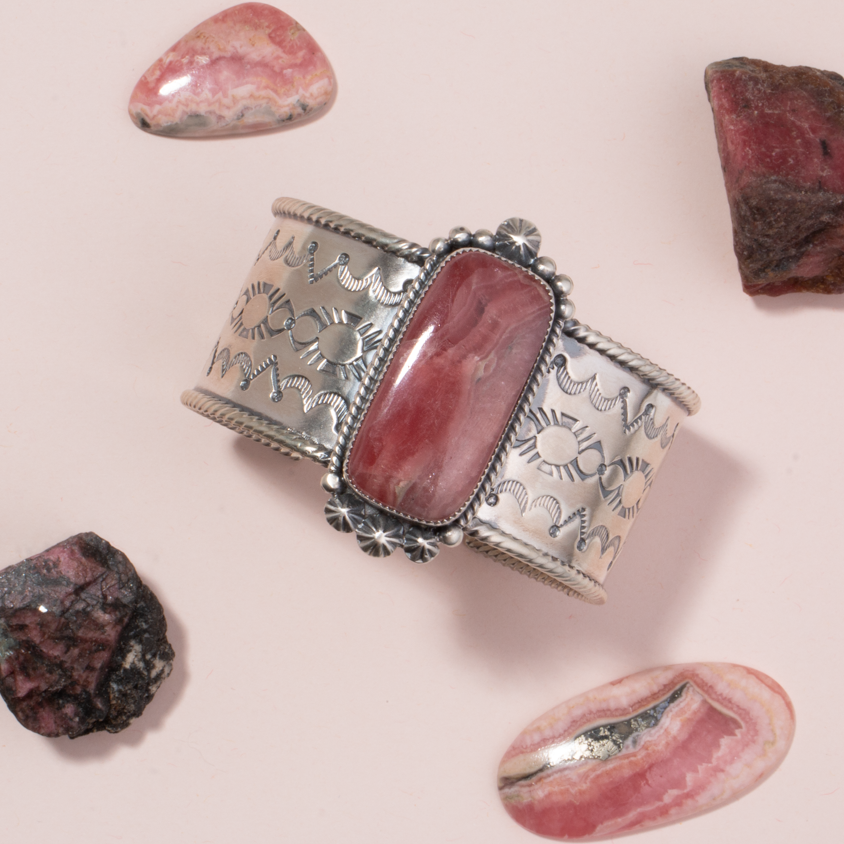
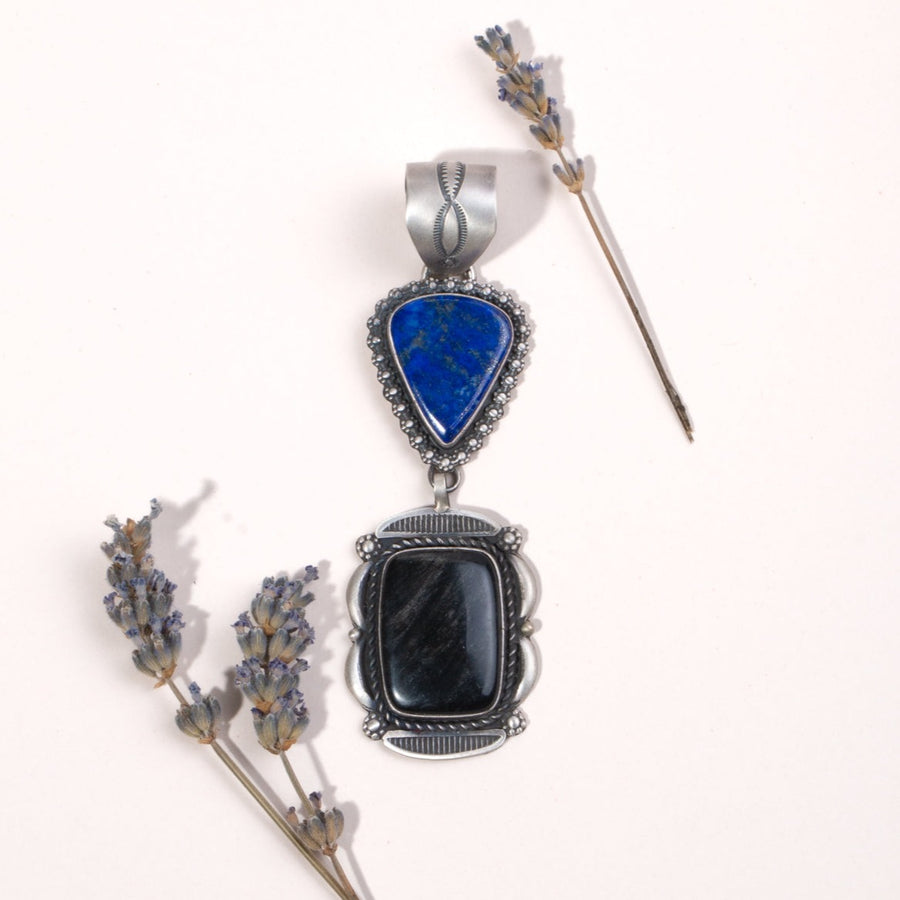
Navajo silversmiths are the source of much of what people picture as “Southwestern jewelry.” The hallmark is the silver itself: heavy-gauge sterling, deep hand-stamping and repoussé, sandcast and tufa-cast forms (molten silver poured into a carved stone mold), and large single turquoise stones in clean bezels — the stone framed by the silver rather than crowded by it. The squash blossom necklace with its crescent naja, and the concho belt, are classic Navajo forms. If the piece leads with bold, sculptural silver and one commanding stone, think Navajo.
Zuni — stone-forward, lapidary masters
Zuni artists are the lapidary masters of the Southwest — the stonework is the point, and the silver is mostly a setting for it. Two signatures to know:
- Inlay — stones (turquoise, coral, jet, shell) cut to fit precisely together into a mosaic or channel pattern, flush and smooth.
- Needlepoint & petit point — many small stones cut into shapes (thin pointed slivers for needlepoint, tiny teardrops for petit point) and set in intricate clusters, often radiating like a flower or setting sun.
Zuni artists are also known for fetish carving. If the piece is defined by many precisely-cut stones in fine, patient arrangements, think Zuni.
Hopi — silver overlay
The Hopi signature is overlay, and it’s unmistakable once you’ve seen it. The smith cuts a design out of one sheet of silver and solders it over a second solid sheet; the bottom layer is then oxidized dark and often textured, so the top design reads bright silver against a black recessed background. The motifs are frequently geometric or drawn from Hopi visual tradition. If the piece is two-tone silver — a raised bright design over a dark carved-out ground, with little or no stone — think Hopi overlay.
A quick side-by-side
| Signature | Look for | |
|---|---|---|
| Navajo (Diné) | Silverwork | Bold stamped/cast silver, one large stone, squash blossoms, conchos |
| Zuni | Lapidary | Fine inlay; needlepoint/petit-point stone clusters; fetishes |
| Hopi | Overlay | Bright cut design over a dark recessed silver ground; little/no stone |
These are the classic signatures — but all three are living, evolving traditions, not museum pieces. Individual artists cross and combine techniques, and contemporary makers create innovative work that may look nothing like the traditional forms. A style tells you a tradition; only a maker’s mark and a named artist tell you who actually made a piece — and under the Indian Arts and Crafts Act, that documentation (not the style) is what verifies a genuine Native-made work.
Frequently asked
What is the main difference between Navajo and Zuni jewelry? Navajo work is silver-forward — bold silverwork and large single stones. Zuni work is stone-forward — fine lapidary, inlay, and needlepoint/petit-point clusters where the stonework is the focus.
How do I recognize Hopi jewelry? By the overlay technique: a bright cut-silver design raised over a dark, recessed, textured silver background — usually geometric, usually little or no stone.
Are Navajo, Zuni, and Hopi the same thing as “Native American jewelry”? No — they’re three distinct nations with distinct traditions (and there are many more). “Native American jewelry” is an umbrella; the specific nation and artist are what actually matter.
How can I be sure of the artist and nation? Look for a maker’s hallmark, and buy from a seller who names the artist and their nation. A documented, named source is the real proof.
A style will get you close; a name gets you certain. To verify a genuine Native-made piece, look for a maker’s hallmark and a seller who names the artist and their nation — that documentation, not the style, is what confirms it. (You can see how that documentation works in our silversmith directory and hallmark guide, or go deeper in the Reference Shelf.)
Ready to shop? Browse our full collection of turquoise jewelry. Pieces by named artists name the maker on the listing; our house designs are Southwest-inspired.
From the T.Skies Journal
From the Library: Frank, Indian Silver Jewelry of the Southwest (1990)
1990 primary source. Anything described as current here describes 1990, not today.
Frank (1990, Fig. 235, p. 187) warned how hard the earliest pieces are to sort:
“It is difficult to identify early Zuni Pueblo silverwork since it hardly differs from the Navajo work of the same period.”
— Frank (1990), p. 187 [1]
According to Frank (1990, p. 187, Fig. 235), a bracelet of seventeen green turquoise stones, circa 1900, collected in 1934 near Tohatchi on the Navajo Reservation, might be early Zuni: crude by later Zuni standards but, next to Navajo work of its time, lighter and freer, which he called the trademark of Zuni silverwork. [1]
According to Frank (1990, p. 155, Fig. 189), cutout stepped cloud shapes on a ketoh of circa 1910 pointed to a Pueblo origin. [1]
From the Library: Turnbaugh, Indian Jewelry of the American Southwest (2007)
2007 primary source. Anything described as current here describes 2007, not today.
Turnbaugh (2007) summed up the Navajo (Diné) approach:
“Navajo silversmiths always have emphasized bold, simple silver jewelry and have used turquoise, coral, or other materials as accents for the silver.”
— Turnbaugh (2007), p. 43 [2]
As of the late 1980s, Turnbaugh (2007, p. 46) reported that Navajo (Diné) smiths had recently begun borrowing methods from other tribes, including silver overlay, mosaic stone inlay and stone channelwork, used alone or with more typically Navajo techniques, and that such pieces still kept a characteristic Navajo look. [2]
From the Library: Wright, Hopi Silver (2003)
2003 primary source. Anything described as current here describes 2003, not today.
According to Wright (2003, p. 1), before contact with Europeans the Hopis did no metalwork; their jewelry was made from bone, wood, shell, colored stones including turquoise, and seeds. [3]
Wright (2003) on when Hopi men began making silver themselves:
“The Zuni and Navajo jewelry was used exclusively until close to the 1900s, when a small amount of silver jewelry was crafted by Hopi men.”
— Wright (2003), p. 4 [3]
Wright (2003) on why so little early Hopi silver is recognised:
“Part of the apparent lack of early Hopi jewelry lies in the fact that it was not distinct in style from the Navajo and so was considered as Navajo once it was removed in distance from its maker.”
— Wright (2003), p. 24 [3]
According to Wright (2003, p. 25), from the pre-1940 silver known to be Hopi she believed some Hopi smiths were excellent and made proportionately as many large pieces (bow guards, concha belts and necklaces) as Navajo smiths, though there is little sign they made saddle and bridle silver; their concha belts resembled Navajo belts of the time. [3]
According to Wright (2003, p. 24), another reason silver long stayed a minor Hopi craft was competition from other work: most Hopi men did some weaving in their spare hours, while Navajo men had no such craft competing with silverwork. [3]
On two brothers with the same initials, Wright (2003) warned of Mitchell Sockyma:
“His mark varies in the relative position of the two initials in comparison with his brother Michael's identical initials.”
— Wright (2003), p. 86 [3]
Distinguishing a Lomayestewa star-and-moon mark from an older one, Wright (2003) noted:
“Billie Ray's hallmark always had the moon underneath the star.”
— Wright (2003), p. 95 [3]
According to Wright (2003, p. 85), Dalton Taylor used the moon from Billie Rae Hawee's mark on a few pieces in 1973, so a mark element can appear on another smith's work. [3]
Wright (2003, p. 88) records that Anthony Honahnie owned the coyote stamp of Dewan Sumatskuku but did not use it. [3]
According to Wright (2003, p. 96), Shannon Lamson was using his brother's mark by 1989, and Wright (2003, p. 84) notes that one of Steven Sockyma's marks was used only on special orders. [3]
Wright (2003) dated when Hopi marking took hold:
“Hallmarks became widely used on Hopi silver during the veterans' classes in 1949.”
— Wright (2003), p. 69 [3]
According to Wright (2003, p. 69), a few older Hopi smiths marked their silver in the 1930s, Mrs. Colton of the Museum of Northern Arizona urged them to do so in her letter of 1939, and in 1938 the Indian Arts and Crafts Board authorized a 'U.S. Hopi' stamp, though Wright doubted many items were marked with it. [3]
According to Wright (2003, p. 69), silver made under Hopi Silvercraft Guild auspices carried the Guild's sun symbol as well as the smith's own mark, but because a smith might also make and sell silver on his own while working for the Guild, pieces from the same period can carry both marks or the smith's mark alone. [3]
According to Wright (2003, p. 69), Hopicrafts workers at first marked their silver with the firm's symbol only, apart from a few special pieces; later some smiths regularly stamped their own initials on Hopicrafts pieces as well. [3]
Wright (2003) explained what most Hopi marks are:
“In the majority of instances, the marks used by the silversmiths are symbols of their clans.”
— Wright (2003), p. 69 [3]
According to Wright (2003, p. 71), because related clans 'go together,' a symbol from any clan in the group could serve as a smith's own clan symbol; in at least one case a father's clan symbol was used, other smiths picked a mark for no obvious reason, and a mark could be reused: Vernon Mansfield used Willard Nuvayauoma's feather mark, but doubled it. [3]
According to Wright (2003, p. 72), many early Hopi smiths have no recorded hallmark because the practice did not begin until the 1930s, and (p. 72) many smiths were known by several names, so one maker may appear under more than one name. [3]
According to Wright (2003, p. 73), a smith's listing may name several villages because a Hopi man customarily moved to his wife's village when he married. [3]
Wright (2003) cautioned readers of her hallmark list:
“Simply because a person is listed does not mean that he is, or was, a professional silversmith.”
— Wright (2003), p. 71 [3]
From the Library: Bassman, The Beauty of Hopi Jewelry (1993)
1993 primary source. Anything described as current here describes 1993, not today.
Writing in 1993, Bassman traced Hopi style back to its neighbours:
“Originally Hopi jewelry resembled the jewelry of the Navajo Indians.”
— Bassman (1993), p. 1 [4]
According to Bassman (1993, p. 2), silversmiths began using hallmarks in the 1930s, identifying themselves by name, by initials or by a distinctive design; as of 1993 she reported that every authentic piece of Hopi overlay bore its maker's hallmark. [4]
From the Library: Bassman, The Beauty of Navajo Jewelry (1997)
1997 primary source. Anything described as current here describes 1997, not today.
Writing in 1997, Bassman named the Navajo signature:
“One of the hallmarks of Navajo jewelry is the extensive use of turquoise.”
— Bassman (1997), p. 6 [5]
Bassman (1997, p. 6) also wrote that the Navajos borrowed ideas from other tribes and worked them into a uniquely Navajo pattern and design. [5]
From the Library: Manley, Collecting Southwestern Indian Arts & Crafts (1979)
1979 primary source. Anything described as current here describes 1979, not today.
Clara Lee Tanner, writing in Ray Manley's 1979 Collecting Southwestern Indian Arts & Crafts, traced Zuñi silver styles to an older stone tradition:
“Virtually the Zuñis have buried themselves in silvercrafting, producing distinctive styles which have grown out of their prehistoric, inherited lapidary.”
— Manley (1979), p. 39 [6]
And on what jewelry meant to the Zuñi economy, as of 1979:
“However, jewelry has been the chief source of cash income for most Zuñis, particularly since about 1940.”
— Manley (1979), p. 39 [6]
From the Library: Jacka, Navajo Jewelry: A Legacy of Silver and Stone (1995)
1995 primary source. Anything described as current here describes 1995, not today.
According to Jacka (1995, p. 33), the Zunis learned silversmithing from the Navajos around 1872 and the Hopis learned from the Zunis in the later 1800s, yet each nation developed styles and skills of its own. [7]
Jacka (1995) on what each became known for after World War II:
“The Zunis were noted for their lapidary work—mosaic, inlay, needlepoint—as well as carved fetishes; the Hopis for overlay; and the Navajos for massive pieces, symmetrical and simple, set with large stones.”
— Jacka (1995), p. 33 [7]
Schiffer (1996, p. 5) also pictured three watch bands that “demonstrate the primary style differences in Southwest Indian jewelry”: the Navajo band “has two large green turquoise stones set on each side of elaborate applique silver work,” the Hopi overlay band “has strong design elements worked in silver alone,” and the Zuni band “has small needlepoint coral set in silver.” [8]
From the Library: Schiffer, Indian Jewelry on the Market (1996)
1996 primary source. Anything described as current here describes 1996, not today.
In 1996 Schiffer pictured Hopi pieces offered for sale without marks:
“A Hopi necklace by Sonny G. and unmarked earrings and two belt buckles, also unmarked.”
— Schiffer (1996), p. 14 [8]
From the Library: Adair, The Navajo and Pueblo Silversmiths (1944)
1944 primary source. Anything described as current here describes 1944, not today.
Adair (1944) quoted Lieutenant Bourke, who visited Zuni in 1881:
“Their finger rings are of silver and their earrings and bangles of the same material cannot be distinguished from those made by the Navajoes.”
— Adair (1944), p. 127 [9]
According to Adair (1944, p. 127), the belief among traders, curio dealers and Southwestern residents that the Zuni learned silversmithing from the Mexicans confused influence and later development with origin. [9]
As of 1944, Adair (1944) described Zuni work of the late 1930s:
“Zuñi jewelry is light in weight, and the silver serves merely as a plastic base to hold the many turquoise sets in position. Sometimes the thin silver of the pieces made for the tourist trade will crack, or the stones will work loose from the bezels.”
— Adair (1944), p. 143 [9]
According to Adair (1944, p. 146), when the Zuni smith Okweene Neese set two turquoise in a plain Navajo buckle he had traded for, because he thought it would look better with stones, it was a good illustration of the Zuni opinion of unset Navajo silver. [9]
In the late 1930s, Adair (1944) found the taste ran the other way too:
“The Navajo like Zuñi-made silver, with its many sets, and they place a high value on it when the jewelry is as well made as that of Okweene.”
— Adair (1944), p. 146 [9]
Writing in 1944 from fieldwork at Zuni, Adair cautioned that the differences hold only for the work as a whole:
“But it is impossible to say with any degree of accuracy that a particular piece of silver was made at Zuñi. One reason for this is that the Navajo in recent years have copied Zuñi patterns in jewelry, and the traders at Zuñi have encouraged certain smiths there to make silver in Navajo style.”
— Adair (1944), p. 151 [9]
According to Adair (1944, p. 151), the first thing to weigh was the turquoise: Zuni smiths of his day rarely made a piece with no sets, and seldom one with only a few. Next came weight, since the silver both tribes made for their own wear ran heavier on the Navajo side, though tourist silver from both was much lighter; third was die-work, found on nearly every Navajo piece and almost as rare on Zuni silver. [9]
Adair (1944) put the difference down to what each people valued in the metal:
“Silver to the Zuñi is primarily a plastic material in which turquoise may be held; silver in itself does not possess the beauty that it does in the eyes of their Navajo neighbors.”
— Adair (1944), p. 151 [9]
According to Adair (1944, p. 152), piece by piece the Navajo concha of his day was larger, heavier and die-marked, the Zuni concha smaller and often set with many stones; Navajo bow-guards were usually stone-cast, Zuni ones a single hammered piece with many sets; and a Navajo ring was simple where a Zuni ring was complicated, with small twists of wire around the bezel. [9]
Writing in 1944, Adair explained why the makers of imitation Indian silver had copied Navajo work but not Zuni work:
“Zuñi silver can not be produced as cheaply as Navajo silver because the labor cost of production is higher and because Zuñi jewelry, with its many small sets, can not be turned out with machinery as easily as Navajo die-marked jewelry.”
— Adair (1944), p. 171 [9]
Adair (1944, p. 171) added that although turquoise could already be ground and polished by machine, the stones still had to be set by hand, and a bracelet with many sets took about twice as long as a Navajo bracelet with no sets or a few large ones. [9]
According to Adair (1944, p. 165), around 1940 Zuni smiths charged fellow Zuni less than they charged the traders, while Navajo smiths charged members of their own tribe, even relatives, more than they charged the traders. [9]
Adair (1944) also recorded who bought Zuni work in the late 1930s besides the traders:
“The smiths also make silver for the other Pueblo Indians and for the Navajo, who place a premium on good Zuñi silver.”
— Adair (1944), p. 165 [9]
According to Adair (1944, p. 166), in 1937-38 sixty Zuni smiths, nine of them women, made jewelry for the traders in the village, and counting part-time smiths, former smiths and those in the outlying farming villages he estimated about one hundred in all, roughly one smith for every sixteen Zuni men. [9]
Adair (1944) warned that style labels had misled even museums:
“In many museums which have collections of old silver, the Hopi and Rio Grande pueblo silver, as well as that which was made at Laguna and Acoma, is all lumped together and called Zuñi, if the pieces are rather fancy, with many sets. If the pieces are plain in design, they are labelled Navajo, irrespective of where they were made.”
— Adair (1944), p. 172 [9]
Of the Rio Grande and western pueblos, Adair (1944) concluded:
“Because of the diffusion of design, it is impossible to tell in which pueblo a particular piece of silver was made.”
— Adair (1944), p. 182 [9]
According to Adair (1944, p. 193), Navajo smiths first set turquoise in silver about 1880, and dies bearing designs were first made about 1885. [9]
According to Adair (1944, p. 193), Zuñi men were making objects of copper and brass wire about 1835; the Zuñi learned silver in 1872, when Lanyade learned from the Navajo smith Atsidi Chon; Zuñi smiths first set turquoise in silver about 1890; and commercial Zuñi silver began about 1920. [9]
According to Adair (1944, p. 193), the Hopi took up silver in 1898, when Sikyatala of First Mesa learned from Lanyade. [9]
From the Library: Lund, Indian Jewelry: Fact and Fantasy (1976)
1976 primary source. Anything described as current here describes 1976, not today.
Lund (1976) on why Zuni work shows so little bare silver:
“It is totally against the Zuni design nature to leave a surface of silver "undressed" — and undressed in their vernacular is any piece of jewelry in which the silver draws as much or more attention than the setting.”
— Lund (1976), p. 71 [10]
Lund (1976, p. 112) cautioned that weight could help judge quality only in Navajo-style work and could not be used to judge Zuni-style jewelry at all. [10]
Lund (1976) summed up the Navajo side:
“Commercial Navajo-style silver has always been flimsy. Fine Navajo silver is heavy.”
— Lund (1976), p. 113 [10]
From the Library: Matthews, Navajo Silversmiths (1883)
1883 primary source. Anything described as current here describes 1883, not today.
Writing in 1883, Matthews compared the Navajo and Pueblo smiths of his day:
“The appliances and processes of the smith are much the same among the Navajos as among the Pueblo Indians. But the Pueblo artisan, living in a spacious house, builds a permanent forge on a frame at such a height that he can work standing, while his less fortunate Navajo confrere, dwelling in a low hut or shelter, which he may abandon any day, constructs a temporary forge on the ground in the manner hereafter described.”
— Matthews (1883), p. 171 [11]
From the Library: Tryk, Santa Fe Indian Market (1993)
1993 primary source. Anything described as current here describes 1993, not today.
Writing in 1993, Tryk traced the spread of silverwork:
“The Navajos taught the Zunis, and soon they and then the Hopis were also working with silver.”
— Tryk (1993), p. 66 [12]
In very general terms, Tryk (1993) wrote,
“the Zunis tended to emphasize the beauty of the turquoise and to keep the silver in the background.”
— Tryk (1993), p. 66 [12]
Tryk (1993) on the Hopi:
“The Hopis liked silver by itself, with geometric and stylized figure designs.”
— Tryk (1993), p. 66 [12]
And on the Navajo (Tryk, 1993):
“The Navajos favored balance in their jewelry and created handsome silver items, frequently set with large chunks of turquoise.”
— Tryk (1993), p. 66 [12]
Tryk (1993, p. 66) warned against pigeonholing Native American artists: even in the earliest days there were exceptions, and intertribal trade was common enough that a Navajo woman might wear a Navajo squash blossom necklace with Zuni and Hopi bracelets, Navajo and Zuni rings, and beads from Cochiti or Santo Domingo. [12]
Field Notes by Mateo James
Field Notes by Mateo James: John Adair, working from 1938 fieldwork, wrote that the Hopi made mostly small pieces, with a concha belt or bow guard only now and then. Wright, looking back at the pre-1940 silver known to be Hopi, believed they made as many large pieces for their numbers as Navajo smiths did. I show both readings.
Field Notes by Mateo James: This page says to look for a maker's hallmark, and for Hopi silver that advice comes with a date. Wright (2003, p. 69) puts the wide use of hallmarks on Hopi silver at the veterans' classes of 1949, with a few older smiths marking their work in the 1930s, so a Hopi piece made before then may carry no mark at all. Our hallmark guide gives the late 1970s as the point when signing became common among Native jewelers generally. That date may fit other nations' work better, so I show both rather than pick one.
I noticed two of our books pulling in different directions here. Bassman (1993, p. 2) reported that every authentic piece of Hopi overlay bore its maker’s hallmark, while three years later Schiffer (1996, p. 14) pictured Hopi earrings and belt buckles offered for sale with no mark at all, and wrote (p. 5) that many fine pieces were never marked. Schiffer does not say who made those unmarked pieces, so I am setting the two accounts side by side rather than choosing between them.
Sources
- Frank, Larry, with the assistance of Millard J. Holbrook II. Indian Silver Jewelry of the Southwest, 1868-1930. Atglen, PA: Schiffer Publishing, 1990. First published 1978 by New York Graphic Society. Cited by printed page. Statements describe conditions as of 1990.
- Turnbaugh, William A., and Sarah Peabody Turnbaugh. Indian Jewelry of the American Southwest. Foreword by Barry M. Goldwater. Atglen, PA: Schiffer Publishing, 2007 (copyright 1996 and 2007; first published 1988). ISBN 0-7643-2577-9. Cited by printed page. Statements describe conditions as of 2007.
- Wright, Margaret Nickelson. Hopi Silver: The History and Hallmarks of Hopi Silversmithing. Revised edition. Albuquerque: University of New Mexico Press, 2003. Originally published by Northland Publishing. Cited by printed page. Statements describe conditions as of 2003.
- Bassman, Theda. The Beauty of Hopi Jewelry. Photography by Gene Balzer. Walnut, California: Kiva Publishing, 1993. Cited by printed page. Statements describe conditions as of 1993.
- Bassman, Theda. The Beauty of Navajo Jewelry. Photography by Gene Balzer. Walnut, California: Kiva Publishing, 1997. Cited by printed page. Statements describe conditions as of 1997.
- Manley, Ray. Ray Manley's Collecting Southwestern Indian Arts & Crafts. Text by Clara Lee Tanner and others; photography by Naurice Koonce, Ray Manley and Alan Manley. Tucson: Ray Manley Photography, 1979. Includes Clara Lee Tanner, "Southwest Indian Silverwork," pp. 39–41. Cited by printed page. Statements describe conditions as of 1979.
- Jacka, Lois Essary. Navajo Jewelry: A Legacy of Silver and Stone. Photographs by Jerry Jacka. Flagstaff: Northland Publishing, 1995. Cited by printed page. Statements describe conditions as of 1995.
- Schiffer, Peter N. Indian Jewelry on the Market. Text and photography by Peter N. Schiffer. Atglen, PA: Schiffer Publishing Ltd., 1996. Cited by printed page. Statements describe conditions as of 1996.
- Adair, John. The Navajo and Pueblo Silversmiths. The Civilization of the American Indian Series. Norman: University of Oklahoma Press, 1944. Cited by printed page. Statements describe conditions as of 1944.
- Lund, Marsha Mayer. Indian Jewelry: Fact and Fantasy. Boulder, CO: Paladin Press, 1976. Cited by printed page. Statements describe conditions as of 1976.
- Matthews, Washington. “Navajo Silversmiths.” In Second Annual Report of the Bureau of Ethnology to the Secretary of the Smithsonian Institution, 1880–81, pp. 167–178, plates XVI–XX. Washington: Government Printing Office, 1883. Cited by printed page. Statements describe conditions as of 1883.
- Tryk, Sheila. Santa Fe Indian Market: Showcase of Native American Art. Photography by Mark Nohl; introduction by Allan Houser. Santa Fe, NM: Tierra Publications, in cooperation with SWAIA (Southwestern Association on Indian Affairs), 1993. Cited by printed page. Statements describe conditions as of 1993.