


How to Choose a Silver and Turquoise Ring: Styles, Stones, Labels and Fit

A good silver and turquoise ring comes down to four choices: the style of the setting, the stone, the silver, and the fit. Most guides also skip a fifth question, which is what a word like “Navajo” or “Native American” on the listing actually claims. This guide takes all five in turn, with the answers drawn from the reference books and the federal rules. When you know what you’re after, browse our silver rings or go straight to our turquoise ring collection, and ask us about any piece before you buy.
What “Navajo” or “Native American” on a ring claims
If you searched for Navajo silver rings, start here. On a listing, “Navajo,” “Zuni,” “Hopi” or “Native American” is a statement about who made the ring. It doesn’t describe a look. The U.S. Indian Arts and Crafts Board explains the federal law: under the Indian Arts and Crafts Act, “it is illegal to offer or display for sale, or sell, any art or craft product in a manner that falsely suggests it is Indian produced, an Indian product, or the product of a particular Indian Tribe.” The Board puts the test in one line: “Indian labor makes art or craftwork an Indian product.” The stone is a separate matter, since “the use of materials, such as turquoise, in the production of Indian art or craftwork is not within the scope of the Act.”
Field Notes by Mateo James: how we use these words. At T.Skies we sort turquoise into three groups. Natural turquoise is as it comes out of the earth, with nothing added except the water or mineral oil used while cutting. Treated turquoise has something added, and we label it stabilized (clear resin that locks in the stone's own color and integrity), enhanced (dyed, hardened, or both), or stabilized enhanced. Upcycled and manufactured material (composite, chip inlay, reconstituted, block) is made from turquoise pieces or powder bound together, and it is its own category. The IACB's definitions, quoted above, say stabilizing also darkens the color, and keep “enhanced” for one patented color process; our labels draw the line at whether dye or a hardening process changed the stone. Whatever the label, a treated stone should be disclosed as treated: the FTC Jewelry Guides (16 CFR §23.24) require it whenever a treatment isn't permanent, needs special care, or significantly affects the stone's value.
New Mexico goes further. The same brochure notes that the state’s Indian Arts and Crafts Sales Act, “unlike the federal Indian Arts and Crafts Act, requires the seller to disclose in writing the type of materials used.” Wherever you buy, the Board’s advice is to “request a written receipt that includes all the vital information about your purchase,” including the “name of artist and their Tribal affiliation” and “whether the turquoise is natural, stabilized, or treated.”
A style is not proof of a maker, either. Millard J. Holbrook II, writing in Larry Frank’s 1978 book, gave collectors a rule of thumb for older pieces: “Indian jewelry made well into the 1940s can usually be identified as Navajo if the silver is emphasized, and Zuni if the emphasis is on lapidary work.” That helps you read a vintage ring. It can’t tell you who made a new one. The style names in this guide, such as cluster, needlepoint, inlay and overlay, describe how a ring is built, not who built it.
Here is how we label our own rings. Our rings shelf carries three kinds of listing. Many rings are T.Skies house designs by Mateo James, and we don’t call them Navajo or Native American. Some are by named artists, and those listings name the artist, and only their work carries their nation. Two Navajo silversmiths whose hallmarked work we carry are Philbert Secatero and Devin Edison, and their rings are listed under their names. A few rings carry no hallmark. If a listing doesn’t name its maker, ask us, and we’ll tell you what we know. If you want a Navajo-made ring specifically, ask us about a custom piece: our custom Navajo commissions are made by our in-house Diné (Navajo) silversmiths, and the maker is named on the piece. Custom commissions are paused until January; see how custom Navajo work is made. More in our guides to authentic Native American jewelry and Navajo, Zuni and Hopi jewelry.
Where the Southwest ring came from, in brief
The ring started as a plain silver band, and turquoise came later. Our guide to men’s turquoise rings and the myths around them tells that history from John Adair’s 1944 study, including the first turquoise-set ring he recorded. The rest of this guide is about choosing a ring today.

Choose the setting first
The setting decides how a ring looks, how it wears and how easily it can be cared for. Here are the main styles you’ll meet, with the terms the reference books use.
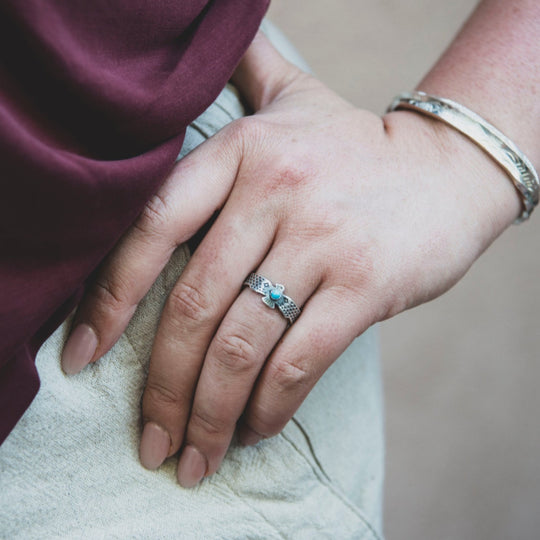
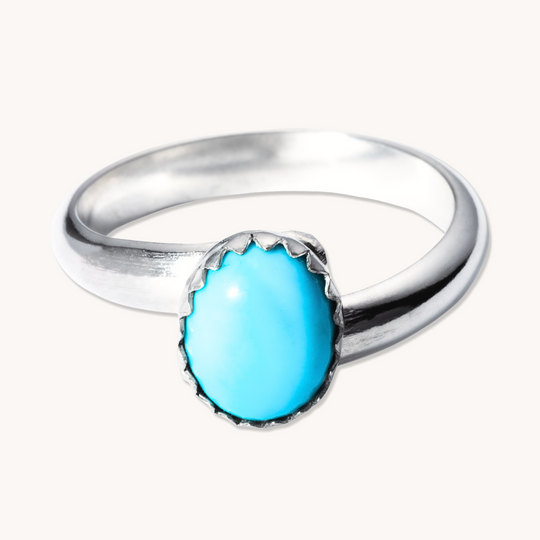
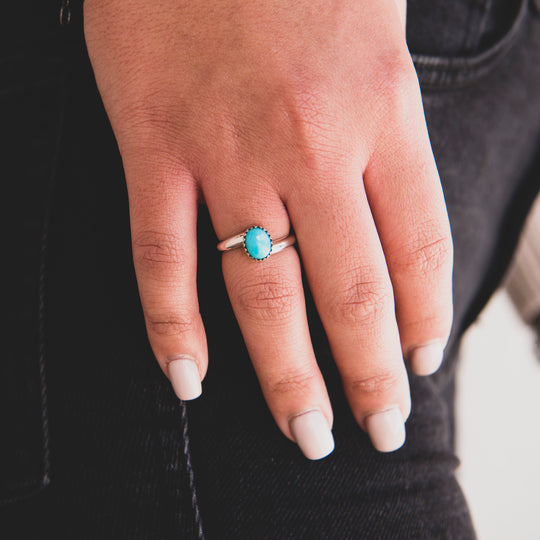
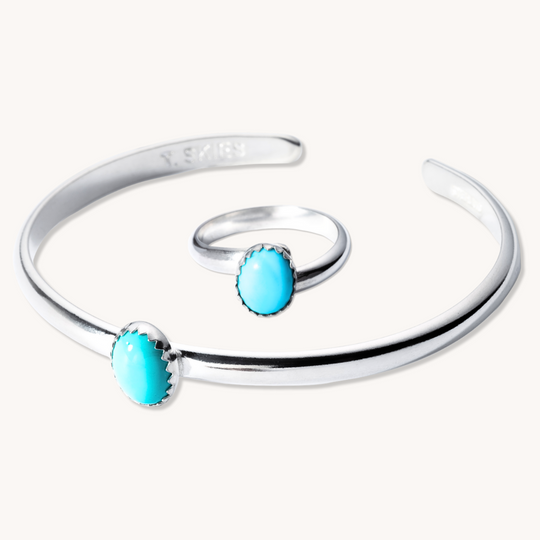
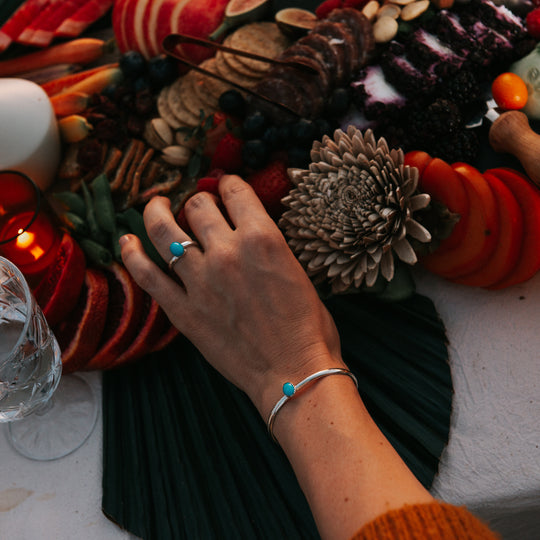
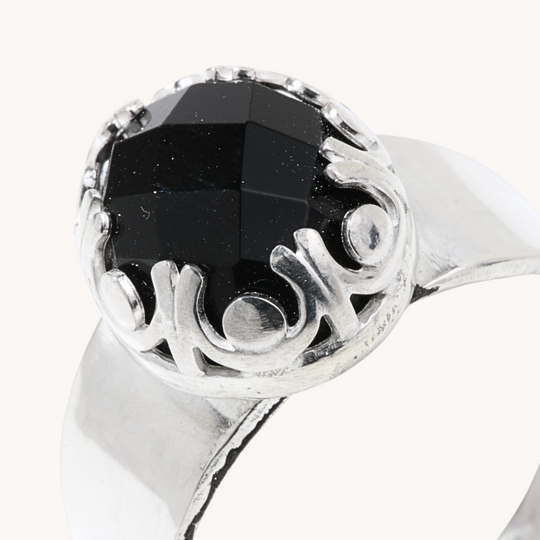
A single stone in a bezel. One cabochon held by a collar of silver, the bezel, is the simplest ring and the easiest to check. The bezel should sit tight all the way round. Our turquoise ring buyer’s guide shows the anatomy of a bezel-set ring and explains why this setting is the easiest to inspect, clean and resize. On our listings you’ll also see the border around the stone named: file work, saw work, twisted wire or bead wire. Those borders are where much of the silverwork on a single-stone ring shows.
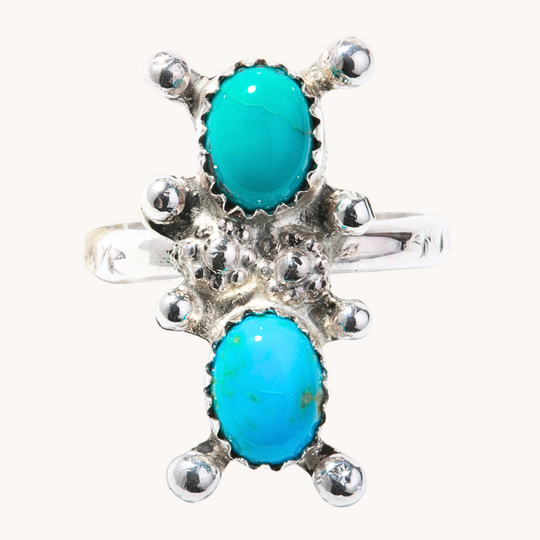
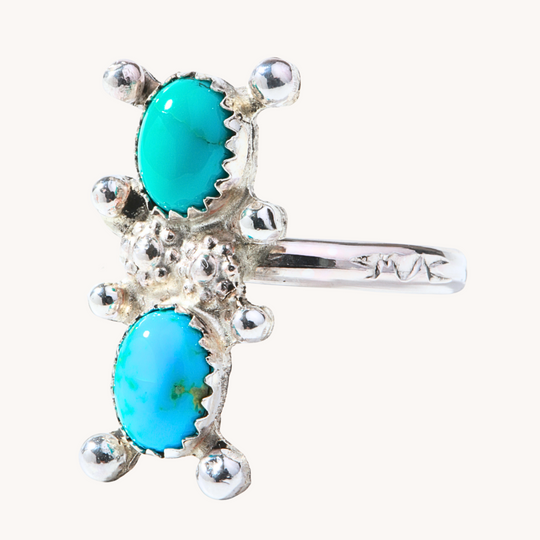
Row and cluster. Several stones, each in its own bezel, set in a line or grouped around a center. The Encyclopedia of Native American Jewelry credits the cluster to Zuni lapidaries: Southwestern lapidary work “reached a certain climax in the Zuni creation of the cluster technique, in which multiple stones in silver mountings were added to jewelry pieces.” From the cluster came finer versions, “such as needlepoint (clusters of narrow elongated stones), petitpoint (clusters of ovoid stones), and row work (clustering of stones in straight, symmetrical lines).” Theda and Michael Bassman define the two small cuts precisely. Needlepoint is “An oval stone ground to fine points at both ends and set in a silver bezel,” and petit point is “An oval stone ground to a fine point at one end, rounded on the other end and set in a silver bezel.” A cluster ring is bold. Its many small bezels also mean more places to check, so look at each one. More in our page on cluster work.
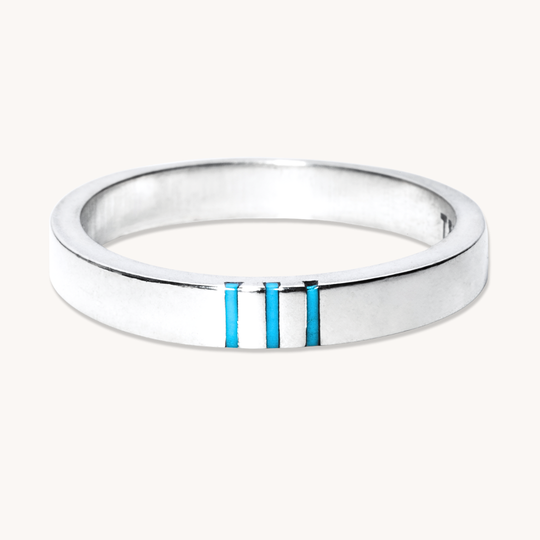
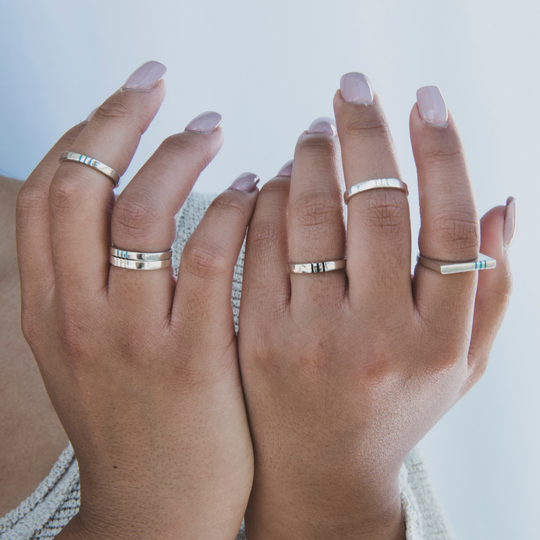
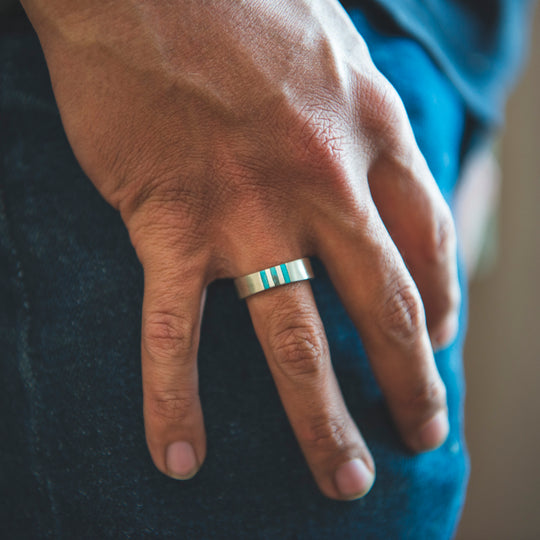
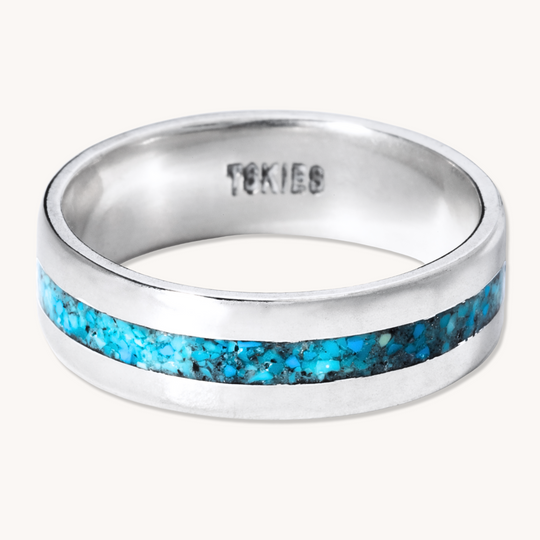
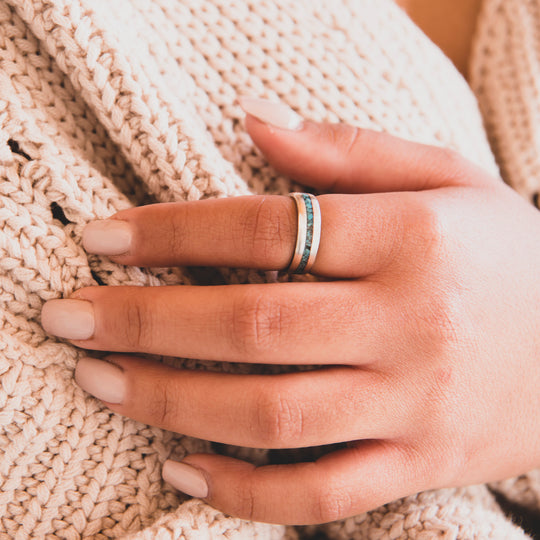
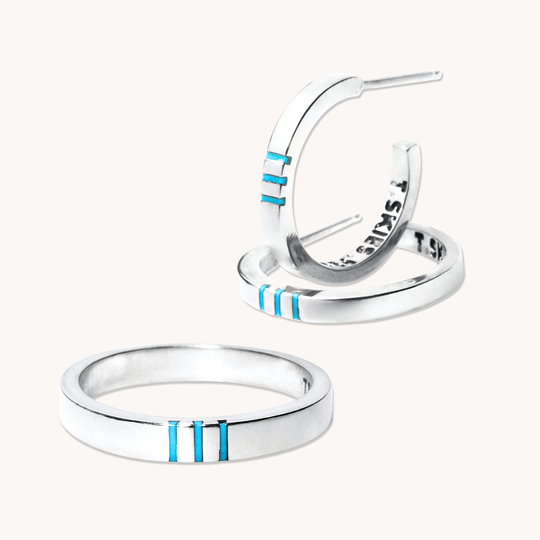
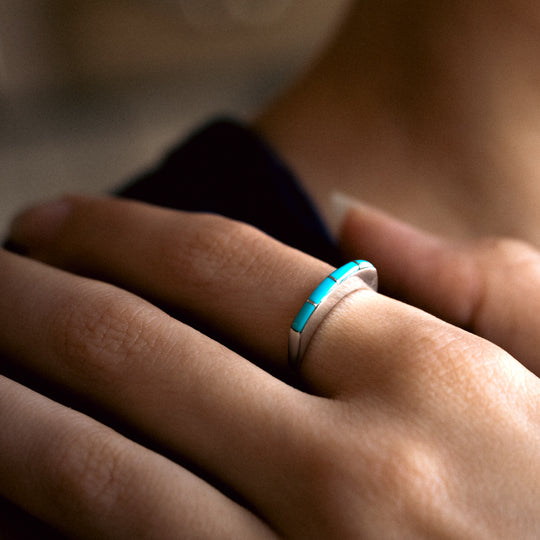
Inlay and channel inlay. The stone sits flush with the silver instead of rising above it. The Turnbaughs define inlay as “A technique in which a decorative stone or mosaic is set into silver or shell so that it is flush with the surface.” In channel inlay, in the Bassmans’ words, the design has “a silver bezel between each stone. The stones are sanded level and are polished.” An inlay ring has a low profile and a smooth face, which makes it easy to wear every day. More in our page on inlay.
Overlay. The Turnbaughs’ glossary describes overlay as “A technique of silverworking in which two sheets of silver are soldered together after first cutting out a design in the top layer,” and adds: “This technique was first practiced among the Hopi.” Many guides, including the old version of this post, present overlay as a Navajo technique. The book says otherwise.
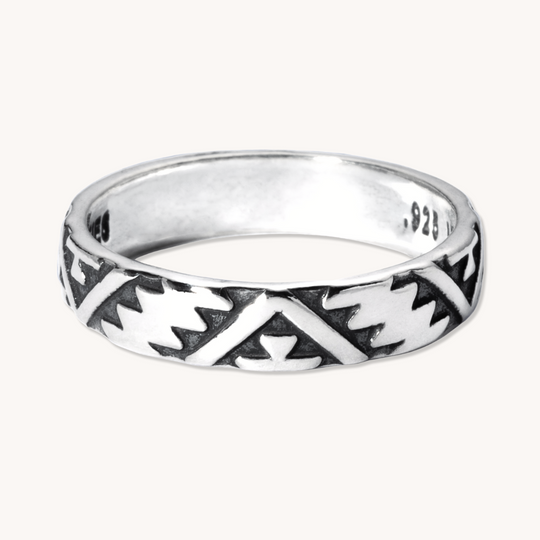
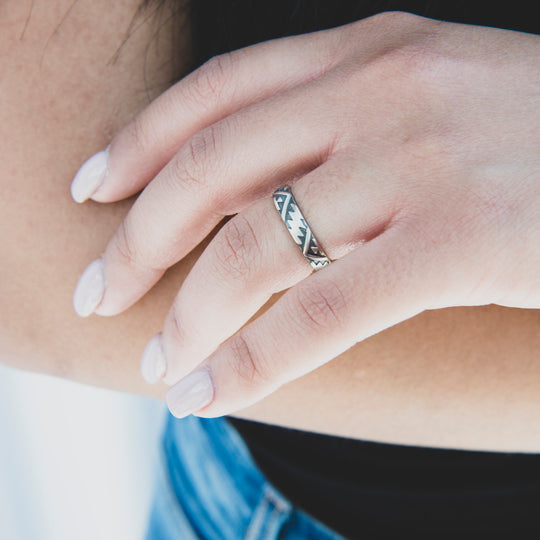
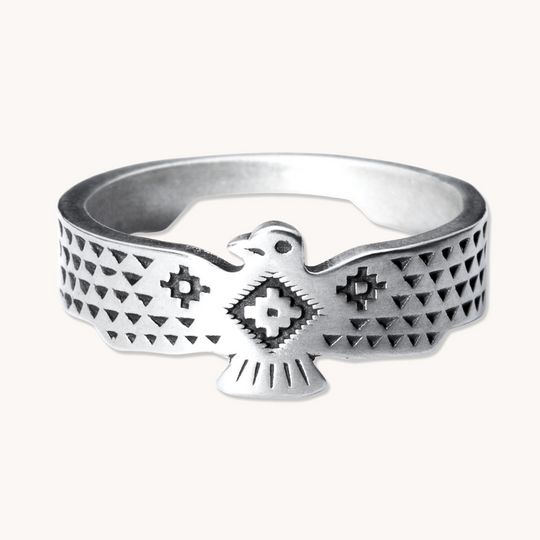
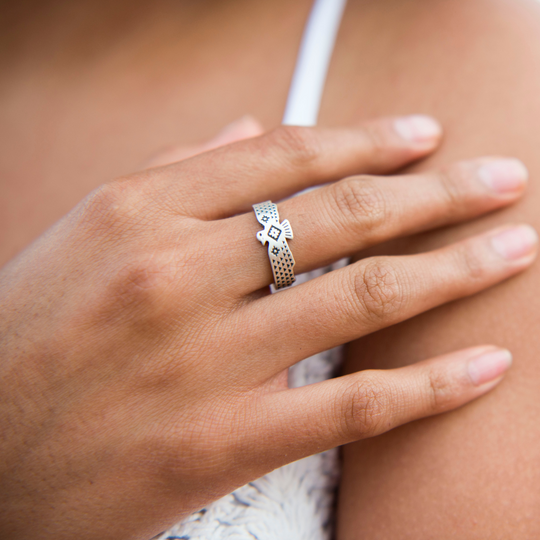
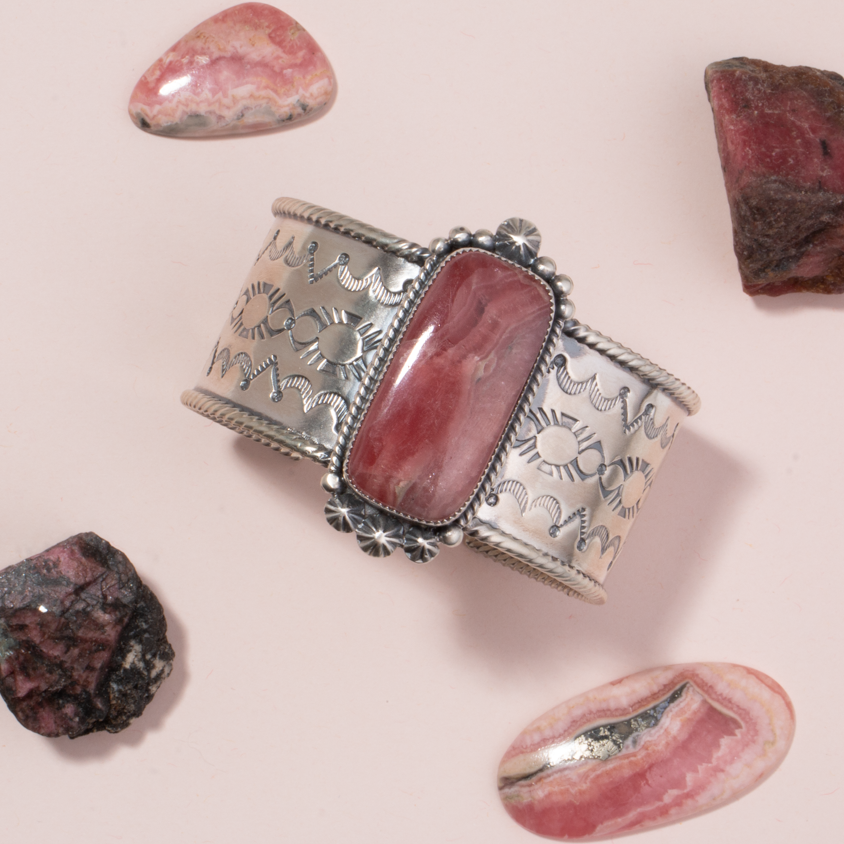
Stamped bands. A band decorated with file marks or stamps is close to the oldest form of the Southwest ring, and still one of the easiest rings to wear. Our page on stampwork explains where the stamps came from.
Choose the stone
For a ring, the most useful question about turquoise isn’t “is it real?” It’s “is it natural, stabilized or treated?” The Indian Arts and Crafts Board brochure, written with the Turquoise Museum’s Joe Dan Lowry, explains why most turquoise is treated: “When retrieved from the earth, approximately 85% of the turquoise is too soft to cut or polish.” On the other side of that line: “Approximately 15% of the world’s turquoise supply is natural turquoise.” (The old version of this post said about 10% was hard enough to set untreated. We’ve replaced it with the Board’s figure.) Stabilized turquoise is “turquoise combined with colorless resins (plastics) under a vacuum or pressure to harden the stone and darken the color.” It is still turquoise. What matters is that the seller tells you.
A ring takes more knocks than a necklace does. Turquoise is a soft stone: the Turnbaughs’ glossary gives it “a hardness of Moh 5-6.” In our view, a disclosed stabilized stone is often the sensible choice for a ring worn every day, and a natural stone is a fine choice if you’ll take the ring off for work with your hands.
Color is a matter of taste, not grade. The Board is plain about it: “Natural blue and green turquoise stones are the most sought after and have many color variations. However, neither of these two colors is more valuable than the other.” For matrix, the veins of host rock in the stone, it notes that “An evenly distributed matrix is desired.” As for mines, “The most commonly marketed American turquoise is from the Sleeping Beauty and Kingman mines in Arizona.” To go further, see our guides to spotting fake turquoise, turquoise color and value, Kingman vs. Sleeping Beauty and turquoise mines.
One test to skip: the old advice to touch the stone to your cheek or tongue and see whether it stays cold. It isn’t in any of our reference books, and a stabilized stone is real turquoise anyway. Ask the seller, and get the answer on the receipt.
Check the silver and the stamp inside the band
Look inside the band. Under the Federal Trade Commission’s jewelry guides, “Sterling” or “Sterling Silver” may only describe metal that is “at least 925/1,000ths pure silver.” A maker’s hallmark beside it tells you who made the ring, but not how well. Marsha Lund wrote in 1976 that “Much of the excellent jewelry produced in the Navajo and Zuni styles was not signed, and some very sub-standard work was.” An unsigned older ring isn’t a fake for that reason alone, and a signed one still deserves a look at the setting. To read the marks, see our guide to Native American hallmarks. For the older silver standard found on vintage rings, see coin silver vs. sterling, and for what the law says about “handmade,” see handmade vs. handcrafted jewelry.
Get the size right
Start with our ring sizing chart. To measure, wrap a strip of paper snugly around your finger, mark where it overlaps, and read the length against the chart’s inside circumference, or measure the inside diameter of a ring that already fits. Measure at the end of the day, when fingers are largest, and if you fall between two sizes, choose the larger one.
Width changes the fit. A wide band covers more of the finger than a thin one, so the same size can feel tighter. You’ll often read that a wide band needs a half or a whole size larger. We haven’t found that rule in our reference library, so treat it as a rough guide, and ask us to check the size against the specific ring you want.
Several of our rings are adjustable, which helps if you are between sizes or buying a gift. Our adjustable ring sizing chart explains how they work: find your general size, then open or close the band slightly. Adjust gradually and avoid repeated wide bending, which can weaken any metal over time. Bend only the band, never across the stone.
If a fixed ring needs resizing, the setting matters. Our ring buyer’s guide explains why a single bezel-set stone is easier to resize than cluster or channel work. For wearing several rings at once, see how to stack rings. Stacking is a modern way to wear traditional materials. Our reference books don’t record it as an old form.
Care
A ring meets soap, lotion and knocks more than any other piece, so take it off to wash your hands, clean or swim. For the silver, the Turnbaughs recommend a jeweler’s rouge cloth: it “will remove tarnish from the surface without damaging stones and without polishing dark areas of the silver that the craftsman deliberately oxidized to heighten the contrast of the silver design.” Keep liquid polishes and dips away from the stone. Our ring buyer’s guide explains why some turquoise shifts color with wear, and our jewelry care guide covers the rest.
A note on symbols
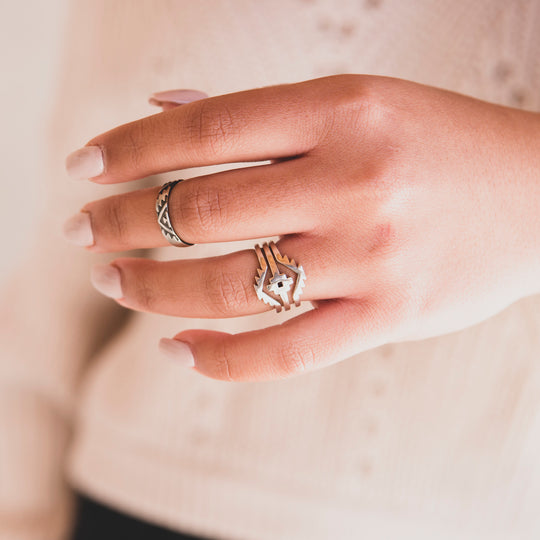
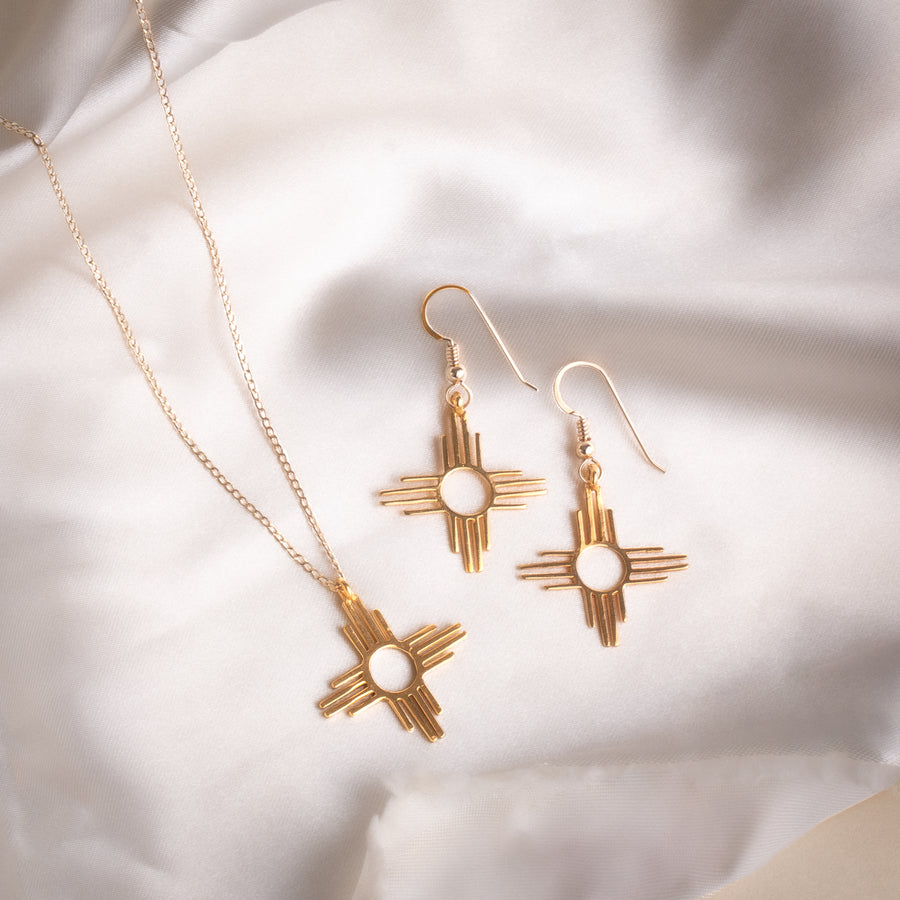
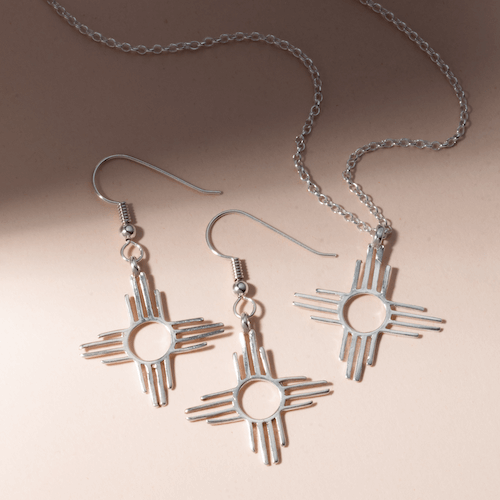
A design on a ring doesn’t tell you who made it either. The Zia sun symbol, for example, comes from the Pueblo of Zia, not from the Navajo, and T.Skies uses it with permission from the Pueblo of Zia. If a symbol is what draws you to a ring, ask where it comes from and who made the piece. For what rings themselves have meant across cultures, see our older post The Eternal Circle.
Choosing with confidence
Pick the setting first: a single stone, a row, a cluster, inlay or a stamped band. Ask whether the stone is natural, stabilized or treated, and choose blue or green by taste. Look for the sterling mark and the name beside it. Measure at the end of the day, allow for a wide band, and consider an adjustable ring if you’re between sizes. If a label says Navajo or Native American, ask who the artist is, and get every answer on your receipt. When you’re ready, browse our turquoise rings or the full rings collection. If nothing on the shelf fits your hand or your idea, a custom ring is another route. Custom commissions are paused until January.
Related reading
- Turquoise rings: a buyer’s guide
- Ring sizing chart
- Adjustable ring sizing chart
- Men’s turquoise rings and cuffs: five myths
- How to choose an authentic Southwest bracelet
- How to choose turquoise earrings
Frequently asked questions
Is a “Navajo silver ring” always made by a Navajo silversmith?
It must be if it is sold that way. Under the Indian Arts and Crafts Act it is illegal to sell a product “in a manner that falsely suggests it is Indian produced, an Indian product, or the product of a particular Indian Tribe,” and “Indian labor makes art or craftwork an Indian product” (Indian Arts and Crafts Board, turquoise brochure, p. 2). Ask for the artist’s name and tribal affiliation on your receipt (p. 1).
What is the difference between cluster, needlepoint and petit point?
A cluster sets several stones, each in its own silver mounting. Needlepoint and petit point are finer clusters: “needlepoint (clusters of narrow elongated stones), petitpoint (clusters of ovoid stones)” (Encyclopedia of Native American Jewelry, 2000, p. xxxvii). A needlepoint stone is “ground to fine points at both ends” (Bassman, Zuni Jewelry, glossary).
Is stabilized turquoise a good choice for a ring?
Often, yes, if it is disclosed. “Approximately 85% of the turquoise is too soft to cut or polish” without treatment, and stabilizing combines it with “colorless resins (plastics) under a vacuum or pressure to harden the stone” (Indian Arts and Crafts Board, turquoise brochure, p. 2). Turquoise has “a hardness of Moh 5-6” (Turnbaugh, Indian Jewelry of the American Southwest, glossary).
Is blue turquoise worth more than green?
Not by color alone. “Natural blue and green turquoise stones are the most sought after and have many color variations. However, neither of these two colors is more valuable than the other” (Indian Arts and Crafts Board, turquoise brochure, p. 2).
How do I find my ring size at home?
Wrap a strip of paper snugly around your finger, mark the overlap, and match the length to the inside circumference on our ring sizing chart. Measure at the end of the day, and if you fall between sizes, choose the larger one (T.Skies Adjustable Ring Sizing Chart).
From the Library: Tanner, Navajo Silver Craft (1954)
1954 primary source. Anything described as current here describes 1954, not today.
According to Tanner (1954, p. 30), before 1880 stones were lacking, and a Navajo man was lucky to own a single plain silver ring. [1]
While turquoise was still scarce, Tanner (1954) wrote, smiths set other stones:
“In early years when turquoise was still scarce, other stones were used in rings, and bracelets too, such as garnets, cannel coal, and malachite.”
— Tanner (1954), p. 30 [1]
Tanner (1954, p. 30) traced rings from round, oval and square-cut stones set in plain silver, with or without raindrops at the sides, to more elaborate styles. One of the most popular later rings had a larger central turquoise surrounded by many smaller stones. [1]
Sources
- U.S. Department of the Interior, Indian Arts and Crafts Board, with Joe Dan Lowry (Turquoise Museum). Indian Arts and Crafts Act turquoise consumer brochure (GPO gpo58769). n.d., pp. 1–2.
- Federal Trade Commission. Guides for the Jewelry, Precious Metals, and Pewter Industries, 16 CFR § 23.5(b)(2).
- Larry Frank with Millard J. Holbrook II. Indian Silver Jewelry of the Southwest, 1868–1930. Schiffer Publishing, 1990 (first published 1978), p. 16.
- Paula A. Baxter with Allison Bird-Romero. Encyclopedia of Native American Jewelry. 2000, p. xxxvii.
- Theda and Michael Bassman. Zuni Jewelry. Revised and expanded 3rd ed., 2006, glossary (“Terms used with Zuni jewelry”).
- William A. Turnbaugh and Sarah Peabody Turnbaugh. Indian Jewelry of the American Southwest. Schiffer, n.d., glossary and “Care of Jewelry.”
- Marsha Mayer Lund. Indian Jewelry: Fact and Fantasy. 1976, p. 114.
- T.Skies. “Ring Sizing Chart” and “Adjustable Ring Sizing Chart,” tskies.com/pages/ring-sizing-chart and tskies.com/pages/adjustable-ring-sizing-chart (accessed September 23, 2026).
- Tanner, Clara Lee. “Navajo Silver Craft.” Arizona Highways 30, no. 8 (August 1954): 16–33. Cited by printed page. Statements describe conditions as of 1954.