


How to Choose Turquoise Earrings

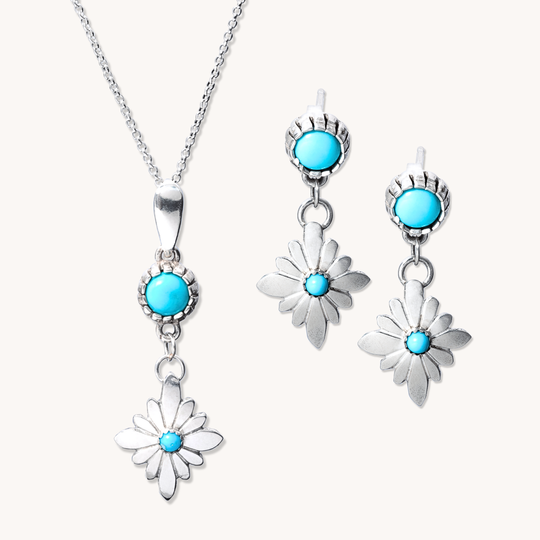
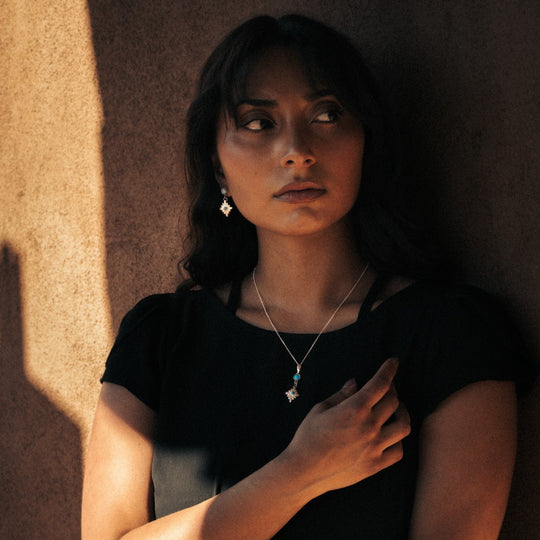
A good pair of turquoise earrings comes down to four things you can check: the stone, the way it is set, the silver, and what the label claims. You don’t need a gemologist for any of them. You need the right question, asked before you pay. This guide goes through those questions and starts with a short history of Southwest earrings, because the old forms explain a lot of what you see today. When you know what you want, our turquoise earrings are the place to look, and you can ask us about any stone before you buy.
Turquoise came first: a short history of Southwest earrings
Earrings are among the oldest ornaments in the Southwest, and turquoise was worn in the ear long before silver. Writing in 1915, the mineralogist Joseph Pogue described turquoise ear pendants this way: “Pendants are frequently worn alone, suspended from the ears; indeed this is perhaps the most common ornament seen in the Southwest.” Marsha Lund’s history of Southwest jewelry makes the same point: “Long before silverworking was learned, Navajo and Pueblo Indians wore shells or turquoise drops or beads in their ears and around their necks.” She names the Santo Domingo and Zuni peoples, long-time traders, as the source of those ornaments.
The first silver earrings were simple. Lund again: “The first earrings made of silver which were worn both by men and women, were made of silver wire. The wire was filed down at one end to go through the hole in the ear, and then bent into a loop.” Then came beads. “The first addition to these silver wire loops was one or two hollow silver beads. A later extension of this style used pomegranate beads.” After the loops came cone-shaped drops, “from two to four inches in length,” and Lund notes the view that “these cone-shaped ornaments were originally used on Spanish capes.”
Clara Lee Tanner, writing in Arizona Highways in 1954, described the same two men’s styles: “a large hoop earring, usually with small and hollow silver balls at the bottom, and a second elongate pendant type with a pomegranate form suspended from the bottom.” Women’s earrings followed another line. In earlier years, Tanner wrote, Navajo women wore “a string of turquoise beads with a few red shell fragments at the bottom.” By 1954 those loops had moved to necklaces, and “taking their place are silver earrings of a style which reflects Zuni influence, and which are elaborate in design, often set with turquoises.”
Lund calls those turquoise bead loops jaclas, “of Santo Domingo origin and manufacture,” and she also notes that “Jaclas are now seen only on necklaces.” The pomegranate form lasted too. Larry Frank’s history of Southwest silver shows a pair made by Gushgi, a Zuni silversmith, and collected at Zuni in 1901, with “heavy silver pomegranates hanging from thick forged silver loops.” That same pomegranate is the bead that became the “squash blossom.” Lund writes that squash blossom beads were probably “facimilies of pomegranates” (her spelling), and that the form came from Spain. Read more in our squash blossom guide.
The stone: natural, stabilized or imitation
Earring stones are small, and small stones are where treatment is easiest to hide. The U.S. Indian Arts and Crafts Board puts the key question plainly: “Most consumers will ask if the turquoise is ‘real,’ but the question to ask is if it is ‘natural’ turquoise.” Its consumer brochure gives the working definitions:
- Natural: cut and polished, nothing added. The brochure puts it at about 15% of the world’s supply: “Approximately 15% of the world’s turquoise supply is natural turquoise.”
- Stabilized: “turquoise combined with colorless resins (plastics) under a vacuum or pressure to harden the stone and darken the color.” It is real turquoise, and the trade depends on it, because “when retrieved from the earth, approximately 85% of the turquoise is too soft to cut or polish.”
- Blocked: “chips and fragments are mixed with epoxy to form blocks for cutting.”
- Dyed: “a pigment is added to deepen the stone’s color or create a ‘matrix’ design within a treated stone.”
Field Notes by Mateo James: how we use these words. At T.Skies we sort turquoise into two groups. Natural turquoise is as it comes out of the earth, with nothing added except the water or mineral oil used while cutting. Everything else is treated, and we label treated stone stabilized (clear resin that locks in the stone's own color and integrity), enhanced (dyed, hardened, or both), or stabilized enhanced. The IACB's definitions, quoted above, say stabilizing also darkens the color, and keep “enhanced” for one patented color process; our labels draw the line at whether dye or a hardening process changed the stone. Whatever the label, a treated stone should be disclosed as treated: the FTC Jewelry Guides (16 CFR §23.24) require it whenever a treatment isn't permanent, needs special care, or significantly affects the stone's value.
The veining in a stone, called matrix, is part of its character. The same brochure says: “If a matrix is present, it will appear as tiny veins or dots of other rock within the turquoise, which can be golden, brown, black, white, or sienna in color. An evenly distributed matrix is desired.” It calls spiderweb, a fine even web of matrix, the rarest kind. On a matched pair, look at the two stones side by side. Natural stones from one piece of rough can match closely, but they are rarely identical.
For the tests that do and don’t work, read how to tell real turquoise from fake. For what color and matrix do to the price, see what color of turquoise is worth more and how much turquoise is worth.
The setting: single stone, cluster, needlepoint and petit point
Southwest earrings split roughly into two traditions: silver first, or stones first. Larry Frank puts it simply: “Indian jewelry made well into the 1940s can usually be identified as Navajo if the silver is emphasized, and Zuni if the emphasis is on lapidary work.” A single turquoise in a plain bezel belongs to the first tradition. The many small stones of cluster work belong to the second.
Cluster work is a Zuni development. The Encyclopedia of Native American Jewelry says Southwest lapidary work “reached a certain climax in the Zuni creation of the cluster technique, in which multiple stones in silver mountings were added to jewelry pieces.” It continues: “cluster work gave birth to attractive techniques using small stone settings, such as needlepoint (clusters of narrow elongated stones), petitpoint (clusters of ovoid stones), and row work (clustering of stones in straight, symmetrical lines).” It dates cluster work to the 1920s. The earlier version of this page listed cluster and petit point among Navajo techniques. The sources credit them to Zuni, and we have corrected it here.
The stone shapes have exact names. Theda and Michael Bassman’s glossary of Zuni jewelry defines them:
- Needlepoint: “An oval stone ground to fine points at both ends and set in a silver bezel.”
- Petit point: “An oval stone ground to a fine point at one end, rounded on the other end and set in a silver bezel.”
- Inlay: “Stones or shells ground flat on the top and level with the surrounding silver.”
In needlepoint and petit point, each tiny stone is cut and set by hand, so look for even spacing and matched stones. Our page on needlepoint and petit point shows what fine work looks like, and Navajo, Zuni and Hopi styles compares the traditions.
The silver: sterling, the stamp, and how it was worked
In the United States, “sterling” has a legal floor. The Federal Trade Commission’s jewelry guides treat it as misleading to use “Sterling Silver,” “Sterling” or “Ster.” to describe “all or part of an industry product unless it is at least 925/1,000ths pure silver.” The rule covers “all or part,” so with earrings it is fair to ask whether the posts and ear wires are sterling too, not only the drop.
A quality stamp should come with a name. Under the National Stamping Act, as the FTC guides summarize it, whoever puts a silver quality mark on a piece “shall apply to the article the trademark or name of such person.” Earrings are small and the mark may be tiny, but a “925” with no name beside it is worth asking about. For the older coin-silver standard, see coin silver vs. sterling.
Then look at how the silver was worked. Southwest jewelry is either wrought or cast. Frank’s catalogue uses “hand forged and hammered (wrought)” for sheet and wire work and lists sandcast pieces separately. Two decorative methods show up on earrings all the time:
- Stamping. Designs struck into the silver with hand-made steel dies. Frank traces the designs to Mexico: “The entire range of stamp designs used on first phase silverwork is also found on nineteenth-century Mexican leatherwork.”
- Repoussé. Raised forms hammered from the back. In Frank’s words, “Repoussé was done by placing the blank sheet of annealed silver face down on a piece of wood and then doming the metal from the back with a hammer and rounded punches.”
Hand stamping is rarely perfectly even. The same die struck twice lands a little differently each time, and small variations like that are the mark of a hand.
“Handmade” also has a legal meaning. The FTC calls it deceptive to claim a product is handmade “unless the entire shaping and forming of such product from raw materials and its finishing and decoration were accomplished by hand labor.” Our guide to handmade vs. handcrafted jewelry explains where the line falls.
Studs, hoops, drops and dangles: choosing a form
The history above still covers most of what you will find: the loop, the loop with a bead, the drop, and the stone worn alone. What matters most when you choose is weight, length and how the earring fastens.
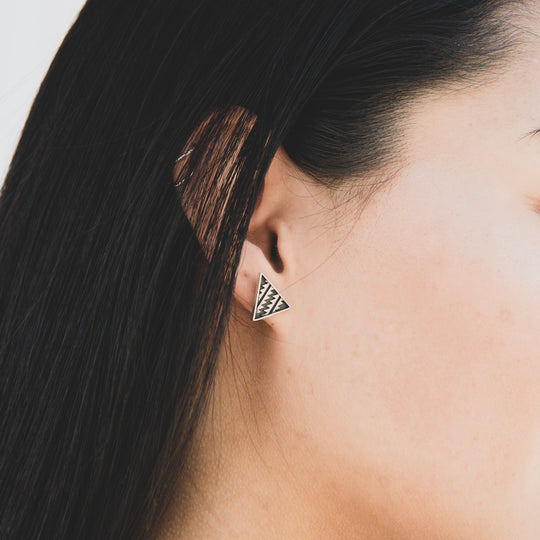
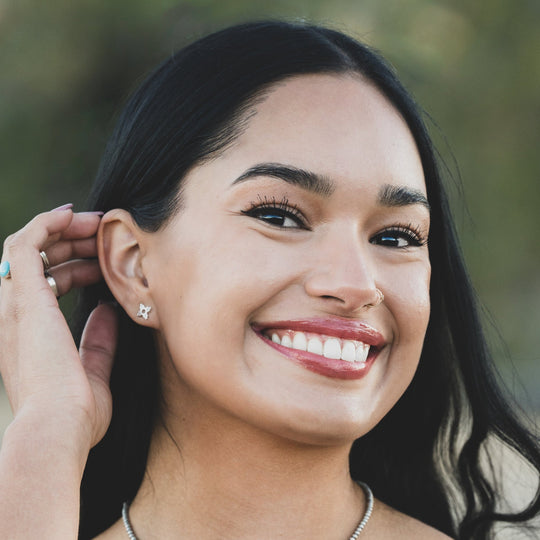
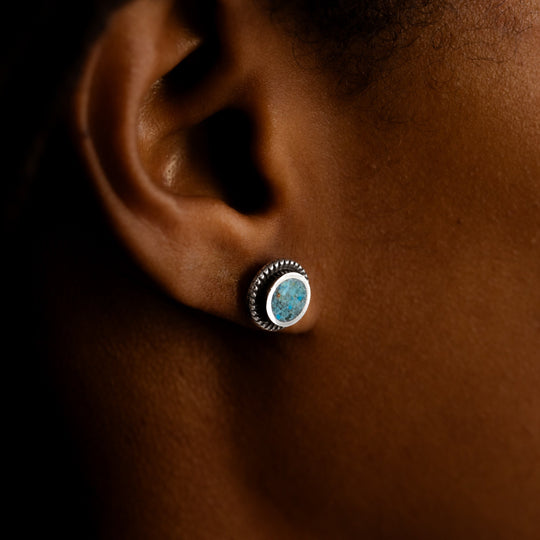
- Studs are the stone worn alone. They are light and easy to wear every day, and a good way to own a fine small stone.
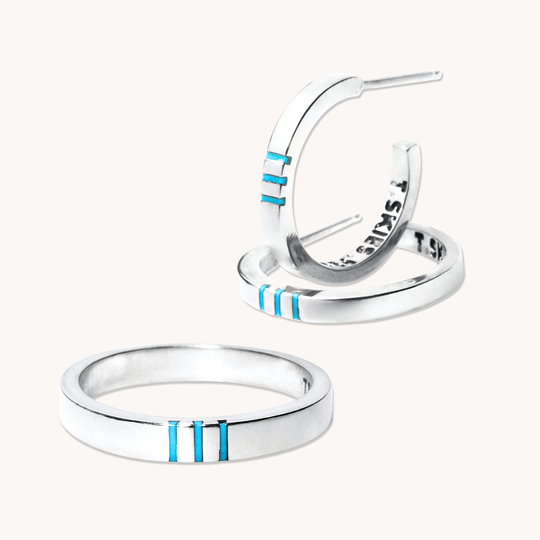
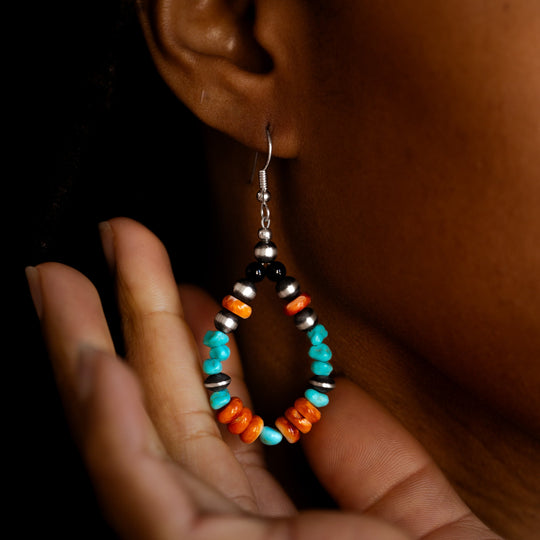
- Hoops go back to the first silver earrings. A hoop with a bead or a small stone gives movement without much weight.
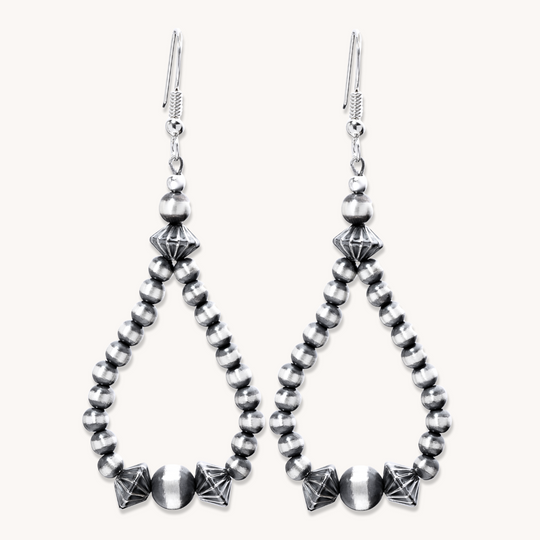
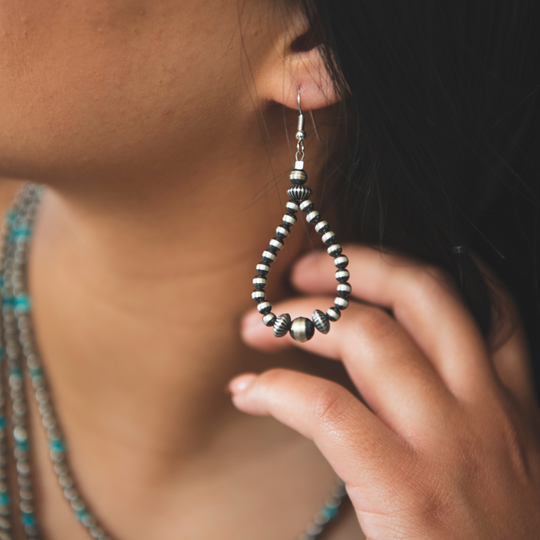
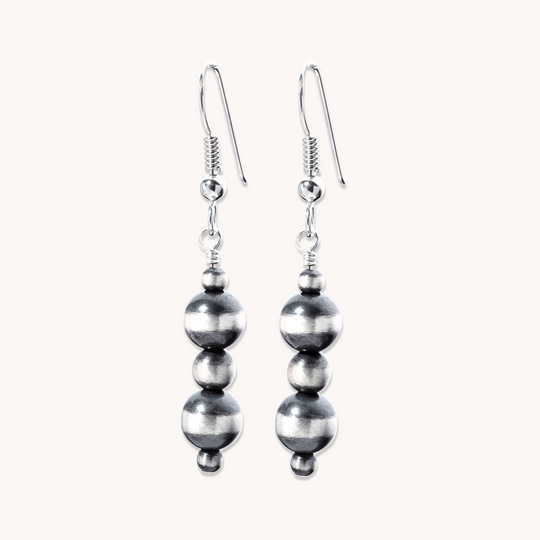
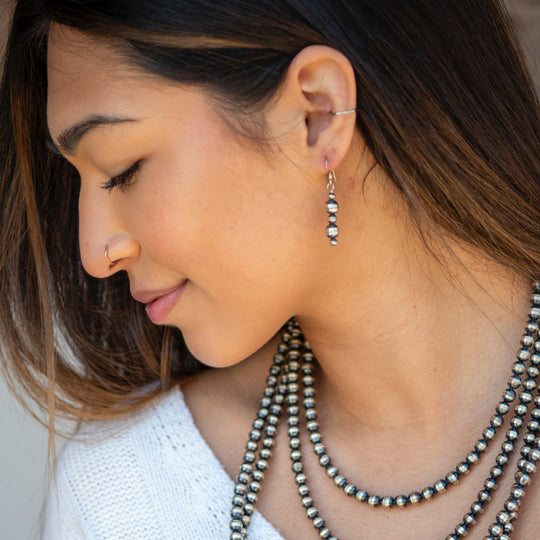
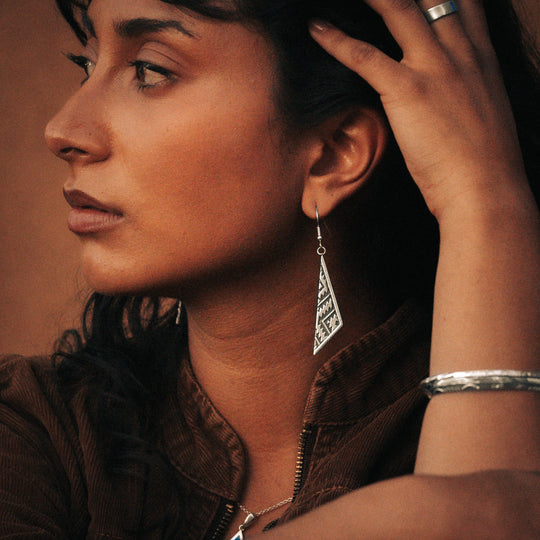
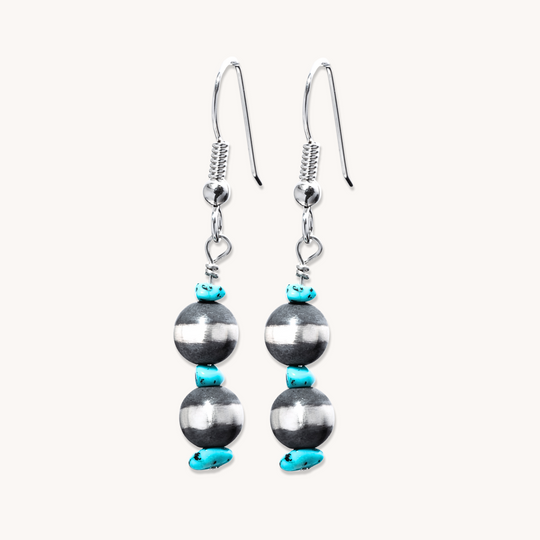
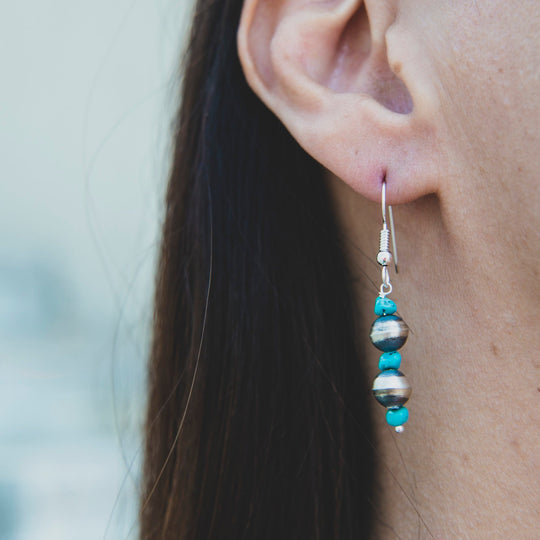
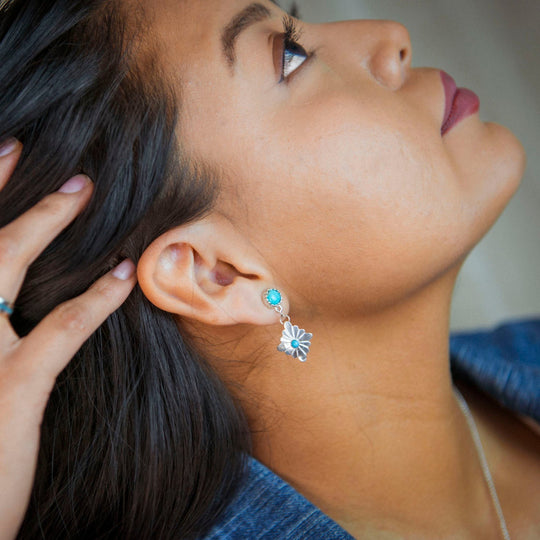
- Drops and dangles carry more silver and more stone. Check the listed length and ask about the weight. A heavy drop pulls on the ear, and a long one catches on collars and scarves.
- Posts or hooks: posts sit close and stay put. Hooks let a drop swing. Either way, ask what the post or wire is made of.
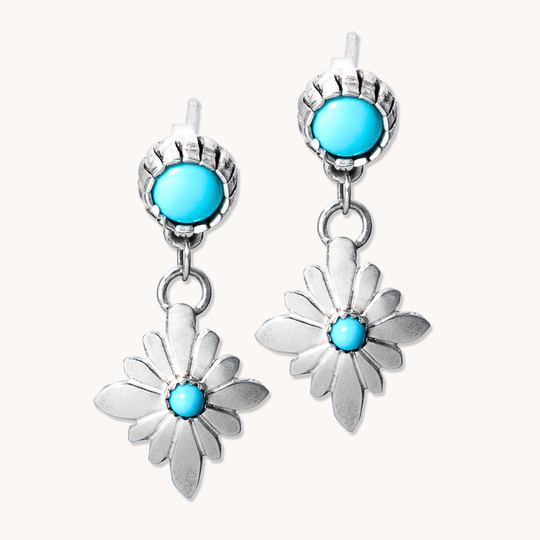
If you are unsure, compare the listed length with a pair you already wear and like. The full earring collection has every form, from small studs to long dangles.
“Navajo earrings” and “Native American earrings”: what the label claims
Either phrase on a listing is a claim about who made the earrings. It says nothing about the style. The Indian Arts and Crafts Board explains the federal law: under the Indian Arts and Crafts Act, “it is illegal to offer or display for sale, or sell, any art or craft product in a manner that falsely suggests it is Indian produced, an Indian product, or the product of a particular Indian Tribe.” A seller who calls earrings Navajo is telling you a Navajo artist made them.
The stone is a separate question. The same brochure notes that “the use of materials, such as turquoise, in the production of Indian art or craftwork is not within the scope of the Act.” New Mexico goes further: its Indian Arts and Crafts Sales Act “requires the seller to disclose in writing the type of materials used.” So ask two questions, one about the maker and one about the stone.
A hallmark helps, but it doesn’t settle quality. Lund wrote in 1976 that “much of the excellent jewelry produced in the Navajo and Zuni styles was not signed, and some very sub-standard work was.” The Encyclopedia of Native American Jewelry notes that signing work “did not become popular practice until the late 1960s,” so older unsigned earrings are normal. Our page on Native American hallmarks explains how to read them.
What protects you is the receipt. The Indian Arts and Crafts Board advises buyers to “request a written receipt that includes all the vital information about your purchase,” including the “name of artist and their Tribal affiliation,” the “name of the mine from which the turquoise was extracted,” and “whether the turquoise is natural, stabilized, or treated.”
Here is how we label our own earrings. Most of our earrings are T.Skies house designs, and we don’t call them Navajo or Native American. When a piece is made by a named Native artist, the listing names that artist, and only their work carries their nation. Read more in our guide to authentic Native American jewelry.
Symbols on earrings: whose meaning is it?
Many small earrings carry a symbol, and many listings print a meaning beside it. Be careful with those meanings. The Encyclopedia of Native American Jewelry is direct: “Non-Indians were responsible for the intentional invention and enlargement of ‘Indian’ symbols; for example, industrial stamps using obvious images such as arrows, feathers, and thunderbirds.” Buy a design because you love how it looks. Be wary of a meaning printed on a card.
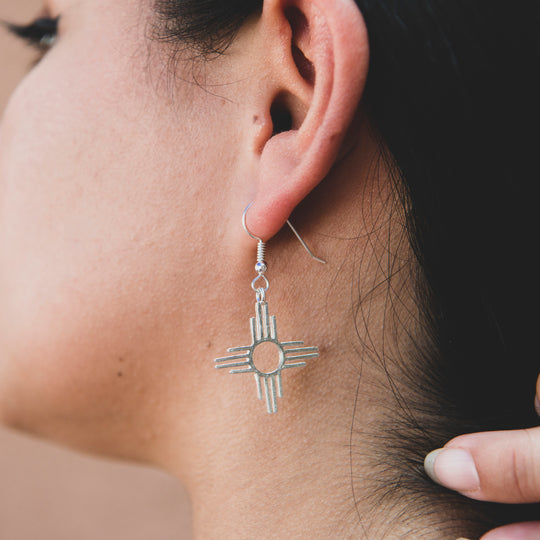
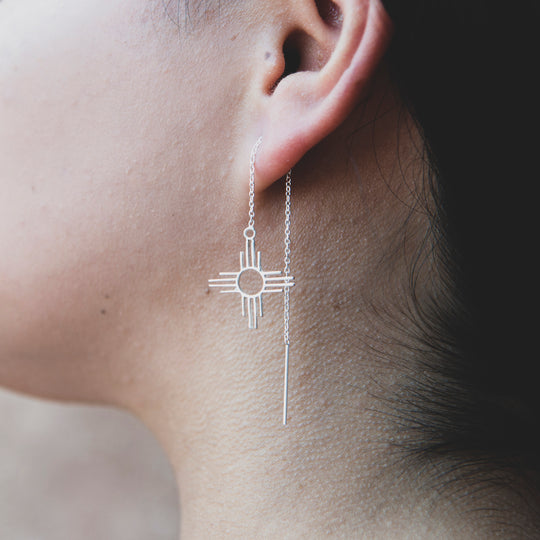
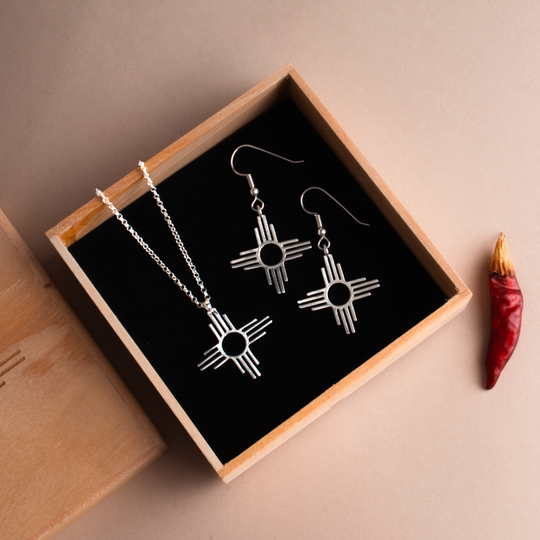
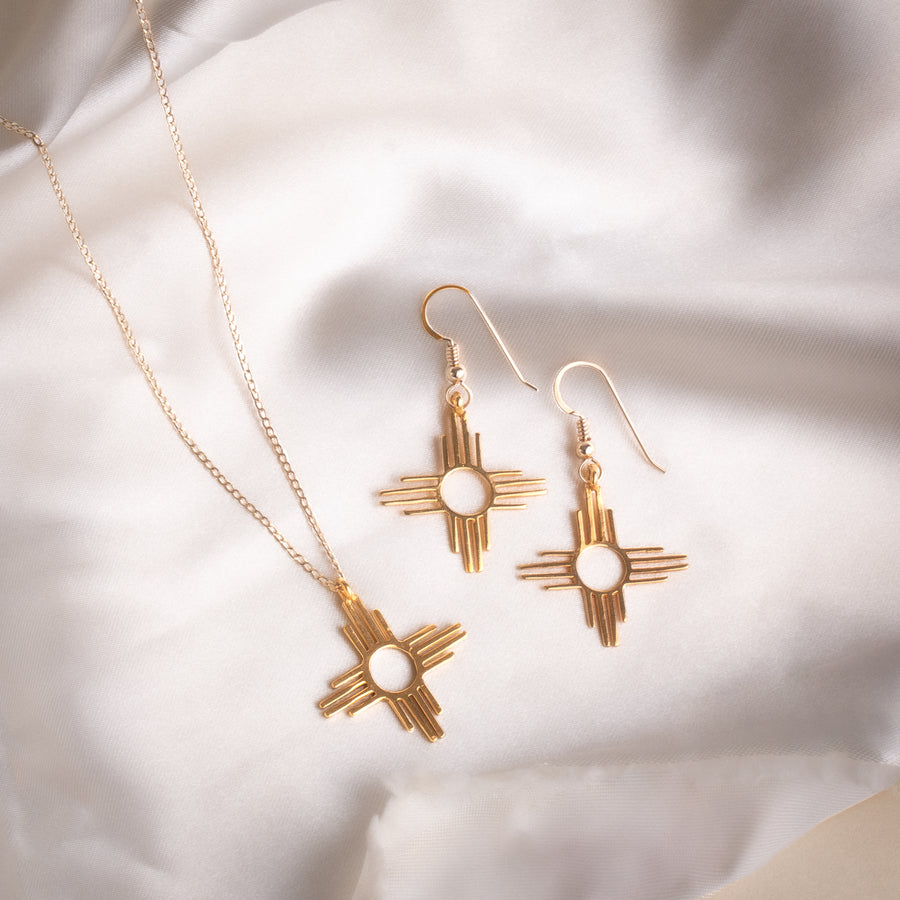
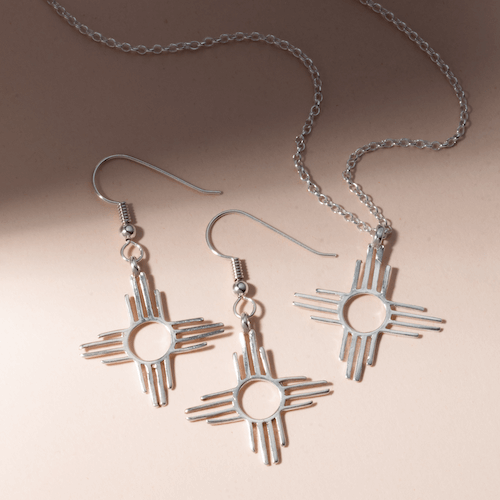
Where a symbol does carry a meaning, that meaning belongs to the people who hold it, and the best source is their own words. The Zia sun symbol comes from the Pueblo of Zia in New Mexico. It is not a Navajo symbol. In a letter to us, the Pueblo of Zia described it this way: “The Zia Sun Symbol holds significant cultural meaning for our community, representing harmony and the interconnectedness of the four directions, the four seasons, the four stages of life, and the four parts of the day.” T.Skies uses the Zia sun symbol with permission from the Pueblo of Zia. That permission was first granted by the late Peter Pino, then Governor of the Pueblo of Zia, and renewed with the Pueblo in 2026. Read more in our Zia symbol guide.
Caring for turquoise earrings
Treat the stone and the silver differently. The Encyclopedia of Native American Jewelry recommends cleaning silver “with a jeweler’s rouge polishing cloth because liquid polishes can remove oxidation that should remain in place.” The dark recesses in stamped silver are usually deliberate, so polish the raised surfaces and leave them. Keep liquid polishes and dips away from the stone.
Earrings sit where hairspray, perfume and lotion land, so put them on last and take them off before you swim or shower. Store each pair on its own, so a post or hook can’t scratch another stone. More in our jewelry care guide.
Choosing with confidence
Ask whether the stone is natural, stabilized or treated. Look at the setting and check that the stones match. Check the stamp, the name beside it, and what the posts are made of. If the label says Navajo or Native American, ask who the artist is, and get the answers on your receipt. When you are ready, start with our turquoise earrings, and ask us about any stone’s mine and treatment.
Related reading
- How to choose an authentic turquoise necklace
- Kingman vs. Sleeping Beauty turquoise
- Needlepoint and petit point
- Authentic Native American jewelry
Frequently asked questions
What are needlepoint turquoise earrings?
Earrings set with clusters of narrow stones, each “an oval stone ground to fine points at both ends and set in a silver bezel” (Bassman, Zuni Jewelry, glossary). Needlepoint grew out of Zuni cluster work, which dates to the 1920s (Baxter, Encyclopedia of Native American Jewelry, p. xxxvii).
What did early Navajo earrings look like?
Before silver, turquoise drops and beads; the first silver earrings were wire loops, “filed down at one end to go through the hole in the ear, and then bent into a loop,” later hung with hollow silver or pomegranate beads (Lund, Indian Jewelry: Fact and Fantasy, p. 46). Tanner describes men’s hoops with silver balls and pendants with a pomegranate form (Arizona Highways, 1954, scan p. 32).
Does “Navajo earrings” on a listing mean Navajo-made?
It should. Under the Indian Arts and Crafts Act, it is illegal to sell a craft “in a manner that falsely suggests it is Indian produced, an Indian product, or the product of a particular Indian Tribe” (Indian Arts and Crafts Board, turquoise brochure, p. 2). Ask for a receipt with the artist’s name and Tribal affiliation (p. 1).
Are the posts on sterling earrings sterling too?
They should be, if the seller calls the earrings sterling. The FTC treats “Sterling” as misleading for “all or part of an industry product unless it is at least 925/1,000ths pure silver” (16 CFR § 23.5(b)(2)). If you are unsure, ask what the posts or ear wires are made of.
Is stabilized turquoise real turquoise?
Yes. Stabilized turquoise is “turquoise combined with colorless resins (plastics) under a vacuum or pressure to harden the stone and darken the color” (Indian Arts and Crafts Board, turquoise brochure, p. 2). Blocked stone, made when “chips and fragments are mixed with epoxy,” is a different thing (p. 2).
From the Library: Branson, Turquoise: The Gem of the Centuries (1975)
1975 primary source. Anything described as current here describes 1975, not today.
According to Branson (1975, p. 10), the Navajo word jacla (or jaclah) translates literally as "ear string," and the oldest photographs of Navajos show men and women wearing them in their ears and hanging from necklaces.
Branson (1975) described how a pair is made from one strand:
“The beads are restrung, alternating one at a time, onto two separate strings, making a pair of Jacla.”
— Branson (1975), p. 10
On where the beads came from, Branson (1975) wrote:
“These disc-shaped turquoise beads have been a very important trade item between the Rio Grande pueblo people and the Navajo since prehistoric times.”
— Branson (1975), p. 10
From the Library: Bedinger, Indian Silver (1973)
1973 primary source. Anything described as current here describes 1973, not today.
According to Bedinger (1973, p. 56), Major John Wesley Powell described a guide wearing silver rings in his ears in October 1870, and Mrs. Stevenson noted Zuni silver hoop earrings in 1879. Early hoops could be heavy: Eikemeyer, travelling in 1896, reported wire often an eighth of an inch thick. [2]
According to Bedinger (1973, p. 57), shortly after 1900, as turquoise became more plentiful, Navajo men gradually went back to the old-style turquoise nugget earring, and Hodge chose 1918 as the year by which Navajo, Hopi and Zuni men no longer wore silver in their ears. [2]
From the Library: Adair, The Navajo and Pueblo Silversmiths (1944)
1944 primary source. Anything described as current here describes 1944, not today.
Writing in 1944 about the late 1930s, Adair noted how recent the turquoise ear pendant was for Navajo men:
“If one had visited the reservation fifty years ago, very few of these turquoise pendant earrings would have been seen. At that time two types of silver earrings were still being worn by the men of the tribe.”
— Adair (1944), p. 48 [3]
According to Adair (1944, p. 49), Navajo women had mostly worn loops of small turquoise beads up to four or five inches long, with bits of red shell at the bottom; by the late 1930s these were rarely seen in the ear, having given way to silver earrings set with many stones and bent wire, a style he credited to Zuñi influence. [3]
Sources
- U.S. Department of the Interior, Indian Arts and Crafts Board, with Joe Dan Lowry (Turquoise Museum). Indian Arts and Crafts Act turquoise consumer brochure (GPO gpo58769). n.d., pp. 1–2.
- Federal Trade Commission. Guides for the Jewelry, Precious Metals, and Pewter Industries, 16 CFR § 23.2(a), § 23.5(b)(2), and Note 2 to § 23.10.
- Joseph E. Pogue. The Turquois (Memoirs of the National Academy of Sciences, vol. XII). 1915, p. 101.
- Marsha Mayer Lund. Indian Jewelry: Fact and Fantasy. 1976, pp. 39, 46, 114.
- Clara Lee Tanner. “Navajo silver,” Arizona Highways, August 1954, scan p. 32.
- Larry Frank with Millard J. Holbrook II. Indian Silver Jewelry of the Southwest, 1868–1930. 1978, pp. 16, 17, 19, 32, 77.
- Paula A. Baxter with Allison Bird-Romero. Encyclopedia of Native American Jewelry. 2000, pp. xxv, xxxvii, xlii, 160.
- Theda and Michael Bassman. Zuni Jewelry, revised and expanded 3rd ed. 2006, glossary.
- Pueblo of Zia. Letter to Turquoise Skies Inc., September 19, 2025.
- Branson, Oscar T. Turquoise: The Gem of the Centuries. Santa Fe: Treasure Chest Publications, 1975. Cited by printed page. Statements describe conditions as of 1975.
- Bedinger, Margery. Indian Silver: Navajo and Pueblo Jewelers. Albuquerque: University of New Mexico Press, 1973. Cited by printed page. Statements describe conditions as of 1973.
- Adair, John. The Navajo and Pueblo Silversmiths. The Civilization of the American Indian Series. Norman: University of Oklahoma Press, 1944. Cited by printed page. Statements describe conditions as of 1944.