



Kingman vs. Sleeping Beauty Turquoise: How the Two Arizona Mines Differ

If you own a piece of blue American turquoise jewelry, the odds are good that the stone came from one of two places. The Indian Arts and Crafts Board says it flatly: “The most commonly marketed American turquoise is from the Sleeping Beauty and Kingman mines in Arizona.” The two are easy to confuse. That confusion is the point of this guide: what each mine produced, where they actually differ, and why the difference usually comes down to treatment and supply rather than color.
Two copper mines, one famous blue
Neither mine was dug for turquoise. Both are copper operations that turned up turquoise along the way, and in quantity. Joe Dan Lowry and Joe P. Lowry of the Turquoise Museum: “The large productions of turquoise from the Sleeping Beauty and Kingman mines in Arizona were so great that the sheer volume was able to supply large quantities around the world, thereby becoming famous sources of turquoise.”

Kingman
“The copper mining operations in the historic Mineral Park area near Kingman, Arizona, have produced substantial quantities of turquoise in prehistoric and modern times,” the Lowrys write. The deposits sit in the Cerbat Mountains of Mohave County, and the stone has been “marketed using the names Kingman, Ithaca Peak, and Turquoise Mountain.” It “became world famous for turquoise when Leonard W. Hardy marketed it during the 1950s, ’60s, and ’70s,” and “the Colbaugh family has controlled these claim rights for several generations.” Philip Chambless and Mike Ryan II date the modern pit precisely: “The Duval Corporation began open-pit mining at Kingman in 1963-64.” Full field guide: Kingman turquoise, mine by mine.
Sleeping Beauty
The name is literal. The Lowrys: “From a distance, the mountain range where this copper mining area is located resembles a sleeping woman.” The pit is in “the Globe/Miami District of Gila County, Arizona.” Its reach went well past the Southwest: “Sleeping Beauty has become famous around the world, especially in European and Middle Eastern markets as well as with the Native American Zuni Pueblo artists in New Mexico.” Elsewhere the Lowrys note that Zuni artists “have been using Sleeping Beauty turquoise mined near Globe, Arizona, along with a few other mines for over fifty years.” Full field guide: Sleeping Beauty turquoise and its mine.
Color: closer than the legend says
The popular story sets Sleeping Beauty's clear blue against Kingman's range. The Lowrys see the two as one family: “The production amounts of Kingman’s blue colors along with Sleeping Beauty’s similar hues have made this color of turquoise the most common ‘look’ of any American turquoise.”
Sleeping Beauty’s own range is wider than its reputation. The Lowrys: “The turquoise this mine produces is anywhere from a chalky white to a sky blue with a clarity that can rival similar turquoise that is famous from the countries of Iran and Chile.” The clear sky blue is the top of the mine’s output, not all of it.
So color alone won't tell you which mine a stone came from. What color does tell you is grade. The IACB: “The higher grade turquoise has greater clarity and deeper color.” And on the old blue-versus-green argument, the same brochure: “Natural blue and green turquoise stones are the most sought after and have many color variations. However, neither of these two colors is more valuable than the other.” For the full color picture, see how turquoise color is graded.
Matrix: the detail most people get backwards
Matrix is the host rock left in the stone. The IACB describes it as “tiny veins or dots of other rock within the turquoise, which can be golden, brown, black, white, or sienna in color. An evenly distributed matrix is desired.” The prize is spiderweb: “The rarest matrix, ‘spider web’ turquoise, has a natural and uniform matrix that is evenly laced throughout the gemstone.”

Here is what the comparison charts leave out. The Lowrys: “Since a darker-colored matrix is more popular in the turquoise markets, black or brown shoe polish or other dyes are used to darken the matrix in the rough and/or finished cabochons. Lapidaries have implemented this technique with such mines as Sleeping Beauty and Kingman, which mostly have a natural white matrix.” They add that because it doesn’t change the turquoise itself, the practice “has generally been accepted by most American turquoise dealers.”
A dark, dramatic web on stone sold as Kingman or Sleeping Beauty is a reason to ask one more question, not a mark of the mine.
Treatment: where the real premium is
Most turquoise, from any mine, is too soft to use as it comes out of the ground. Chambless and Ryan: “It is estimated that up to 80 percent of all turquoise produced is too soft and pale to be used commercially unless it is treated for color or hardness or both.” The IACB puts natural turquoise at “approximately 15% of the world’s turquoise supply.”
Kingman sits at the heavy end of that. Chambless and Ryan: “Colbaugh Processing, the largest turquoise producer in the United States, has the turquoise concession at Kingman. Most of everything they find requires their proprietary treatment, with only a small percent natural.” Treated stone is legitimate. The IACB defines stabilized turquoise as “turquoise combined with colorless resins (plastics) under a vacuum or pressure to harden the stone and darken the color.” It simply has to be sold as what it is.
That is why the natural/treated line matters more than the mine name. The Lowrys state it as a rule: “A natural high-grade Sleeping Beauty turquoise stone is always worth more than an Enhanced Sleeping Beauty stone that was processed to look similar to it in color and clarity.” And for Kingman: “A natural Kingman turquoise nugget necklace is rarer and more valuable than a Kingman nugget necklace that is treated to look like it.” For how treatments are named and disclosed, see fake and treated turquoise, explained.
Supply: one mine kept producing
This is the difference that holds. Chambless and Ryan: “Today the only remaining turquoise concession in Arizona is at Kingman with the Colbaugh family. The mines at Bisbee, Morenci, Castle Dome, and Sleeping Beauty are all closed, with little prospect of any turquoise ever again coming from those areas.”
When Chambless and Ryan wrote, Kingman was the last active concession. Sleeping Beauty turquoise on the market today comes from stone already mined. For where turquoise mining stands now, see turquoise mining today, and for every Southwest source on one map, the turquoise mines of the Southwest.
Look-alikes from other mines
The Kingman–Sleeping Beauty blue is imitated by nature as well as by factories. The Lowrys: “Several of the Mexican mines can produce a turquoise that is almost a perfect match to the more famous Kingman, Sleeping Beauty, and Morenci mines located in Arizona.” A seller who can name the mine and show you why is worth more than a label. Why so many mines overlap is its own story: turquoise doppelgangers. Our documented stone study shows real stones side by side, mine by mine.
Which to choose
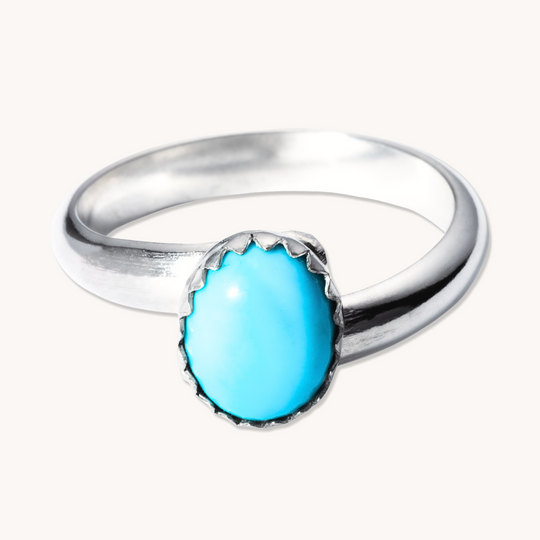
Choose by the stone in front of you, not the name on the tag. A clean, even blue with a fine, pale matrix is what both mines are known for. Ask whether the stone is natural or stabilized and whether the matrix has been darkened. Then decide whether you're paying for Sleeping Beauty's closed-mine scarcity or Kingman's continuing supply. When you know what you want, browse turquoise set in sterling silver and ask us which mine any stone came from.
Frequently asked questions
What is the difference between Kingman and Sleeping Beauty turquoise?
Less than most people think in color, and more in supply and treatment. Kingman’s blues and Sleeping Beauty’s “similar hues” together make “the most common ‘look’ of any American turquoise” (Lowry & Lowry, p. 226). Kingman remained the working concession (Chambless & Ryan, p. 187), and most of what it produces “requires their proprietary treatment, with only a small percent natural” (Chambless & Ryan, p. 182). Sleeping Beauty is closed (Chambless & Ryan, p. 187).
Is the Sleeping Beauty mine still producing turquoise?
No. Chambless and Ryan list Sleeping Beauty among the Arizona mines that “are all closed, with little prospect of any turquoise ever again coming from those areas.” Kingman, under the Colbaugh family, is “the only remaining turquoise concession in Arizona” (Turquoise in America, p. 187).
Does Sleeping Beauty turquoise have matrix?
When it does, it is mostly pale. The Lowrys describe both Sleeping Beauty and Kingman as mines “which mostly have a natural white matrix,” and note that the matrix is often darkened with “black or brown shoe polish or other dyes” (p. 169).
Can Kingman turquoise look like Sleeping Beauty?
Yes. The Lowrys write that “Kingman’s blue colors along with Sleeping Beauty’s similar hues” form one common look (p. 226), and that several Mexican mines produce “a turquoise that is almost a perfect match” to both (p. 230).
Is natural Sleeping Beauty worth more than stabilized?
Yes. “A natural high-grade Sleeping Beauty turquoise stone is always worth more than an Enhanced Sleeping Beauty stone that was processed to look similar to it in color and clarity” (Lowry & Lowry, p. 189).
Sources
- U.S. Department of the Interior, Indian Arts and Crafts Board, with Joe Dan Lowry (Turquoise Museum). Indian Arts and Crafts Act turquoise consumer brochure (GPO gpo58769), n.d., pp. 1–2.
- Joe Dan Lowry & Joe P. Lowry. Turquoise: The World Story of a Fascinating Gemstone. 2010, pp. 169, 189, 224, 226–227, 230.
- Philip Chambless & Mike Ryan II. Turquoise in America: The Great American Turquoise Rush 1890–1910, Part 1. Callais Press, 2021, pp. 182, 186, 187.