


How to Choose an Authentic Turquoise Necklace

A good turquoise necklace comes down to three things you can check: the stone, the silver and the way it was made. None of them needs a gemologist. Each one needs a question, asked before you pay. This guide walks through those questions in the order a buyer meets them, from the stone to the beads to the mark on the clasp. It also covers the squash blossom, the length and the care. When you know what you want, our turquoise necklaces are the place to look, and you can ask us about any stone before you buy.
Start with the stone: natural, stabilized or imitation
The question most buyers ask is the wrong one. The U.S. Indian Arts and Crafts Board says so in its consumer brochure: “Most consumers will ask if the turquoise is ‘real,’ but the question to ask is if it is ‘natural’ turquoise.” A stabilized stone is real turquoise. An imitation is not. Those are two very different purchases, and a seller who blurs them is not helping you.
The same brochure gives the working definitions:
- Natural: the stone as it came out of the ground, cut and polished and nothing else. The brochure puts it at roughly 15% of the world’s supply: “Approximately 15% of the world’s turquoise supply is natural turquoise.”
- Stabilized: “turquoise combined with colorless resins (plastics) under a vacuum or pressure to harden the stone and darken the color.” It is still turquoise, and it is the honest workhorse of the trade, because “when retrieved from the earth, approximately 85% of the turquoise is too soft to cut or polish.”
- Blocked: “chips and fragments are mixed with epoxy to form blocks for cutting.”
- Dyed: “a pigment is added to deepen the stone’s color or create a ‘matrix’ design within a treated stone.”
The live version of this page once described stabilized stones as soft rocks like magnesite dyed and filled with plastic. That describes an imitation, not stabilized turquoise, and we have corrected it here. For the tests that do and don’t work, read how to tell real turquoise from fake. For what each grade does to the price, see how much turquoise is worth.
Then the silver: sterling, coin silver and the stamp that proves it
Most turquoise necklaces are set in sterling silver, and in the United States the word has a legal floor. The Federal Trade Commission’s jewelry guides treat it as misleading to use “Sterling Silver,” “Sterling” or “Ster.” on any product “unless it is at least 925/1,000ths pure silver.” Coin silver has its own floor, lower: the FTC treats “coin silver” as misleading “unless it is at least 900/1,000ths pure silver.”
Early Navajo smiths worked in coin. Describing the smiths he watched in the early 1880s, Washington Matthews wrote that for hollow beads “they did not melt the silver, but beat out a Mexican dollar until it was of the proper tenuity.” Today a necklace stamped “coin” and one stamped “925” are different metals, and both stamps are claims a seller can be held to. Our guide to coin silver vs. sterling goes deeper.
One more thing about the stamp. Under the National Stamping Act, as the FTC guides summarize it, whoever puts a silver quality mark on a piece “shall apply to the article the trademark or name of such person.” A “925” with no maker’s or seller’s mark beside it is worth asking about.
Silver beads: handmade, bench-made or spun
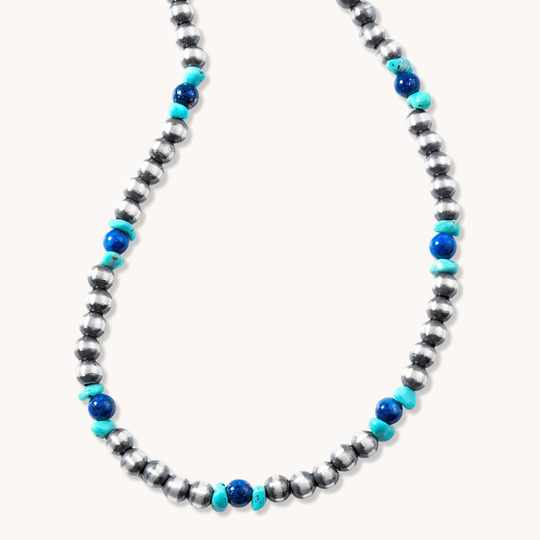
A strand of round silver beads is the backbone of many Southwest necklaces, and it is where the gap between handwork and machine work is easiest to see. Matthews described the old method: the silver was beaten thin, shaped into halves, and the halves were soldered into globes. The Encyclopedia of Native American Jewelry defines “bench beads” as “metal (usually silver) beads created by handmade processes; the term may also refer to beads shaped by machine and then finished by hand.”
You can often tell them apart by eye. The same encyclopedia: “Bench beads can be recognized by an apparent ‘shoulder,’ or dip, on each half where the curve irregularly tails off to the seam at the center of the bead.” It adds that “spun” beads are made entirely by machine and have no seam. A small irregularity at the seam is the mark of a hand, not a flaw.
The word “handmade” also has a legal meaning. The FTC calls it deceptive to claim a product is handmade “unless the entire shaping and forming of such product from raw materials and its finishing and decoration were accomplished by hand labor.” A strand built from machine-made halves that a smith soldered and finished can be fine work, but it is not handmade in that sense. Our guide to handmade vs. handcrafted jewelry explains the difference.
Navajo Pearls, Desert Pearls and Santa Fe Pearls
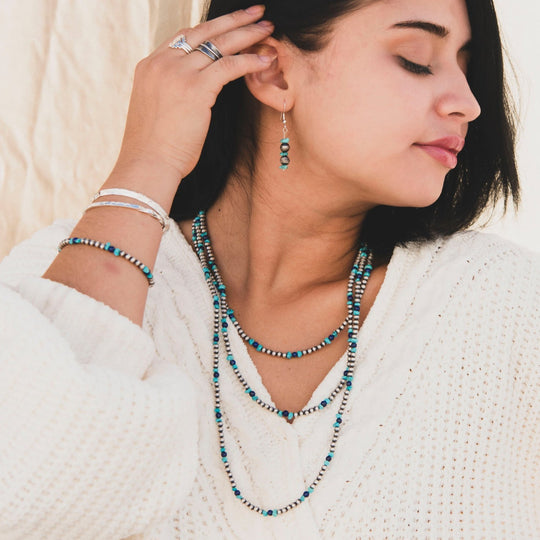
Round silver bead strands are sold under several names, and the name is a claim about who made them, not just how. Our rule is simple. We call a strand Navajo Pearls only when it is 100% made by a Navajo artisan. Otherwise we call it Desert Pearls or Santa Fe Pearls, however carefully it was made. Our own Desert Blossom line is a Mateo James house design, so it is never labeled Navajo. When you shop elsewhere, ask what “Navajo Pearls” means on that listing. For more on the bead itself, read our guide to Navajo pearls, and for the finer tube-and-disc strands, the beauty of heishi.
The squash blossom and the naja
The squash blossom is the most recognizable Southwest necklace: a strand of silver beads with flared “blossom” beads, and a crescent pendant at the center called the naja. The crescent came first. Larry Frank’s history of Southwest silver notes that “the early necklaces had no squash blossoms strung between silver beads, only a naja.” Clara Lee Tanner traced the crescent to the Navajo horse bridle, where a crescent pendant hung at the center front of the headstall, and wrote that it “is very possibly the source of the ‘naja’ of the squash blossom necklace.”
Meanings are often attached to the naja in sales copy. Marsha Lund’s study is plainer: the crescent “is referred to by the Navajo as a Naja (crescent). There is no concrete evidence that they place any symbolic significance in it at all.” The full story, including what Diné writers say about it, is on our squash blossom and naja guide and in the naja’s own page. You can browse squash blossom necklaces here, and read how the squash blossom necklace evolved.
Pendants and symbols: whose meaning is it?
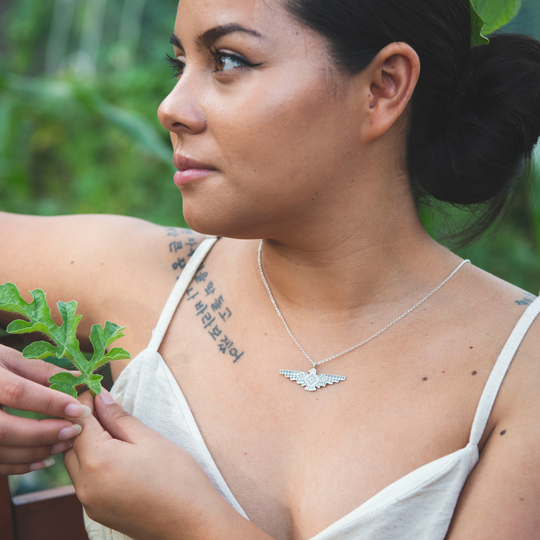
Many turquoise pendants carry a symbol, and many listings attach a meaning to it. Be careful with those meanings. The Encyclopedia of Native American Jewelry is direct: “Non-Indians were responsible for the intentional invention and enlargement of ‘Indian’ symbols; for example, industrial stamps using obvious images such as arrows, feathers, and thunderbirds.” Buy a thunderbird because you love the way it looks. Be wary of a meaning printed on a card.
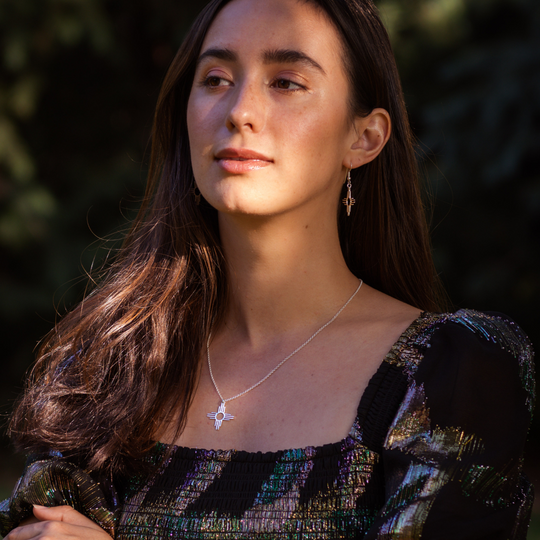
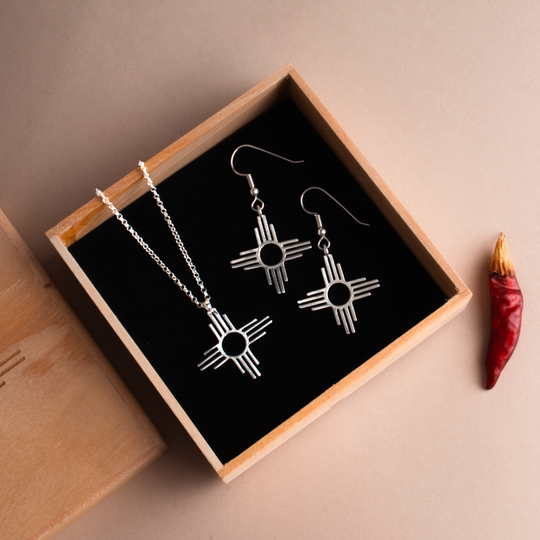
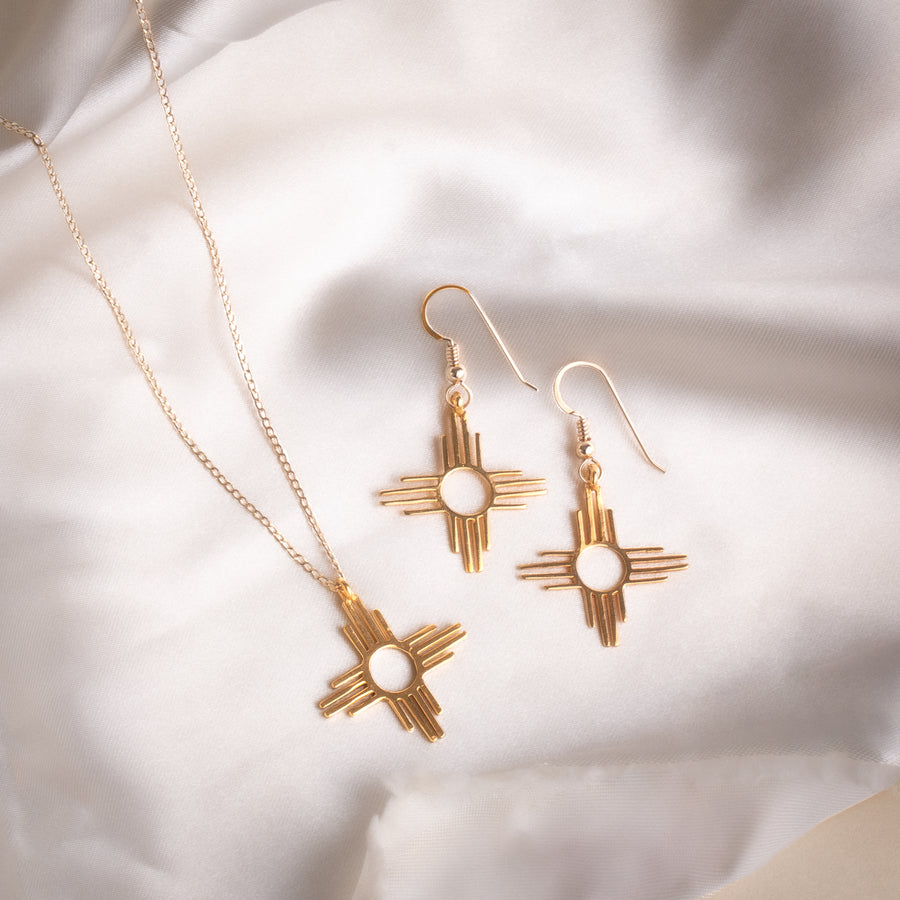
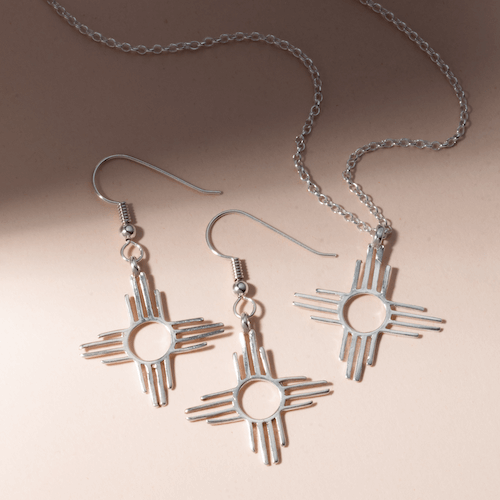
Where a symbol does carry a meaning, that meaning belongs to the people who hold it, and the best source is their own words. The Zia sun symbol comes from the Pueblo of Zia in New Mexico. It is not a Navajo symbol. In a letter to us, the Pueblo of Zia described it this way: “The Zia Sun Symbol holds significant cultural meaning for our community, representing harmony and the interconnectedness of the four directions, the four seasons, the four stages of life, and the four parts of the day.” T.Skies uses the Zia sun symbol with permission from the Pueblo of Zia. That permission was first granted by the late Peter Pino, then Governor of the Pueblo of Zia, and renewed with the Pueblo in 2026. Our Enchantment line was designed in collaboration with the late Peter Pino, then Governor of the Pueblo of Zia, and T.Skies uses the Zia sun symbol with permission from the Pueblo of Zia. Read more in our Zia symbol guide.
Length, weight and layering
The simplest way to choose a length is to measure one you already wear. Lay a chain you like against your neck, or use a piece of string, and note where it falls on your collarbone, your neckline or your chest. Then compare that number with the length given in the listing. If you are unsure, ask us before you buy.
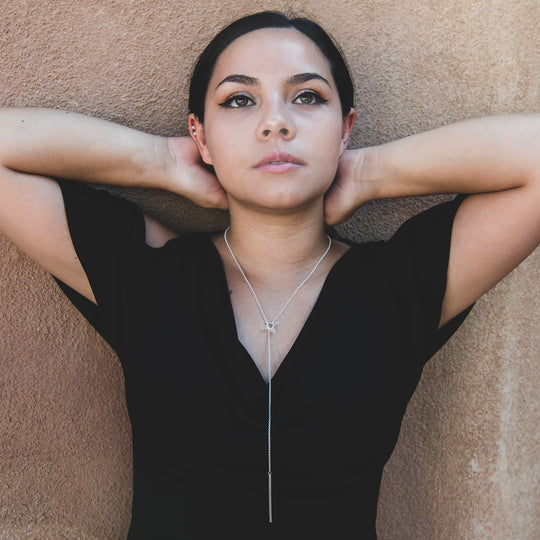
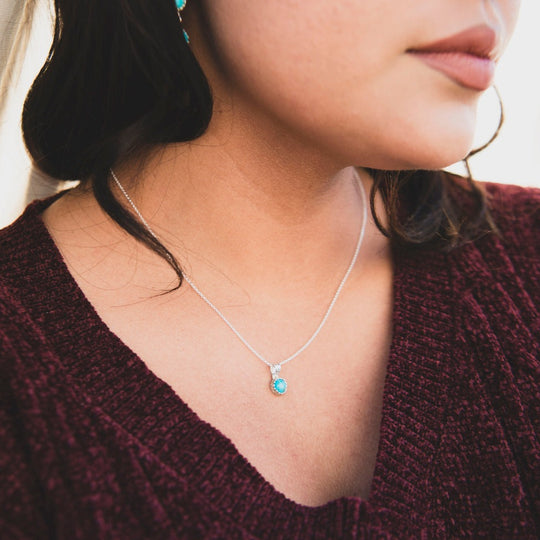
Weight matters as much as length. A heavy stone pendant needs a chain or bead strand strong enough to carry it and a bail it can move through freely. A small pendant can disappear against heavy beads. To layer, vary the lengths so the strands don’t tangle, mix one textured strand with one smooth one, and let a single piece be the focal point. Our full necklace collection includes chains, bead strands and pendants for building a layered look.
Marks, receipts and what to ask
A maker’s mark tells you who made a piece. It does not tell you how good it is. Marsha Lund made the point in 1976: “Much of the excellent jewelry produced in the Navajo and Zuni styles was not signed, and some very sub-standard work was.” Individual hallmarks spread late. The Encyclopedia of Native American Jewelry notes that the practice, although it had been building before World War II, “did not become popular practice until the late 1960s.” An older unsigned piece is normal.
What protects you is paperwork. The Indian Arts and Crafts Board advises buyers to “request a written receipt that includes all the vital information about your purchase,” including the “name of artist and their Tribal affiliation,” the “name of the mine from which the turquoise was extracted,” and “whether the turquoise is natural, stabilized, or treated.” Its brochure also explains the law behind those questions. The federal Indian Arts and Crafts Act makes it illegal to sell any craft “in a manner that falsely suggests it is Indian produced, an Indian product, or the product of a particular Indian Tribe.” The stone, though, is outside that Act: “the use of materials, such as turquoise, in the production of Indian art or craftwork is not within the scope of the Act.” New Mexico goes further. Its own Indian Arts and Crafts Sales Act “requires the seller to disclose in writing the type of materials used.” So ask about the maker and the stone as two separate questions, and get both answers in writing.
Caring for a turquoise necklace
Treat the stone and the silver differently. The Encyclopedia of Native American Jewelry recommends cleaning silver “with a jeweler’s rouge polishing cloth because liquid polishes can remove oxidation that should remain in place.” The dark recesses in stamped or overlay silver are usually deliberate, so polish the raised surfaces and leave them. Keep liquid polishes and dips away from the stone. Put the necklace on after lotion and perfume, and take it off to swim. More in our jewelry care guide.
Choosing with confidence
Ask whether the stone is natural, stabilized or treated. Check the silver stamp and the mark beside it. Look at the seams on the beads. Get the answers on your receipt. Do those four things and you will know exactly what you bought. When you are ready, start with our turquoise jewelry or go straight to the necklaces, and ask us about any stone’s mine and treatment.
Related reading
- The evolution of a squash blossom necklace
- Navajo pearls
- The beauty of heishi
- What color of turquoise is worth more?
Frequently asked questions
Is stabilized turquoise real turquoise?
Yes. Stabilized turquoise is “turquoise combined with colorless resins (plastics) under a vacuum or pressure to harden the stone and darken the color” (Indian Arts and Crafts Board, turquoise consumer brochure, p. 2). It differs from blocked stone, made when “chips and fragments are mixed with epoxy,” and from dyed stone (p. 2). The better question to ask a seller is whether the stone is natural (p. 2).
What does 925 mean on a turquoise necklace?
It means sterling silver. The FTC treats “Sterling Silver” or “Sterling” as misleading “unless it is at least 925/1,000ths pure silver” (16 CFR § 23.5(b)(2)). Coin silver must be “at least 900/1,000ths pure silver” (§ 23.5(b)(3)).
What are Navajo pearls?
Round hollow silver beads. The classic form is the bench bead: “metal (usually silver) beads created by handmade processes” (Baxter, Encyclopedia of Native American Jewelry, p. 13), recognizable by a “shoulder,” or dip, where each half tails off to the seam (p. 14). At T.Skies the name is reserved for strands 100% made by a Navajo artisan. Otherwise we use Desert Pearls or Santa Fe Pearls.
What is the crescent on a squash blossom necklace?
The naja. Early necklaces had “only a naja,” with no squash blossoms (Frank, Indian Silver Jewelry of the Southwest, p. 7), and the form very possibly came from the crescent on the Navajo horse bridle (Tanner, Arizona Highways, 1954, scan p. 31). Lund found “no concrete evidence” that the Navajo attach symbolic significance to it (Indian Jewelry: Fact and Fantasy, p. 42).
What does the Zia symbol mean on a necklace?
In the Pueblo of Zia’s own words, it represents “harmony and the interconnectedness of the four directions, the four seasons, the four stages of life, and the four parts of the day” (Pueblo of Zia, letter to Turquoise Skies Inc., September 19, 2025). T.Skies uses the symbol with the Pueblo’s permission.
From the Library: how turquoise beads were made (1975)
1975 primary source. Anything described as current here describes 1975, not today.
According to Branson (1975, p. 40), the Pueblo people of the Rio Grande Valley had for centuries been the principal bead makers, possibly because nearby Cerrillos gave them an excellent turquoise source, and Zuni bead makers were also famous and favored the chunk necklace. This is an outside observer's record; the Pueblos are the authority on their own craft history.
Branson (1975) described the first step:
“The beads are made by flattening the turquoise fragments on both sides before drilling.”
— Branson (1975), p. 40
According to Branson (1975, p. 40), drilling had moved from the old pump drill to electric drills, often with diamond bits for hard natural turquoise. Treated turquoise was soft enough for an ordinary drill. The drilled blanks were strung on a wire and rounded on a flat sandstone slab.
According to Branson (1975, p. 41), by 1975 beads were usually rounded against a revolving emery wheel, then polished and strung on a cord. The work was usually a family affair, with the wife drilling, the husband cutting and polishing, and the children stringing.
Branson (1975) added:
“A strand of beads seldom is the work of one single person.”
— Branson (1975), p. 41
Sources
- U.S. Department of the Interior, Indian Arts and Crafts Board, with Joe Dan Lowry (Turquoise Museum). Indian Arts and Crafts Act turquoise consumer brochure (GPO gpo58769). n.d., pp. 1–2.
- Federal Trade Commission. Guides for the Jewelry, Precious Metals, and Pewter Industries, 16 CFR § 23.2(a), § 23.5(b)(2)–(3), and Note 2 to § 23.10.
- Washington Matthews. “Navajo Silversmiths,” Second Annual Report of the Bureau of Ethnology. 1883, p. 177.
- Paula A. Baxter with Allison Bird-Romero. Encyclopedia of Native American Jewelry. 2000, pp. xxv, xlii, 13–14, 160.
- Larry Frank with Millard J. Holbrook II. Indian Silver Jewelry of the Southwest, 1868–1930. 1978, p. 7.
- Clara Lee Tanner. “Navajo silver,” Arizona Highways, August 1954, scan pp. 31, 35.
- Marsha Mayer Lund. Indian Jewelry: Fact and Fantasy. 1976, pp. 42, 114.
- Pueblo of Zia. Letter to Turquoise Skies Inc., September 19, 2025.
- Branson, Oscar T. Turquoise: The Gem of the Centuries. Santa Fe: Treasure Chest Publications, 1975. Cited by printed page. Statements describe conditions as of 1975.