



Spiny Oyster: The Red Shell of Southwest Jewelry
Spiny oyster — the spondylus shell — is the red-orange fire of Southwest jewelry. Long before coral reached the region by trade, this thorny Pacific shell was the Southwest's red: cut into beads, inlaid beside turquoise, and worn in ceremony. It still is. This guide traces what the historical record actually documents, cited to the books in our reference library.


Older Than Silver — the Ancient Red
Spondylus was worked in the Southwest centuries before the first silversmith. A mosaic-covered shell from the prehistoric Mogollon culture found at Kinishba Ruin, dating to about 1300 A.D., carries a red centerpiece of spondylus shell, and a pair of light blue turquoise earrings with red spondylus shell centers, made by the Anasazi culture about 1200 A.D., was found in Nitsie Canyon.[1] George Frederick Kunz, writing in 1890, described a prehistoric finger-ring "made of the central whorl of a cone-like shell… in which triangular-shaped pieces of turquoise and red spondylus shell were inlaid."[2]
The trade route is older than the jewelry. Turnbaugh’s plate of prehistoric shell work shows a necklace of 295 beads and fetish-like pendants dated stylistically to the Mogollon culture, ca. 1000–1400 A.D., worked from Laevicardium and Spondylus shell carried inland from the Gulf of California. Spondylus is the spiny oyster. Six centuries before the first silver was worked in the Southwest, this shell was already moving up the same corridor it travels today.
A Sacred Red — Spondylus in Ceremony
The shell's standing at Zuni was never merely decorative. Matilda Coxe Stevenson, documenting Zuni ceremonial dress in 1905, described a priest wearing "a profusion of rare necklaces, to one of which is attached an archaic pendent, a red shell (Spondylus princeps), a portion of the shell being set with turquoise."[3] An archaic spondylus pendant, already ancient in 1905, worn with turquoise in ceremony — the red-and-blue pairing runs as deep as the record goes.
The Zuni Mosaic Palette
When Zuni lapidaries built the mosaic style celebrated today, spiny oyster earned its permanent place in the palette. As Margery Bedinger records: "To the turquoise, white shell, and jet of their ancestors, the Zunis have added cannel coal from England, several kinds of shell, including the red abalone, white spiny oyster, mother-of-pearl, and the prestigious coral."[4] Note the detail collectors miss: spiny oyster is not only red — the shell ranges through orange, purple, and white, and Zuni mosaic used the white as well as the flame.
Reading Spiny Oyster Today
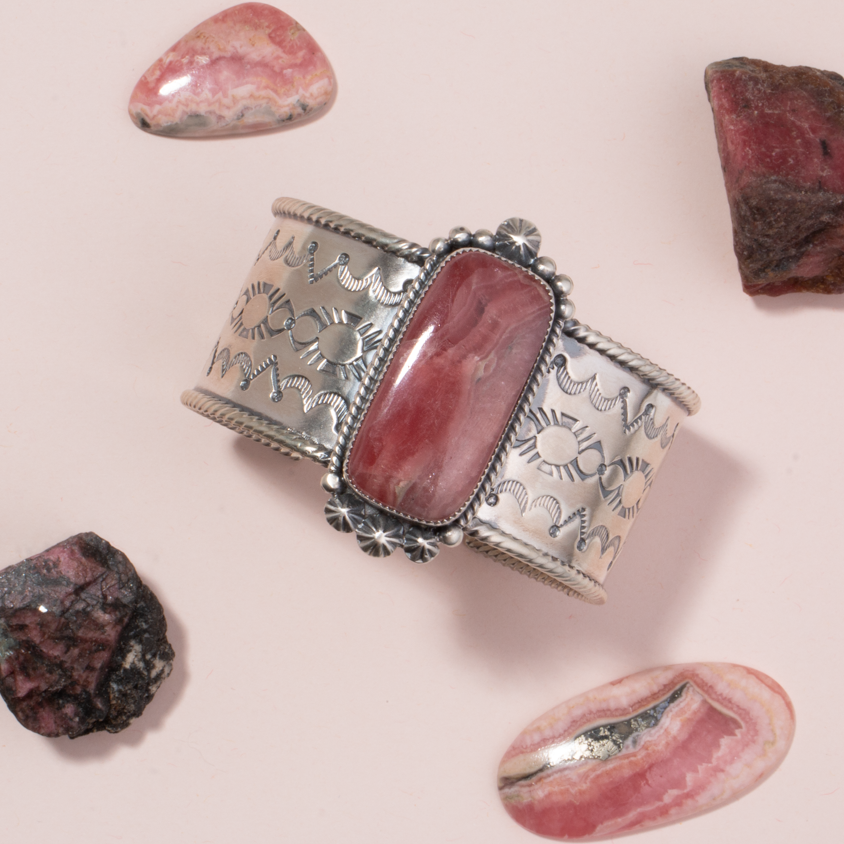
In the current collection you will see spiny oyster carrying the same roles the record documents: as beads (its most ancient form), as cabochons beside turquoise, and as the red-orange voice in multi-stone pieces. Where coral and spiny oyster appear together, look closely — spiny oyster tends toward orange flame with subtle banding, while Mediterranean coral reads as a denser, more uniform red. Both are documented companions of turquoise; our coral guide tells the other half of the red story.
From the Library: Branson, Turquoise: The Gem of the Centuries (1975)
1975 primary source. Anything described as current here describes 1975, not today.
Writing in 1975 of the prehistoric mosaic makers, Branson explained the red:
“They understood the value of contrast, and went to great trouble to secure the beautiful red shell of the spondylus, in order to emphasize the bird, animal, reptile and shell forms that were so much a part of their lives.”
— Branson (1975), p. 18 [6]
Branson (1975, p. 18) illustrated a prehistoric turquoise mosaic on a shell base, made by the Hohokam about 1300 A.D. and then on display at Casa Grande National Monument in Coolidge, Arizona. [6]
From the Library: Turnbaugh, Indian Jewelry of the American Southwest (2007)
2007 primary source. Anything described as current here describes 2007, not today.
Turnbaugh (2007, p. 14) describe which way the shell moved:
“In general, marine shells like abalone, spiny oyster, and olivella moved northward from the coast, along with other goods that probably included copper bells, brightly colored macaw feathers, salt, and domesticated maize or corn.”
— Turnbaugh (2007), p. 14 [7]
According to Turnbaugh (2007, p. 68), shell for Santo Domingo (Kewa) beads had traditionally come from the Gulf of California and the Pacific Ocean since prehistoric times, and olivella, spiny oyster, clam, abalone and conus were among the favorite shells used in its beadwork. [7]
Turnbaugh (2007, p. 82, caption) notes that the red beads at the top of each jocla in a turquoise and shell necklace were glass trade beads in that example, although beads of coral or spiny oyster shell may be used. [7]
From the Library: Baxter, Encyclopedia of Native American Jewelry (2000)
2000 primary source. Anything described as current here describes 2000, not today.
As of 2000, Baxter wrote:
“Shell colors of red and white are prized, with red shell a popular substitution for coral; most native artists presently obtain this reddish-hued shell from the California and Gulf of Mexico coasts.”
— Baxter (2000), p. 159 [8]
Questions
What is spiny oyster?
Spondylus shell: a thorny shell that was the Southwest's red long before coral reached the region by trade. It was cut into beads, inlaid beside turquoise, and worn in ceremony.
How long has spiny oyster been used in Southwest jewelry?
Centuries before the first silversmith. A prehistoric Mogollon mosaic shell from about 1300 A.D. carries a red spondylus centerpiece, and Anasazi turquoise earrings with red spondylus centers date to about 1200 A.D.
Is spiny oyster always red?
No. The shell ranges through orange, purple and white, and Zuni mosaic used the white as well as the flame.
How can you tell spiny oyster from coral?
Spiny oyster tends toward orange flame with subtle banding; Mediterranean coral reads as a denser, more uniform red.
Sources
- Branson, Oscar T. Turquoise: The Gem of the Centuries (1975) — Mogollon Kinishba mosaic shell (~1300 A.D.) with spondylus centerpiece; Anasazi turquoise earrings with spondylus centers (~1200 A.D.), Nitsie Canyon.
- Kunz, George Frederick. Gems and Precious Stones of North America (1890), p. 62 and Colored Plate No. 2 — prehistoric shell finger-ring inlaid with triangular turquoise and red spondylus. Public domain.
- Stevenson, Matilda Coxe. The Zuni Indians (Bureau of American Ethnology, 1905) — archaic Spondylus princeps pendant set with turquoise, worn in ceremonial dress.
- Bedinger, Margery. Indian Silver: Navajo and Pueblo Jewelers — the Zuni mosaic palette: white spiny oyster, red abalone, mother-of-pearl, coral added to ancestral turquoise, white shell, and jet.
- Turnbaugh, Indian Jewelry of the American Southwest, p. 5
- Branson, Oscar T. Turquoise: The Gem of the Centuries. Santa Fe: Treasure Chest Publications, 1975. Cited by printed page. Statements describe conditions as of 1975.
- Turnbaugh, William A., and Sarah Peabody Turnbaugh. Indian Jewelry of the American Southwest. Foreword by Barry M. Goldwater. Atglen, PA: Schiffer Publishing, 2007 (copyright 1996 and 2007; first published 1988). ISBN 0-7643-2577-9. Cited by printed page. Statements describe conditions as of 2007.
- Baxter, Paula A., with Allison Bird-Romero. Encyclopedia of Native American Jewelry: A Guide to History, People, and Terms. Phoenix: Oryx Press, 2000. Cited by printed page. Statements describe conditions as of 2000.
← Back to the Southwest Jewelry Guide · Coral: the Other Red · Inlay · Cluster Work


