



Lapis Lazuli in Southwest Jewelry: The Blue That Isn't Turquoise
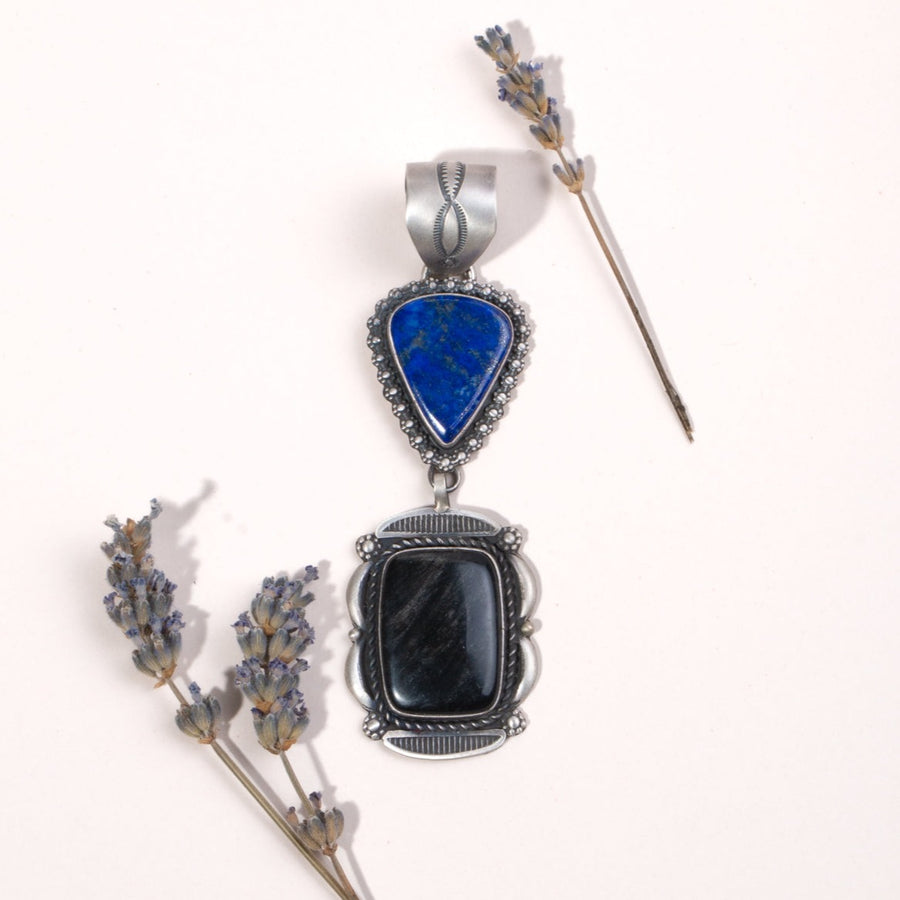
Lapis is the newcomer that earned its place. It is not a Southwest stone and never pretended to be — it is imported from Afghanistan, Chile and Russia[1] — and it arrives in Native jewelry at a specific, datable moment. As lapidary tools improved and art-school training spread, jewelers made bold use of materials that had been exotic to the tradition: lapis lazuli, peridot, sodalite, sugilite and tourmaline[2]. Lapis is the one that stuck, because it does something turquoise cannot. Turquoise is a sky blue that goes green as it ages. Lapis is a night blue, flecked with pyrite, and it holds.


Lapis in the Masters' Hands
The stone tracks the arrival of fine-jewelry technique in Southwest work. Harvey Begay — who studied under the master jeweler Pierre Touraine in the late 1970s — moved between traditional and fine-art registers with equal ease, as comfortable setting diamonds or lapis as gold and turquoise, working by hand fabrication, lost-wax casting and tufa casting[3]. Ben Nighthorse builds sandcast and inlaid pieces in sterling and 18-karat gold, favoring lapis lazuli beside pink coral, malachite, sugilite and turquoise, and hiding additional fine work on the interiors[4]. Gress works lapis, sugilite and opal against sky-blue turquoise and rose coral[5].
Note the pattern in those three: every one of them is a maker who trained formally, works in gold as readily as silver, and treats stone selection as a design decision rather than an inheritance. That is the company lapis keeps.
Reading Lapis
The single most useful thing to know about lapis in this market is that its quality ladder has been inverted by fashion — and the reference literature says so outright. In the 1990s a variety called denim lapis was introduced: a denim-colored, faded, dyed tone of lower-grade lapis, created strictly as a fashion device to match jewelry to the color of denim clothing. It proved so successful that denim lapis, despite its inferior properties, is now more expensive and more sought after than the original stone[1].
Read that carefully before you buy. Denim lapis is not a fake and not a scandal — it is a real, disclosed, dyed commercial grade with a following. But you are paying a premium for the weaker material, and a seller should tell you which one is in the piece.
For fine lapis, look for even, saturated night blue, with pyrite flecking that reads as scattered gold rather than a solid seam, and little to no chalky white calcite. Rub-test a suspiciously uniform stone with acetone on a cotton swab in a hidden spot: dyed material can transfer color. And treat lapis gently — it is soft, and it does not belong in an ultrasonic cleaner.
A note on accuracy. We strive for accuracy, and this page is continuously updated with new information from the artists, their families, and the community. Corrections welcome.
From the Library: Turnbaugh, Indian Jewelry of the American Southwest (2007)
2007 primary source. Anything described as current here describes 2007, not today.
According to Turnbaugh (2007, p. 71), the "new Indian" jewelry of the late 1960s and after added new materials to the artists' range: gold, diamonds, rubies, malachite, lapis lazuli and other precious and semiprecious stones, and shells such as paua (blue abalone) from the South Pacific. [6]
From the Library: Khazeni, Sky Blue Stone (2014)
2014 primary source. Anything described as current here describes 2014, not today.
According to Khazeni (2014, p. 14), lapis lazuli came from Badakhshan Province in the mountains of northern Afghanistan; it was the source of the pigment ultramarino prized by Renaissance painters and the root of the word azure, and it travelled the same routes as turquoise from Asia to Europe. [7]
According to Khazeni (2014, p. 21), northern Afghanistan was known for the rich deposits of balas rubies and lapis lazuli from the mines of Badakhshan, rather than for turquoise. [7]
The formation view below is that of historical Persian books of stones, reported by Khazeni; it is history, not modern mineralogy.
According to Khazeni (2014, p. 39), the precious stones treasured in the Safavid empire included pearls from the Indian Ocean and the Persian Gulf, balas rubies and lapis lazuli (lajvard) from Badakhshan, and turquoise from Nishapur. [7]
Khazeni (2014) on how the Persian books of stones grouped lapis with turquoise:
“Translucent stones, such as rubies and diamonds, were thought to have retained more water during their formation, while opaque stones, such as turquoise and lapis lazuli, contained more earth.”
— Khazeni (2014), p. 33 [7]
According to Khazeni (2014, p. 73), lapis lazuli is called sang-i lajvard in Persian, and the Arabic form of the name, lazward, is the root of the colour word azure. [7]
Khazeni (2014) on the Renaissance name for lapis blue:
“The artists of the period called this color ultramarino, to denote that its source came from far away, “beyond the sea.””
— Khazeni (2014), p. 73 [7]
According to Khazeni (2014, p. 73), lapis pigment was so costly, brought from the mountains of Afghanistan, that it was usually kept to small areas of a painting, and in Renaissance Florence it was deemed the only blue worthy of the Virgin Mary's robe. [7]
From the Library: Bassman and Bassman, Zuni Jewelry (2006)
2006 primary source. Anything described as current here describes 2006, not today.
Bassman and Bassman (2006, p. 7) pictured lapis lazuli among the stones used in making Zuni jewelry, alongside azurite, malachite, jet, serpentine, turquoise and pipestone. [8]
Bassman and Bassman (2006, p. 15) pictured rings made in 1991 that used lapis lazuli in inlay and channel inlay, among them a gold channel inlay ring set with lapis lazuli by Dickie Quandelacy and rings of turquoise, coral and lapis lazuli by Roger Tsabetsaye. [8]
Sources
- Encyclopedia of Native American Jewelry, p. 148
- Encyclopedia of Native American Jewelry, p. 33
- Encyclopedia of Native American Jewelry, p. 62
- Encyclopedia of Native American Jewelry, p. 171
- Encyclopedia of Native American Jewelry, p. 113
- Turnbaugh, William A., and Sarah Peabody Turnbaugh. Indian Jewelry of the American Southwest. Foreword by Barry M. Goldwater. Atglen, PA: Schiffer Publishing, 2007 (copyright 1996 and 2007; first published 1988). ISBN 0-7643-2577-9. Cited by printed page. Statements describe conditions as of 2007.
- Khazeni, Arash. Sky Blue Stone: The Turquoise Trade in World History. The California World History Library 20. Berkeley: University of California Press, 2014. Cited by printed page. Statements describe conditions as of 2014.
- Bassman, Theda, and Michael Bassman. Zuni Jewelry. Revised and Expanded 3rd Edition. Photographs by Gene Balzer. Atglen, Pennsylvania: Schiffer Publishing, 2006 (first published 1992). Cited by printed page. Statements describe conditions as of 2006.
← Back to the Southwest Jewelry Guide · Inlay: the technique · The turquoise guide · Gemstone Guide