



Harvey Begay — Navajo/Diné Silversmith & His Mark
Harvey Austin Begay, c. 1938 – 2009. Tuba City, Arizona. The fighter pilot who came home to silver.
Before Harvey Begay was a jeweler, he landed F-4 Phantoms on aircraft carriers. Son of the most important Navajo silversmith of the century, he took an aerospace degree instead of the bench, flew combat over Vietnam as a fighter officer, and became a production test pilot — the man who takes a brand-new fighter up to find out what breaks. In 1968 one broke: he ejected from a malfunctioning Phantom and survived. A couple of years later he walked away from aviation, went home to the Navajo Nation, and picked up his father's trade. The precision that put a jet on a carrier deck two hundred and thirty times is the same precision you see in the architectural line of his silver.
The Smith
He was born in Tuba City around 1938, son of Kenneth Begay — "the Father of Modern Navajo Jewelry," and an artist already in this directory — and Eleanor Begay, an accomplished weaver. He apprenticed in his father's shop through high school and college, when Kenneth was a partner at Scottsdale's White Hogan. But he took his own road first: a Bachelor of Science from Arizona State in 1961, a commission as a U.S. Navy flight officer flying F-4s off the U.S.S. Midway, then a test-pilot job with McDonnell Douglas in St. Louis.
Around 1970 he left it all to re-examine his Navajo heritage, and settled in Steamboat Springs, Colorado. The break that made him an artist in his own right came in 1972, when he began a formal apprenticeship with the French master jeweler Pierre Touraine — the same Old World goldsmith who trained a generation of Southwestern jewelers — learning European diamond-setting and lost-wax casting. Harvey was blunt about why it mattered: "At first I was heavily influenced by my father, but I knew I had to change that… Now I feel that my pieces are a bridge between the old and the new." Jacka (1995, p. 92) also recorded these words. [1] Bill Faust, great-nephew of the Scottsdale gallerist Lovena Ohl, named Harvey among the jewelers he worked with through her, with Charles Loloma, Larry Golsh and James Little (Ryan & Chambless 2020, p. 172). [12]
The Work
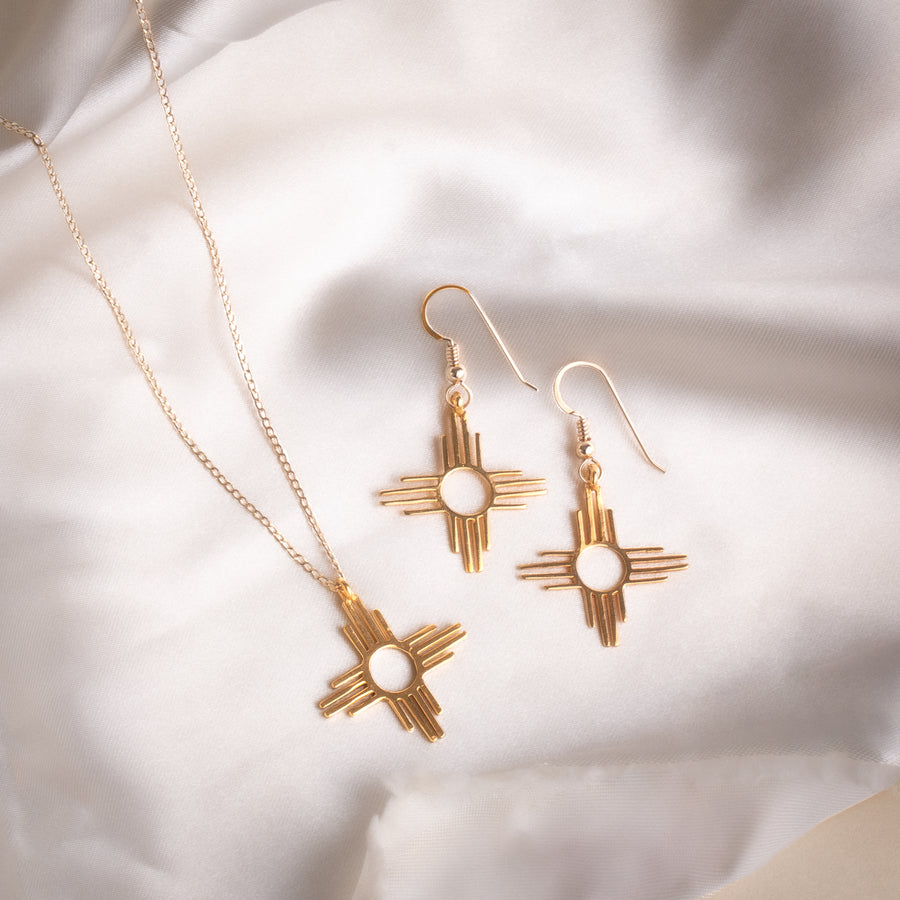
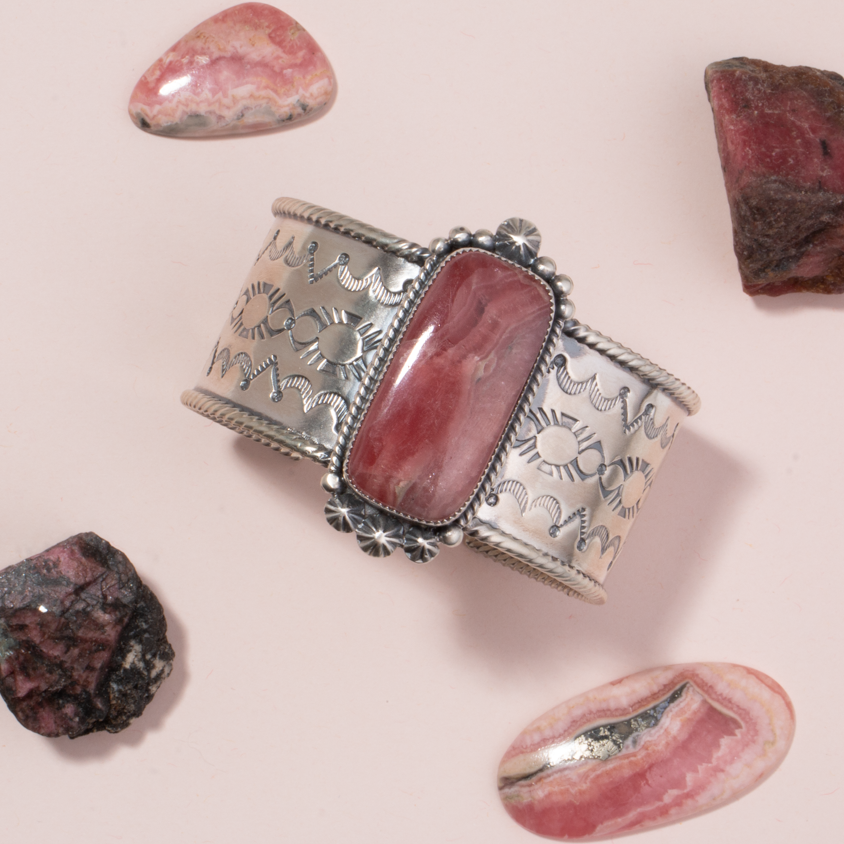
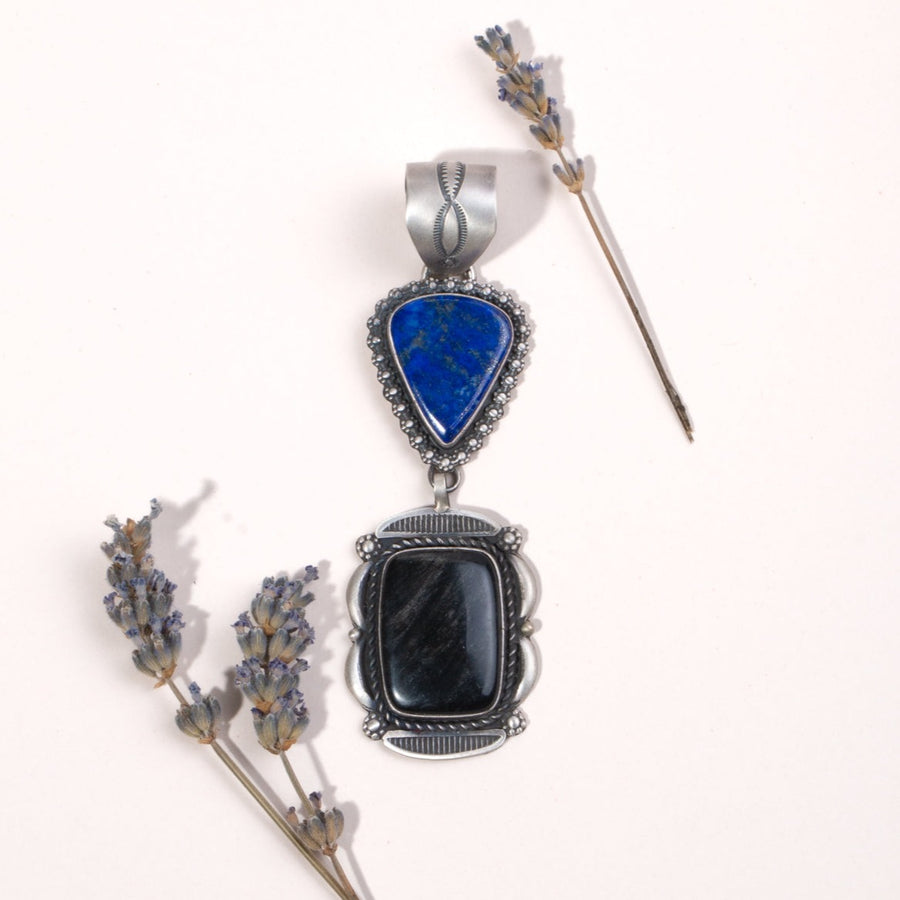
Begay's jewelry is a blend of traditional Navajo form and hard modern precision — classic silver-and-turquoise rooted in the old ways, and bold gold-and-diamond pieces built with finely engineered texture, rough surfaces played against polished ones, motifs repeated in rhythm. He was among the first to push lost-wax casting to extreme fine detail, and he tufa-cast as well, working silver and 14k gold with Nevada turquoise, coral, and diamonds. His designs drew on Navajo figures — the Yei, the Four Directions, First Man and First Woman — and on feather patterns taken from ancient Mimbres pottery. He also honored his father directly, recreating some of Kenneth's designs in his own hand. (We name the Yei as his galleries do; the meaning of such figures belongs to the Diné, and we leave it there.)
The Mark
Begay signed with his own hallmark — documented as "HB" and cataloged by dealers under his full name, Harvey Austin Begay. One dealer notes it echoes his father's mark in feeling; but it is his own, cataloged separately from Kenneth's — a son's signature, not a borrowed one.
The Standing
Harvey Begay was named an Arizona Indian Living Treasure in 2005, and Arizona State University endowed the Harvey A. Begay Memorial Scholarship in his name to help Native undergraduates. In his lifetime he was counted among the museum-quality tier of the Scottsdale scene — featured in National Geographic in 1981 alongside Loloma and Golsh — a jeweler whose work, like the man, moved between worlds. He died in Steamboat Springs on March 2, 2009.
Know more about Harvey? Contact T.Skies.
From the Library: Jacka, Navajo Jewelry: A Legacy of Silver and Stone (1995)
1995 primary source. Anything described as current here describes 1995, not today.
Harvey Begay, speaking to Jacka in 1995, on how he came to Pierre Touraine:
“Then, on a trip to Chicago, I admired some rings in the window of a jewelry store and found that they were made by Pierre Touraine. After talking to him, I sold my home and shop in Colorado Springs and moved to Phoenix to be near him.”
— Jacka (1995), p. 42 [1]
Begay told Jacka (1995, p. 42) that Touraine had him enroll in a diamond correspondence course and, after about two months, told him "You don't need me," though he kept bringing his problems to Touraine for some nine months more. [1]
And on the market in 1995:
“I enjoy metalwork, but galleries say the jewelry must have stones. Where does my personal expression come in?”
— Jacka (1995), p. 45 [1]
Harvey Begay told Jacka (1995, p. 53) that he did very little cast work before 1981, and became interested in lost-wax casting while working with Pierre Touraine, taking a couple of classes. [1]
From the Library: Baxter, Encyclopedia of Native American Jewelry (2000)
2000 primary source. Anything described as current here describes 2000, not today.
Baxter (2000, p. 12) gave his birth date as July 5, 1938. [9]
According to Baxter (2000, p. 12), he returned to his artistic roots in 1970 and was a full-time jeweler by 1972. [9]
Baxter, in her 2000 encyclopedia, placed his time with Pierre Touraine later in the decade:
“His apprenticeships with his father, during high school and college days, and with master jeweler Pierre Touraine in the late 1970s, gave Begay the means to develop his own artistic sense.”
— Baxter (2000), p. 12 [9]
Baxter (2000, p. 13) recorded his work in the Heard Museum in Phoenix, the Denver Museum of Natural History and the Montclair Art Museum in New Jersey, and reported that by then he had won more than 40 awards at Indian art venues, among them the Heard Museum Guild Fair and the SWAIA Indian Market (1994-1996). [9]
From the Library: Tryk, Santa Fe Indian Market (1993)
1993 primary source. Anything described as current here describes 1993, not today.
Tryk (1993, p. 72) pictured a necklace and earrings by Harvey Begay beside a necklace by his father, Kenneth Begay, describing Harvey as following in his father's footsteps. [10]
From the Library: Schaaf, American Indian Jewelry I (2003)
2003 primary source. Anything described as current here describes 2003, not today.
Schaaf (2003) described Harvey Begay's hallmark:
“stamps HB, plain or combined in box or fringed plate”
— Schaaf (2003), p. 75 [11]
Schaaf (2003) recorded his place in a major 2002 show:
“Nine of his pieces were shown in the 2002 "Jewels of the Southwest" exhibit.”
— Schaaf (2003), p. 75 [11]
Schaaf (2003, p. 75) listed his education as a B.S. in aeronautics from Arizona State University in 1984, followed by the Gemological Institute of America in 1986. [11]
Schaaf (2003, p. 111) wrote that Harvey Begay and Charles Supplee were among the Indian jewelers who joined the Isleta jeweler Ted Charveze in studying with the French designer Pierre Tourraine, as Schaaf spells the name, in Phoenix, learning European techniques in gold, diamonds and gemstones. [11]
Schaaf (2003, p. 268) recorded Sylvia Begay Radcliffe, a Navajo jeweler active from the 1970s and taught by her father Kenneth Begay, as a sister of Harvey Begay. [11]
Field Notes by Mateo James
I notice Harvey Begay's own account, as Lois Essary Jacka recorded it in 1995, names Colorado Springs as the home and shop he sold to move near Pierre Touraine, where this page places him in Steamboat Springs. He also described a diamond correspondence course and about two months of guidance before Touraine told him he no longer needed him. I have left both accounts as they stand.
I notice this page dates Harvey Begay's apprenticeship with Pierre Touraine to 1972, while Baxter's 2000 encyclopedia places it in the late 1970s and gives 1972 as the year he became a full-time jeweler. Both dates are shown as printed, and I have not chosen between them.
I notice that this page dates Harvey Begay's Arizona State degree to 1961, while Schaaf's 2003 entry prints 1984 for a B.S. in aeronautics. I show both as printed.
Sources
- Jacka, Lois Essary. Navajo Jewelry: A Legacy of Silver and Stone. Photographs by Jerry Jacka. Flagstaff: Northland Publishing, 1995. Cited by printed page. Statements describe conditions as of 1995.
- Pardue, Diana F. Contemporary Southwestern Jewelry + Bahti, Mark. Silver + Stone.
- Harvey Begay — Garland's
- Harvey Begay (first-person quotes) — Waddell Gallery
- Tom Ross: Harvey Begay walked in multiple worlds — Steamboat Pilot & Today
- Begay, son of Begay — Shiprock Santa Fe
- A History on Lovena Ohl & Museum-Quality Artists — Faust Gallery
- Begay, Harvey Austin hallmark entry — Medicine Man Gallery
- Baxter, Paula A., with Allison Bird-Romero. Encyclopedia of Native American Jewelry: A Guide to History, People, and Terms. Phoenix: Oryx Press, 2000. Cited by printed page. Statements describe conditions as of 2000.
- Tryk, Sheila. Santa Fe Indian Market: Showcase of Native American Art. Photography by Mark Nohl; introduction by Allan Houser. Santa Fe, NM: Tierra Publications, in cooperation with SWAIA (Southwestern Association on Indian Affairs), 1993. Cited by printed page. Statements describe conditions as of 1993.
- Schaaf, Gregory, with Angie Yan Schaaf. American Indian Jewelry I: 1,200 Artist Biographies, ca. 1800-present. American Indian Art Series, Vol. 5. Santa Fe: CIAC Press, 2003. Cited by printed page. Statements describe conditions as of 2003.
- Ryan, Mike, II, and Philip Chambless. Turquoise in America, Part Two: 1910–1990. Callais Press, 2020. Cited by printed page. Statements describe conditions as of 2020.
This profile is maintained in support of Native American silversmiths and compiled from published references. See something inaccurate, or want to add to it? Contact us.