




Stormy Mountain Turquoise: Field Guide to Elko County's Black Matrix Mine
Stormy Mountain turquoise — also marketed as Carlin Black Matrix or Sunnyside — comes from Elko County, Nevada, and was a heavy producer throughout the 1970s. Primary source documentation for this mine is limited; this page reflects that honestly and does not fill gaps with unsupported description.
From the Library: Branson on Stormy Mountain (1975)
1975 primary source. Anything described as current here describes 1975, not today.
Branson (1975) described the stone in two sentences:
“The Stormy Mountain Mine near Tenabo, Nevada produces a hard dark blue turquoise flecked with hard black chert matrix. Colors also range into light blues and pleasing greens.”
— Branson (1975), p. 24
On his 1975 map of Southwest turquoise localities, Branson (1975, p. 30) gave Stormy Mountain and Carlin separate labels, pins and page references (pp. 24 and 43).
According to Branson (1975, p. 43), the Carlin Mine in Elko County, sometimes called the Carlin Black Matrix Mine, produced very striking hard stones of a distinctive blue-green color in a very hard black chert matrix.
As of 1975, Branson (1975, p. 43) reported that the Carlin mine had not operated for many years.
From the Library: Lowry, Turquoise: The World Story of a Fascinating Gemstone (2010)
2010 primary source. Anything described as current here describes 2010, not today.
According to Lowry (2010, p. 225), a cowboy named Sonny Maulden discovered the deposits and told Cutler Edgar; the two became partners until Sonny sold out to Cutler. [2]
From the Library: Ryan & Chambless, Turquoise in America Part Two: 1910–1990 (2020)
2020 primary source. Anything described as current here describes 2020, not today.
Recollections below are the speakers' own memories, recorded in interviews published by Ryan & Chambless (2020); they are credited to the speaker, not stated as fact.
Shane Edgar recalled, in an interview published by Ryan & Chambless (2020, p. 207), that Stormy Mountain lies just north of Carlin; the location was filed as Stormy Hill, but the family called it Swales because it sat on Swales Mountain, and while Swales was private property the mine itself was on government ground. [3]
Shane Edgar, in an interview published by Ryan & Chambless (2020), on who found it:
“Cutler and Sonny Mauldin found Swales after they'd been bought out at Number 8.”
— Ryan & Chambless (2020), p. 207 [3]
Shane Edgar, in an interview published by Ryan & Chambless (2020), on the deposit:
“That was a vein mine, and it ran anywhere from a quarter inch up to an inch-and-a-half thick.”
— Ryan & Chambless (2020), p. 207 [3]
From the Library: Lowry, Turquoise Unearthed: An Illustrated Guide (2002)
2002 primary source. Anything described as current here describes 2002, not today.
Lowry (2002) on the look and the name:
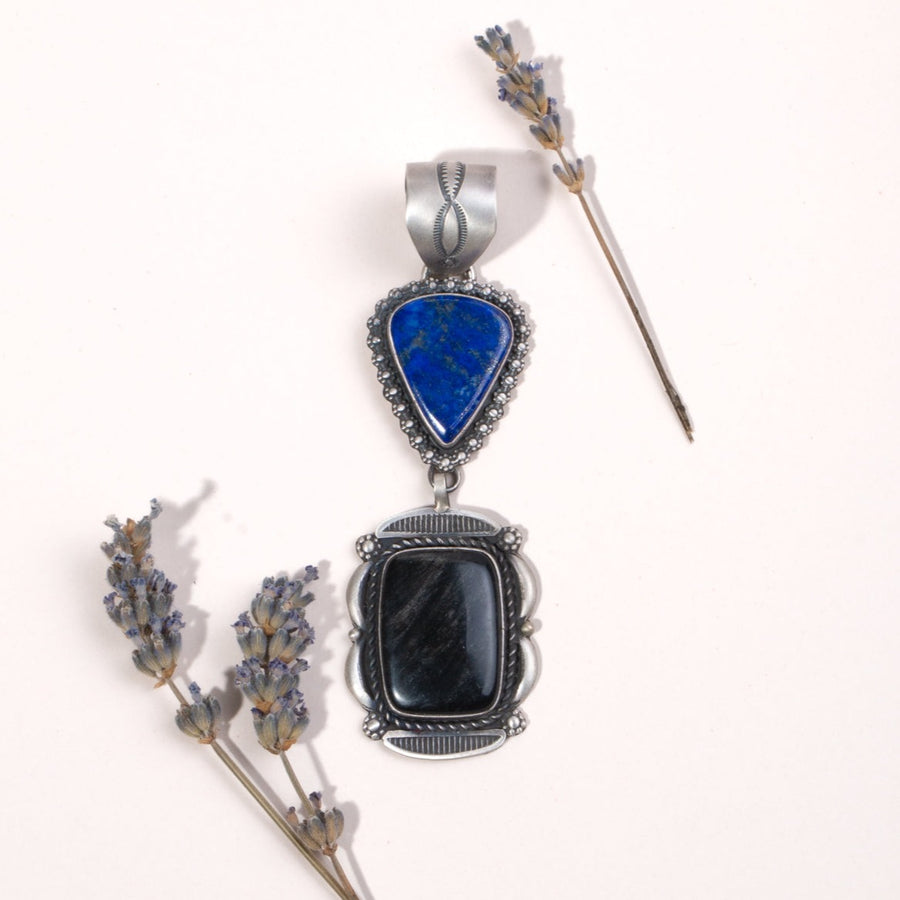
“This mine, along with the Blue Diamond mine, is distinctive for producing hard, dark blue turquoise that includes a blotchy, black chert matrix that resembles storm clouds, hence the name Stormy Mountain.”
— Lowry (2002), p. 67 [4]
As of 2002, Lowry (2002, p. 67) reported that the Elko County mine was not active. [4]
Field Notes by Mateo James
Lowry's account establishes the discovery: "These deposits were discovered by a cowboy named Sonny Maulden, who told Cutler Edgar about his find." The Cutler Edgar connection links Stormy Mountain to the broader network of Nevada turquoise operators who circulated through multiple mines during the mid-to-late twentieth century. Lowry documents it as a heavy producer throughout the 1970s.
The "black matrix" and "Stormy Mountain" marketing names both suggest dark, high-contrast matrix patterns — the kind of visual that photographs dramatically and commands collector attention. The Carlin Black Matrix designation places it geographically near the Carlin, Nevada area. Whether "Stormy Mountain" is a geographic name, a trade designation, or something in between is not clarified in available primary sources.
What our reference library does not provide: specific color range beyond what the marketing names imply; detailed stone character description; or post-1970s production history. These are honest gaps, not oversights in this guide.
Collector's Handbook
What to look for: The "black matrix" designation implies dark, high-contrast matrix patterns — but specific visual documentation in primary sources is limited. Assess stone on its own merits.
Recognition tells: 1970s production peak is documented. Claims of earlier or later production from this specific deposit are not confirmed in available primary sources and should be evaluated carefully.
Honest mine-status hedge: Heavy 1970s production is documented by Lowry. Current status is not confirmed in available primary sources. This is a thin-documentation mine, and this guide says so plainly.
Related mine guides: Pages for Bisbee, Sleeping Beauty, Number Eight, Cerrillos, Royston, Kingman, Lander Blue, and Morenci mines are coming soon to this field guide.
Our entry above follows Lowry, who places Stormy Mountain in Elko County and ties it to the Carlin Black Matrix name. Branson, writing in 1975, puts the mine near Tenabo and maps Stormy Mountain and Carlin as two separate mines. I am noting the disagreement, not settling it. Where Chambless & Ryan cover a point we let them lead; their Part One (2021) does not cover this mine, but their Part Two (2020) does (see the Library section), and both accounts stand side by side.
Part Two of Ryan & Chambless (2020) does cover Stormy Mountain, through Shane Edgar's family memory: he places it just north of Carlin, on Swales Mountain, which fits Lowry's Elko County rather than Branson's Tenabo. I tend to side with Ryan & Chambless here, though it rests on one family's recollection.
We strive for accuracy. This field guide entry is compiled from the published references cited below and is continuously updated with new information from the artists, their families, and the community. See something inaccurate, or hold documentation on this mine? Get in touch — corrections are welcomed and credited.
Back to the Southwest Jewelry Guide.
References
- Lowry, Joe Dan. Turquoise: The World Story of a Fascinating Gemstone (2010).
- Branson, Oscar T. Turquoise: The Gem of the Centuries. Santa Fe: Treasure Chest Publications, 1975. Cited by printed page. Statements describe conditions as of 1975.
- Lowry, Joe Dan, and Joe P. Lowry. Turquoise: The World Story of a Fascinating Gemstone. Layton, UT: Gibbs Smith, 2010. Cited by printed page. Statements describe conditions as of 2010.
- Ryan, Mike, II, and Philip Chambless. Turquoise in America, Part Two: 1910–1990. Callais Press, 2020. Cited by printed page. Statements describe conditions as of 2020.
- Lowry, Joe Dan, and Joe P. Lowry. Turquoise Unearthed: An Illustrated Guide. Photography by Mark Nohl. Tucson, AZ: Rio Nuevo Publishers, 2002. Cited by printed page. Statements describe conditions as of 2002.
Shop the T.Skies turquoise jewelry collection →
Compare this mine with every other: Turquoise Mines Identifier, a documented stone study, mine by mine.