



Royston Turquoise: Field Guide to a District, Not a Mine
Royston is the one name in this guide that does not belong to a mine. Lowry’s own heading for it is “Royston District,” and the entry underneath describes several separate deposits worked and sold under a handful of different names.1 Branson, independently, records “many mines in the Royston district producing turquoise.”3 So a tag that says Royston is naming you an area, not a hole in the ground — and that is worth knowing before you pay for provenance.
More Royston turquoise examples
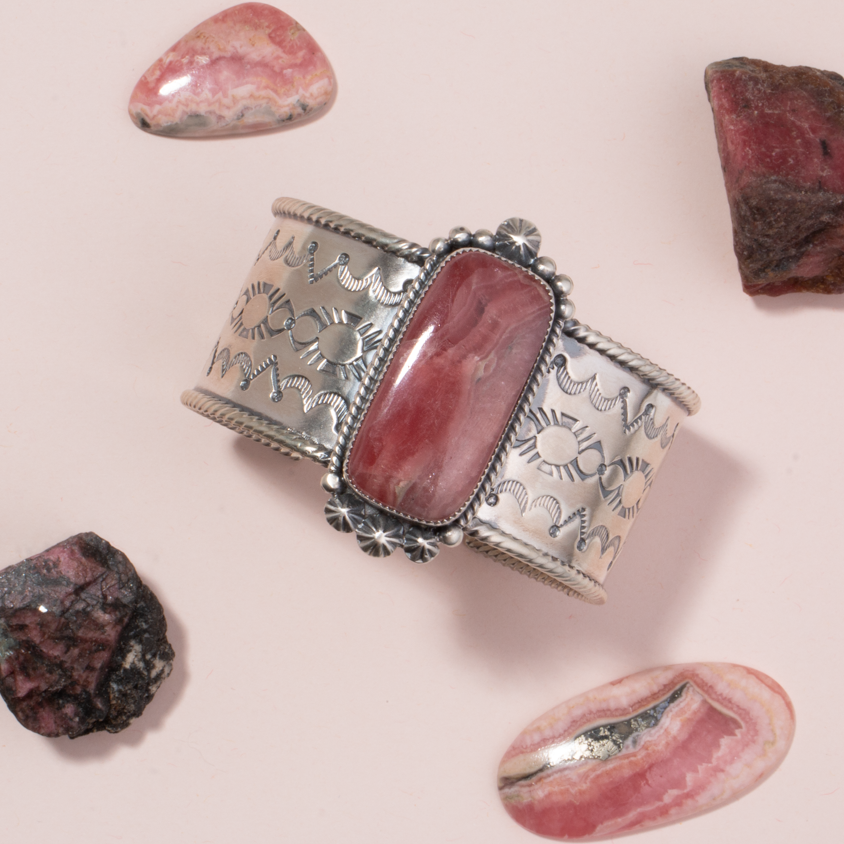
Real stones from the T.Skies archive, photographed by us. Tap any stone to see it up close.
 Green-blue with golden-brown matrix, set in silver
 Cheyenne (Royston district): blue-green with tan matrix, set in silver
 Cheyenne (Royston district): pale blue with dark speckled veining
 Cheyenne (Royston district): pale mint with green and brown flecks
 Emerald Valley (Royston district): green to blue with golden-brown web, set in silver
 Morningstar (Royston district): green with brown matrix, set in silver
Where it comes from, and why one name covers several deposits
The district is in Esmeralda County, Nevada, and Lowry records that the first recorded mining occurred in 1902, with multiple deposits and claims discovered in the area since.1 Schiffer corroborates the date from the other direction, recording that the Royston area’s Royal Blue mine “was discovered in 1902.”2
Lowry lists the names those deposits have been marketed under — Oscar Wehrend, Royal Blue, Bunker Hill and Royston — and records that “the Royal Blue site is the largest.”1 Branson says the same thing in different words: “The Royal Blue Mine is the main producer.”3
Why one name won is stated plainly by Lowry: because most of the turquoise from these multiple sites has “a similar look and color,” material from the area is “generally marketed using the name Royston.”1 That is the whole mechanism, and it is not a marketing trick — it is what happens when neighbouring deposits produce stone you cannot tell apart.
Chambless arrives at the same district framing from provenance research rather than mining history, reporting that artifacts have been linked to turquoise mined from the Royston District in Nevada — while stating in the same breath that research is in its early stages.4 We carry that hedge along with the claim, because he did.
The colour — and the two different scales our sources speak at
This is the part that gets flattened elsewhere, so here are the two statements separately, each at the scale its own source used.
At district scale. Branson records the mines of the Royston district producing turquoise that runs from “deep green to deepest blue.”3 That is a district-wide range, and it is the only district-wide colour statement in our reference books.
At mine scale. Schiffer describes one specific deposit: the Royston area’s Royal Blue mine “has given up stones of dark green and blue color with brown matrix.”2 That sentence is about the Royal Blue mine. It is not about the district.
The two can be connected, but only through steps that are themselves sourced, so here they are. Royal Blue is the largest site in the district1 and its main producer3; the district’s deposits share a similar look and colour, which is the stated reason they are all sold as Royston.1 Follow that chain and Schiffer’s brown matrix can reasonably speak for much of what reaches you as Royston. Skip it and you have quietly turned a one-mine sentence into a district fact.
Branson also plates “unmounted Royston stones, illustrating the great variety of color and matrix pattern found in this locality.”3 That is a plate caption rather than body prose, so we treat it as reinforcement and never as the load-bearing sentence.
Two things our books do not say. No source in our reference books attributes spider-web matrix to Royston, and none gives it a hardness grade. If you meet either stated as fact, it is not coming from these four books.
The fraud — why this page does not say “golden brown matrix”
Look up Royston anywhere else and you will meet the phrase golden brown matrix almost immediately. Before deciding what to do about that, we went looking for it in our own books.
It is there — twice, and neither time is it Royston. Branson uses “a golden brown matrix” to describe Manassa green from the King Mine in Colorado, and separately records Lone Mountain turquoise being graded into “golden matrix; black matrix, and spider web.”3 The word “golden” appears nowhere in our sources in connection with Royston. Brown matrix does — through Schiffer, and scoped to the Royal Blue mine.2
What we are not saying. We are not telling you the trade is wrong about Royston. Absence from our reference library is not absence from the mineral, and we have no basis for the stronger claim. What we can give you is exactly what our sources support and exactly where they stop, which is the boundary this entire page is built on.
Who worked it, and what the record will not carry
Lowry names Julius Tannenbaum as “one of the more famous names to have mined this area.”1
He is also unusually blunt about the district’s reputation. Royston “has been said to produce millions of dollars worth of turquoise, yet there are no fences, castles, mansions, or paper trails to confirm” such claims of prosperity.1 We would rather quote that than the legend.
On ownership, Lowry records three recent owners of the area’s deposits: John Martin, the Otteson family, and Philip Chambless.1 Disclosure: that third name is the co-author of another book on this page’s source list.4 We would rather flag that than quietly cite a source with an interest in the subject.
This section is short, and short is the honest length. One name is what the record in front of us will carry.
The Royal Blue name collision
There is an unresolved conflict inside our own sources here, and smoothing it over would be the easy thing to do.
Schiffer’s alias table lists “Royston (also called Royal Blue),” and lists “No. 8” as a separate entry — so Schiffer does not treat the two as the same thing.2 Lowry, meanwhile, records Number Eight’s claims in Eureka County as being known as “Royal Blue, Royal Blue No. 1, and Blue Star.”1 Both statements sit in books we rely on, and they describe deposits several counties apart.
We are not going to pick a winner on your behalf. The practical version is simple: “Royal Blue” on its own is ambiguous in the literature, so ask which deposit and which county — and expect that the answer will often not be available.
Current status
Uncertain, and our sources do not resolve it.
The most recent reference work we hold is Lowry, published in 2010, which records three recent owners of the district’s deposits as of that date.1 It makes no statement anywhere that the Royston district is open, closed, or currently producing. The one book cited on this page that does is Jacka (1995, p. 81), in which the dealer Gene Waddell listed Royston among the Nevada mines that were closed as of 1995.9 That is a 1995 statement, so we do not state a current status either.
As Lowry puts it, “which mines are active can change year to year depending on whether someone invests the money to reopen an old mine or discovers a new one.”1
From the Library: Branson, Turquoise: The Gem of the Centuries (1975)
1975 primary source. Anything described as current here describes 1975, not today.
Branson (1975), on the neighboring Easter Blue Mine:
“The turquoise produced recently is similar to that found in the nearby Royston mines, and at Pilot Mountain.”
— Branson (1975), p. 38 [5]
According to Branson (1975, p. 39), the Ajax Mine, then one of the small new mines of the Royston area north of Tonopah, produced mostly light blue stone with darker blue veins and blotches and a greenish cast. Some stones were a predominating dark green with light blue blotches, which he found interesting but not especially popular. [5]
From the Library: Lowry, Turquoise: The World Story of a Fascinating Gemstone (2010)
2010 primary source. Anything described as current here describes 2010, not today.
According to Lowry (2010, p. 135), Lee Hand, a Nevada miner of the first half of the twentieth century said to have owned and worked more turquoise mines than any man alive or dead, was involved with the Royston, Blue Gem and Number Eight mines and over seventy others. [1]
According to Lowry (2010, p. 226), the first recorded mining in the Royston district was in 1902; its deposits were marketed as Oscar Wehrend, Royal Blue, Bunker Hill and Royston, the Royal Blue site was the largest, and because the stone looks similar across the sites it is generally sold as Royston. [1]
According to Lowry (2010, p. 226), three recent owners of the district's deposits were John Martin, the Otteson family and Philip Chambless. [1]
According to Lowry (2010, p. 247), "Tiffany" and "Tiffany blue" were used as marketing names in the Royston area of Nevada, the Cerrillos and Tyrone areas of New Mexico and elsewhere, yet there did not seem to be any paperwork proving the Tiffany Company actually owned a turquoise mine. [1]
From the Library: Schiffer, Turquoise Jewelry (2008)
2008 primary source. Anything described as current here describes 2008, not today.
Schiffer (2008, p. 31) illustrated a Navajo bracelet set with Royston, Nevada, turquoise, circa 1965. [2]
From the Library: Turnbaugh, Indian Jewelry of the American Southwest (2007)
2007 primary source. Anything described as current here describes 2007, not today.
Captioning a piece photographed for their late-1980s primer, William and Sarah Turnbaugh (2007) wrote:
“This nugget of natural turquoise from Royston, Nevada, is encircled with silver applique leaf or feather elements.”
— Turnbaugh (2007), p. 32 [6]
From the Library: Ryan & Chambless, Turquoise in America Part Two: 1910–1990 (2020)
2020 primary source. Anything described as current here describes 2020, not today.
According to Ryan & Chambless (2020, p. 57), the Royston District northwest of Tonopah was originally named the Crow Springs district. [7]
According to Ryan & Chambless (2020, p. 64), a week before selling the Royal Blue to William Petry in April 1904, the Workman brothers sold their other Quartzite Mountain claims, all except the Blue Bell, to the Quincy Mining Company, a large Michigan copper company also operating in Arizona; the authors found no sign it cared about turquoise and think it was buying into the Tonopah silver boom. [7]
According to Ryan & Chambless (2020, p. 77), Royston was a small boomtown about 25 miles northwest of Tonopah, named after W. H. Royston, a shareholder of the Hudson Mining and Milling Company, and his name became the name of the mining district; by the end of 1921 it had 300 people and 16 buildings, and it disappeared quickly once the silver mining ended. [7]
According to Ryan & Chambless (2020, p. 77), W. H. Royston also helped establish the core Royston turquoise claims: in August 1921 he and three partners received a patent (survey 4414) for six lode claims lying east of the Royal Blue patent claims and of the unpatented Royal Blue, Montezuma, Aztec and Hill Top groups. [7]
According to Ryan & Chambless (2020, p. 77), after the Hudson company lost its state charter in 1923, its directors (the Walkers and A. H. Jones) controlled the patented claims as trustees and later also acquired the former Quincy Mining Company claims, including the Snow Storm and Storm Cloud; as of 2020 the authors reported these were collectively known as Royston Turquoise. [7]
According to Ryan & Chambless (2020, p. 77), newspaper reports from August to December 1929 said the turquoise mining rights at Royston were leased to B. H. Sewell and Frank Keller, who claimed to have found the old vein of distinctive Royal Blue turquoise. [7]
According to Ryan & Chambless (2020, p. 79), a 1929 brochure of the Royston Royal Blue Turquoise Mine Company survives in a private collection. [7]
According to Ryan & Chambless (2020, p. 75), the Bunker Hill claim next to the Royal Blue was located by Roy Palfreyman, Bert Kopenhaver's partner, and a 1937 list they reproduce records the Bunker Hill in the Royston district as owned by Lee F. Hand and Charles A. Bona. [7]
Tony Edgar, whose family came to turquoise through the King mine at Manassa, recalled in an interview published by Ryan & Chambless (2020):
“What I was told was, in 1939, my grandpa got a lease on a mine. They called it Bunker Hill, but it was in the Royston Mining District.”
— Ryan & Chambless (2020), p. 100 [7]
Tony Edgar recalled, in an interview published by Ryan & Chambless (2020, p. 101), that from about 1940 his grandfather Travis Edgar moved his wife and children out to the Bunker Hill lease, hauled water from the springs up to the mine and mined some turquoise, and that other Edgars then came to Tonopah or Royston. [7]
Interview recollections below are the speaker's memory, published by Ryan & Chambless (2020); they describe the 1940s-1970s.
David Layton recalled, in an interview published by Ryan & Chambless (2020, p. 129), that in the 1930s his father Alvin Layton teamed up with Lee Hand to mine the Royal Blue, now known as Royston turquoise, living in a cabin at Royston about eleven miles from Tonopah. [7]
According to Ryan & Chambless (2020, p. 139), Travis Edgar mined at the Bunker Hill in 1939-1940. [7]
According to Ryan & Chambless (2020, p. 141), in November 1962 Lee Hand granted a four-year lease with a $50,000 purchase option to Grant H. Huntley and Robert B. Daniel of Colorado, covering the Royal Blue patented claim (Survey No. 2404) and the unpatented Blue Bell, Royal Blue, Montezuma, Aztec, Hill Top and Total Wreck claims. [7]
Ryan & Chambless (2020) define the claim group behind the market name:
“These are the claims we will consider the core of what came to be known collectively in the market as Royston turquoise.”
— Ryan & Chambless (2020), p. 141 [7]
According to Ryan & Chambless (2020, p. 141), Lee Faris Hand died on January 18, 1963, in San Bernardino County, California, and was buried in Tonopah, and the claims passed into his estate. [7]
According to Ryan & Chambless (2020, p. 141), Huntley and Daniel assigned the lease to the Anaconda Company in July 1964, and after four unsuccessful exploratory drill holes Anaconda abandoned it in 1965. [7]
According to Ryan & Chambless (2020, p. 141), on May 29, 1967, the First National Bank of Nevada, as executor of Hand's estate, conveyed the Royal Blue patented claim and the core unpatented claims to Nelson O. Smith for a stated $10, which the authors believe was really $2,500; on April 2, 1968, the Smiths quitclaimed the unpatented claims to Ray C. Wilcox and Dale B. Dorothy, known as the Royal Blue Mining Company. [7]
Bill King recalled, in an interview published by Ryan & Chambless (2020, p. 147), that the Edgars learned turquoise mining with his father at Manassa in the 1930s, then went to Tonopah and got the Royston (Bunker Hill) mine before moving on to Battle Mountain. [7]
Tom Otteson recalled, in an interview published by Ryan & Chambless (2020, p. 152), that around 1967 to 1969 Charlie Hammack and John Martin, who had been trying to work silver on the patent claim at Royston, joined his father to mine its turquoise by hand; they sold a lot of it straight from the family's yard near Tonopah, and Martin later bought the patent claims from the owning company in Reno in his own name. [7]
From the Library: Lowry, Turquoise Unearthed: An Illustrated Guide (2002)
2002 primary source. Anything described as current here describes 2002, not today.
According to Lowry (2002, p. 67), Royston was originally known as the Royal Blue mine, and its turquoise mixed blues and greens in the same formation. [8]
As of 2002, Lowry (2002, p. 67) judged that several deposits in the Royston area could still be profitably mined. [8]
From the Library: Jacka, Navajo Jewelry: A Legacy of Silver and Stone (1995)
1995 primary source. Anything described as current here describes 1995, not today.
As of 1995, Gene Waddell of Waddell Trading Company, who also held part of the Lone Mountain Mine, told Jacka (1995, p. 81) that most of the good Nevada mines, Royston among them, were closed. [9]
From the Library: Schiffer, Indian Jewelry on the Market (1996)
1996 primary source. Anything described as current here describes 1996, not today.
In 1996 Schiffer described green Royston spiderweb on a bolo tie:
“one with two bear’s claws, coral, and two green Royston Spiderweb turquoise stones, Kakiki.”
— Schiffer (1996), p. 64 [10]
Field Notes by Mateo James
The thing worth carrying out of this page is that “Royston” answers a smaller question than it looks like it answers. It tells you an area in Esmeralda County. It does not tell you which deposit — and our own sources say the deposits look alike, which is precisely why they all ended up sharing one name on the tag.
That is also why we frame our own sourcing the way we do: most of our turquoise comes from American mines such as Kingman or Royston, or from Campitos in Mexico. “Most” and “such as” are doing real work in that sentence — the list is not exhaustive, and we would rather say so than publish a tidier claim we cannot stand behind.
If you are offered Royston with a confident single-mine provenance and a colour description our books do not contain, it is worth asking that seller what they are citing.
I notice the Ajax sits in two different places in our sources. Branson (1975) lists it among the small new mines of the Royston area north of Tonopah, while Ryan & Chambless (2020, p. 59) trace the Ajax to Carl Riek's Oriental Blue claims in the Candelaria district north of Columbus. I tend to side with Ryan & Chambless, and I have left both on the page.
I notice the county shifts between sources. Lowry places the Royston district in Esmeralda County, while the 1937 list reproduced by Ryan & Chambless (2020) files Royston claims under Nye County, once writing "Nye County (Esmeralda)", and Pogue put the Royal Blue in Nye County in 1915. The district sits near the line between the two counties, so I have shown both rather than pick one.
The Lowrys frame the name two ways. Their 2002 guide says Royston was "originally known as the Royal Blue mine" (Lowry 2002, p. 67); their 2010 book treats Royal Blue as one of several sites in the district, all generally sold as Royston. I show both, because a tag reading Royal Blue or Royston can point to the same stone.
I notice this page said none of its books states whether Royston is open or closed. Lois Essary Jacka's 1995 book now does, through Gene Waddell, who listed Royston among the closed Nevada mines as of 1995. That is one dealer's statement for one year, and I have added it as such.
How this page is sourced. Every factual claim above is drawn from the printed reference works listed below and is footnoted to the book it came from. Where our sources disagree we say so and do not pick a winner; where they are silent we say that too, rather than filling the gap. Nothing on this page comes from general web knowledge.


We strive for accuracy. This field guide entry is compiled from the published references cited below and is continuously updated with new information from the artists, their families, and the community. See something inaccurate, or hold documentation on this mine? Get in touch — corrections are welcomed and credited.
Back to the Southwest Jewelry Guide.
Sources
- Lowry, Joe Dan, and Joe P. Lowry. Turquoise: The World Story of a Fascinating Gemstone. Layton, UT: Gibbs Smith, 2010. Cited by printed page. Statements describe conditions as of 2010.
- Schiffer, Nancy N. Turquoise Jewelry. Revised 4th ed. Atglen, PA: Schiffer Publishing, 2008. Cited by printed page. Statements describe conditions as of 2008.
- Branson, Oscar T. Turquoise: The Gem of the Centuries. Santa Fe: Treasure Chest Publications, 1975. Cited by printed page. Statements describe conditions as of 1975.
- Chambless, Philip, and Mike Ryan II. Turquoise in America, Part One: The Great American Turquoise Rush, 1890–1910. Revised first edition. Callais Press, 2021. Cited by printed page. Statements describe conditions as of 2021.
- Branson, Oscar T. Turquoise: The Gem of the Centuries. Santa Fe: Treasure Chest Publications, 1975. Cited by printed page. Statements describe conditions as of 1975.
- Turnbaugh, William A., and Sarah Peabody Turnbaugh. Indian Jewelry of the American Southwest. Foreword by Barry M. Goldwater. Atglen, PA: Schiffer Publishing, 2007 (copyright 1996 and 2007; first published 1988). ISBN 0-7643-2577-9. Cited by printed page. Statements describe conditions as of 2007.
- Ryan, Mike, II, and Philip Chambless. Turquoise in America, Part Two: 1910–1990. Callais Press, 2020. Cited by printed page. Statements describe conditions as of 2020.
- Lowry, Joe Dan, and Joe P. Lowry. Turquoise Unearthed: An Illustrated Guide. Photography by Mark Nohl. Tucson, AZ: Rio Nuevo Publishers, 2002. Cited by printed page. Statements describe conditions as of 2002.
- Jacka, Lois Essary. Navajo Jewelry: A Legacy of Silver and Stone. Photographs by Jerry Jacka. Flagstaff: Northland Publishing, 1995. Cited by printed page. Statements describe conditions as of 1995.
- Schiffer, Peter N. Indian Jewelry on the Market. Text and photography by Peter N. Schiffer. Atglen, PA: Schiffer Publishing Ltd., 1996. Cited by printed page. Statements describe conditions as of 1996.
Shop the T.Skies turquoise jewelry collection →
Compare this mine with every other: Turquoise Mines Identifier, a documented stone study, mine by mine.