



Onyx in Southwest Jewelry: The Black That Stood In
Onyx entered Southwest jewelry as an understudy and stayed on as a lead. The record is unusually blunt about it: onyx was often substituted for jet through the 1920s and 1930s[1]. Where jet is fossil wood, onyx is banded chalcedony, harder and denser, and it takes a mirror polish that jet cannot hold. By the mid-century it had become a material in its own right — Bedinger lists it among the genuinely new arrivals of the period, alongside walrus and elephant ivory, ironwood from southern Arizona, and obsidian[2].


Onyx in the Masters' Hands
Onyx is a channel-work stone. The Encyclopedia names the standing palette for channel inlay directly — turquoise, onyx, and shell — set into silver compartments normally built from 18-gauge stock, with each stone requiring expert grinding to seat[3]. That is why onyx suits the technique: it is hard enough to take a crisp ground edge without crumbling, so the black lines stay true against the metal. It is also why channel pieces are difficult to repair — the fit that makes them beautiful is the fit that makes them unforgiving[3].
Named hands: Ben Nighthorse works white onyx for inlay, beside pink coral, lapis, malachite, sugilite and turquoise[4]. Loco sets carnelian, obsidian and onyx in hammered silver and gold, drawing on Apache Mountain spirit dancers and the four-pointed morning star[5]. Davida Lister, working since 2017, sets turquoise, coral and onyx in cluster work[6] — the material is still in the current generation's hands, not a period curiosity.
Reading Onyx
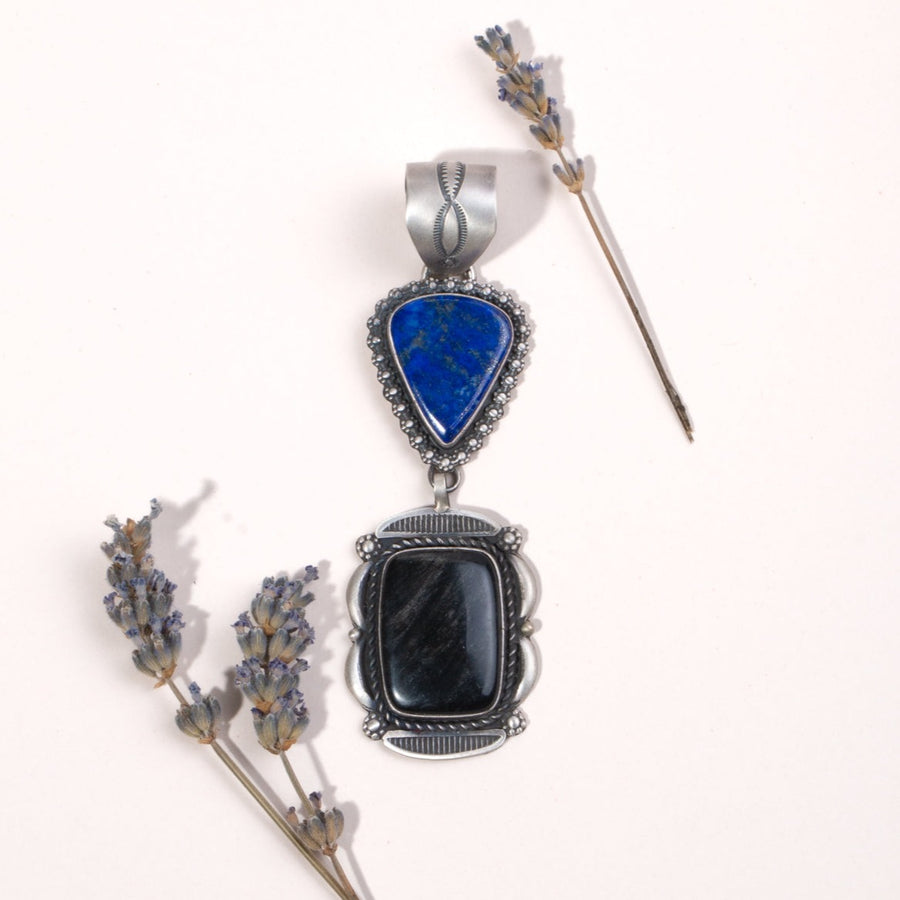
Know what you are buying. Most jewelry onyx is Mexican onyx, and its black is not always native to the stone: it runs white to gray to tan, and reaches deep black after treatment with heat. Black and white are the most popular colors among contemporary fine-art jewelers[7]. Heat treatment is standard, stable and permanent — this is not a defect and not a trick, but it is a fact a seller should be willing to state plainly.
Then the substitution question, which runs in both directions. If a piece dates from the 1920s or 1930s, a black stone may be onyx standing in for jet[1]. If it dates from the Depression years, it may be neither: Santo Domingo makers used pieces of phonograph records and automotive battery cases in place of jet or onyx[8], and those improvised mosaics are now collected and valued as the record of that decade.
The practical tell is hardness and weight. Onyx is a quartz — heavy in the hand, cool to the touch, and it holds a sharp unchipped edge where jet and plastic will not.
A note on accuracy. We strive for accuracy, and this page is continuously updated with new information from the artists, their families, and the community. Corrections welcome.
From the Library: Bassman, The Beauty of Navajo Jewelry (1997)
1997 primary source. Anything described as current here describes 1997, not today.
Bassman (1997, p. 57) pictured black onyx set in bola ties: silver overlay and stampwork by Kee Nez, and a stamped bola tie and belt buckle set by Howard Nelson. [9]
Sources
- Encyclopedia of Native American Jewelry, p. 141
- Bedinger, Indian Silver, p. 187
- Encyclopedia of Native American Jewelry, p. 80
- Encyclopedia of Native American Jewelry, p. 171
- Encyclopedia of Native American Jewelry, p. 150
- Hougart, Native American and Southwestern Silver Hallmarks (5th ed.), p. 250
- Encyclopedia of Native American Jewelry, p. 177
- Encyclopedia of Native American Jewelry, p. 205
- Bassman, Theda. The Beauty of Navajo Jewelry. Photography by Gene Balzer. Walnut, California: Kiva Publishing, 1997. Cited by printed page. Statements describe conditions as of 1997.
← Back to the Southwest Jewelry Guide · Inlay: the technique · Cluster work · Gemstone Guide