



Magnesite: The White Stone Sold as Turquoise
Magnesite earns a page here for the opposite reason to every other stone in this guide. It is a magnesium carbonate, similar to calcite, naturally white[1] — and in this market you will most often meet it wearing another stone's name. Lowry states the practice without softening it: howlite and magnesite are naturally white minerals that are dyed to imitate a variety of turquoise colors[2]. If you are learning to buy turquoise, magnesite is the shape the mistake usually takes.

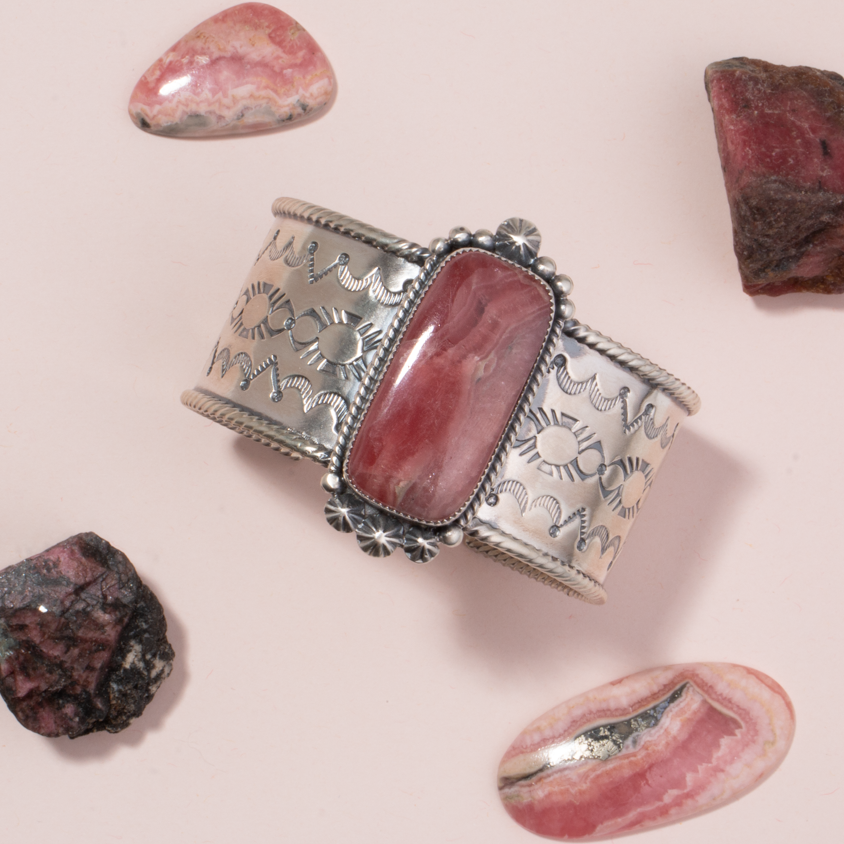
More magnesite examples
Real stones from the T.Skies archive, photographed by us. Tap any stone to see it up close.


Magnesite in the Masters' Hands
Honest answer: it doesn't have a roster, and we are not going to invent one. Magnesite appears in the literature of this trade chiefly as an imitation material and as a mineralogical near-neighbor of turquoise, not as a stone that named Southwest masters chose for its own qualities. Where white stone is deliberately set in Southwest work, the documented material is usually white shell — the Zuni turn to white shell alone as a setting for silver bracelets, brooches and rings is a recorded mid-century development[3], and it is a different story with a different meaning. Magnesite, dolomite, howlite and calcite have all been marketed in the turquoise industry for their unusual white colors and matrixes[1]. Marketed is the operative verb.
Reading Magnesite
Dyed white stone is convincing, and it fools careful people. Lowry records a buyer who paid for a turquoise necklace at a well-known Santa Fe store and later learned it was dyed howlite; the manager replaced it immediately[4] — which is the useful half of the anecdote. Most reputable dealers want the correction made.
What to look for: dyed magnesite and howlite tend toward an even, flat, slightly chalky blue with the color concentrated in the matrix veining rather than in the body of the stone — because the dye travels through the porous seams first. Natural turquoise runs the other way, with color in the stone and the matrix reading as host rock. If a "turquoise" is uniformly, cheerfully blue across a large piece at a small price, weigh that.
Your real protection is paper. The FTC guidelines call for a written guarantee carrying the seller's name, address, telephone number and date, and describing the grade of what you bought[5]. Ask for it in writing. A dealer who will put the stone's identity and treatment on paper is a dealer worth returning to — and a dealer who won't has told you what you needed to know.
A note on accuracy. We strive for accuracy, and this page is continuously updated with new information from the artists, their families, and the community. Corrections welcome.


Sources
- Lowry & Lowry, Turquoise: The World Story of a Fascinating Gemstone (2010), p. 118
- Lowry & Lowry, Turquoise: The World Story of a Fascinating Gemstone (2010), p. 209
- Bedinger, Indian Silver, p. 202
- Lowry & Lowry, Turquoise: The World Story of a Fascinating Gemstone (2010), p. 214
- Lowry & Lowry, Turquoise: The World Story of a Fascinating Gemstone (2010), pp. 193–194 (summarizing FTC guidance)
← Back to the Southwest Jewelry Guide · How to tell real turquoise · Gemstone Guide
From the T.Skies Journal