



Glossary of Southwest & Native American Jewelry Terms
This glossary defines the words you will meet when buying Southwestern and Native American jewelry — the bench techniques, stone treatments, metals, forms and trade terms that describe how a piece was made and what it is. It gathers 203 terms in plain language so you can read a tag, ask a better question, and know what the answer means.
A B C D E F G H I J K L M N O P R S T V W Y
A
- agate
- A semiprecious gemstone consisting of a hard vareiety of chalcedony often found in a wide range of colors.
- annealing
- Treating metal with heat to change its physical properties for design and workability.
- Antique
- A piece at least a hundred years old, by long-standing trade convention. Like "vintage" it has no definition in the FTC Jewelry Guides, so an antique claim rests on the documentation behind it — construction, materials, provenance — and not on the word.
- anvil
- Any hard surface a smith hammers against. Early Southwest smiths used whatever was solid and to hand — a smooth rock, a cut length of railroad rail, the head of a sledge or a large bolt.
- appilique
- An element of a design that accents the main design feature.
- Appraisal
- Professional valuation of a jewelry item.
- arranged cluster
- Arranged clusters are oriented in a repeating circular pattern starting with a center stone then encasing the center stone with geometrically measured “rows” of stones matching in size and shape.
- Art Jewelry
- Individually made, one-of-a-kind or limited edition pieces.
- Authenticity Certificate
- Proof a piece was made by a verified artist.
- azurite
- A deep blue copper carbonate, often found intergrown with green malachite. It is softer than turquoise and is used in inlay and in cabochons.
B
- backing
- A strong base to reinforce the back side of a stone.
- bail (bale)
- The bail or bale is a loop or hook that connects a pendant to another piece of jewelry. Traditionally the bail is an independent piece however in Native American jewelry the bail can be completely attached to the pendant.
- band
- The encircling body of a ring. Used loosely for a ring with no set stone.
- bandolier pouch
- A leather pouch decorated with silver buttons, carried on a strap over the shoulder.
- bangle
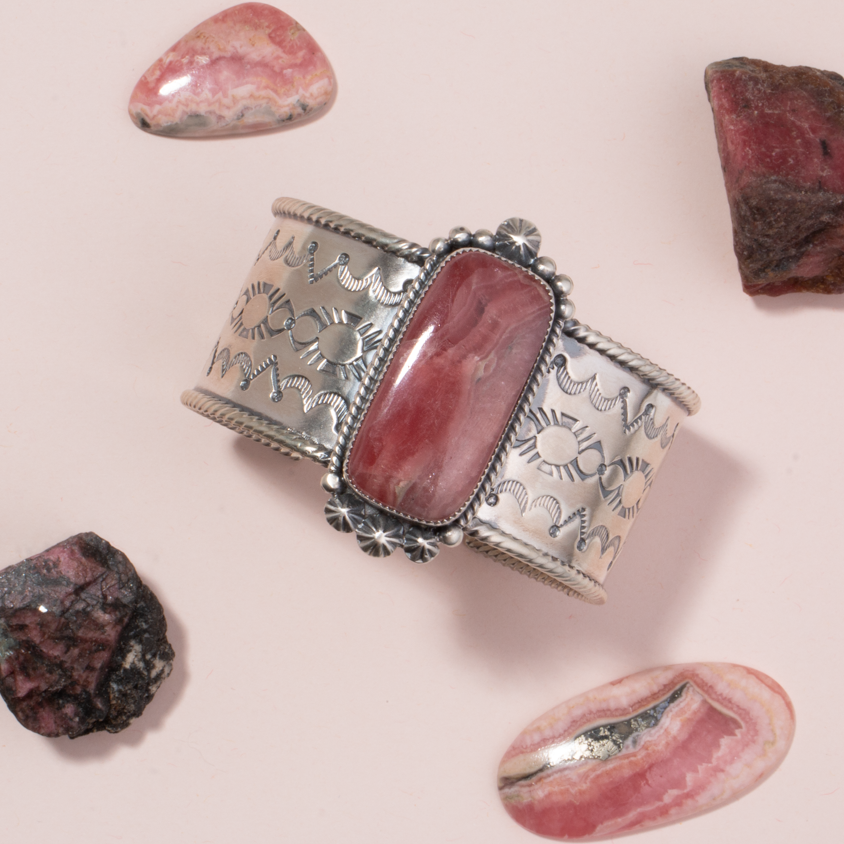
- An early style bracelet that is a large heavy wire or shank that is decorated with stamp or file work.
- barrel clasp
- A two-part clasp that screws together into a barrel shape, the seam concealed in the profile.
- barrette
- A hair clasp with a sprung or hinged bar on the reverse. One of the newer forms Southwest smiths took up in the twentieth century, alongside hair combs, tie tacks and money clips.
- bead
- A small decorative object that can be strung by a pierced hole in its structure.
- bead cap
- A small shaped cup seated against the end of a bead, framing it and finishing the point where it meets the strand.
- bead work
- Bead work or beaded jewelry uses strung beads of stone or shell. Beadwork is most commonly seen on necklaces however can be found on just about every type of jewelry. There are many different types of beads and several things that they can be strung on. Beads can be made from gemstones, natural organic materials, metals, glass, or plastic in different shapes and sizes. Most commonly beads are natural stone nuggets and finely cut shell disk beads called heishi. In Native American jewelry, beads are strung on woven thread string, metal cable, or plastic. Historically bead jewelry can be found on classical organic fibers from plants such as yucca, which are very rare but can still be found.
- beading wire
- Fine multi-strand steel cable, usually nylon-coated, used to string beads where thread would abrade through. Commonly called tigertail.
- belt
- A band that fits around a person's waist traditionally made to support pants. This item of clothing is not only used for utility but also for fashion. In the Native American jewelry industry the buckle or band can be decorated with precious metal and gemstones. The most common style features a leather band decorated with a series of sterling silver oval plaques called conchos.
- bench beads
- A craftwork type handmade bead when at artist takes two prefabricated metal half bead shells, decorates them and fixes them together.
- beveled
- A stone that is cut on a slant.
- bezel
- A metal strip that serves as the side walls of gemstone housing to hold the stone in place.
- bezel setting
- A setting in which a strip of metal wraps the full edge of the stone. See bezel.
- block turquoise
- A synthetic resin turquoise that is colored with dyes. The material is sold in cubic blocks which were it gets its name. There is no real turquoise in true block turquoise. It can be found in a wide range of patterns and colors as manufacturers try to mimic some of the more famous and popular turquoise mines.
- bloodstone
- A dark green chalcedony flecked with red iron oxide. Used as an inlay material rather than as a set stone.
- bola
- A variant spelling of bolo, used for the same slide-and-cord necktie. Both spellings appear throughout the literature and refer to the same object. See bolo tie.
- bolo tie
- A western style necktie consisting on a decorative slide clasp pendant centerpiece strung on braided leather cords. Also spelled bola tie.
- bolo tips
- The decorated metal sheaths finishing the two cord ends of a bolo tie. Also called aiglets, from the same word as the tip of a shoelace.
- bowguard
- A leather armpiece that protects the arm from the bow string often decorated with silver.
- box chain
- A chain of square links joined face to face, reading as a continuous row of small cubes.
- box clasp
- A clasp in which a folded metal tongue is pushed into a hollow box and springs open to lock. Traditional on strung bead necklaces, where the box can carry stones and become part of the design.
- bracelet
- A piece of jewelry worn on the arm or wrist.
- brilliant cut
- A faceted cut of triangular and kite-shaped facets arranged to return the maximum light through the top of the stone.
- brooch
- A piece worn fastened to cloth by a hinged pin and catch. The Southwest trade more often says "pin."
- buckle
- A clasp like hinged pin used for fastening two ends of a strap.
- burnisher
- A tool used to push the bezel around a stone to hold it in place.
- butterfly
- The small shaped spacer set between the conchas on a concha belt, named for its pinched waist and flared ends.
- button
- A small circular garment used to fasten or for decoration.
C
- cable chain
- The plainest chain: uniform oval links, each set at a right angle to the last. The default against which other chains are described.
- cabochon
- a cut and polished gemstone usually in a round or oval shape and flat on one side.
- calcite
- Calcium carbonate in crystaline form.
- Calibrated Stones
- Machine-cut to standard sizes for easy setting.
- carat
- A unit used to measure weight. 5 Carats = 1 Gram
- carding
- The process of separating the wool fibers before spinning.
- cast work
- Casting style is jewelry made from cast metal. Casting is the process of heating and melting metal, and then pouring the molten metal into a mold to form the desired shape. There are basic types of casting used in Native American Jewelry; Tufa Casting, Sandcasting, and Machine casting. The end result cast can have different textures according to the type of material that was used as a mold.
- chain
- A series of metal links used to hang or connect independent pieces of jewelry
- chain work
- Chain is not generally a style but a way to string, hang or connect other parts of jewelry. However, artists can sometime get creative with their chain work. Most of the time chains are found on necklaces to string pendants or as a terminal finish to give a little style to bead work necklaces. Chains can be either prefabricated or handmade. Handmade chains can take a long time as the artist has to individually create every link and connect them by hand. Handmade chains generally greatly increase the value of a piece.
- chalcosiderite
- A member of the turquoise group in which iron takes the place of aluminum. It is one of the minerals most often mistaken for turquoise, and telling the two apart reliably takes a laboratory test.
- chalk block turquoise
- A type of block turquoise which fine natural, normally unsuable turquoise chalk is added to the resin mixture so that the material can be called real turquoise.
- chalk turquoise
- Pale, soft, porous turquoise that will not take a polish in its natural state. It is the grade most often stabilized, which is why "stabilized" on its own says nothing about the quality of the stone underneath.
- channel
- Walls of silver that create grooves to hold stones in place.
- channel inlay
- Channel is a more rare and traditional style. Channel inlay is where the artists use stripes of metal called channels to hold the stones in place. It is easily recognizable by the segmenting metal lines between the stones. The channels are often made first, and then stones are carefully measured and cut to fit between the channels. Most of the time, a type of epoxy is used to secure the stone for a more secure long term fit.
- channel setting
- A setting in which stones sit in a metal channel with no metal between them. See channel and channel inlay.
- charoite
- A rare silicate mineral that makes a beautiful purple color with cream white matrix.
- chemical oxidation
- The use a chemical to cause oxidation.
- chert matrix
- Matrix made of chert, a hard dense silica, usually reading as black and holding a sharp edge against the turquoise. It describes what the matrix is made of rather than the pattern it makes.
- chip inlay
- A technique in which recessed areas of a silver design are filled with epoxy and fragments of crushed turquoise, coral, jet or shell rather than with cut stone. It was first worked in the early 1960s by Navajo smiths including Dean Kirk and Tom Singer, and fills the areas that plain overlay would have left dark.
- choker necklace
- A necklace that fits tightly around the neck.
- chrysocolla
- A copper silicate ranging through blue and green, frequently confused with turquoise. It is softer and is often cut with the quartz it forms in to make it workable.
- chunk necklace
- A necklace strung from large, irregular, minimally shaped turquoise nuggets rather than cut or matched stones.
- clasp
- An interlocking device used for holding two things together.
- closed center
- A concha with a solid, unpierced center, fastened to the belt by loops soldered to the back rather than by a slot through the face.
- cluster
- The stone cluster design is another term that refers to the arrangement of the stones. The stones are placed in a non-linear fashion. There are two different types; arranged clusters and random clusters. The arranged cluster is the classical or traditional cluster design, it has been used for many generations by Navajo and Zuni jewelry artists.
- cluster setting
- A setting of many small stones grouped in one design. See cluster.
- coin silver
- Silver from melted down coins. Coins were fairly accessible to the general public and Native American silversmiths often melted down the coins as a base for their jewelry. Old coins ranged in silver purity from 75% to 95% until the early 19th century. In 1906 the US passed a law stating that coins had to be at least 90% pure silver. In 1964 the US stopped the use of silver in coins. Coin silver is generally assumed to be less pure than sterling silver or fine silver. The value of Native American jewelry made from coin silver can be actually more valuable. This is because it can be associated with the age of the vintage pieces. A piece of jewelry actually made with coin silver would have to be made prior to the act of 1964.
- cold chisel
- A hardened steel tool with a straight cutting edge, used to cut sheet and to chase lines into metal. It was the primary cutting tool of the earliest period of Navajo silverwork.
- comtemporary
- If the jewelry does not fit into one of these categories then we commonly call it contemporary or “new style”. When contemporary styles become more common then they usually acquire their own nomenclature and become part of its own category. Contemporary jewelry can vary extremely and can sometimes look futuristic or impractical. Native artists are always coming up with new interesting styles to add to the industry.
- concha
- From the Spanish for "shell." An oval or round silver plaque, worn in a series on a belt or a bridle, and by extension the belt itself. "Concho" is the same word in its Anglicized trade spelling; the older literature uses "concha."
- concho
- A round or oval decorative plaque. Also spelled concha, the older and more common form in the literature.
- cones
- Sterling silver pieces used in jewelry to create or transition a design.
- connector
- Any component joining two or more elements or strands, from a plain ring to a worked multi-hole plate.
- copper
- a reddish brown metal that is used for jewelry making.
- coral
- Coral is considered an organic gemstone stone because it originates from the hardened tissue of a Coral Polyp. Corals are marine animals which are found in tropical oceans, they are an important in the support and creation of ocean reefs. Corals produce a hard skeleton made from calcium carbonate secretions. This hardened skeleton is what is collected and used to form the gemstone. Coral is found in many different colors it has become difficult collect many of the varieties due to the diminishing populations of coral. Coral reefs have become an endangered ecosystem and are strictly regulated. Some types of coral have been brought inland for farming and commercial use. One of the most modern and now commonly seen today is Chinese white coral which is stained red for a more natural look. This processed coral is shipped all over the world for jewel crafting and other arts. Coral jewelry has been found in many different cultures around the world. It comes in many different beautiful colors from black to white and from blue to red. Coral jewelry has a history of being strongly connecting with religious and spiritual meanings in the Italian, Chinese and Celtic cultures, it is also one treasure in the Buddhist scriptures. The southwestern Native American tribes quickly acknowledged the value of this jewel. Coral gems are softer than most other gemstones and can be easily shaped in to beads, center stones and other small shapes. It is seen in different types of jewelry that requires intricate sculpting such as inlay jewelry. Small samples of the gem can run up to $1000 per 1 mm diameter for some of the rare forms to about $5 at the low end. The market for coral is doing very well but the supply is slowly depleting which makes the prices for this precious gem continue to rise. Native Americans prefer to use red corals in their jewelry which are rare. Because natural red coral is becoming so scarce, some of the dyed processed gem is used to give that deep red look. One of the most valuable red versions is Oxblood Coral which is farmed in the Mediterranean. The pairing of its natural deep red color in contrast with a well selected turquoise stone can remarkably excaudate the blues and greens making it one of the most desired Native American styles.
- Corn Maiden
- A pan-Pueblo fertility and life-giving figure embodying corn as the sustaining crop, with distinct Hopi and Zuni traditions. She is carved as a fetish or set as a pendant in the form of a female figure with a corn-ear body, and is a common subject in Zuni fetish carving.
- craft work
- Work assembled by hand from pre-made components rather than shaped from raw stock — bench beads, built from two prefabricated half shells, are the standard example. Under the FTC Jewelry Guides only work whose entire shaping and forming is done by hand from raw materials may be called handmade.
- crimp bead
- A soft metal bead squeezed flat over beading wire to secure a strand end without a knot.
- crimp tube
- A short soft metal tube used as a crimp. It grips over a longer span than a crimp bead and holds heavier strands more reliably.
- Crow Mother (Angwusnasomtaka)
- A Hopi wuya — one of the chief kachinas — regarded as a mother and leadership figure among them. She presides over the Powamu (Bean Dance) ceremony and guides children's initiation into Hopi religious life; her mask is white with black-tipped crow wings tied at the sides. Hopi carvers and silversmiths openly render her in cottonwood dolls and in silver.
- crown
- The top area of a faceted gem
- crucible
- A container to melt silver in.
- crystal
- A mineral that has grown in a regular geometric structure with natural faces. The word is also used loosely in jewelry for cut leaded glass, which is not a crystal at all.
- cuff
- A jewelry bracelet that covers a fairly large part of the wrist.
- cufflinks
- A pair of fasteners joining the two sides of a French cuff, each with a decorated face and a hinged or fixed backing.
- culet
- A small facet at the very bottom of a gemstone.
- Cultural Appropriation vs. Cultural Appreciation
- Using vs. honoring cultural symbols; an important distinction for responsible buyers.
- curb chain
- A chain of interlocking links twisted and flattened so they lie flush in one plane rather than standing up.
D
- dangle
- An earring whose ornament hangs and swings below the ear wire.
- diamond slot
- An early concha style held to the belt by a bar with a triangular opening at either side for the leather to pass through; the two triangles together read as a diamond.
- die
- A steel tool used to raise or lower the surface of silver for decoration. Dies are sometimes cut in pairs, a male and a female, so the metal is formed between them.
- die stamping
- Working a design into silver with a shaped steel die under a hammer, either lowering the surface or raising it, depending on the die.
- disk bead
- A round flat bead in the shape of a disk or coin with a punctured hole in the center.
- dop stick
- A short rod to which a stone is cemented with wax so the lapidary can hold and turn it while grinding and polishing.
- Double-Barred Cross
- A stylized abstraction of the Zuni dragonfly (Shumakolowa) in which a second horizontal crossbar reads as the dragonfly's outstretched wings, carrying the same associations of rain and renewal. It is used as a simplified geometric pendant or repeated necklace motif, sometimes called a Pueblo cross.
- doublet
- A stone made by cementing a thin slice of turquoise to a backing of another material. Backing lets a thin or fragile stone be cut and set, and it increases the yield per pound of rough, so a doublet must be identified to the buyer.
- Dragonfly (Shumakolowa)
- Shumakolowa is the Zuni word for dragonfly, regarded as a messenger that carries prayers and a harbinger of rain and life. It is one of the most iconic Zuni motifs, rendered as pendants and earrings in silver with turquoise, coral, and shell inlay, and is sometimes abstracted as the double-barred cross.
- draw plate
- A plate of metal or bone drilled with a graduated series of tapered holes; wire is pulled through successively smaller holes to reduce its diameter.
- drop
- Any element that hangs free below the body of a piece — from a necklace, an earring or the arms of a naja.
- Dry Creek
- The Dry Creek turquoise mine is located outside of Austin, Nevada. The color of Dry Creek turquoise makes it unique among natural American stones. The turquoise is a very light blue/green, almost off-white.
- dyeing
- The use of colored dye to enhance the color of a substance or make it more uniform.
E
- ear back
- The fitting that secures a post behind the ear — a friction nut, a screw, or a locking back. Also called an ear nut.
- ear post
- A straight rigid pin passing through the piercing, secured behind the ear by a separate back. Also called simply a post.
- ear wire
- The wire that passes through the piercing and carries the body of an earring.
- earring
- An article of jewelry that is worn on the ears
- Earring Back Types
- Posts, hooks, or clips.
- Easter Blue
- The Easter Blue turquoise mine is a small claim located in southwestern Nevada. The mine is found in the Royston Mining District, along with many other active turquoise producing claims. The Easter Blue mine was initially claimed in 1907.
- eggshell matrix
- Another name for spiderweb matrix — host rock forming an even, enclosed web across the face of the stone. It is the rarest and most valued matrix pattern. See spiderweb.
- end cap
- A fitting closing the end of a strand or a length of wire and providing the attachment point for the clasp. See terminal caps.
- etched inlay
- Inlay in which a picture or design is etched into the surface of the set stone or shell, so the drawing sits in the stone rather than in the metal around it.
- Ethically Sourced
- Materials obtained in a way that respects both people and the environment.
- eye pin
- A straight wire with a loop already formed at one end, used to build linked segments and chains of beads.
F
- facet
- A flat polished surface of a gem
- faceted
- Cut with flat polished planes arranged to return light, as against a cabochon, which is domed and unfaceted. See facet.
- faustite
- A member of the turquoise group in which zinc takes the place of copper, giving a yellow-green stone. It was first identified in 1953 at the Carico Lake Mine in Nevada and is sold as a cabochon material in its own right.
- felting
- The process of soaking an kneading raw wool until it mats together into a fabric
- fetish
- A carving that is in a shape of an animal or deity
- figaro chain
- A curb variant with a repeating rhythm of links — typically three short followed by one long.
- file
- A tool used to shave or leave markings on a piece of jewelry.
- filework
- File work is very similar and also very simple. The artist will use a file sometimes along with a hammer in line markings into patterns along the metal base of the piece of jewelry. File work is also when using a file to shave or scratch the jewelry.
- filigree
- Wire that is used as applique.
- findings
- A small article of jewelry or piece of jewelry.
- fine silver
- 99.9% pure silver.
- flank
- A decorative element of a jewelry that is on the side of another element.
- flat bezel
- A type of bezel that has no teeth.
- flush setting
- A setting in which the stone is sunk level with the surface of the metal and held by the metal burnished over its edge. Also called a gypsy setting.
- fluted beads
- Beads worked with ridges radiating from the center out to the soldered seam of each half, so the finished bead is grooved rather than smooth.
- flux
- A chemical used to prevent the silver from oxidizing.
- fold-over clasp
- A clasp in which a hinged arm folds down over a bar or into a slot and snaps flat.
- forge (wrought)
- To shape by using a hammer.
- fracture-sealing
- Filling the cracks, pits and holes in a porous stone with a sealant, lacquer or filler to create a smooth, workable surface. It is a treatment and belongs in the disclosure, not in the description of the stone.
- Freeform Stones
- Hand-shaped, irregular stones preserving natural beauty.
G
- gallery
- The open structure between the setting and the shank, seen from the side. It is where a maker's finish shows most plainly, because it is the part a wearer rarely looks at.
- gaspeite
- An apple- to yellow-green nickel carbonate, named for the Gaspé Peninsula in Quebec and mined commercially in Western Australia. It appears in contemporary Zuni and Navajo inlay for its unusual green.
- Gauge
- Thickness of metal sheet or wire.
- gem-grade turquoise
- The hardest and most saturated turquoise, dense enough to cut and take a polish with no treatment at all. It is the smallest fraction of any mine's production.
- girdle
- The middle section of a gem between the crown and pavilion that usually foram a ridge line.
- glass
- A hard transparent substance made by melting and rapidly cool sand with other ingrediants.
- gold
- A deep yellowish precious metal that is highly valued. Used to make Money and jewely.
- gold filled / gold foil
- A base metal that has been covered in an outer layer of gold.
- Gold Karats (10K–24K)
- Measure of gold purity (24K is pure gold).
- graduated
- To be ordered from small to large.
- granular solder
- Early handmade solder, predating commercially available solder, named for the grainy surface texture it leaves after melting.
- graver
- A tool used for cutting or shaving metal.
- gypsy setting
- Another name for a flush setting, where the stone sits level with the surrounding metal.
H
- hair comb
- A decorative comb worn set into the hair, the teeth doing the holding and the silver head carrying the design.
- hallmark
- A signature stamp used by an artist to mark the art piece as their work.
- halo
- A ring of small stones set around a larger center stone, framing it and increasing its apparent size.
- hammer work
- A jewelry style that has been created by using a hammer to create designs or forge its shape.
- hand saw bezel
- A bezel whose upper edge is hand-sawn into teeth that are then bent over to grip the stone. The same construction the trade also calls a saw-toothed bezel; see sharktooth bezel.
- Handcrafted
- Assembled by hand from pre-made components.
- Handmade
- Created from raw materials by an individual artist.
- hard solder
- Solder alloyed with silver, melting at a relatively high temperature. It is the correct solder for silver jewelry because the joint matches the metal around it.
- head pin
- A straight wire with a stop at one end, threaded with beads and then looped at the top to make a drop.
- headstall
- The strapping of a bridle that holds the bit in the horse's mouth. In Southwest silverwork it is mounted with conchas and plaques, and it is where much early silver ornament was worn before it moved onto the body.
- heishi
- A thinly cut shell disk type bead.
- hook clasp
- A simple clasp made of a loop and a hook that hooks in the loop.
- hoop
- A circular or oval earring passing through the piercing and closing on itself.
- host rock
- Rock where a precious metal or other materal forms. With turquoise the host rock material becomes the matrix.
- housing
- The bezel frame that holds a stone or cabochon.
- howlite
- A naturally white mineral stone as a result of evaporiation made of calcium borosilicate hydroxide. Howlite is often dyed blue to look like turquoise
- huggie
- A small thick hoop sitting close against the lobe rather than hanging from it.
I
- Indian Arts & Crafts Act (IACA)
- U.S. law protecting Native artists from misrepresentation; ensures “Native Made” means made by enrolled tribal members.
- ingot
- A casted block or piece of silver.
- inlay
- The inlay jewelry style is a lapidary style where flattened stones are measured, cut, shaped, and carefully laid in place to create a design. The Zuni tribe is often given credit for mastering this style of art. There are types of inlay according to how the stones are held in place; channel inlay and stone to stone inlay.
- ironwood
- Any type of natural tree word that produce hard timber can be used also as center jewelry pieces.
- Irradiation
- Irradiation is the process by which an item is exposed to radiation used to make turquoise less “chalky”.
- ivory
- An organic white hard material from the tusks of animals such as elephants and walruses.
J
- jacla (jacklas)
- Traditional 2 strand beaded Native jewely earrings that are centered with a pendant like stone or shell. Today the Jacla is often hung as a centerpiece of a necklace.
- jet
- A minor gemstone derived from the decaying of organic wood under extream pressure. This material is black and very light, often found in stone inly and smal cut heishi work.
- jewelry (jewellery)
- Decorative personal ornaments that are worn on parts of the body.
- jewelry nomenclature
- The systematic method of naming jewelry
- jump ring
- A small ring of wire, open at a single cut, used to link one component to another. The commonest connector in jewelry and the commonest point of failure when it is not soldered shut.
K
- kachina
- A deity or supernatural being origionating from the Hopi tribe
- kachina doll
- Scuplted doll to represent a deity
- karat
- A unit that measures the purity of gold
- ketoh
- The Navajo word for "bowguard"
- Kingman
- Kingman is the name of a Turquoise mine in Northwest Arizona. It is named after the town of Kingman, situated 14 miles to the southeast. The closest major city is Las Vegas, Nevada. The Kingman site is next to a large copper mine, which is commonly found alongside turquoise. In fact, the presence of copper is what gives the Kingman Blue turquoise its distinctive hue. Within the umbrella of the Kingman name are actually three separate claims: Mineral Park, Ithaca Peak, and Aztec Mountain. All are known as Kingman turquoise.
- Knifewing (Achiyalatopa)
- A Zuni war deity depicted as a half-man, half-eagle figure whose wings and tail are formed of rainbow-colored flint knife-blades. First rendered in silver by Zuni smith Horace Iule in the late 1920s, it became one of the earliest Zuni stone-inlay figures and remains a signature Zuni motif in pins, pendants, and buckles.
- kokopelli
- A deity that represents fertility
L
- lanolin
- An oily substance that can be used in making soaps and lotions.
- lapindary
- The art of cutting, shapping and polishing stones.
- lapis
- A metamorphic rock ranging in color from bright blue to deep lavender purple.
- lariat
- A long necklace with no clasp, worn looped, knotted, or passed through a ring at one end.
- lead solder
- A low-melting solder. It was used extensively in Plains metalwork and not at all in the Southwest, so its presence on a piece is a repair or a warning, not a period feature.
- lever back
- An ear wire closed by a hinged lever that snaps shut behind the lobe, securing the earring.
- liquid silver
- Very fine tubular silver beads strung many strands to a necklace, so the whole falls and moves like poured metal. Most liquid silver is machine-made and strung by hand.
- liver of sulfur
- A sulfide mixture that is used to chemically oxidize silver.
- lobster clasp
- A sprung hook with a hinged, thumb-operated gate, named for its shape. Also called a lobster claw.
- Lost Wax Casting
- Wax model melted away to form a detailed metal duplicate.
M
- machine cast
- Machine casting is when a design is turned into a prefabricated mold and can be reused many times. This is usually looked down on in the Native American jewelry industry and it takes the uniqueness out of the jewelry. Many factories take advantage of the Native art industry be filling the market with cheap reproductions using this technique.
- magnesite
- Magnesium carbonate that appears white and sometime crystilne or with host rock matrix. Magnesite can sometimes be dyed to look like turquoise.
- magnetic clasp
- A clasp closed by opposed magnets. Easy to fasten one-handed and correspondingly easy to lose — not suited to heavy pieces.
- malachite
- A semiprecious bright green stone variation of copper carbonate
- Manta Pin
- A large silver brooch, historically set with turquoise cabochons and twisted-wire accents, once used by Navajo and Pueblo women to fasten a manta — a wrapped woven dress — at the shoulder. As manta dress fell out of everyday use, the pins persisted as collectible decorative brooches.
- maponi
- The Hopi word for "bowguard"
- matinee length
- A necklace of roughly twenty to twenty-four inches, falling to the top of the breastbone.
- matrix
- The part of the host rock that surrounds and intersects the precious material or gemstone often creating a pattern.
- matte (matting)
- The process of adding texture to metal.
- medicine wheel
- A sacred hoop used my indigenous Native Americans for healig and other religious purposes that illistrates the 4 directions.
- melon bead
- A round bead cut or formed with deep vertical grooves, so it reads like the segments of a melon.
- metal accents
- Accenting designs made out of metal
- mollusk
- A boneless animal that produces a hard calcareous exoskeleton called a chell that supports and protects the animals soft parts.
- mosaic
- a picture or pattern made with stones
- mosaic inlay
- A design built from small pieces of stone or shell laid directly against one another with no silver dividing them.
- mother of pearl
- An organic shiny white substance that forms the inner layer of shells of sea creatures such as mollusks, and oysters.
- Mudhead (Koyemshi)
- A disciplinary ceremonial figure in Zuni (Koyemshi) and Hopi tradition, responsible for enforcing proper conduct during ceremonies. Out of respect for its sacred role, it is not depicted, sold, or represented outside the pueblos' authorized use.
- multi stone
- The multi stone design is also very common. It is a classification meaning literally more than one stone. It is a broader term used for other unique styles such as Row, Cluster, and Inlay styles. The basic multi stone designs used in Native American jewelry use three to five matching stones. The center stone is usually the largest and most profound, and then is flanked by the other stones. The stones are commonly set in a graduated pattern where the stones are arranged from largest to smallest, starting in the center.
- multi-strand
- A necklace of several strands worn together from shared ends, either matched or graduated in length.
N
- naja
- Inverted crecent symbol usually made into a pendant found as the center piece of squash blossom necklaces.
- Native Inspired
- Made in a similar style but not by an enrolled Native artist.
- Native Made
- Created by an enrolled Native American artist.
- natural turquoise
- Turquoise used as it came out of the ground — cut and polished only, with no resin, dye, oil, wax or other treatment. It is the smallest share of the turquoise on the market, because only harder grades take a polish without help.
- Navajo pearl
- A completely handmade silver sphearical pearl shaped bead sometimes decorated with stampwork found in Navajo jewelry.
- necklace
- An article of jewelry that is worn around the neck
- needlepoint
- Stones that are cut and shapped to have a sharp point at each end.
- nickle silver (german silver)
- Not actually silver but an alloy of nickel, zinc and copper that appears silver in color. Nickel silver originally called German silver, which is not really silver at all is a far less valued imitation of sterling silver. In the mid 1970s artists started to stamp sterling silver or 925 in their work to indicate the quality of the materials they used. By the late 1980s it became common practice to stamp the sterling marks. If shopping for silver jewelry look for this mark however it is not a guarantee that it truly is sterling silver. Some not so honest silversmiths will sometimes try to stamp the work sterling or 925 on a nickel silver piece. Experts that work with silver on a daily can usually tell if the silver is nickel just by touching it however this is still not 100% accurate. The only way to truly tell is to do a silver acid test. Another clue to look for is to check the hardness. Nickel silver is a much harder metal and smiths working with this material need to be a little stronger with their forge and stamp work. Pieces with stamp designs can look slightly faded because the stamping is not as deep.
- nizhóní
- Navajo word for "beautiful"
- nodular turquoise
- Turquoise deposited in an open pocket rather than a fracture, which comes out rounded. Also called nugget turquoise.
- nugget
- A raw chunk of precious material
O
- oiling
- Finishing softer, lower-grade turquoise with an oil- or wax-based polish to deepen its color. The effect is not permanent — oiled stones lighten or spot as the oil breaks down under sunlight and changing temperature — and it is a treatment that must be disclosed.
- onyx
- A semiprecious variety of agate usually found in black but can be many different colors. Within the Native American jewelry industry artists usually only use black.
- opal
- A semiprecious gemstone made of hydrated silica found in a variety of colors and often many colors at once. Opal has manytimes an almost plastic look an feel.
- opera length
- A necklace of roughly twenty-eight to thirty-six inches, long enough to be worn doubled.
- overlay
- The overlay style is made when two or more metals are overlaid one on top of another, and then using the depth of the two layers to create dimension in a design. The Hopi tribe is well known for mastering geometric pattern overlay work. The most common overlay design is when the artist cuts out shapes in a silver strip and then layers it on top of a second silver strip. Darkening of the bottom strip by tempering, scratching, or chemically oxidizing the metal is common to help give contrast between the layers.
- ox blood
- A name for coral that is a dark red color simular to the color of blood.
- oxidation
- The chemical reaction from being exposed to oxygen. The darekening of silver in the form of patina is the result of oxidation over time.
- Oxidized Silver
- Silver darkened intentionally for contrast or antique look.
P
- patina
- The darkening of the surface of metal from oxidation over a period of time.
- pavilion
- THe lower area of a faceted gem
- pavé
- A setting in which small stones are placed so closely together that almost no metal shows between them.
- pavé setting
- A setting in which small stones are placed so close together that the metal beneath is hidden. See pavé.
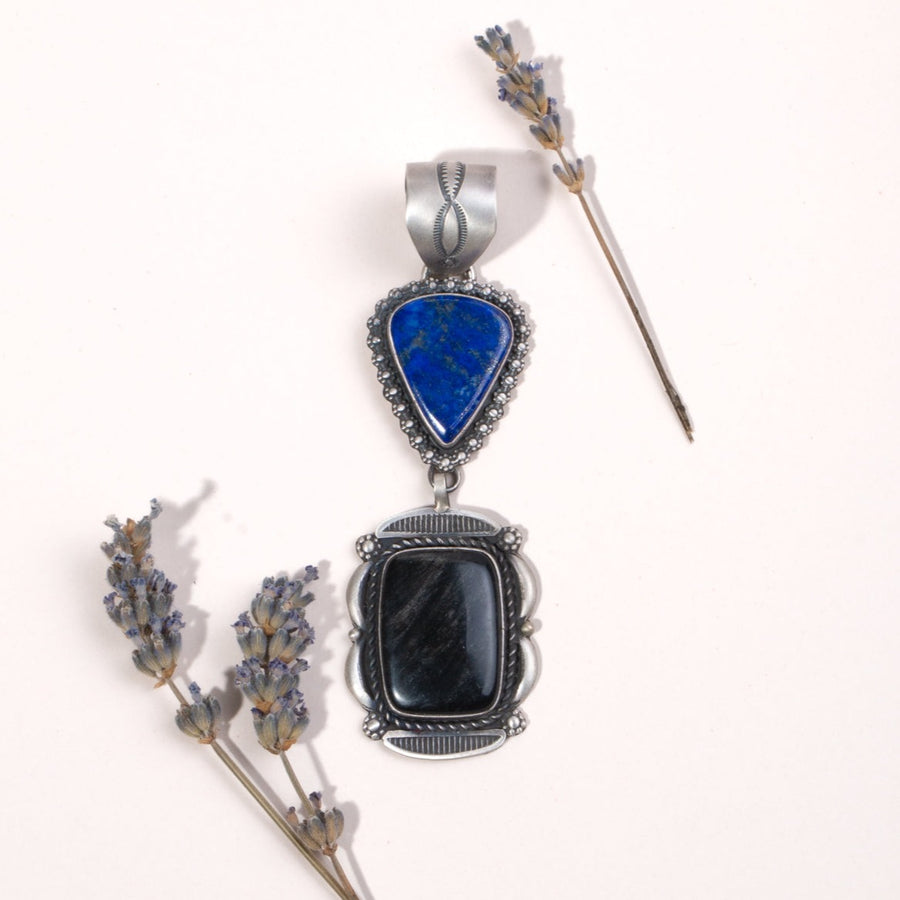
- pendant
- A piece of jewelry that hangs.
- petrified wood
- Fossilzed remains of wood that has turned into stone.
- pettipoint
- Stones that are cut to be very small usually in a round or oval shape.
- picture-rock matrix
- Matrix that happens to form a recognizable shape — a tree, a coastline, a figure. It is valued for the accident, and no two are alike.
- pin
- A piece worn fastened to cloth by a hinged pin and catch on the reverse. Used interchangeably with "brooch" in the Southwest trade, where "pin" is the more common word.
- pipestone
- A fine red argillite, soft when freshly quarried and hardening on exposure, used in the Southwest as an inlay and carving material. Also called catlinite. It carries ceremonial significance for Plains nations that is not ours to explain here.
- pitch mosaic
- An ancient technique in which small stone or shell pieces are set into a bed of pine pitch on a shell or wood backing, rather than into metal. It predates silverwork in the Southwest by centuries.
- planishing
- To flatten and widen a piece of metal with a hammer.
- plastic
- A synthetic material made from carbon polymers.
- polish
- To make the surface so something smooth and shiney my rubbing it.
- polished
- Although most styles can be polished and shiny, the polished style of native American jewelry is usually fairly simple and straight forward. The base metal used in the style is smooth and polished to be reflective and shiny, like a mirror. This is commonly found in cuff style bracelets, rings, and earrings. With the polished style, there is not any other accenting work on the metal such as stones or metal stampwork.
- princess length
- A necklace of roughly seventeen to nineteen inches, sitting at the collarbone. The most common length sold.
- Production Jewelry
- Mass-produced, factory-made jewelry.
- prong
- A narrow metal finger bent over the edge of a stone to hold it. Prongs hold with the least metal and show the most stone.
- prong setting
- A setting holding a stone with bent metal fingers. It exposes the most stone and the most light, and it is the most vulnerable to catching.
- Provenance
- The origin or history of a jewelry piece; where it was made and by whom.
- pseudomorph
- A stone that has taken the outward crystal form of a different mineral it replaced, so the shape belongs to one mineral and the substance to another. Turquoise pseudomorphs are sometimes sold as "fossil turquoise," a trade name rather than a mineralogical one.
- pump drill
- A hand drill driven by a weighted shaft and a crossbar on cords, spun by pushing the bar down. It is the traditional tool for drilling shell and stone beads.
- pyrite
- A golden colored material consisting of crystaline iron disulfide found in turquoise matrix
R
- Rainbird
- One of the oldest Zuni design motifs, originating in pottery: a spiraled beak set between two stepped, cloud-like wings that represent the eye of the storm and the rain cycle. It later migrated from historic pottery into contemporary silver and inlay jewelry. It is distinct from the Water Bird and Thunderbird.
- rainbow
- The rainbow design is a type of row or cluster multi stone style using more than two colors of stones. The stones don’t necessarily have to be of different type, but the colors have to differ enough to give a minimum of a three color effect. Many Native artists will use all of the colors of the rainbow in these designs.
- rainbow calsilica
- A brightly striped material that appeared in Southwest jewelry in recent decades. Gem laboratories have classified it as man-made — pigments and epoxy, not a natural stone — so it must be identified as an imitation.
- Rainbow Man
- A Navajo yé'ii, or Holy Person, who commands the rainbow and is invoked as a symbol of harmony and beauty. He is depicted as an arched, rainbow-shaped figure — sometimes framing other Yei figures within his arc — in cast-silver pendants, bolos, and conchas.
- raised inlay
- Inlay in which each stone is left rounded on top instead of ground flat, so the finished surface is domed rather than level.
- random cluster
- Random cluster designs are when the grouping of stones are dispersed in a seemingly random fashion, and there is not really a pattern to the order of the stones. However, the stones are usually placed evenly and equidistant. The artists have to make careful measurements of the stones and their placement to make all the stones fit evenly in a desired area. Therefore, these designs may not be as random as the name suggests.
- ranger buckle
- A matched set of belt hardware for a narrow strap — buckle, keeper and tip, sometimes with a second keeper as a four-piece set. In Southwest work the pieces carry matching stampwork or stones so the set reads as one design.
- raw
- A precious stone or metal that has been pulled straight from the earth and has not undergone any processing.
- Reconstituted Turquoise
- Powdered stone mixed with resin; imitation turquoise.
- reconstitution
- When fine fragments are to small to be used they are bonded together to form a larger solid mass. Many times other substances are added to the mixture making many “reconstituted” substances artificial.
- repousse
- Repousse style is another design technique that uses a hammer to shape the jewelry also known as forge work. Unlike stamp work and file work that stamp designs into the metal, repousse work is created when the artist uses a hammer and post on one side of the piece and some kind of shaped template on the other side. The metal will take the shape of the desired template causing the metal to have large indentions. These indentions of different shapes and sizes can be presented in various patterns that form the design
- ring
- An article of jewelry that is worn on the finger.
- rocker engraving
- Decoration cut by rocking a short-bladed chisel corner to corner while pushing it forward, leaving a continuous zigzag line. One of the earliest decorative cuts in Southwest silver.
- rope chain
- Links set in a spiral so the finished chain twists like laid cord. Not to be confused with rope wire, which is twisted wire used as a single element in silverwork.
- rope wire
- I set of wires that are braded to form the apearence of a rope and are used as one wire.
- row
- The row is a type of multi stone design. The row of stones must be in a straight line but can be oriented vertically, horizontally or diagonally. The horizontal row is the most common orientation of stones in Native American jewelry. Another variation of this style is called the multi row design, which describes multiple rows stacked parallel to each other.
- Royston
- Royston is the name of a turquoise mine and turquoise mining district in southwestern Nevada. Royston is known for its quality dark green to lighter blue color range.
S
- Sand Casting
- Molten metal poured into a sand mold, creating organic texture.
- sandcast
- An artist sandcasting will use sandstone to carve out a design. This can take from a few hours to a few months to complete relative to the complexity of the design and skill of the artist. A sandstone cast can be used multiple times before the mold degrades.
- scintillation
- The flashes of light produced when a diamond or translucent gemstone reflects a light source.
- scratch engraving
- Decoration scratched into metal with a needle or a steel awl, leaving a fine shallow line rather than a cut groove.
- seafoam turquoise
- A trade name for light, irregular turquoise nuggets set in close to their natural form rather than cut to a shape.
- Secondary Market
- Resale or collector market for previously owned jewelry.
- serpentine
- A green magnesium silicate, soft enough to carve easily, long used in the Southwest for fetish carving and inlay.
- serrated bezel
- A bezel whose edge is cut into teeth that are bent over to hold the stone; also called a saw-toothed bezel. See sharktooth bezel.
- Setting
- The metal structure that holds a stone in place.
- shadowbox
- A style in which stone, shell or inlay is set at the bottom of a deep silver frame, so the raised walls throw a shadow across the design. Wall depth is the whole effect: too shallow and it reads flat, too deep and the stone disappears into the box.
- Shalako
- Towering messenger spirits of the Zuni, honored in the annual Shalako ceremony that marks the turn from winter into spring. Because of the figure's deep ceremonial weight, it appears in jewelry less often than motifs such as Knifewing or Sunface.
- shank
- A thick wire used as a supporting base or decoration in handmade jewelry.
- shank work
- Shank work style is jewelry made out of silver wire shanks. Silver and other metals used in jewelry making are sold at supply shops in plates, bars and wires. The wires that reach at least ¼” in diameter can be called shanks. These shanks can take different sizes, from round ¼” wire to thick 1” thick triangular wire. Shank work artists can do many things with them, from weaving smaller shanks together to layering them in different ways. Often, shank work is used to make supportive cuffs for stones and other design elements for bracelets.
- sharktooth bezel
- A type of bezel that has sharp triangular teeth used to be bent around a stone to hold it in place.
- shell
- The protective hardened outer organic material created by a mullush or oyster often white but can be found in a variety of colors.
- shepherd's hook
- A curved ear wire that passes through the piercing and hangs free, named for the crook of a shepherd's staff. Also called a French hook or fishhook.
- shoulder
- The part of the shank that widens as it rises to meet the setting, on either side of the stone.
- silver acid test
- A spot test in which acid is applied to a small scratch in the metal and the color of the reaction indicates silver content. It is the standard bench test where a hallmark is absent or not trustworthy, and it leaves a mark.
- silver plated
- A base metal that has been covered in an outer layer of silver.
- silver solder
- Solder containing silver and melting at a high temperature; the same material as hard solder, named for its content rather than its melting point.
- silversmith (metalsmith)
- A Native American Jewely artist that works with silver.
- single stone
- The single stone style is one of the most common designs in Native American jewelry. The single stone style literally means one stone. The single stone is usually the centerpiece of the jewelry and other designs are in place to accent the stone’s unique qualities and beauty. There are many types of gemstones and natural materials that are commonly used as center-stones in the single stone style. Keep in mind that we refer to all these materials as “stones” though some of them are natural organic materials.
- snake chain
- A chain of tightly fitted plates or rings forming a smooth, round, flexible tube with no visible gaps.
- Snake Dancer
- The Hopi Snake Dance is closed to non-Natives. Out of respect for the Hopi community, we cannot speak to it or share information about it here.
- snake eyes
- A cluster of very small perfectly round stones, each set in its own bezel. The trade also describes it as petit point cut with round rather than pointed stones.
- solder
- A metal that melts at a low tempature used to join metals together.
- Soldering
- Joining metals using heat and silver solder.
- spacer
- A small bead or disc set between larger elements to control their placement and rhythm along a strand.
- spiderweb
- A pattern of matrix that looks like a spider web.
- Spiny Oyster
- Colorful shell (orange, purple, red) used in Southwestern jewelry.
- split ring
- A jump ring wound in a double coil, like a key ring, so it cannot pull open under load.
- spring lock clasp
- A type of clasp that uses a small spring to keep the clasped locked.
- spring ring
- A hollow ring with a spring-loaded gate that retracts under a small lever. The same mechanism as the spring lock clasp already listed here.
- squash blossom
- The petaled silver bead strung at intervals along a squash blossom necklace, on either side of the naja. Our full guide covers the form, its Spanish and Mexican antecedents, and how to date one: What Is a Squash Blossom Necklace.
- stabilization
- Also known as bonding, stabilization is the binding of turquoise or other natural substances with plastic or glass to increase the durability.
- Stabilized Turquoise
- Treated with resin to increase durability and preserve color.
- stamp (punch)
- A tool used to engrave a specific design or hallmark in metal.
- stamp blank
- A length of carbon steel from which a smith cuts and files his own stamp. Because the blank is hand-cut, a stamp is effectively a signature.
- stampwork
- For stamp work the artist uses a metal stamp and hammers the design into the metal of the piece. The artists can then create beautiful designs using this repeated technique in patterns with single or multiple stamps.
- station necklace
- A chain carrying beads or stones spaced at intervals along its length rather than massed at the center.
- step cut
- A faceted cut of long parallel facets in rows, like steps. It gives depth and flashes of color rather than sparkle, and is the usual cut for emeralds.
- sterling silver
- Silver that contains 92.5% silver and 7.5% other metals. Sterling silver is the most commonly use base material in the Native American Jewelry industry. It is fairly valuable but not too expensive to be impractical for an artist to use. Although it is less pure than fine silver it is less soft which allows it to be a better base material to work with.
- stone to stone inlay
- Stone to stone inlay is much more common in modern Native American jewelry. The style is recognized by the stones being in direct contact with one another. The stones are held in place by other stones, the sidewalls of the area of the design, and a strong stone epoxy. It takes a lot of talent to measure and hand cut the stones to fit perfectly together.
- Storyteller
- A figural design of a seated elder, mouth open in mid-story, covered in small listening children, honoring Pueblo oral tradition. It is not ancient: it was originated by Cochiti Pueblo potter Helen Cordero in 1964 and later adapted from pottery into cast-silver pendants and pins.
- strand
- A single continuous line of strung beads. The count of these in a necklace is how bead work is usually described — a two-strand, a five-strand.
- stud
- An earring sitting flush to the lobe on a post, with no hanging element.
- sugilite
- A purple manganese-bearing mineral, mined chiefly in South Africa, which entered Southwest inlay work in the 1980s. Its intense violet has no natural counterpart among Southwest stones.
- Sunface
- A Zuni motif honoring the Sun Father: a round face with slit eyes, a small round mouth, and a forehead divided into sunrise and sunset halves, often ringed with radiating points. It is a signature Zuni inlay design set in mother-of-pearl, jet, coral, and turquoise, and is distinct from the Zia sun symbol.
T
- table facet
- A large facet on the top of a gem above the crown
- Tax-Deductible Donation
- A jewelry donation eligible for charitable tax credit through a 501(c)(3).
- tension setting
- A setting in which the stone is held by the sprung pressure of the metal alone, with no bezel or prongs. It demands a hard stone and precise work.
- terminal caps
- Decorative metal pieces that cover the ends of a strip of metal wire, plate of cuff.
- threader
- A fine chain drawn through the piercing and left to hang on both sides.
- Thunderbird
- A supernatural bird-being, found across many Native nations with distinct meanings, whose wingbeats are said to bring thunder and whose eyes flash lightning. In Southwest silverwork it has appeared since the 1860s on squash-blossom necklaces, concho belts, and stamped cuffs, generally invoking rain and abundance.
- tie tac
- A short pin with a separate clutch on the reverse, worn through a necktie to hold it to the shirt.
- tiger eye
- A variety of semiprecious lusterous quartz that apears yellowish brown.
- toggle clasp
- A clasp closed by passing a bar through a ring and letting it turn crosswise to catch. Simple, visible, and often made a decorative feature in its own right.
- treated turquoise
- Turquoise altered after mining by any means — resin, oil or wax, dye, sealant or a proprietary process — to improve its hardness, color or surface. The category covers everything that is not natural turquoise.
- Tribal Style
- Design elements reflecting the traditional art of a specific Native Nation (e.g., Navajo stampwork, Zuni inlay).
- tsil no'oli
- A sacred symbol that Means whirling log, a symbol that repersents healing. Often confused as a Nazi swastika but noteably this symbol is flowing in the opposite direction.
- tufa
- A porus rock made of calcium carbonate used for casting.
- tufa cast
- Tufa casting is done my using volcanic stone called tufa to do the cast work. Tufa is generally more fragile than sandstone and can be used only once before it has a tendency to crack. This is used many times by artists who want to have a one of a kind bracelet, and prove that it is the only one by delivering the tufa block along with the item.
- Turquoise
- A blue-green copper-based stone symbolic of protection and harmony.
- turquoise fingerprint
- A pattern of coloration and matrix asscociated with a paricular turquoise mine.
- twisted wire bezel
- A bezel finished with a length of twisted wire soldered around its base, adding a rope-like border between stone and setting.
V
- varicoise
- A stone that is either a mix between turquoise and variscite or can not be determined if it is one or the other without labatory testing.
- variscite
- A blueish gren gem stone that looks very simular to turquoise.
- vein turquoise
- Turquoise deposited in a fracture in the host rock, which comes out as flat plates or seams. Also called seam turquoise, and the reason some mines yield stones with a natural flat back.
- Vintage
- A piece old enough to be collectible but not antique — by common trade convention roughly twenty to a hundred years old. The FTC Jewelry Guides define no age terms at all, so this is a convention rather than a standard.
W
- watchband
- A silver bracelet built to carry a watch case, usually hinged in two halves with the design worked to either side of the face.
- Water Bird
- A rain-and-renewal bird motif of Plains origin, closely associated with the Native American Church and also called the Peyote Bird. Distinct from the Southwest Thunderbird, it was adopted by Zuni jewelers in the 1960s in inlaid pins, bracelets, and stylized squash-blossom necklaces.
- waterweb matrix
- A softly defined web, created either by a pale host rock or by darker spheres of turquoise surrounding lighter ones within the same formation. The pattern reads as a blur rather than a hard line.
- wave bezel
- A type of bezel that is cut in a wave pattern. The crests of the waves can be bent to hold a stone in place.
- waxing
- Waxes and oils can be used as treatments to enhance the color and shine of a stone on a piece of jewelry.
- Whirling Log
- A Navajo sacred symbol — a four-armed rotational motif tied to the Diné creation story and representing well-being, healing, and balance. Once common in early-20th-century silverwork and weaving, it was voluntarily retired by Native artists in the 1930s after being confused with the Nazi swastika, and it remains rare and culturally sensitive today.
- white brass
- An older name for the nickel-and-copper alloy also called German silver. See nickle silver (german silver).
- White Gold / Rose Gold / Yellow Gold
- Alloys of gold with metals that change color.
- wire
- Metal that has been been formed into a rod or flexible thread.
- wire work
- The process of using metal wires to create artistic designs
- wristguard
- A leather band worn on the bow arm to take the snap of the string, usually faced with a worked silver plaque. The Navajo word is ketoh; see bowguard.
- wrought (forge)
- To be shapped by beating with a hammer.
Y
- Yei
- The Yei are the Navajo Holy People, supernatural beings who mediate between people and the divine and appear in healing ceremonies and sandpaintings. The masked dancers who impersonate them in the Nightway ceremony are called Yei-bi-chai, and stylized Yei figures appear in cast-silver pendants, bolos, and cuffs.
Z
- Zachery process
- A patented enhancement that introduces a formula into the structure of medium-grade turquoise to deepen and even its color, without the resin of ordinary stabilization. Its originator recommended describing the result as "micro-crystalline structurally enhanced by the Zachery process."
A note on this glossary. These definitions are our own bench-and-counter knowledge at T.Skies, written to be useful rather than technical. See a term we should add or sharpen? Tell us.