



Malachite in Southwest Jewelry: The Green That Was Always Here
Malachite reads as an import — that saturated banded green looks like it arrived from somewhere else. It didn't. Adair is explicit: before turquoise had become plentiful, the Navajo set other stones in their rings and bracelets — malachite, cannel coal and garnets, "all of which are found on the reservation"[1]. A 1954 account of the same period gives the identical short list: garnets, cannel coal, and malachite[2]. This is a local stone with a longer Southwest record than most of what sits beside it in a modern inlay.
Malachite in the Masters' Hands

The oldest documented working of it is a trade story, not a studio one. In 1884 John Bourke watched Santo Domingo craftsmen at the bow-drill — more than a dozen at work in a single walk through the pueblo — manufacturing "the perforated beads of chalchihuitl, or impure malachite, and sea-shells, which they send to the Navajoes of the west at a great enhancement upon their value in the raw state"[3]. That single sentence contains a lapidary technique, a supply route and a markup. Elsewhere in the same account he notes necklaces of fine shells, malachite or coral, "of home manufacture, bored out by the bow-drill with flint tip"[4]. Bedinger adds malachite to the list of stones obtained by barter in the early silver period[5], and the Encyclopedia keeps it in the standing roster of favored stones for setting in silver — coral, garnet, jet, malachite, onyx[6]. Ben Nighthorse still reaches for it, favoring malachite alongside pink coral, lapis, sugilite and turquoise for inlay[7].
Reading Malachite

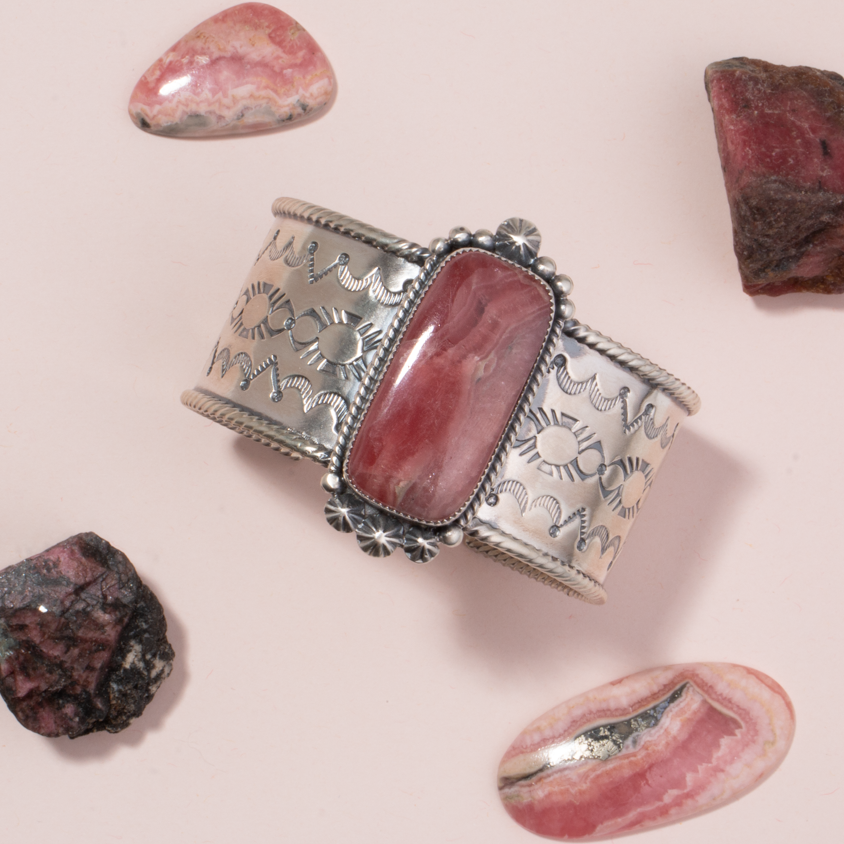
Malachite is a copper carbonate, and its banding is its signature: concentric light-and-dark green rings, bullseyes and ribbons, formed as the mineral deposited in layers. No two cuts repeat. If the banding is too even, too regular, or repeats across several stones in the same piece, you are probably looking at a pressed reconstitution rather than solid stone.
The real caution is care, not authenticity. Malachite is soft — it will scratch against silver in a drawer, and it does not like acid, ammonia or ultrasonic cleaners. Wipe it dry, store it apart from harder stones, and it will hold its polish for generations.
One term worth knowing, because it will confuse you in the older books: chalchihuitl. Bourke uses it in 1884 to mean "impure malachite"[3], but across the wider historical literature the same word is applied to turquoise and to green stone generally. When you meet it in a nineteenth- century source, read it as green stone and let the context decide which one.
A note on accuracy. We strive for accuracy, and this page is continuously updated with new information from the artists, their families, and the community. Corrections welcome.

From the Library: Turnbaugh, Indian Jewelry of the American Southwest (2007)
2007 primary source. Anything described as current here describes 2007, not today.
Turnbaugh (2007, p. 71) grouped malachite with gold, diamonds, rubies and lapis lazuli as new materials that the "new Indian" jewelry of the late 1960s and 1970s added to the artists' range. [8]
From the Library: Welch, Indian Jewelry (1973)
1973 primary source. Anything described as current here describes 1973, not today.
According to Welch (1973, p. 53), soon after Navajo smiths learned to set turquoise, which was still rare, they also used native garnets, jet, malachite, and occasionally abalone shell and glass. [9]
Welch (1973, p. 54) wrote that once newer mines in Colorado and Nevada sent turquoise to the reservation in quantity, the other stones fell out of use and smiths often pried them out and replaced them with turquoise, so that as of 1973 Navajo pieces set with other stones were seldom seen outside museums. [9]
From the Library: Adair, The Navajo and Pueblo Silversmiths (1944)
1944 primary source. Anything described as current here describes 1944, not today.
According to Adair (1944, p. 15), once the Navajo had learned to set turquoise they also set native garnets, jet and malachite, and occasionally abalone shell and colored glass, because these were less scarce than turquoise. [10]
Adair (1944) recorded what became of those early settings:
“As turquoise became more and more plentiful, the other stones fell into disuse, and many of them were pried out of the bezels and turquoise set in their places.”
— Adair (1944), p. 15 [10]
From the Library: Baxter, Encyclopedia of Native American Jewelry (2000)
2000 primary source. Anything described as current here describes 2000, not today.
According to Baxter (2000, p. 105), from the 1980s matching sets of malachite jewelry drew greater interest and more marketing, perhaps because green turquoise had become harder to get; malachite fetish figures were also strung on fetish necklaces. [11]
Field Notes by Mateo James
The Turnbaughs list malachite among the new materials of 1970s "new Indian" jewelry, but Adair and Bourke put it in Navajo and Santo Domingo hands in the 1800s. The book does not say whether it means malachite was new to fine contemporary work only, so I show both records.
Sources
- Adair, The Navajo and Pueblo Silversmiths, p. 28
- Arizona Highways, 1954, p. 32
- Bourke, The Snake Dance of the Moquis of Arizona (1884), p. 72
- Bourke (1884), p. 62
- Bedinger, Indian Silver, p. 49
- Encyclopedia of Native American Jewelry, p. 33
- Encyclopedia of Native American Jewelry, p. 171
- Turnbaugh, William A., and Sarah Peabody Turnbaugh. Indian Jewelry of the American Southwest. Foreword by Barry M. Goldwater. Atglen, PA: Schiffer Publishing, 2007 (copyright 1996 and 2007; first published 1988). ISBN 0-7643-2577-9. Cited by printed page. Statements describe conditions as of 2007.
- Welch, Frankie. Indian Jewelry: How To Wear, Buy and Treasure America's First Fashion Pieces. McLean, VA: EPM Publications, Inc., 1973. Cited by printed page. Statements describe conditions as of 1973.
- Adair, John. The Navajo and Pueblo Silversmiths. The Civilization of the American Indian Series. Norman: University of Oklahoma Press, 1944. Cited by printed page. Statements describe conditions as of 1944.
- Baxter, Paula A., with Allison Bird-Romero. Encyclopedia of Native American Jewelry: A Guide to History, People, and Terms. Phoenix: Oryx Press, 2000. Cited by printed page. Statements describe conditions as of 2000.
← Back to the Southwest Jewelry Guide · Inlay: the technique · The turquoise guide · Gemstone Guide