



Culture, Respect and the Law
Part of the Southwest Buyer's Guide.
Please note. Every tribe is different, and beliefs can be unique to a tribe, a clan or even a family. Please take the cultural points in this guide as general information. If you are a tribal member yourself, seek the guidance of your elders or tribal leaders. This guide is not the final authority.
This guide is for anyone buying, wearing, giving or visiting to see Southwest jewelry. It covers the etiquette most people are never told.
How to talk about it
This guidance comes from our cultural guidelines and what our artists have taught us.
- It's polite to say Diné for the Navajo people.
- In the same way, it's respectful to name the specific pueblo rather than just saying "Pueblo people": "an artist from San Ildefonso Pueblo," not just "a Pueblo artist."
- Kewa Pueblo is the reclaimed original name of Santo Domingo Pueblo.
- It helps to know two terms collectors often mix up. Frank (1990, p. 32): "The term "bowguard" is reserved for the actual item used in the early days as an authentic guard against the snap of the bow and not used later as a personal or dance ornament. The latter item is called a ketoh."
- It's more respectful to say teachings or story than "myth."
- It's customary to capitalize Indigenous, and it's best used sparingly, since it's a very broad word.
Asking what a design means
This guidance comes from our cultural guidelines and what our artists have taught us.
It's always fine to ask the artist or the seller what a design means. If the answer is "that's private," it's polite to leave it there. Some knowledge is sacred, and some is earned only through years of apprenticeship. It belongs to the people who earned it. As Bahti (2007, p. 10) noted of clans: "Further, some Navajos are insistent about prefacing their self-introduction with their clans, while others are not inclined to offer that information."
It's worth remembering that a meaning you've read somewhere may not apply everywhere. The same motif can carry different teachings in different pueblos, clans and families. Bahti (2007, p. 14) gave an example: "The cross is a Navajo symbol for stars, but it means something entirely different to Navajo artist Roland Brady, a devout Catholic, and you can see that in his jewelry." If a seller offers a confident meaning for every symbol, a second question is worth asking. Writing in 1973, Margery Bedinger noted that owners sometimes told visitors quite seriously what the designs on their silver "meant," and that some sellers had invented meanings because a story helped goods sell (Bedinger 1973, p. 111).
Wearing it
This guidance comes from our cultural guidelines and what our artists have taught us.
- Many Diné (Navajo) people consider a ring worn on the thumb or pointer finger a bad omen, so it's respectful to wear Navajo rings on your other fingers. (Mateo James, founder)
- Some pieces aren't meant for people outside the community they come from. A good seller generally won't offer these pieces publicly, but if you have a question, it doesn't hurt to ask.
- It's common for both men and women to wear jewelry in the Southwest, and most jewelry is unisex. On rare occasions, some designs are meant for men or for women only. A knowledgeable seller will usually tell you, but if you're buying one as a gift, it's worth asking. Of a 1903–1911 photograph of a Hopi boy in silver buttons, Frank (1990, p. 27) noted: "Men wore silver jewelry and, in the early days, perhaps wore even more than did the women."
- Wearing a lot of silver at once has a long history here. Holbrook, writing in Frank (1990, p. 22): "Silver jewelry soon became so important that neither men, women, nor children felt properly dressed for a social occasion unless they were wearing many objects of silver."
- If an artist gives you instructions for a piece, such as keeping it apart from your other jewelry, it's respectful to follow them.
- It's worth going easy on polishing older silver. Bedinger warned buyers: "More subtle is the contrast of silver darkened from exposure in the deeper cuts or stampings and the higher surfaces kept clean by wear, an attraction of older pieces that can be destroyed by too zealous polishing." (Bedinger 1973, p. 106)
Buying it
This guidance comes from our cultural guidelines and what our artists have taught us, with other sources credited where they appear.
- It's recommended to ask who made the piece and which tribe they belong to, and to get both on your receipt. What the law says is below.
- Style alone rarely settles who made a piece, so it's worth asking for the maker's name rather than guessing from the look. Bedinger advised caution: "Each tribe influences the other and imitates the other's product to so great a degree that it is unwise to be dogmatic about the maker of any given piece." (Bedinger 1973, p. 144) She also cautioned that a piece bought in one pueblo may have been made in a different village and passed through many hands, Mexican and Indian, before reaching its latest owner (p. 161). Frank gave an example: a bracelet collected at Sichomovi (Hopi) in 1911 was quite possibly Navajo, because the Navajos quickly became the chief early source of silver jewelry and much trading was done with them (Frank 1990, p. 60, Fig. 59).
- A signature can stand for more than one pair of hands, so if it matters to you, it's fair to ask who worked on a piece. Bedinger recorded that top designers such as Preston Monongye employed specialist craftsmen to make parts of a piece, yet the finished work was credited to the designer, in the way a building is credited to its architect (Bedinger 1973, p. 198).
- It's worth being cautious about any date based on style alone. Frank (1990) was plain about it: "There are no foolproof criteria to go by when dating Southwest Indian jewelry." (p. 27) He explained why: "A style would continue to be utilized in a remote and isolated region of the Navajo Reservation for some time after it had been abandoned in the cities." (p. 10) Even well-documented pieces can only show that a motif or tool was in general use in a period, not when that use began or ended (p. 10), and museum buyers on the Navajo Reservation in 1932 brought back fine 1920s pieces, some of them revivals of early-1900s styles (p. 30). Holbrook's sequence of techniques is supported by museum collection dates, but all of those techniques were in use within fifteen years of the return from Bosque Redondo, so sequencing helps but is not foolproof (p. 11).
- If a seller cites a museum date, it helps to know which kind it is. Frank (1990, p. 26): "The collection date, when available, signifies when the piece was actually collected "on the Reservation," while the accession date shows only when the museum added the piece to its collection." He added that most pieces are a good deal older than their accession dates suggest, and often older than their collection dates.
- Repairs and composite pieces are normal in old jewelry, and it's fine to ask about them. Frank (1990, p. 141, Fig. 172): "Many such necklaces broke from wear. Often some of the pieces were lost and composite necklaces were assembled using the remains of more than one object." On an 1880 belt, two different stamps on one concha probably meant a broken or lost stamp had been replaced, and sometimes a concha was added later to enlarge a belt; a normal-size belt had six to eight conchas (p. 139, Fig. 168).
- Top-grade stone isn't the only sign of good early work. Frank (1990, p. 133, Fig. 161) described an early pendant necklace of about 1915 with a large oval green stone in place of the naja and poor-grade green stones in place of the squash blossoms, all in old serrated bezels and showing considerable wear: the green, lower-grade stone was part of what early work looked like.
- If a seller calls a piece "old pawn," it's worth asking what they mean by it. Bedinger wrote that "old pawn" gained its reputation for excellent design and weight in the 1920s and 1930s, when collectors combed remote posts for traditional pieces made before the flood of cheap silver. Strictly, she wrote, "old" should be reserved for pieces made before 1899, or about 1900 for convenience (Bedinger 1973, p. 118; see also p. 117).
- It's a good habit to keep the maker's name with the piece. Bedinger noted that the Museum of Northern Arizona recorded the maker's name for each piece of modern Hopi silver it held, a practice that, in her words, documents an artist's growth (Bedinger 1973, p. 209).
- It's best to pass on imitations of ceremonial items, such as sandpainting designs, ceremonial masks or face designs, or prayer feather designs.
- It helps to know that some fakes are made overseas and sold here as Native work. National Geographic reported in 2018 on an investigation it called "the most extensive ever conducted into Native American art fraud," which traced jewelry to a factory in the Philippines. Of Zuni jeweler Roxanne Seoutewa, the magazine wrote: "She doesn't sell to the local shops in Zuni anymore, or even to the wholesalers 40 miles away in Gallup. The problem, she says, is all the cheaply made foreign imports illegally sold as Zuni handmade." (Maraya Cornell, National Geographic, March 15, 2018.)
- Price can be a clue. When business owners pleaded guilty under the Indian Arts and Crafts Act in 2019, the U.S. Attorney said they had "endeavored to cheapen the cultural heritage of Native American artists by passing off imported trinkets as authentic Indian jewelry." (U.S. Department of the Interior, Indian Arts and Crafts Board, April 29, 2019.) The Board's buyer advice: "if a price seems too good to be true, be sure to ask more questions about the item and its maker." (IACB brochure, p. 1.)
- Thunderbird, bear paw and eagle designs appear across many nations. If a piece is presented as a particular tribe's design, it's worth asking whether the artist is from that tribe. In Mark Bahti's profiles, Zuni silversmith Dennis Edaakie counted the thunderbird among his first four designs, and Mary Coriz Lovato of Santo Domingo made thunderbird necklaces following a Santo Domingo tradition dating to the early 1900s (Bahti 2007, pp. 46, 101).
- It's worth asking whether a design is the artist's own tradition; a good seller will know. Artists guard their designs. As Zuni jeweler Loren Panteah told Bahti: "We started thinking of protecting our own designs" (Bahti 2007, p. 133).
- Mass-produced jewelry isn't wrong in itself, as long as it's sold for what it is. Writing in 1973, Bedinger put it simply: "This commercialization, which horrified the aficionados of old, is not wholly bad, provided the buyer knows what he is getting!" (Bedinger 1973, p. 186)
- Your choices as a buyer matter. Bedinger saw the remedy for imitations on both sides of the counter: "But the final answer is twofold: consumers who demand excellence and will pay for it, and artists who consider the desires of their patrons." (Bedinger 1973, p. 211)
Visiting an artist
This guidance comes from our cultural guidelines and what our artists have taught us.
- At an artist's table or a live show, it's polite to ask before you photograph an artist at work, and to respect a request for privacy.
Visiting a pueblo or a dance
These are outside observers' records, written in the late 1980s, the late 1990s and 2013. The Hopi, Zuni and Kewa peoples are the authority on their own customs, and on who may visit and when.
- Before you visit a pueblo, it's worth checking the village's or the tribe's current visitor guidance. Access is set village by village, and it changes.
- Where makers sell from home or at a market, buying directly is the simplest way to know who made a piece. As of the late 1980s, Turnbaugh (2007, p. 30) recorded that at the Hopi First Mesa village of Sichomovi many artists made and sold jewelry, baskets and pottery in their homes: "Many of the artists readily welcome potential buyers." At the portal of the Palace of the Governors in Santa Fe, Native artisans gathered each day to sell, and the vendors were chosen periodically by lottery.
- Turnbaugh (2007, p. 63) described the Hopi Arts and Crafts Silvercraft Cooperative Guild, begun in 1949 and then located at Second Mesa: "The guild is a mecca for visitors and serves as a major outlet for jewelry and other arts which Hopi artisans create."
- Turnbaugh (2007, p. 69) noted that strands of Santo Domingo (Kewa) heishi could be bought from the craftsmen at the pueblo itself, as well as from Native vendors and shops elsewhere.
- At Hopi, it's best not to take photographs unless you've been told you may, and to check whether a village is open to visitors before you go. Writing in 2013, June recorded that uninvited guests "are no longer permitted to enter Hopi villages at certain times," and that "Signs erected outside some villages warn visitors of trespassing and behavior codes, particularly prohibiting photography" (June 2013, p. 88). He also noted that photography "has been restricted at various times in Hopi villages, beginning c.1930s" (June 2013, p. 156).
- Whether a visitor may watch a dance is the village's decision, and our books don't agree on how open that has been.
Field Notes by Mateo James: Two of our books describe visiting the dances differently, and I show both rather than pick one. Writing in the late 1980s, the Turnbaughs reported that many Hopi ceremonial dances "usually are open to the public" (Turnbaugh 2007, p. 59), and that some Zuni ceremonies and dances were open to visitors (p. 51). Writing in the late 1990s, Wright recorded an older welcome: "Formerly the elders declared that anyone who "has a good heart" was welcome to observe the plaza dances." But she also recorded that some younger leaders, discouraged by the use of Hopi subjects all over the country, had banned non-Indians from all ceremonies and dances, and she added: "Many times it is difficult to know whether one is welcome at a village until one is there." (Wright 2003, p. 51) Both books are more than twenty years old, and access is set village by village and changes. Check the village or tribe's current visitor guidance; if a dance is closed, it's closed.
Cultural etiquette, nation by nation
This guidance comes from our cultural guidelines and what our artists have taught us.
Notes in italics are credited: to our reference books, to artists speaking about their own work, or to T.Skies' own cultural guidelines. Book records are the work of outside observers. The nations themselves are the authority on their own beliefs and traditions.
Across the Southwest: according to Schiffer (2008, p. 15), many Southwestern tribes associated turquoise with water and rain, because of its color and the way its texture changed when wet or dry.
Bedinger (1973, p. 170) reported John Adair's finding that in 1938 Isleta and Zuni were the only pueblos still making traditional jewelry, and that it was passed down as family heirlooms rather than pawned, so it seldom reached museums or private collectors.
Frank (1990, p. 193, Fig. 244) recorded that manta pins were often set with whole silver U.S. coins, because the pins could always be turned back into money to buy goods, which is why one pin could carry a dime beside a quarter.
Diné (Navajo) Nation
- It's respectful to keep Navajo rings off the thumb and pointer finger (see Wearing it).
- It's best to pass on imitations of yeibichai imagery or sandpainting designs.
- It's worth being thoughtful with four-part designs. Our cultural guidelines note that four is a sacred number in Diné tradition.
- Frank (1990, p. 3) traced silver's first public place to the horse: "By the 1850s the Navajos used silver work and colorful blankets to adorn their horses, much as the Plains Indians bestowed feathers and bead-and-quill work upon them." A family's silver proclaimed its rank and earned respect alongside its sheep, and in the 1870s only the relatively wealthy who were friends of a silversmith could own jewelry, because the metal was hard to get and very costly (p. 7).
- According to Frank (1990, p. 22), the photographer Ben Wittick kept a selection of silver jewelry that Navajo (Diné) sitters were welcome to wear for his camera, so the same necklace appears in portrait after portrait. People owned jewelry, but apart from a few favorite rings, buttons or bracelets it was too valuable to wear every day on the sheep trail and was kept safe at home or on the pawn racks of the trading posts.
- Navajo silversmiths also made silver for children: Frank (1990, p. 192, Fig. 242) described, from around 1900, a stamped ring with turquoise, a thin stamped bracelet small enough only for a baby, and bracelets worn by youngsters.
- According to Schiffer (2008, p. 15), recorded Navajo belief held that turquoise offered to the wind would bring rain, because the blowing wind was searching for turquoise.
- It's worth knowing that older Navajo silver was often worn wealth, and that pawn was part of how that wealth was kept. Writing about the 1880s, Bedinger explained: "The ornaments did more than enhance their appearances; they were money in the bank. Silver articles had become an important form of wealth and prestige, ranking equally with goats and horses." (Bedinger 1973, p. 41) She recorded that the Diné counted wealth in two classes, hard goods (silver and turquoise, coral and shell) and soft goods (horses, sheep and goats), which together measured the standing of a person and of the whole family (p. 113). An earlier record uses the term more narrowly: writing in 1910, the Franciscan Fathers recorded that the Navajo word they translated as "hard goods" ordinarily meant four stones, white shell, turquoise, abalone shell, and obsidian or cannel coal. Their list names no silver (Franciscan Fathers 1910, p. 410). Bedinger quoted the anthropologist John Adair: "Frequently a well-to-do Navajo will have a dozen or more bracelets, while he will have only one or two strands of beads or a single set of moccasin buttons" (p. 89). Around 1910, one- and two-ounce bracelets were often used in place of money at the trading post, because cash was scarce and a bracelet was easier to carry on the wrist than a coin in the pocket (p. 89). A coin with a shank soldered on made a practical button: "The custom had advantages; the money was there for all the world to see, and the button could be snipped off and used as money, on the reservation at least." (p. 30) In a Navajo account of the first concha belts, one or two disks were often taken off a belt and used as money when the owner wished to gamble or buy (p. 63).
- Pawn wasn't a sign of hard luck. According to Bedinger, the pawn rack served as a safe-deposit box for heavier ornaments and as a visible bank account. By custom, owners could take their pieces out to wear to a dance or sing and then conscientiously returned them, and a piece might go in and out of pawn for years (Bedinger 1973, p. 113). A long-time trader, Clay Lockett, told her that some owners wore their best bracelets only on special occasions and left them in pawn the rest of the time (p. 89).
- Bedinger recorded the custom behind small silver bells: "Both sexes wore them at dances, and women sometimes fastened them to their sashes to warn their sons-in-law of their approach because no Navajo was supposed to look on his wife's mother; hence the occasional term 'mother-in-law bell.'" As of 1973, she reported that such bells were no longer made (Bedinger 1973, p. 40). Frank, describing a Navajo "mother-in-law" bell with its hide bag of about 1915, gave the custom with a hedge of his own: "The bell was supposedly used to warn a married man of the approach of his wife's mother." (Frank 1990, p. 91, Fig. 104)
Pueblo of Zia
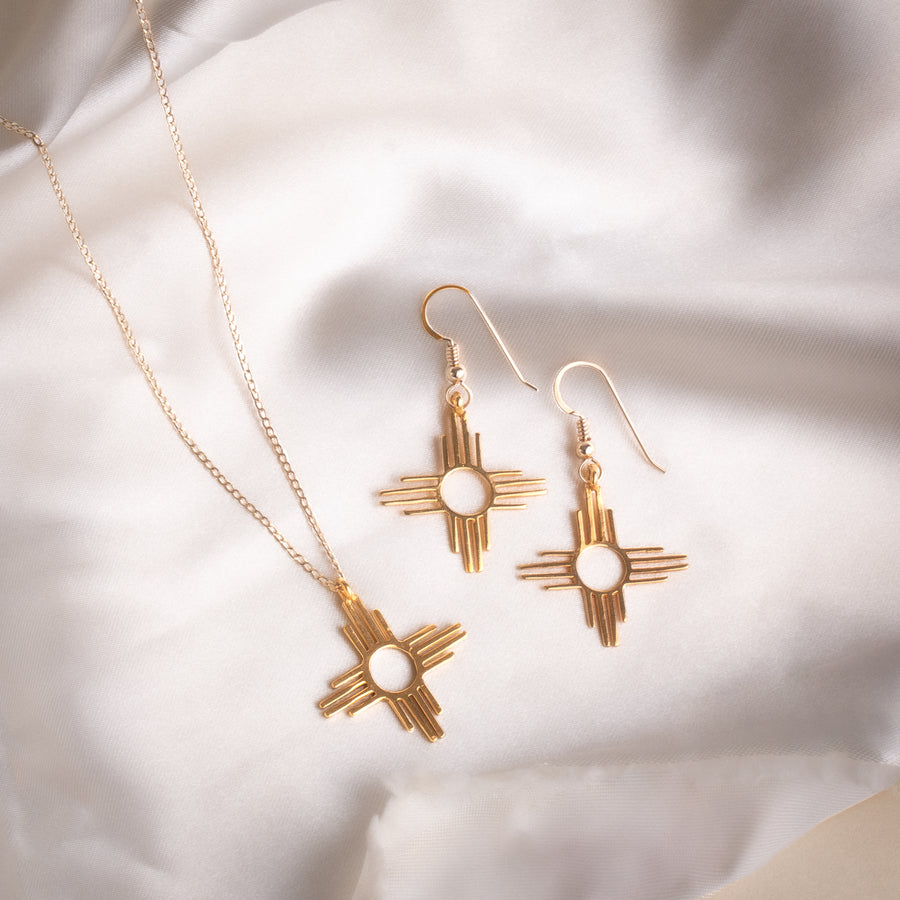
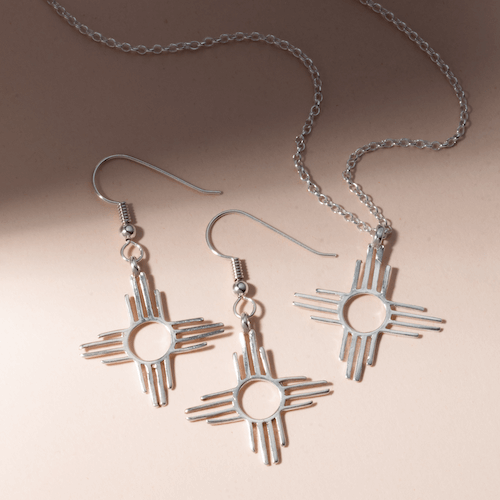
- The Zia sun belongs to the Pueblo of Zia. It's recommended to buy Zia sun pieces from sellers who have the Pueblo's permission, and it doesn't hurt to ask. The Pueblo of Zia describes the symbol as "representing harmony and the interconnectedness of the four directions, the four seasons, the four stages of life, and the four parts of the day" (Pueblo of Zia, letter to Turquoise Skies Inc., September 19, 2025).
- Our cultural guidelines note that red and yellow are significant colors in Zia tradition.
Kewa Pueblo (Santo Domingo)
- Kewa heishi takes intensive handwork, so it's worth asking who made it.
- Before you buy a Kewa-style necklace or mosaic inlay piece, it's worth asking whether a Kewa artist made it. Kewa mosaic has often been worked out within families. Angie Reano Owen, recalling how she began: "Me and my brother Percy sat down and figured it out" (Bahti 2007, p. 140).
- Some Kewa designs are associated with a particular family or clan, so ask before buying a copy.
Zuni Pueblo
- Needlepoint and petit point are Zuni techniques. When you see them, it's worth asking whether the piece is Zuni-made. Jennie Vicenti, on moving from her parents' petit point into needlepoint: "My parents were doing petit-point, in kind of a flat style. We wanted to do our own style" (Bahti 2007, p. 187).
- Bahti (2007, p. 192) credits Bryant Waatsa Sr. with pioneering needlepoint work in the late 1930s. In Waatsa's words: "It was a few years before the war I started making needlepoint jewelry. I'm the original one."
- It's best not to take apart or rework a Zuni inlay piece. The artist may intend its elements to stay together; ask before breaking up a set.
- Rainbow designs are worth treating with care. Our cultural guidelines note that rainbow designs have ceremonial significance at Zuni.
- According to Schiffer (2008, p. 15), at Zuni a perfect turquoise was regarded as male and an off-color stone as female, and blue indicated the western direction.
- According to Bedinger (1973, p. 143), the basic difference between the two traditions was emphasis: Navajo smiths put silver first and used turquoise to set off the metal, while Zuni jewelers treated silver mainly as a way to hold and frame stones. She added that each tribe copied the other so much that the line often blurred.
Hopi
- Overlay is the technique Hopi smiths are known for. When you see it, it's worth asking whether the piece is Hopi-made. Bahti records that by the 1940s traders and the Museum of Northern Arizona had helped steer Hopi smiths toward overlay using Hopi textile and pottery designs (Bahti 2007, p. 12).
- It's best to pass on imitations of Hopi clan, migration or ceremonial calendar symbols, and of Spider Grandmother imagery.
- The same goes for imitation Hopi corn and cloud symbols. Our cultural guidelines note that they carry deep spiritual meaning in Hopi tradition.
Acoma Pueblo
- Fine-line work is an Acoma technique, and Sky City designs belong to Acoma. Before you buy an Acoma-style piece, it's worth asking whether an Acoma artist made it. According to Bedinger (1973, p. 165), old Acoma silver was scarce, and some likely survived in museums and private collections under the label 'early Navajo.' Between trading, wagers won and lost, similar work by both peoples, and pieces with no documented history, their origins were often obscure.
- Treat one village's motif as that village's own, not as interchangeable with a neighbor's. June (2013, p. 24) gives an example: "the Zia bird is strikingly similar to the Acoma bird, but you would never see one copy the other."
Laguna Pueblo
- Laguna is its own pueblo with its own identity. It's respectful not to treat Laguna work as Acoma work, or the reverse.
Apache Nations (Jicarilla and Mescalero)
- Some beadwork patterns belong to a person or a family, so it's respectful not to commission copies of them.
- Frank (1990, p. 59, Fig. 58) on bracelets from Apache and Navajo country: "Whether found in Apache or Navajo hands, the bracelets are quite similar and Plains Indian influence on both of these cultures is apparent."
- It's best to pass on imitation Mountain Spirit representations.
- According to Schiffer (2008, p. 15), Apache hunters attached a turquoise bead to a gun or bow so that it would shoot accurately.
Cochiti Pueblo
- Many storyteller figures are associated with specific families and their makers; buy from the family where you can.
Our commitments
- We keep these traditions, but we don't own them. Our artists speak for themselves, not for entire nations.
- We don't make ceremonial items.
- T.Skies uses the Zia sun symbol with permission from the Pueblo of Zia. That written permission was originally granted by the late Peter Pino, then Governor of the Pueblo of Zia, and renewed with the Pueblo in 2026. We don't alter or stylize the symbol beyond approved uses. The Zia sun symbol, and whose it is
- When a thunderbird, bear paw or eagle design is a specific tribe's own version, we use it only with that tribe's permission.
- We don't imitate Kewa mosaic inlay.
- In our own designs we follow written guidelines for each nation: no sandpainting, wedding basket, ceremonial basket, clan, migration or ceremonial calendar designs; no Taos Pueblo architectural imagery; no water serpent (avanyu) or corn maiden imagery without permission; and no copies of family designs such as Cochiti Storytellers or the Maria Martinez family's pottery.
- We keep private what isn't ours to share, and we name the maker.
The Indian Arts and Crafts Act, in its own words
The Indian Arts and Crafts Board describes the law this way:
"The federal Indian Arts and Crafts Act (Act) of 1990, Public Law 101-644, as amended, is a truth-in-marketing law administered by the Indian Arts and Crafts Board, U.S. Department of the Interior. Under the Act, it is illegal to offer or display for sale, or sell, any art or craft product in a manner that falsely suggests it is Indian produced, an Indian product, or the product of a particular Indian Tribe. Indian labor makes art or craftwork an Indian product." (IACB turquoise brochure, p. 2)
The Act's regulations define its key words (25 CFR §309.2):
- Indian: "a person who is a member of an Indian tribe or for purposes of this part is certified by an Indian tribe as a non-member Indian artisan." (§309.2(a)) In plain terms: a member of a federally or state-recognized tribe, or an artisan a tribe has certified.
- Indian artisan: "an individual who is certified by an Indian tribe as a non-member Indian artisan." (§309.2(b))
- Indian tribe: a tribe, band, nation, Alaska Native village or community "recognized as eligible for the special programs and services provided by the United States to Indians because of their status as Indians," or a group "formally recognized as an Indian tribe by a State legislature or by a State commission or similar organization legislatively vested with State tribal recognition authority." (§309.2(e)) In short, a federally or state-recognized tribe.
- Indian product: "any art or craft product made by an Indian… The labor component of the product, however, must be entirely Indian for the Indian art or craft object to be an 'Indian product.'" (§309.2(d)(1))
- Product of a particular Indian tribe: "the origin of a product is identified as a named Indian tribe or named Indian arts and crafts organization." (§309.2(f))
The regulations also name what does not qualify, including:
"A product in the style of an Indian art or craft product made by non-Indian labor"; "A product in the style of an Indian art or craft product that is designed by an Indian but produced by non-Indian labor"; and one "produced in an assembly line or related production line process using multiple workers not all whom are Indians." (§309.2(d)(3)(i), (ii), (vi))
What the Act doesn't cover: the materials. "While the use of materials, such as turquoise, in the production of Indian art or craftwork is not within the scope of the Act…" (IACB brochure, p. 2). New Mexico goes further: "The State of New Mexico's Indian Arts and Crafts Sales Act, unlike the federal Indian Arts and Crafts Act, requires the seller to disclose in writing the type of materials used. Under New Mexico law, a seller's failure to give the required written disclosure to a consumer violates the State law and may entitle the consumer to a repayment of the purchase price upon the return of the item." (IACB brochure, p. 1)
What to ask for. The Board recommends a written receipt that includes the artist's name and Tribal affiliation, the mine the turquoise came from, whether the turquoise is natural, stabilized or treated, where the stone was purchased, the price, the date, and the business address. (IACB brochure, p. 1)
What this means at T.Skies
We sell our own Southwest designs, and pieces made by Native artists. Native-made pieces are listed under the artist's name and, with their permission, their tribal affiliation. We don't market jewelry by race. We name the maker.
Pieces made by Native artists →
About the founder
T.Skies founder Mateo James is of Spanish, Welsh and Indigenous Native American descent. He does not claim a Yaqui tribal affiliation: he isn't from the Yaqui homelands, and he grew up in Aztec, New Mexico, on the edge of the Navajo Nation. So T.Skies' own designs are not sold as Native American made.
A note on accuracy. We strive for accuracy, and this page is continuously updated with new information from the artists, their families, and the community. Corrections welcome.
Sources
Mateo James, founder (firsthand, 2026). Mark Bahti, Silver + Stone: Profiles of American Indian Jewelers, 2007, pp. 10, 12, 14, 46, 101, 133, 140, 187, 192. Nancy N. Schiffer, Turquoise Jewelry (revised 4th ed.), 2008, p. 15. Margaret Nickelson Wright, Hopi Silver: The History and Hallmarks of Hopi Silversmithing, revised edition, University of New Mexico Press, 2003, p. 51. Dennis June, Fred Harvey Jewelry 1900–1955, Schiffer Publishing, 2013, pp. 24, 88, 156. William A. Turnbaugh and Sarah Peabody Turnbaugh, Indian Jewelry of the American Southwest, Schiffer Publishing, 2007 (first published 1988; text c. 1985–88), pp. 30, 51, 59, 63, 69. Margery Bedinger, Indian Silver: Navajo and Pueblo Jewelers, University of New Mexico Press, 1973, pp. 30, 40, 41, 63, 89, 106, 111, 113, 117–118, 143, 144, 161, 165, 170, 186, 198, 209, 211. The Franciscan Fathers, An Ethnologic Dictionary of the Navaho Language, Saint Michaels, Arizona, 1910, p. 410. Larry Frank, with the assistance of Millard J. Holbrook II, Indian Silver Jewelry of the Southwest, 1868–1930, Schiffer Publishing, 1990 (first published 1978), pp. 3, 7, 10, 11, 22, 26, 27, 30, 32, 59, 60, 91, 133, 139, 141, 192, 193. U.S. Department of the Interior, Indian Arts and Crafts Board, "Business Owners Plead Guilty to Violations of Indian Arts and Crafts Act," April 29, 2019. Maraya Cornell, "History's Biggest Fake American Indian Art Conspiracy Revealed," National Geographic, March 15, 2018. Pueblo of Zia, letter to Turquoise Skies Inc., September 19, 2025 (meaning sentence only). T.Skies Cultural Sensitivity Guidelines (employee handbook, 2026). U.S. Department of the Interior, Indian Arts and Crafts Board, with Joe Dan Lowry (Turquoise Museum), turquoise consumer brochure, 2010, pp. 1–2. 25 CFR §309.2 (eCFR, current to 2026-09-24). Pueblo of Zia permission (T.Skies records, renewed 2026). Bahti, Mark. Silver + Stone: Profiles of American Indian Jewelers. Tucson: Rio Nuevo Publishers, 2007. Schiffer, Nancy N. Turquoise Jewelry. Revised 4th ed. Atglen, PA: Schiffer Publishing, 2008.