



Morenci Turquoise: Field Guide to the Pyrite-Matrix Benchmark
Morenci is the mine that gave the trade its reference point for one specific look: metallic flecks of iron pyrite in deep blue. Lowry is explicit that other mines around the world also produce a pyrite matrix, “but Morenci is the standard and is the most famous of these mines.”1
It is also the mine in this guide with the clearest sourced answer to “can I still get it,” and the answer is more interesting than a yes or a no.
More Morenci turquoise examples
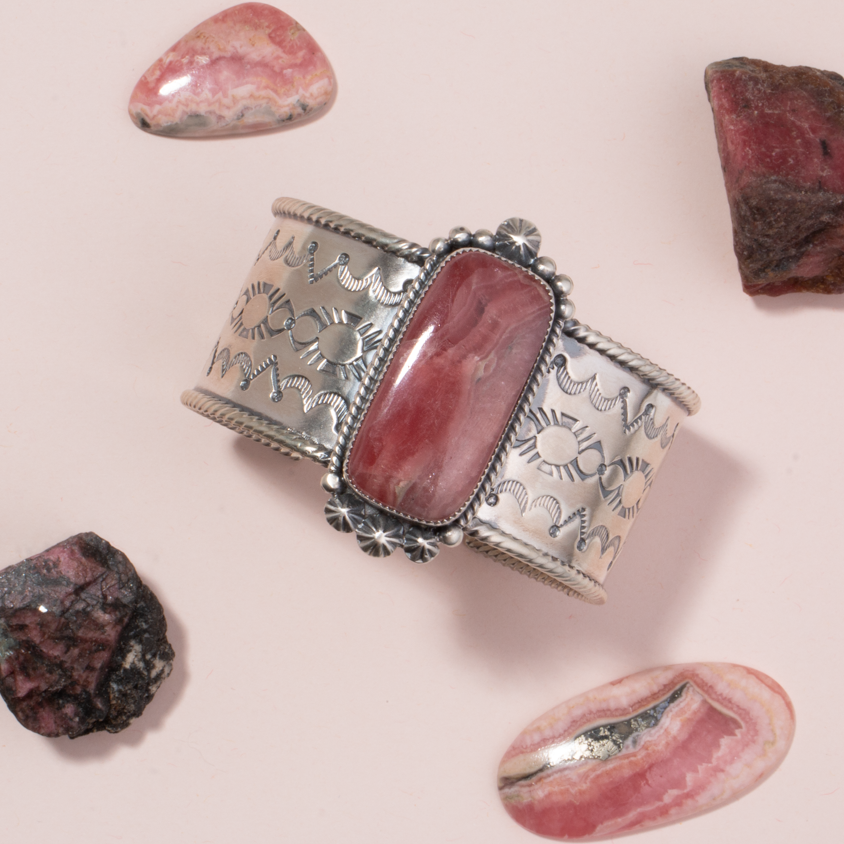
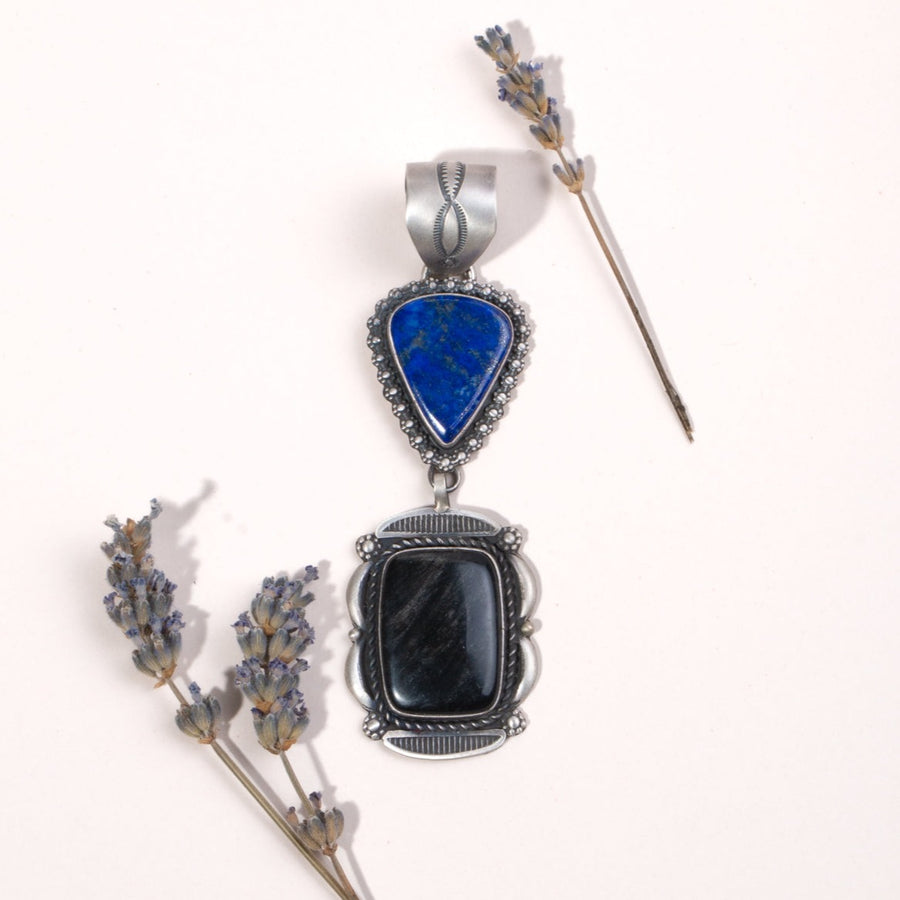
Real Morenci turquoise from the T.Skies archive, photographed by us. Tap this stone to see it up close.

Where it comes from
Morenci is “located in southeastern Arizona in the Shannon Mountains and is the by product of a large copper-producing open-pit mine” — Greenlee County.1 Lowry also calls it a prehistoric mine.1
A date that is easy to get wrong. Lowry records that “the first records of this area were those of Henry Clifton and an army scout by the name of Robert Metcalf in 1864.”1 That is the first record of the area — the mining district — and it is not a turquoise discovery date. Lowry calls the mine prehistoric in the same entry, so the two would flatly contradict each other if 1864 were read as the discovery of the turquoise. If you see “Morenci turquoise, discovered 1864” somewhere, that is this sentence being misread.
What to match on — and what the second book says
Lowry: “although this prehistoric mine produces many varieties of colors, the most sought after variety is its deep blue with iron pyrite matrix.”1 And: “the Morenci Mine in Arizona is famous for a nice blue color and pyrites in its matrix formation.”1
Note what that sentence actually claims. Pyrite is the most sought-after variety, not the only one — Lowry says in the same breath that the mine produces many colours. “Morenci equals pyrite” is an over-flattening, and Schiffer shows why: at Morenci, turquoise deposits “have yielded large quantities of light to dark blue stones with a light tan matrix.”2
These reconcile rather than conflict once you see what each is describing: Lowry is describing the prized material, Schiffer the bulk. A light-tan-matrix Morenci is not a fake; it is the common case. The pyrite stone is the one people are looking for.
The Brown family, and a good story
“William ‘Lucky’ Brown and J. W. Edgar were mining turquoise at the Carico Lake Mine in Nevada when they received a letter that offered them the turquoise mining rights at Morenci. They partnered in Morenci for seven months until J. W. went back to Nevada.”1
“Mr. Brown leased and marketed this turquoise concession (1956–1984), and the Brown family has continued his work for generations.”1
Lowry also records Brown’s own account of how much unofficial collecting went on: at night, people would come over the fences and hills “like ants” to search the freshly graded areas for turquoise.1
The fraud
Morenci is named in the same list as the other famous mines: “tons of Mexican and Chinese turquoise have been misrepresented and sold as Morenci, Sleeping Beauty, Lander Blue, Lone Mountain.”1 Mexican mines can produce “almost a perfect match” to Morenci, and China’s Ma’anshan produces blue “similar to the American mines at Kingman and Morenci.”1
The pyrite matrix helps here, but it is not proof on its own — Lowry says plainly that other mines around the world produce a pyrite matrix too.1 Get the mine of origin in writing.3
Current status
This is the best-sourced status in the guide, and it is as of 2010.
Lowry states it directly: “currently, this mine does not produce any significant amounts of turquoise, but the Brown family still cuts cabochons from the rough that has been previously mined.”1
That is a genuinely useful thing for a buyer to know, because it is a sourced explanation of scarcity rather than a sales line: Morenci on the market is being cut from old stock. Lowry supplies his own forward-looking hedge in the next breath — “as with most copper-bearing zones, when copper prices continue to gain value, there could be more turquoise produced in later years.”1
As Lowry puts it, “which mines are active can change year to year depending on whether someone invests the money to reopen an old mine or discovers a new one.”1
From the Library: Chambless & Ryan, Turquoise in America, Part One (2021)
2021 primary source. Anything described as current here describes 2021, not today.
Chambless & Ryan (2021) on how the Brown story began:
“As early as 1936, he began to sell the turquoise he was finding to the Zuni, Navajo, and Santo Domingo Indians.”
— Chambless & Ryan (2021), p. 187 [4]
Chambless & Ryan (2021) date the Morenci concession:
“Brown obtained the official contract for the turquoise concession at Morenci in 1953, which he continued to mine until 1984, and also had mines in Colorado and Nevada.”
— Chambless & Ryan (2021), p. 187 [4]
As of 2021, Chambless & Ryan reported:
“The mines at Bisbee, Morenci, Castle Dome, and Sleeping Beauty are all closed, with little prospect of any turquoise ever again coming from those areas.”
— Chambless & Ryan (2021), p. 187 [4]
From the Library: Lowry, Turquoise: The World Story of a Fascinating Gemstone (2010)
2010 primary source. Anything described as current here describes 2010, not today.
According to Lowry (2010, p. 228), Morenci is a prehistoric mine in the Shannon Mountains of southeastern Arizona, a by-product of a large copper open pit, and its most sought-after variety is deep blue with iron pyrite matrix. [1] Lowry (2002, p. 49) also describes Morenci as highly sought after for its blue colors and iron pyrite matrix. [8]
According to Lowry (2010, p. 229), the first records of the area were those of Henry Clifton and army scout Robert Metcalf in 1864; William "Lucky" Brown and J. W. Edgar were mining at Carico Lake, Nevada, when they were offered the Morenci turquoise rights, and Brown leased and marketed the concession from 1956 to 1984. [1]
As of 2010, Lowry (2010, p. 229) reported that the mine produced no significant turquoise, but the Brown family still cut cabochons from previously mined rough. [1]
According to Lowry (2010, p. 231), other mines around the world also have pyrite matrix, but Morenci is the standard and the most famous of them. [1]
From the Library: Bassman, The Beauty of Hopi Jewelry (1993)
1993 primary source. Anything described as current here describes 1993, not today.
Bassman (1993, p. 5) pictured a cast bracelet with Morenci turquoise, coral, lapis lazuli and ironwood made in 1973 by the Hopi jeweler Charles Loloma. [5]
From the Library: Bassman, The Beauty of Navajo Jewelry (1997)
1997 primary source. Anything described as current here describes 1997, not today.
Bassman (1997, p. 12) pictured a necklace, bracelet and ring from the 1950s, artist unknown, with twisted silver rope, stampwork and contour-cut Morenci turquoise. [6]
Bassman (1997) pictured a watch bracelet:
“Stampwork with Morenci turquoise and salmon coral stones made by Roy Vandever.”
— Bassman (1997), p. 23 [6]
Bassman (1997) pictured a squash blossom necklace, belt buckle, bola tie and bracelet made by Leon Garcia, noting:
“The squash blossom necklace is made with Morenci turquoise.”
— Bassman (1997), p. 66 [6]
From the Library: Ryan & Chambless, Turquoise in America Part Two: 1910–1990 (2020)
2020 primary source. Anything described as current here describes 2020, not today.
Nila Brown recalled, in an interview published by Ryan & Chambless (2020, p. 162), that Bill "Lucky" Brown came to Arizona from Texas in the mid-1930s and worked for Phelps Dodge at Morenci; after a card-game friend took him to Gallup and Zuni, he quit to source turquoise from Morenci and Castle Dome, opened a lapidary shop in Globe, and was soon custom cutting for many traders. [7]
Nila Brown recalled, in an interview published by Ryan & Chambless (2020, p. 162), that underground mining at Morenci ended in 1932, overburden stripping began in 1937, the concentrator was built in 1942, and the big Metcalf open pit opened in 1953; Brown went after the turquoise concession while that area was being prepared in 1952 and hired full-time miners, one of whom stayed with him 32 years. [7]
Nila Brown recalled, in an interview published by Ryan & Chambless (2020, p. 163), that Brown wrote the concession contract himself; the company required him to take everything out and pay for all of it, chalk or blue, and whenever turquoise was exposed, all operations stopped in that area while he worked the veins with backhoe, bulldozer and pick and shovel. [7]
Nila Brown recalled, in an interview published by Ryan & Chambless (2020, p. 163), that the Browns opened Browns Turquoise Shop in Albuquerque in 1955, moved it to Gallup in 1968, and moved to Safford in the late 1970s to be near the mine; as of 2020 the Safford shop, open until 2005, had become Browns Trading Company. [7]
Bill King recalled, in an interview published by Ryan & Chambless (2020, p. 148), that thin Morenci turquoise nobody wanted, which broke up and was used only a little for inlay, led him to start backing turquoise in 1969, first with plastic wood and then auto-body filler; he bought it from Bill Brown, who held the Morenci lease, and within a year the backed stones were in high demand in Gallup. [7]
From the Library: Lowry, Turquoise Unearthed: An Illustrated Guide (2002)
2002 primary source. Anything described as current here describes 2002, not today.
According to Lowry (2002, p. 49), much Morenci turquoise was "lunch box" stone, carried out of the open pit in lunch boxes by sharp-eyed heavy-equipment operators and miners. [8]
From the Library: Stacey, Turquoise Blue Book and Indian Jewelry Digest (1975)
1975 primary source. Anything described as current here describes 1975, not today.
David L. Neumann, a Santa Fe dealer whose El Palacio article the 1975 Turquoise Blue Book reprinted, on the Morenci turquoise of the early 1970s:
“The Morenci open pit has a contract with a turquoise dealer now established in Gallup, New Mexico. The rough Morenci turquoise obtained is legally his and legitimately marketed.”
— Stacey (1975), p. 71 [9]
Neumann went on, as reprinted in 1975:
“It is probable, however, that a larger quantity reaches cutters through shovel operators who have scooped it up on the sly.”
— Stacey (1975), p. 71 [9]
From the Library: Manley, Collecting Southwestern Indian Arts & Crafts (1979)
1979 primary source. Anything described as current here describes 1979, not today.
According to Manley (1979, p. 37), a Frank Patania-designed squash blossom necklace crafted by Jimmie Herald was set with soft-toned Morenci turquoise and dated about 1950. [10]
Another 1979 caption in Ray Manley's Collecting Southwestern Indian Arts & Crafts described Morenci in a mosaic pendant:
“Preston Monongye made this massive pendant of sandcast silver set with a mosaic of gold-filled Morenci turquoise, coral, jet, ironwood, and mother-of-pearl.”
— Manley (1979), p. 37 [10]
A 1979 caption in Ray Manley's Collecting Southwestern Indian Arts & Crafts on a cast belt:
“fine Navajo sandcast belt; buckle set contains Morenci nuggets.”
— Manley (1979), p. 47 [10]
From the Library: Schiffer, Indian Jewelry on the Market (1996)
1996 primary source. Anything described as current here describes 1996, not today.
In 1996 Schiffer dated a pair of Morenci bracelets to the 1940s:
“Two large triangles of Morenci mine turquoise made in the 1940s marked “WW”.”
— Schiffer (1996), p. 31 [11]
Field Notes by Mateo James
The line to hold on to here is “most sought-after variety.” Morenci is the benchmark for pyrite matrix, and it is also a mine that produced a lot of ordinary-looking blue with a tan matrix. Both of those are Morenci. The second fact is the one that gets left out, and leaving it out is how a buyer talks themselves out of a real stone because it does not sparkle.
This page, following Lowry, starts the Brown concession at Morenci in 1956, while Chambless & Ryan say Brown obtained the official contract in 1953. Both end it in 1984. I tend to side with Chambless & Ryan.
This page now carries three start dates for Lucky Brown's Morenci concession. Lowry (2010) gives 1956, Chambless & Ryan's Part One (2021) says the official contract came in 1953, and Nila Brown, interviewed in Part Two (2020), says 1952, when the Metcalf area was being prepared. All three end in 1984. I have left all three on the page.
I noticed a date that does not line up. Chambless & Ryan (2021, p. 187) date the Brown turquoise concession at Morenci from 1953, and Lowry from 1956, but Schiffer (1996, p. 31) dated two Morenci bracelets marked WW to the 1940s. The caption does not say how that stone was obtained before the concession, so I am noting the gap rather than resolving it.
How this page is sourced. Every factual claim above is drawn from the printed reference works listed below and is footnoted to the book it came from. Where our sources disagree we say so and do not pick a winner; where they are silent we say that too, rather than filling the gap. Nothing on this page comes from general web knowledge.


We strive for accuracy. This field guide entry is compiled from the published references cited below and is continuously updated with new information from the artists, their families, and the community. See something inaccurate, or hold documentation on this mine? Get in touch — corrections are welcomed and credited.
Back to the Southwest Jewelry Guide.
Sources
- Lowry, Joe Dan, and Joe P. Lowry. Turquoise: The World Story of a Fascinating Gemstone. Layton, UT: Gibbs Smith, 2010. Cited by printed page. Statements describe conditions as of 2010.
- Schiffer, Nancy. Turquoise Jewelry. Schiffer Publishing. Cited at the book level.
- U.S. Department of the Interior, Indian Arts and Crafts Board, consumer brochure on the Indian Arts and Crafts Act and turquoise (GPO document gpo58769). Independence note: this brochure states that the Board “collaborated with Mr. Joe Dan Lowry, of the Turquoise Museum” to produce its turquoise information. Joe Dan Lowry is the lead author of the Lowry volume above, so where the two agree that is one voice speaking twice and not independent corroboration.
- Chambless, Philip, and Mike Ryan II. Turquoise in America, Part One: The Great American Turquoise Rush, 1890–1910. Revised first edition. Callais Press, 2021. Cited by printed page. Statements describe conditions as of 2021.
- Bassman, Theda. The Beauty of Hopi Jewelry. Photography by Gene Balzer. Walnut, California: Kiva Publishing, 1993. Cited by printed page. Statements describe conditions as of 1993.
- Bassman, Theda. The Beauty of Navajo Jewelry. Photography by Gene Balzer. Walnut, California: Kiva Publishing, 1997. Cited by printed page. Statements describe conditions as of 1997.
- Ryan, Mike, II, and Philip Chambless. Turquoise in America, Part Two: 1910–1990. Callais Press, 2020. Cited by printed page. Statements describe conditions as of 2020.
- Lowry, Joe Dan, and Joe P. Lowry. Turquoise Unearthed: An Illustrated Guide. Photography by Mark Nohl. Tucson, AZ: Rio Nuevo Publishers, 2002. Cited by printed page. Statements describe conditions as of 2002.
- Stacey, Joseph, ed. Turquoise Blue Book and Indian Jewelry Digest. Arizona Highways Collectors Series. Phoenix: Arizona Highways (Arizona Department of Transportation), 1975. Cited by printed page. Statements describe conditions as of 1975.
- Manley, Ray. Ray Manley's Collecting Southwestern Indian Arts & Crafts. Text by Clara Lee Tanner and others; photography by Naurice Koonce, Ray Manley and Alan Manley. Tucson: Ray Manley Photography, 1979. Includes Clara Lee Tanner, "Southwest Indian Silverwork," pp. 39–41. Cited by printed page. Statements describe conditions as of 1979.
- Schiffer, Peter N. Indian Jewelry on the Market. Text and photography by Peter N. Schiffer. Atglen, PA: Schiffer Publishing Ltd., 1996. Cited by printed page. Statements describe conditions as of 1996.
Shop the T.Skies turquoise jewelry collection →
Compare this mine with every other: Turquoise Mines Identifier, a documented stone study, mine by mine.