



Candelaria Turquoise: Field Guide to the Candelaria/Columbus District
Part of the Turquoise Mines field guides and The Southwest Jewelry Guide.
Joe Dan and Joe P. Lowry’s 2010 book describes the Candelaria/Columbus district along the Esmeralda-Mineral county line in Nevada. Every statement below is quoted or paraphrased from that book, with page numbers, so you can check each one. The book was published in 2010; anything described as current describes 2010.
More Candelaria turquoise examples
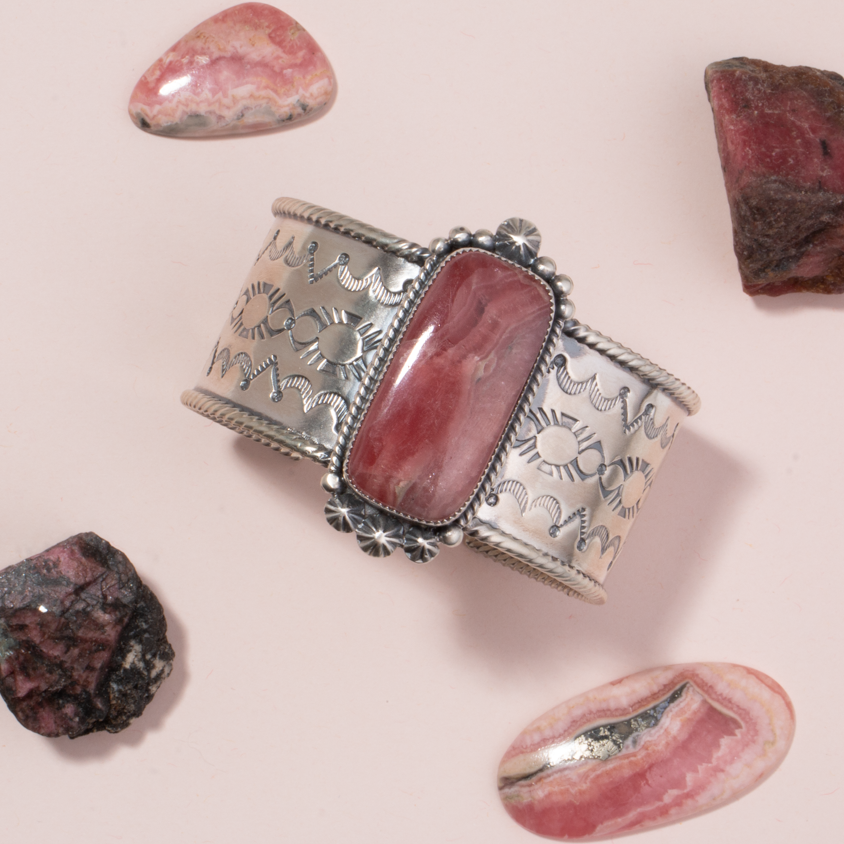
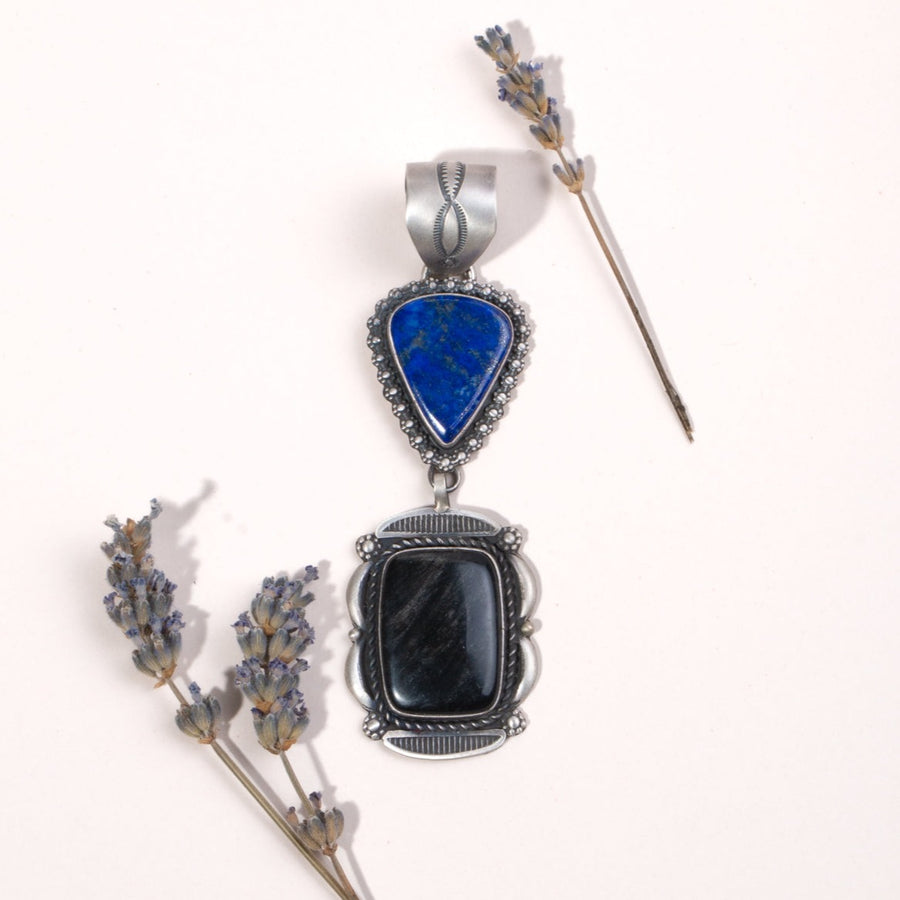
Real Candelaria turquoise from the T.Skies archive, photographed by us. Tap these stones to see it up close.


What Lowry recorded
According to Lowry (2010, p. 233), the Candelaria/Columbus district runs along the Esmeralda-Mineral county line, was settled in the middle 1800s by Spanish gold and silver prospectors, and in 1905-1908 the Los Angeles Gem Company placed claims there. [1]
Lowry (2010) on why turquoise turns up there:
“Whenever the area is actively mined for its metals, more turquoise and variscite becomes available.”
— Lowry (2010), p. 233 [1]
According to Lowry (2010, p. 233), the district's turquoise has been marketed as Ajax, Blue Boy, Blue Moon, Miss Moffet, Blue Mine and Candelaria. [1]
See all the turquoise mines we profile, across the Southwest.
How this page is sourced. We strive for accuracy: every factual statement above is quoted from or credited to the printed work listed below, with page numbers, and this page is continuously updated with new information as we read more of our library. See something we should correct? Contact us.
From the Library: Kunz, Gems and Precious Stones of North America (1890)
1890 primary source. Anything described as current here describes 1890, not today.
According to Kunz (1890, p. 60), J. E. Clayton found turquoise on a sharp ridge about half a mile southwest of the Northern Bell Mine in the Columbus District of southern Nevada, some five miles north of Columbus. [2]
Kunz (1890) relayed Clayton's description of the host rock: the turquoise was
“in seams and bunches in a metamorphic sandstone of a brownish color, not vitreous enough to be classed as a quartzite.”
— Kunz (1890), p. 60 [2]
On the best material, Kunz (1890) wrote:
“The best specimens were in small, roundish pebbles in clusters”
— Kunz (1890), p. 60 [2]
As of 1890, Kunz reported how it was sold:
“The principal sale is in San Francisco, where the sandstone is cut with the turquoise in it, making a rich mottled stone for jewelry.”
— Kunz (1890), p. 61 [2]
Kunz (1890) ranked it highly:
“Although the nodules are small, this is the finest turquoise for color and quality found on the continent”
— Kunz (1890), p. 61 [2]
From the Library: Ryan & Chambless, Turquoise in America, Part Two (2020)
2020 primary source. Anything described as current here describes 2020, not today.
According to Ryan & Chambless (2020, p. 55), J. L. Clayton is generally credited with discovering turquoise in Nevada in the mid-1860s, about five miles from the town of Columbus in the Candelaria Hills; at the time there was no economic reason to mine it, because turquoise sold for the price of coal. [3]
Ryan & Chambless (2020) on the district's first commercial output:
“Turquoise was also discovered in the Candelaria Mountains and the Los Angeles Gem Company shipped considerable amounts for gem purposes.”
— Ryan & Chambless (2020), p. 55 [3]
According to Ryan & Chambless (2020, p. 58), a 1937 U.S. Bureau of Mines report by William O. Vanderburg credited A. L. Dees and Edward Murphy with discovering turquoise and variscite in the Candelaria Mountains in 1905, a few miles northwest of the old camp of Columbus, with a second find closer to Coaldale. [3]
According to Ryan & Chambless (2020, p. 59), Dees and Murphy sold their claims to the Los Angeles Gem Company, as Morrissey had noted. [3]
According to Ryan & Chambless (2020, p. 59), Carl Riek sold his claims in the Candelaria district north of Columbus to Walter Lawrence Godber in 1936; they were the Oriental Blue claims (Oriental Blue Number 1 was being worked in 1937), which Morrissey listed as the Miss Moffet, also called Blue Boy, Blue, Persian Blue and Los Angeles Gem Company Mine. The Oriental Blue claims later became the Ajax, which, as of 2020, Helen and Richard Shull owned. [3]
According to Ryan & Chambless (2020, p. 60), turquoise and variscite were at first equally prized around Candelaria and Coaldale, and the Los Angeles Gem Company prospected here mainly for variscite; over the next several years turquoise overtook variscite in the market. [3]
According to Ryan & Chambless (2020, p. 59), Sterrett's 1910 government report recorded that Carl Riek and W. K. Botts had located the Blue Bell turquoise-variscite claim four miles northeast of Coaldale, where the turquoise ran in veinlets, seams and small nodules in rhyolite up to an inch thick. [3]
Sterrett's 1910 verdict on the Blue Bell stone, as quoted by Ryan & Chambless (2020):
“Some of the turquoise is very hard and has a deep sky-blue color rarely exceeded by that from any other locality.”
— Ryan & Chambless (2020), p. 59 [3]
According to Ryan & Chambless (2020, p. 79), in 1936 the Godbers' Western Gem & Jewelry Company bought three claims from Carl Riek in the Candelaria district. [3]
Ken Godber recalled, as reported by Ryan & Chambless (2020, p. 79), that his father James, then about 18, spent the summer of 1936 mining turquoise at the Riek claims with his friends. [3]
According to Ryan & Chambless (2020, p. 81), the Bureau of Mines engineer Vanderburg reported in 1937 that the Riek claims were producing about one pound of turquoise a day with three miners by October 1936, while the Western Gem & Jewelry Company was using about 25 pounds a day to meet wholesale demand. [3]
A 1937 list of Nevada turquoise properties reproduced by Ryan & Chambless (2020) recorded:
“Riek Mine in Candelaria district Mineral County owned by W. F. Godber. Turquoise occurs in veinlets in limestone and shale.”
— Ryan & Chambless (2020), p. 88 [3]
According to Ryan & Chambless (2020, p. 138), Grace and John Callahan moved to the ghost town of Columbus, north of the Columbus Marsh, in 1941, to work turquoise claims left to Grace by her brother George, an Indian trader who had acquired them in 1931. [3]
According to Ryan & Chambless (2020, p. 139), the Callahans told Desert Magazine in 1948 that Columbus had been founded as a mill town for the silver camp of Candelaria, about five miles away, and they hauled their water two barrels at a time from Basalt, 25 miles off. [3]
The Callahans described their method to Desert Magazine in 1948, as reprinted by Ryan & Chambless (2020):
“You find a stringer of turquoise and follow it. It may be knife-blade thin but somewhere it will open out.”
— Ryan & Chambless (2020), p. 139 [3]
In 1948, the Callahans told Desert Magazine, as reprinted by Ryan & Chambless (2020, p. 139), that they could sell all the high-grade Columbus turquoise they found at one hundred dollars a pound. [3]
Recollections below are the speakers' own memories, recorded in interviews published by Ryan & Chambless (2020); they are credited to the speaker, not stated as fact.
Wayne Nelson recalled, in an interview published by Ryan & Chambless (2020, p. 190), that in 1976 he and others cleaned out an unclaimed pocket they called Hidden Valley in the Candelaria Hills, a spot later covered by a leach bed. [3]
Wayne Nelson recalled, in an interview published by Ryan & Chambless (2020, p. 190), that in 1985 he held the turquoise rights at NERCO's Candelaria Silver Mine on a verbal agreement, paying by the pound for turquoise the company's trucks set aside, until about a year later a company memo ended the arrangement. [3]
The mine glossary in Ryan & Chambless (2020, p. 343) lists the Candelaria Mine in the Candelaria Mining District of Mineral County, Nevada, as turquoise from a silver mine. Nearby Candelaria Hills mines in Esmeralda County include Ajax, Black Widow, Blue Moon and Hidden Valley. [3]
From the Library: Morrissey, Turquoise Deposits of Nevada (1968)
1968 primary source. Anything described as current here describes 1968, not today.
Morrissey (1968, p. 8) placed the Miss Moffet mine, also known as the Blue Boy, Blue, Persian Blue and Los Angeles Gem Co. mine, about 4.5 miles southeast of Candelaria, with good-quality turquoise in the narrow, most strongly clay-altered zones of a sheared shale; its short adits, pits and trenches were being worked off and on when the Bureau field-checked the report in 1965. [4]
According to Morrissey (1968, p. 8), variscite was found on the group first, in 1908, by L. A. Dees of Los Angeles and Edward Murphy of Goldfield, who sold their claims to the Los Angeles Gem Co.; turquoise was first found on the Pirate No. 3 claim, at the west end of the variscite claims. [4]
Of the Miss Moffet group's second deposit, small seams in a dark jasperoid, Morrissey's 1968 report wrote:
“The very dark brown and black matrix in this turquoise yielded very beautiful gems.”
— Morrissey (1968), p. 9 [4]
Morrissey (1968, p. 10) wrote that the exact location of the Blue Bell prospect on the Riek and Botts variscite claims was unknown by the time of the report, and that it had reportedly been covered by a flash flood several years before. [4]
Field Notes by Mateo James
I notice the discoverer's initials differ between our sources. Kunz (1890) names him J. E. Clayton; Ryan & Chambless (2020, p. 55) write J. L. Clayton. Both place the find near Columbus, so I have left both spellings on the page rather than guess which initial is right.
I notice the year and the initials differ. Ryan & Chambless (2020, p. 58), citing a 1937 Bureau of Mines report, give A. L. Dees and Edward Murphy finding turquoise and variscite in 1905; Morrissey's 1968 report gives L. A. Dees and 1908, and says the variscite came first. I have left both on the page.
Sources
- Lowry, Joe Dan, and Joe P. Lowry. Turquoise: The World Story of a Fascinating Gemstone. Layton, UT: Gibbs Smith, 2010. Cited by printed page. Statements describe conditions as of 2010.
- Kunz, George F. Gems and Precious Stones of North America. New York: The Scientific Publishing Company, 1890. Public domain. Cited by printed page. Statements describe conditions as of 1890.
- Ryan, Mike, II, and Philip Chambless. Turquoise in America, Part Two: 1910–1990. Callais Press, 2020. Cited by printed page. Statements describe conditions as of 2020.
- Morrissey, Frank R. Turquoise Deposits of Nevada. Nevada Bureau of Mines Report 17. Reno: Mackay School of Mines, University of Nevada, 1968. Cited by printed page. Statements describe conditions as of 1968.