



Yungai Temple Mine (Hubei, China): Field Guide to Chinese Turquoise
Part of the Turquoise Mines field guides and The Southwest Jewelry Guide.
Mike Ryan II and Philip Chambless’s 2020 history records, through interviews with Allan Voshall, Ron Alexander and Danny Lopacki, the story of the Yungai mine near Yunxian in western Hubei, China, and of the Chinese turquoise they brought to the American market in the 1980s. Every statement below is quoted or paraphrased from their book, with page numbers, so you can check each one. Their book was published in 2020; anything described as current describes 2020. Where our other books disagree, the Field Notes say so.
More Chinese turquoise examples
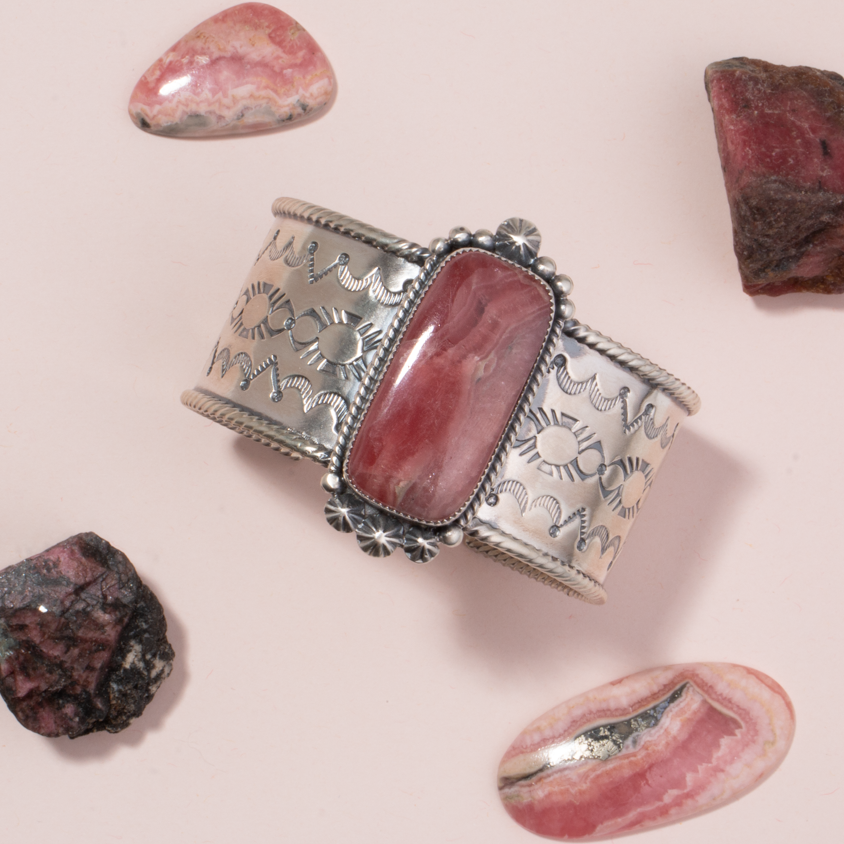
Real stones from the T.Skies archive, photographed by us. Tap any stone to see it up close.
 Sold as China Mountain: mint-green blocks in a dark matrix web
 Sold as China Mountain: sky-blue cells in a dense black spiderweb
 Sold as China Mountain: blue-green patches on rust-red matrix
 Sold as China Mountain: pale green with bold dark-brown matrix
 Sold as China Mountain: blue-green with a fine black web
 Sold as China Mountain: blue with pale patches and brown veining
 Sold as China Mountain: teal-green with thin brown veins
 Sold as China Mountain: blue-green with a pale green eye and dark matrix
Where it is, and its names
Allan Voshall recalled, in an interview published by Ryan & Chambless (2020, p. 239), that Yunxian ('Cloud Prefecture'), a town on the Han River in the north of western Hubei, was the site of the old Chinese turquoise carving shop and of the cutting shop he and Ron Alexander built there in the 1980s for exporting Chinese turquoise. [1]
Allan Voshall recalled, in an interview published by Ryan & Chambless (2020, p. 250), that the work unit joined the mine itself, about forty miles up the river at the small village of Bao Xia, with the Yunxian cutting shop; the two belonged to one work unit but argued over who was in charge. [1]
Allan Voshall told Ryan & Chambless (2020, p. 250) that in the 1980s he never heard the mine called the Yun Shan (Cloud Mountain) Mine, and suspected the name was a mishearing of Yunxian; the ruined Yun Gai Temple ('lingering clouds') stands on the mountain, so the mine may have carried the temple's name before 1949, while the work unit's official name was along the lines of the Yun County Turquoise Mine. [1]
Ron Alexander recalled, in an interview published by Ryan & Chambless (2020, p. 258), that a geology ministry report pointed him to the Yungai mine outside Yunxian, which he described as an ancient mine of the Han emperors, opened in the Han period (206 BC-220 AD) when, as he told it, turquoise was reserved for the royal family. [1]
The workings
Voshall described the workings in an interview published by Ryan & Chambless (2020):
“This is a very large, multi-level mine that has been operating for a long, long time.”
— Ryan & Chambless (2020), p. 245 [1]
On the kind of mining, Voshall told Ryan & Chambless (2020):
“This is all deep-shaft mining in what you would consider hard rock.”
— Ryan & Chambless (2020), p. 249 [1]
Allan Voshall recalled, in an interview published by Ryan & Chambless (2020, p. 253), that the mine's warehouses held decades of stockpiled stone piled eight or nine feet high, ranging from chalk to the best Chinese turquoise, with perhaps a couple hundred tons of high-grade in all; grading it by sampling a cubic meter at a time took about two years. [1]
Allan Voshall recalled, in an interview published by Ryan & Chambless (2020, p. 255), that the state work unit kept digging whether or not it found turquoise, until the government stopped funding and disbanded it, and that no one could privatize the mine because the economics were not there. [1]
Bringing it to America
Ron Alexander recalled, in an interview published by Ryan & Chambless (2020, p. 258), that his group were the first to bring hundreds of kilos of glassy, hard spiderweb turquoise of this quality into the United States. [1]
Danny Lopacki recalled, in an interview published by Ryan & Chambless (2020, p. 264), that the first rough reached the US when Allan Voshall hand-carried two hundred pounds, sold to Eddie Mauzy; a second two-hundred-pound load went to Chet Jones for more than $100,000; and by September 1987 Lopacki was at the mine himself. [1]
On a trade name buyers may meet, Danny Lopacki told Ryan & Chambless (2020):
“We considered marketing it under the name of "Sky Horse," but that never came to pass.”
— Ryan & Chambless (2020), p. 264 [1]
Other Hubei sources
Danny Lopacki recalled, in an interview published by Ryan & Chambless (2020, p. 266), that his Chinese partner Lu Zhengming also sourced turquoise at Bamboo Mountain (Zhu Shan), not far from the main mine in Hubei, and as far east as Ma'anshan near Nanjing in Anhui Province. [1]
Field Notes by Mateo James
Ron Alexander, in Ryan & Chambless (2020, p. 258), remembered the Yungai as an ancient mine opened in the Han period (206 BC–220 AD). Laufer (1913, p. 58), writing a century earlier, concluded that the Chinese knew turquoise no earlier than the Yuan, or Mongol, period of the thirteenth and fourteenth centuries; he also thought it “very probable that the turquois production of Yun-yang fu is of recent date” (p. 65), Yun-yang being the Hubei prefecture his informants named as their source. Alexander’s account is his own recollection, not a dated record. The two can’t both be right, so I have given both.
See all the turquoise mines we profile, across the Southwest and beyond.
How this page is sourced. We strive for accuracy: every factual statement above is quoted from or credited to the printed works listed below, with page numbers, and this page is continuously updated with new information as we read more of our library. See something we should correct? Contact us.
Sources
- Ryan, Mike, II, and Philip Chambless. Turquoise in America, Part Two: 1910–1990. Callais Press, 2020. Cited by printed page. Statements describe conditions as of 2020.
- Laufer, Berthold. Notes on Turquois in the East. Field Museum of Natural History, Anthropological Series, Vol. XIII, No. 1. Chicago, 1913. Public domain. Cited by printed page. Statements describe conditions as of 1913.