



Number Eight Turquoise: Field Guide to Nevada's Vanished Spiderweb Mine
Number Eight Turquoise — A Stone Study
← Part of the T.Skies Turquoise Stone Study: turquoise mines
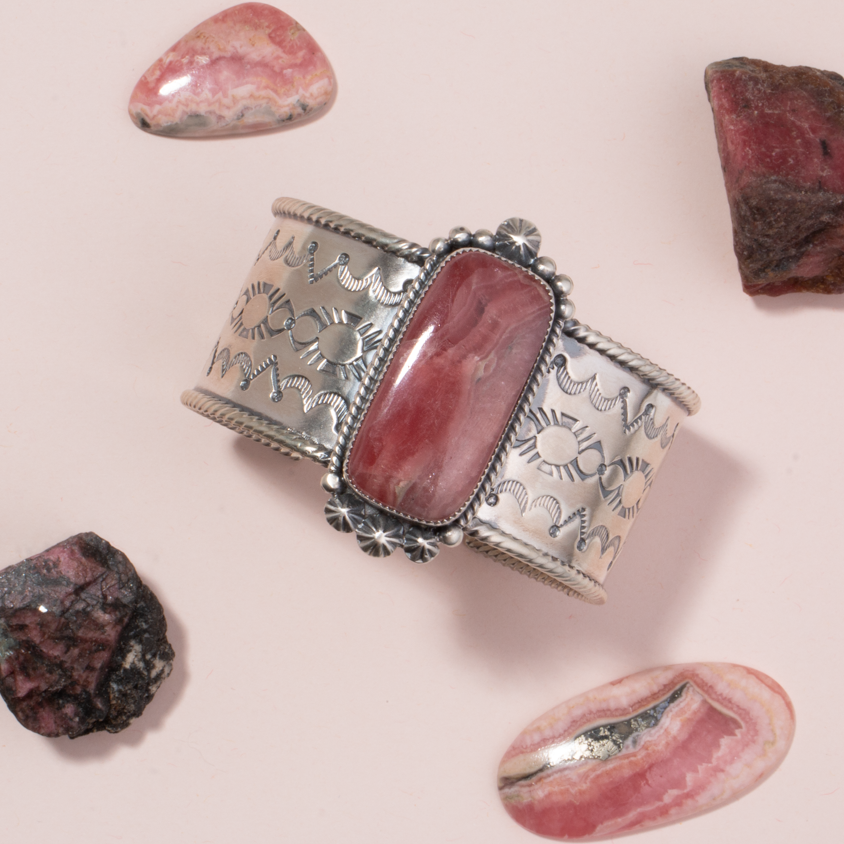
Number Eight turquoise, photographed in the T.Skies studio. More stones to come. Tap any stone to see it up close.

Number Eight turquoise, photographed in the T.Skies studio. Shown for reference. © Turquoise Skies Inc.
Number Eight turquoise is also written #8, the form the Indian Arts and Crafts Board uses. Start with the fact that governs every Number Eight purchase you will ever make: the source is closed and the ground itself is gone. Lowry and Lowry record that the last production of turquoise from this area was by Dowel Ward in 1976, and that after a mining conglomerate bought the Number Eight area and began working it for copper and gold, the ground where the best turquoise was mined no longer exists.1 Every genuine Number Eight stone on the market today came out of the earth before that. There is no new supply, and there cannot be one.
The second thing to carry into a purchase is the name. These same claims were also known as Royal Blue, Royal Blue No. 1, and Blue Star.1 A historical reference to "Royal Blue" material therefore does not, on its own, point at this mine — and as set out below, the record attaches that name to two different Nevada counties.
More Number 8 turquoise examples
Real Number 8 turquoise from the T.Skies archive, photographed by us. Tap this stone to see it up close.

From the Library: Branson, Turquoise: The Gem of the Centuries (1975)
1975 primary source. Anything described as current here describes 1975, not today.
According to Branson (1975, p. 13), a large Santo Domingo Pueblo chunk necklace pictured in his book was made from Number 8 turquoise and weighed almost 2,200 carats. [3]
According to Branson (1975, p. 33), Number Eight produced some of the largest turquoise nuggets ever discovered, and almost all of its output was spider web, with matrix running from brown to black. [3]
According to Branson (1975, p. 33), almost all the turquoise the mine produced was spider-web type. [3]
On the color range, Branson (1975) wrote:
“The colors grade from very light blue to very dark blue, some with interesting tints of green.”
— Branson (1975), p. 33 [3]
From the Library: Lowry, Turquoise: The World Story of a Fascinating Gemstone (2010)
2010 primary source. Anything described as current here describes 2010, not today.
According to Lowry (2010, p. 109), the largest turquoise specimen then recorded in the United States was a lower-grade Number Eight nugget weighing 152 pounds, sold by Travis King to Manny Goodman around 1962 for $3,200; as of 2010 it was on display at the Natural History Museum in Albuquerque. [1]
According to Lowry (2010, p. 134), the mining conglomerate that had bought the Number Eight area began mining it for copper and gold in 1961, and the ground where the best turquoise was mined no longer exists. [1]
According to Lowry (2010, p. 219), a town barber discovered the deposits about thirty miles north of Carlin, Nevada, in 1925, and active mining did not start until 1929, under claim owners Earl Buffington and Lawrence Springer. [1]
According to Lowry (2010, p. 219), Number Eight was famous for what was considered some of the best golden and black spiderweb matrix turquoise in the world. [1] Lowry (2002, p. 50) also lists black and golden spiderweb, with red and brown, among its famous varieties. [7]
According to Lowry (2010, p. 220), around 1959 the Edgar brothers sold the ten claims to a large metal mining outfit, not knowing that gold deposits lay below the well-known turquoise and copper outcroppings; the last turquoise production was by Dowel Ward in 1976. [1]
Writing in 2010, Lowry cautioned that fine spiderweb is not unique to the American classics:
“Many of the Chinese mines produce the best grades of spiderweb that can compare with the Number Eight, Lone Mountain, or other American mines.”
— Lowry (2010), p. 230 [1]
Lowry (2010) named one Nevada look-alike, the Warm Springs deposits in Nye County:
“The best turquoise from this area can produce a nice golden web with a soft blue turquoise color that is similar to the Number Eight Mine.”
— Lowry (2010), p. 241 [1]
From the Library: Schiffer, Turquoise Jewelry (2008)
2008 primary source. Anything described as current here describes 2008, not today.
Schiffer (2008, p. 60) illustrated a matching set in Number 8 turquoise (a squash blossom necklace with large naja, bracelet, earrings and ring), made circa 1978. [4]
From the Library: Bassman, The Beauty of Navajo Jewelry (1997)
1997 primary source. Anything described as current here describes 1997, not today.
Bassman (1997, p. 10) listed a bracelet with seven #8 turquoise stones among bracelets she dated to the 1920s, artists unknown. [5]
Bassman (1997, p. 11) pictured a cluster bracelet with #8 Nevada turquoise among pieces she dated to the 1940s, artists unknown. [5]
From the Library: Ryan & Chambless, Turquoise in America Part Two: 1910–1990 (2020)
2020 primary source. Anything described as current here describes 2020, not today.
Ryan & Chambless (2020) on the name:
“The Number 8 turquoise mine is among the most famous in Nevada, but that had always been a marketing name as there is no claim named Number 8.”
— Ryan & Chambless (2020), p. 83 [6]
According to Ryan & Chambless (2020, p. 84), Morrissey's story that a Carlin barber first located the mine in 1925 may be true, but the barber only gathered surface float, and the authors found no record that he ever located a claim. [6]
According to Ryan & Chambless (2020, p. 84), on July 1, 1930 Earl Buffington and L. A. Springer of Los Angeles located the Royal Blue and Royal Blue Number 1 claims, about 25 miles north of Carlin in the Boulder Ridge mining district, and Springer added the Royal Blue Extension that September. [6]
According to Ryan & Chambless (2020, p. 84), Buffington apparently bought out Springer and on August 5, 1931 deeded the Royal Blue claims to C. T. (Ted) Johnson. [6]
Ted Johnson recalled, in an interview published by Ryan & Chambless (2020, p. 85), that Buffington and Springer had located two claims above the Berning Mine near the top of the mountain, that he leased them and then bought Buffington out, and that those claims became famous as the Number 8 Mine. [6]
Ryan & Chambless (2020) sum up Earl Buffington, who died in 1970:
“His legacy was as the original locator of the Number 8 turquoise mine.”
— Ryan & Chambless (2020), p. 85 [6]
According to Ryan & Chambless (2020, p. 85), Morrissey recorded that Doc Wilson bought the claim from Ted Johnson in 1935 but did not work it and let it lapse. [6]
Ryan & Chambless (2020) found the earliest use of the name in an October 1944 claim filing:
“this claim is situated about one quarter mile southwest of the old Number 8 turquoise now called the Blue Star.”
— Ryan & Chambless (2020), p. 135 [6]
According to Ryan & Chambless (2020, p. 135), the Blue Star lies about 23 miles northwest of Carlin in the Blue Star sub-district of the Lynn Mining District, on the west side of the Tuscarora Range in Eureka County. [6]
According to Ryan & Chambless (2020, p. 135), Doc Wilson had bought the claims from Ted Johnson in 1935 but let them lapse; R. L. Taylor and E. H. Emmons located the Blue Star on July 10, 1943, and Lee Hand located the Blue Star Number 1 and Number 2 on October 28, 1944, with Cutler, Lem and Pete Edgar. [6]
According to Ryan & Chambless (2020, p. 136), after the Edgars believed they had taken most of the turquoise, they hired a bulldozer to trench for copper and instead uncovered perhaps the highest-grade black web turquoise ever found in Nevada. [6]
Ryan & Chambless (2020) warn that the famous dark web came from a single pocket:
“Although the mine turned out some beautiful turquoise, it was defined by a lighter blue on a brown matrix, very different from the dark web, which was never found again. Much of the turquoise mined later needed to be stabilized.”
— Ryan & Chambless (2020), p. 137 [6]
According to Ryan & Chambless (2020, p. 137), Morrissey put the dark web at 1,600 pounds without giving a source, and the authors suspect the true amount was lower given how rare dark-web Number 8 is in the market. [6]
According to Ryan & Chambless (2020, p. 137), a nine-pound nugget sold to C. G. Wallace was offered in 1975 at $150,000 without selling; after Wallace's death his family had it cut by the jeweler White Buffalo, and the cabochons showed more white than blue. [6]
According to Ryan & Chambless (2020, p. 137), Carl Hannaman's grandson John Hannaman credits Carl with finding the 152-pound nugget that stood for years in the window of Manny Goodman's Covered Wagon Trading Post in Albuquerque's Old Town and, as of 2020, was in the Albuquerque Museum. [6]
According to Ryan & Chambless (2020, p. 137), low-grade gold was found at the Number 8 in 1959, and a Carlin company set up a 100-ton cyanide plant there the next year. [6]
According to Ryan & Chambless (2020, p. 138), the Edgars' last proof of labor on the Blue Star claims was filed on August 8, 1964; Newmont Mining Company had filed blanket claims over the ground, and its subsidiary, the Carlin Gold Mining Company, began open-pit operations in 1974. [6]
Bill King recalled, in an interview published by Ryan & Chambless (2020, p. 147), that he was at Battle Mountain in 1952 when the Edgars (Travis, Cutler and the twins Dick and Ben) hit the Number 8. They hauled it out in pickup trucks as big chunks of clay, the type of clay decided whether the spider web nuggets carried black or red matrix, and they washed it in cement mixers day and night until only nuggets were left. [6]
Grace Winfield recalled, in a letter published by Ryan & Chambless (2020, p. 145), that the Number 8 and Lone Mountain were her family's competition in the 1950s, and that both closed down when huge turquoise strikes in the Arizona copper mines sold for as little as five dollars a pound. [6]
According to Ryan & Chambless (2020, p. 199), Dowell Ward obtained the turquoise concession from Newmont Mining at its Carlin gold mine and mined the Number 8 during the late 1970s. [6]
Ryan & Chambless (2020) explain what most Number 8 in the market actually is:
“Dowell Ward removed lots of low grade chalk turquoise that was later stabilized and became the predominate Number 8 turquoise available in the market.”
— Ryan & Chambless (2020), p. 205 [6]
According to Ryan & Chambless (2020, p. 205), the dark web produced briefly in the early 1950s remained one of the most expensive and rarest turquoises, and apart from Stormy Mountain the area around Number 8 produced little turquoise. [6]
Recollections below are the speakers' own memories, recorded in interviews published by Ryan & Chambless (2020); they are credited to the speaker, not stated as fact.
Bob Wells recalled, in an interview published by Ryan & Chambless (2020, p. 206), that there were three pits (the main pit, the Blue Star Pit and the Number 8 Mine at the very top of the hill), and that the original Number 8 was worked through narrow horizontal shafts only twenty or thirty feet underground. [6]
Bob Wells, in an interview published by Ryan & Chambless (2020), on breaking into the old Edgar workings:
“They (Edgars) had quit mining when there was still turquoise there to be mined.”
— Ryan & Chambless (2020), p. 206 [6]
Bob Wells recalled, in an interview published by Ryan & Chambless (2020, p. 206), that around 1978 the ore began going through the gold mine's crushers, with workers picking turquoise off the conveyor belt, and that by about 1979 it was gone. [6]
Shane Edgar recalled, in an interview published by Ryan & Chambless (2020, p. 207), that Number 8 was one of the Blue Star claims owned by his grandfather Travis Edgar, who sold them to his brothers Cutler and Dick weeks before he died in 1965, and that the Edgar brothers then sold the Blue Star claims to the Carlin Gold Company for ten thousand dollars. [6]
Shane Edgar recalled, in an interview published by Ryan & Chambless (2020, p. 207), that the gold-era turquoise sat in gunny sacks in Dowell Ward's shop in Crescent Valley, that it was all chalk, and that he understood Elven Jennings of California bought much of it and treated it with the Eljen treatment. [6]
From the Library: Lowry, Turquoise Unearthed: An Illustrated Guide (2002)
2002 primary source. Anything described as current here describes 2002, not today.
According to Lowry (2002, p. 50), the Number 8 district took in ten 20-acre claims and was very active from the 1930s through the early 1950s, when production peaked; Lee Hand, the Edgar family and Dowell Ward were all involved in developing it. [7]
According to Lowry (2002, p. 50), Number 8 is famous for black, golden, red and brown spiderweb varieties. [7]
Writing in 2002, Lowry (2002) explained its scarcity:
“The Number 8 Mine in Nevada, on the other hand, has not been mined since 1961, and thus the availability of stones from this site is very limited.”
— Lowry (2002), p. 45 [7]
According to Lowry (2002, p. 46), that rarity made a medium-grade Number 8 stone worth considerably more than a high-grade stone of comparable weight from Sleeping Beauty or Carico Lake. [7]
According to Lowry (2002, p. 50), some enormous nodules came out of the district, one of them weighing 150 pounds. [7]
From the Library: Schiffer, Indian Jewelry on the Market (1996)
1996 primary source. Anything described as current here describes 1996, not today.
In 1996 Schiffer dated a pair of Number Eight spiderweb bracelets to the 1940s:
“Two large silver Navajo bracelets with large Number Eight Spiderweb turquoise stones set in the center, silver backing is overlay wire with two and three solid wire bands supporting the piece, 1940s.”
— Schiffer (1996), p. 35 [9]
From the Library: Baxter, Encyclopedia of Native American Jewelry (2000)
2000 primary source. Anything described as current here describes 2000, not today.
As of 2000, Baxter (2000) wrote of Nevada:
“Nevada has the largest concentration of mines, including Blue Gem, Godber’s Dry Mine, Fox, Lone Mountain, Royston, Royal Blue, and Spider Web #8. These mines have been worked on an irregular basis, with many playing out and being periodically closed, and then reopened upon discovery of a new vein of mineral.”
— Baxter (2000), p. 182 [10]
Baxter (2000, p. 182) noted that, by the time she wrote, Native American jewelry set with stone from older or defunct mines had become quite fashionable with collectors. [10]
From the Library: Woodward, A Brief History of Navajo Silversmithing (1946)
1946 primary source. Anything described as current here describes 1946, not today.
In his 1938 list of Nevada mines supplying the Indian trade, Woodward (1946) entered it this way:
“No. 8 (no definite name) also near Carlin.”
— Woodward (1946), p. 45 [11]
From the Library: June, Fred Harvey Jewelry 1900–1955 (2013)
2013 primary source. Anything described as current here describes 2013, not today.
As of 2013, June (2013) reported Number Eight in vintage tourist bracelets:
“It is fairly common to find a Fred Harvey bracelet with a fine specimen of (now highly regarded) Number Eight (#8) spiderweb or Blue Gem turquoise.”
— June (2013), p. 138 [12]
Field Notes by Mateo James
The deposits sit about thirty miles north of Carlin, Nevada.1 Lowry's plate caption places the mine in Eureka County.1 The turquoise lay above copper and gold outcroppings — a detail that turns out to be the reason the mine has the history it does, because the metal underneath was ultimately worth more to its owners than the stone on top.1
Bassman dates a bracelet set with #8 turquoise to the 1920s. Lowry (2010), cited on this page, records the deposit's discovery in 1925 and active mining only from 1929, which leaves a narrow window for a 1920s piece. The caption's decade may be approximate, so I show both as printed.
I notice the Number Eight timeline runs a year or two later in the claim records. Lowry has Buffington and Springer mining from 1929 and Johnson buying Buffington out in 1930, while Ryan & Chambless (2020) find the two men's first location filed on July 1, 1930 and Buffington's deed to Johnson dated August 5, 1931; Johnson's own memory has him leasing their claims in the spring after the winter of 1929-30. I tend to side with Ryan & Chambless on the dates, and both versions stay on the page.
I notice two accounts of the 152-pound nugget. Lowry (2010) says Travis King sold it to Manny Goodman around 1962 and places it in the Natural History Museum in Albuquerque, while Ryan & Chambless (2020) record the Hannaman family's account that Carl Hannaman found it and place it in the Albuquerque Museum. Both books agree it went through Manny Goodman, and I have kept both versions on the page.
Lowry (2010) has a town barber finding the Number 8 deposits in 1925, with mining under way by 1929. Bill King, interviewed by Ryan & Chambless (2020), says the Edgar brothers found the Number 8 and that he was there in 1952 when they hit it. The interview doesn't say whether he means the first discovery, so Lowry's date stays and King's memory sits beside it.
Lowry has the Edgar brothers selling the claims around 1959 and Dowel Ward's last production in 1976. In the interviews Ryan & Chambless (2020) published, Shane Edgar remembers the Blue Star claims going to the Carlin Gold Company in 1965 or 1966, and Bob Wells, who worked at the Carlin gold mine, remembers Ward's crews still picking turquoise off the crusher belts around 1978-79. Both of their dates are memories, so I show them beside Lowry's rather than replacing his.
The two Lowry books disagree with each other here. The 2002 guide says Number 8 "has not been mined since 1961" and weighs its great nodule at 150 pounds (Lowry 2002, pp. 45, 50); the 2010 book dates the last turquoise production to Dowel Ward in 1976 and gives the nugget as 152 pounds, the weight Ryan & Chambless (2020) also give. I have kept both Lowry versions on the page rather than choose between them.
Why the matrix is the whole story
Number Eight is, in Lowry's words, "famous for producing what is considered to be some of the best golden and black spiderweb matrix turquoise in the world."1 That is the identifier. Not the blue — the web, and specifically a web that runs golden and black together.
The Indian Arts and Crafts Board defines the pattern precisely: "The rarest matrix, 'spider web' turquoise, has a natural and uniform matrix that is evenly laced throughout the gemstone."2 Evenness is the test. A stone with a coarse, blotchy, or interrupted pattern is not what the term describes, whatever the listing calls it.
The ownership chain — the most completely documented in this guide
Most mine histories in the Southwest arrive as fragments. Number Eight's does not, which means a claim about the mine's history can be checked against the record. A claim about a particular stone still cannot.
- 1925 — discovery. A town barber originally discovered the deposits.1
- 1925–1935 — speculation. The claims changed hands multiple times and were sold for their copper- and gold-ore content, not for turquoise.1
- 1929 — active mining begins, under claim owners Earl Buffington and Lawrence Springer.1
- 1930 — Ted Johnson bought out Buffington. Several owners worked the deposits after him, including Lee Hand, Doc Wilson, Myron Clark, the Edgar family, and Dowel Ward.1
- c. 1959 — the sale that ended it. The ten claims were sold to a large metal mining outfit by the Edgar brothers, who did not know that gold deposits lay below the well-known turquoise and copper outcroppings.1
- 1976 — last production, by Dowel Ward.1
Doc Wilson, one of the names in that chain, worked Number Eight, Blue Gem, Lone Mountain and the Copper Basin area, and eventually opened the American Gem Company in Los Angeles.1 Lee Hand appears in this guide as well, in the Royal Blue entry.
On the name itself, Lowry is careful and so are we: it is said that the name "Number Eight" originated because the best turquoise was found on the eighth claim.1 That hedge is in the source. We keep it rather than repeating the story as settled fact.
What happened to the ground
A mining conglomerate that had purchased the Number Eight mining area in Nevada began mining it for copper and gold, and the area where the best turquoise was mined no longer exists.1
We are not going to give you a year for that. A page that supplies a confident year here is supplying something its sources do not contain. What can be said is that it appears to have followed the c. 1959 sale to the metal mining outfit, and that turquoise production ended in 1976.1
"Royal Blue" points at two different counties
This is the one genuine unresolved conflict in the Number Eight record, and it sits inside a single book.
- Lowry records that the Number Eight claims were also known as Royal Blue, Royal Blue No. 1, and Blue Star — in Eureka County.1
- Lowry also lists Royal Blue as a marketing name in the Royston District, Esmeralda County, and states that the Royal Blue site is the largest there.1
Two counties, the same name, the same volume. Our reference library does not resolve it, and we are not going to resolve it for you. It is either a real historical reuse of a common name or an inconsistency in the source. Either way the practical consequence is the same: a stone marketed as "Royal Blue" needs its district specified before the name means anything. Our Royal Blue entry treats the name as a colour grade, a Royston-district mine, and a former name of this mine, without asserting a county; read the two together.
Collector's Handbook
All genuine Number Eight is old stock. Last production was 1976 and the ground is gone.1 A seller offering "newly mined" Number Eight is describing something our sources say cannot exist.
Judge the web, not the blue. The mine's reputation rests on golden-and-black spiderweb matrix.1 The government definition asks for a matrix evenly laced through the stone.2 Uneven blotching is a different thing wearing the same word.
"Royal Blue" is not an attribution. It names this mine's former claims in Eureka County and a Royston-district mine in Esmeralda County in the same book.1 Ask which district is meant.
Ask for the receipt. For any turquoise purchase, the Indian Arts and Crafts Board asks a seller to put in writing the artist's name and Tribal affiliation, the mine of origin, whether the stone is natural or stabilized or treated, the place of purchase, the price, the date, and the business address.2 Mine of origin is on that list for exactly the reasons this page describes. More on this in How to Tell If Turquoise Is Real.
Treat any "current status" claim as dated. The most recent reference work we hold is from 2010, and as Lowry puts it: "Which mines are active can change year to year depending on whether someone invests the money to reopen an old mine or discovers a new one."1
We strive for accuracy. This field guide entry is compiled from the published references cited below and is continuously updated with new information from the artists, their families, and the community. Hold a claim record, a dated photograph, or documentation that settles the year the Number Eight ground was worked out — or the Eureka/Esmeralda "Royal Blue" question? Get in touch — corrections are welcomed and credited.


Sources
- Lowry, Joe Dan, and Joe P. Lowry. Turquoise: The World Story of a Fascinating Gemstone. Layton, UT: Gibbs Smith, 2010. Cited by printed page. Statements describe conditions as of 2010.
- U.S. Department of the Interior, Indian Arts and Crafts Board. Indian Arts and Crafts Act / Turquoise consumer brochure, GPO document gpo58769. Born-digital, clean text. Covers the definition of "spider web" matrix as evenly laced through the gemstone, and the written-receipt checklist including mine of origin. Note on independence: this brochure states that the Indian Arts and Crafts Board collaborated with Mr. Joe Dan Lowry of the Turquoise Museum in Albuquerque to provide its turquoise information. Joe Dan Lowry is the lead author of reference 1. Where this brochure and Lowry agree, that is one voice speaking twice and not two-source corroboration; it is cited here only for the matrix definition and the consumer checklist, neither of which is used to confirm a Lowry claim.
- Branson, Oscar T. Turquoise: The Gem of the Centuries. Santa Fe: Treasure Chest Publications, 1975. Cited by printed page. Statements describe conditions as of 1975.
- Schiffer, Nancy N. Turquoise Jewelry. Revised 4th ed. Atglen, PA: Schiffer Publishing, 2008. Cited by printed page. Statements describe conditions as of 2008.
- Bassman, Theda. The Beauty of Navajo Jewelry. Photography by Gene Balzer. Walnut, California: Kiva Publishing, 1997. Cited by printed page. Statements describe conditions as of 1997.
- Ryan, Mike, II, and Philip Chambless. Turquoise in America, Part Two: 1910–1990. Callais Press, 2020. Cited by printed page. Statements describe conditions as of 2020.
- Lowry, Joe Dan, and Joe P. Lowry. Turquoise Unearthed: An Illustrated Guide. Photography by Mark Nohl. Tucson, AZ: Rio Nuevo Publishers, 2002. Cited by printed page. Statements describe conditions as of 2002.
- Jacka, Lois Essary. Navajo Jewelry: A Legacy of Silver and Stone. Photographs by Jerry Jacka. Flagstaff: Northland Publishing, 1995. Cited by printed page. Statements describe conditions as of 1995.
- Schiffer, Peter N. Indian Jewelry on the Market. Text and photography by Peter N. Schiffer. Atglen, PA: Schiffer Publishing Ltd., 1996. Cited by printed page. Statements describe conditions as of 1996.
- Baxter, Paula A., with Allison Bird-Romero. Encyclopedia of Native American Jewelry: A Guide to History, People, and Terms. Phoenix: Oryx Press, 2000. Cited by printed page. Statements describe conditions as of 2000.
- Woodward, Arthur. A Brief History of Navajo Silversmithing. With field notes by Richard Van Valkenburgh. Museum of Northern Arizona Bulletin 14, 2d ed. Flagstaff: Northern Arizona Society of Science and Art, December 1946 (first edition 1938). Cited by printed page. Statements describe conditions as of 1946.
- June, Dennis. Fred Harvey Jewelry 1900–1955. Atglen, PA: Schiffer Publishing, 2013. Cited by printed page. Statements describe conditions as of 2013.
Related Entries
Southwest Jewelry Guide · Turquoise Mines · Royal Blue Mine · Lone Mountain Mine · Blue Gem Mine · How to Tell If Turquoise Is Real · Sourcing & Impact · Shop Turquoise Jewelry
Compare this mine with every other: Turquoise Mines Identifier, a documented stone study, mine by mine.