


How to Wear a Squash Blossom Necklace

A squash blossom is usually the largest piece in a jewelry box, and it is easier to wear than it looks. Five questions settle it: how long it should be, where the naja lands, what goes under it, what goes beside it, and how to keep it in good repair. This guide answers each one, with the history where it helps and our own advice where the books are silent. If you already know the look you want, our squash blossom necklaces are here, and the wider necklace collection has the bead strands and pendants that wear alongside them.
The three parts, in one paragraph
A squash blossom has three parts: a strand of round silver beads, the flared “blossom” beads set in pairs along the lower half, and the crescent pendant at the center, called the naja. The crescent is the oldest part. Larry Frank’s history of early Southwest silver notes that “the early necklaces had no squash blossoms strung between silver beads, only a naja.” Where the crescent came from, and what it does and doesn’t mean, is the subject of our squash blossom and naja guide and of the naja’s own page. This post is about wearing one.
Length: where the naja lands
The length on a listing is the strand. The naja hangs below it, so a squash blossom always sits lower than its number suggests. Measure the naja too, and add its height to the strand before you picture it on you.
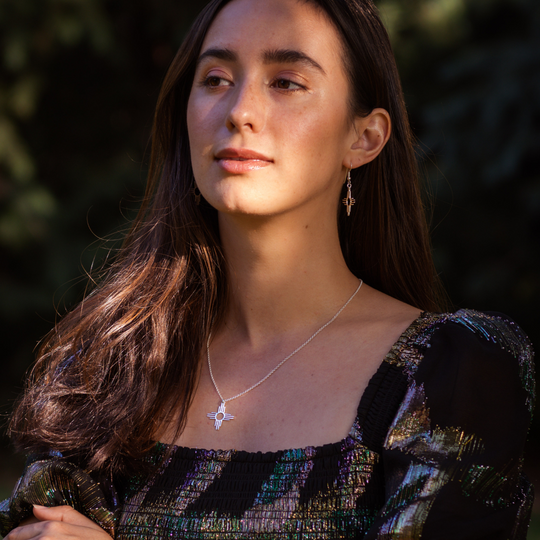
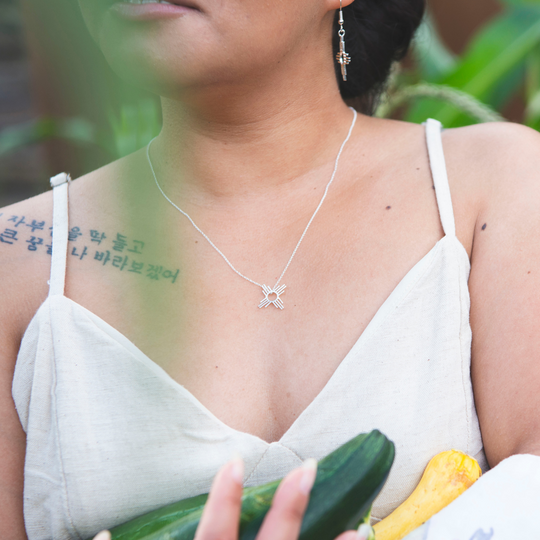
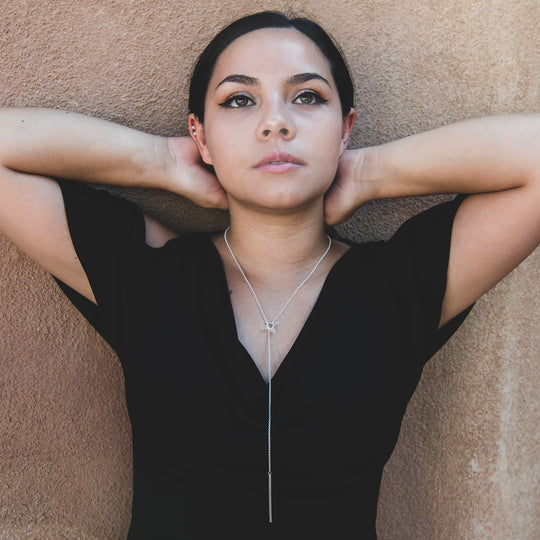
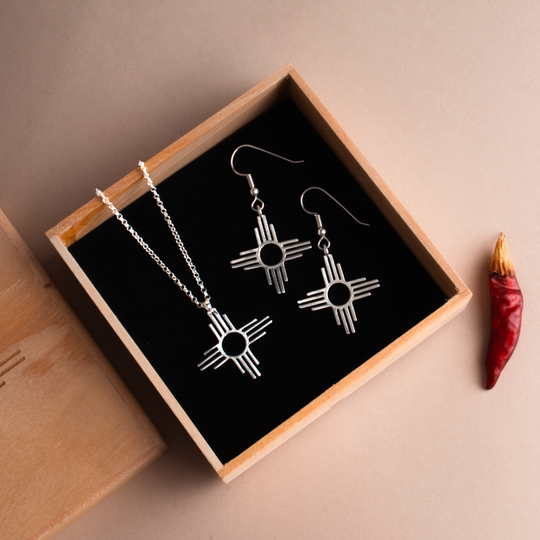
The necklaces on our shelf show the range. The Sun Blossom Zia squash necklace is 16 inches with a 2-inch extender and a 1¼-inch center pendant, so it wears close, at the collarbone. The Granada Grande is 18 to 20 inches with a naja 1¼ by 1 inch, which puts it on the upper chest. Philbert Secatero’s Turquoise Squash Blossom is 20 to 22 inches and adjustable, with a naja 2¾ inches across, so on most people it lands near the breastbone. The Corn Blossom is 24 inches with a 2-inch extender. The longest is his Sterling Silver Navajo Naja Necklace, a 28-inch strand of beads with a 3½-inch naja, which falls to about the middle of the chest.
Our advice is to match the naja to your frame, not the fashion. A small naja on a short strand reads as a finished piece on a narrow frame and disappears on a broad one. A large naja on a long strand needs room to hang flat. If you are between two, choose the adjustable or extender length and try it against the neckline you wear most.
What to wear under it
A squash blossom brings its own pattern: the rhythm of the beads, the repeat of the blossoms, the arc of the naja. In our view it looks best against a quiet field, with nothing competing for the same space.
- Plain, close necklines. A crew-neck tee, a fine knit or a plain dress gives the whole necklace a clean ground. White and black both work. Soft solid color does too.
- Collared shirts. Let the necklace sit outside the collar and over the placket, or choose a strand long enough to clear the collar points. A 24-inch strand or longer usually does.
- Open jackets. Wear the jacket open. A lapel frames the necklace. A buttoned jacket cuts it in half.
- What to skip. Busy prints and heavy ruffles fight the pattern. So does a second statement necklace at the same length.
Hold back on everything else at first. A squash blossom with plain earrings and one bracelet looks deliberate. Once the necklace is doing the work, the outfit doesn’t have to.
Layering, and wearing the parts on their own
Wearing more than one strand is not a modern invention. A photograph in Frank’s book shows a Navajo woman from Arizona in the 1920s wearing two at once: “Two squash blossom necklaces, with the blossoms placed closely together and next to the najas, adorn this Navajo woman from Arizona” (Indian Silver Jewelry of the Southwest, p. 9). John Adair describes a photograph by Wittick of the Navajo smith Slender Maker of Silver: “He wears a string of plain hollow beads with a large najahe at the bottom. The other, shorter strands of beads appear to be made of turquoise.” Adair adds a fair caution, that Wittick “photographed many of his subjects with properties that he carried with him,” so the silver may not have been the smith’s own. The arrangement is still worth copying: a long strand with the naja, and shorter strands above it.
That is our advice for layering today. Keep one naja. Add one or two shorter strands above it, plain silver beads or turquoise, so they fill the space between the collarbone and the top of the blossoms without touching them. Keep the shorter strands simpler than the squash blossom, and don’t add a second pendant at the same depth. If the strands tangle when you move, they are too close in length. Leave about two inches between them.
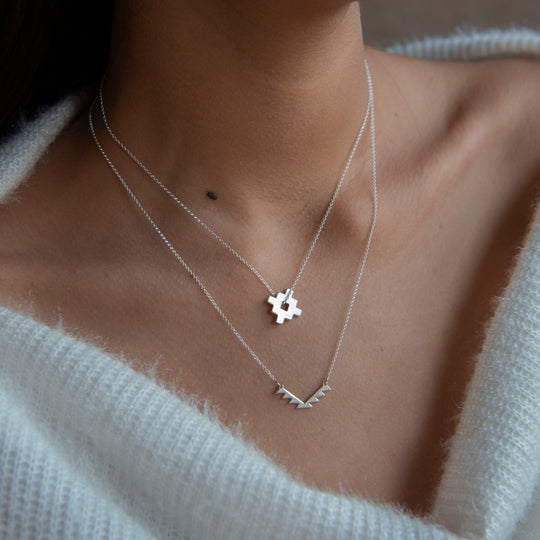
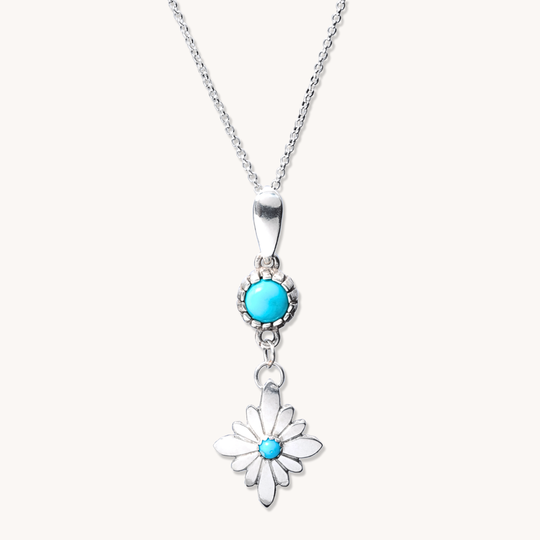
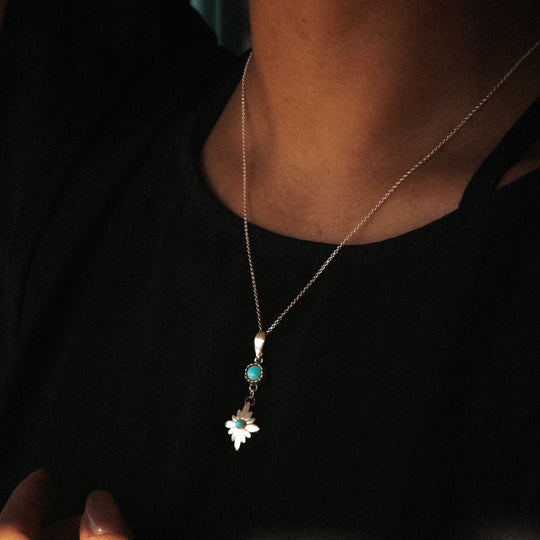
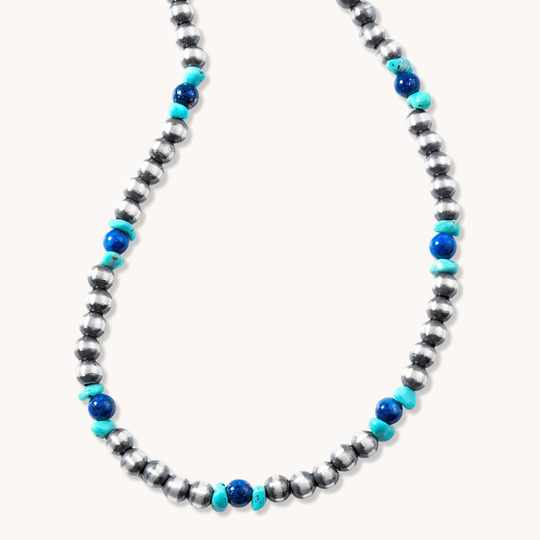
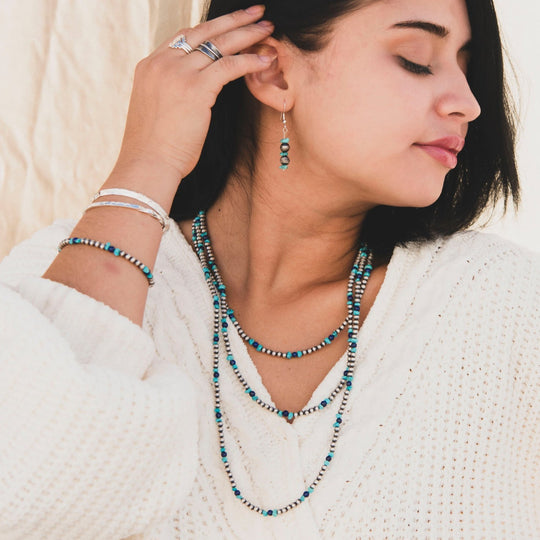
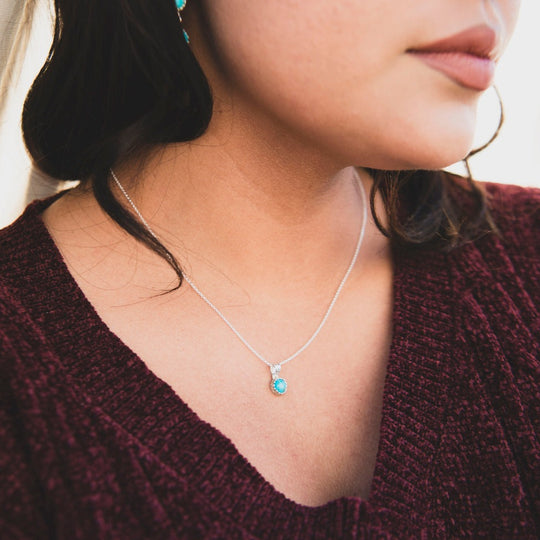
The parts also work alone. Early bead strands, Marsha Lund writes, “were not always worn in combination with the squashblossoms or the naja, but often were strung alone.” A plain strand of silver beads is the easiest necklace in this family to wear every day. Our house strands are called Desert Pearls, and they are in the Desert Blossom collection. (We use the name “Navajo pearls” only for beads made entirely by a Navajo silversmith.) For more on stacking bead strands, see how to layer silver bead necklaces. A naja also wears well on its own as a pendant, like our turquoise naja pendant by J. Nelson, whose hallmarked work we carry. Without the blossoms and the long strand of beads, a pendant is far lighter than a full necklace and easier to wear with a collar.
Weight: choose one you will actually wear
Squash blossoms got lighter once they were made for a wider market, and that is worth knowing when you choose. Lund notes that the older beads “were quite large compared to those later encouraged by the traders for tourists wear.” Writing in 1944, Adair saw the same change underway: “The traders have encouraged the smiths to make strands of small beads which are much lighter in weight than those they formerly made.” He also describes a variation common in his day, “a double or triple strand of small beads held together at the lower end by squash-blossoms which have large bases set with stones.”
A heavy, cast naja on large beads is a statement for an evening or an occasion. A lighter strand with a smaller naja is a necklace you can wear to work. Both are real squash blossoms. If you plan to wear yours often, pick it up before you buy, or ask us for the weight. How the naja was made also changes the weight, and our naja guide explains how to tell a cast naja from a fabricated one.
Is it all right to wear one?
This is the question we hear most, and we can’t answer it for any nation. Here is what we can tell you. The squash blossom has been worn widely outside the nations that make it for a long time. In 1944 Adair recorded that it had become “a popular item with the white residents of the Southwest.” In 2011 the New Mexico Legislature adopted it as the state’s official necklace, according to the New Mexico Secretary of State.
What you can control is how you buy and how you wear it. Know who made it, and get the maker’s name on the receipt. A necklace sold as Navajo or Native American must be made by a Navajo or Native American artist under federal law, and our guide to authentic Native American jewelry explains what to ask. Treat the necklace as jewelry, not as a costume: no headdresses, no borrowed regalia. And don’t repeat sales-copy meanings as fact. The naja is often sold as a sacred protection symbol, and our squash blossom guide explains, with Diné writers and elders in their own words, why that is wrong.
Squash blossoms are for men too
The squash blossom has never been only a woman’s necklace. Some of the earliest photographs in our reference books show men wearing it. Frank’s book includes a Hopi man, photographed between 1903 and 1911, wearing an old-style flat silver naja (p. 7), and the Wittick photograph Adair describes shows a Navajo silversmith with a large naja on a strand of hollow beads (p. 23). The New Mexico Secretary of State notes that it is “traditionally worn by both male and female.” Ungelbah Dávila-Shivers, a Diné writer, puts it in one line in our journal: najas have always been “proudly worn by men and women.”
Silver jewelry also carried standing. Frank writes that among the Navajo, a rich man who owned a good many sheep “and his family would also be the proud possessors of a large quantity of silver jewelry, which would proclaim for them a certain rank and respect.” Standing and respect are what the books describe. The vague “protection” in so much sales copy is not.
For men, our advice is the same as for anyone: a plain shirt or tee, a strand long enough to sit flat, and nothing else at the neck. A naja pendant on a bead strand is the easy way in. More in our guide to men’s turquoise rings and cuffs.
Care: watch the naja loop
The naja is the heaviest part of the necklace, and it wears first. Lund explains why: “When a Squashblossom has been worn over a long period of time, the back of the loop which attaches the Naja to the necklace portion will show definite wear, since it is the heaviest part of the piece, and comes in constant contact with clothing.” Check that loop now and then, and have it repaired before it thins.
For tarnish, William and Sarah Turnbaugh recommend a jeweler’s rouge cloth, which “will remove tarnish from the surface without damaging stones and without polishing dark areas of the silver that the craftsman deliberately oxidized to heighten the contrast of the silver design.” Keep dips and liquid polish away from the turquoise. In our experience a squash blossom stores best laid flat or hung full length, so the blossoms don’t catch on each other. Put it on after lotion and perfume, not before. Our jewelry care guide covers the rest.
Our squash blossom necklaces
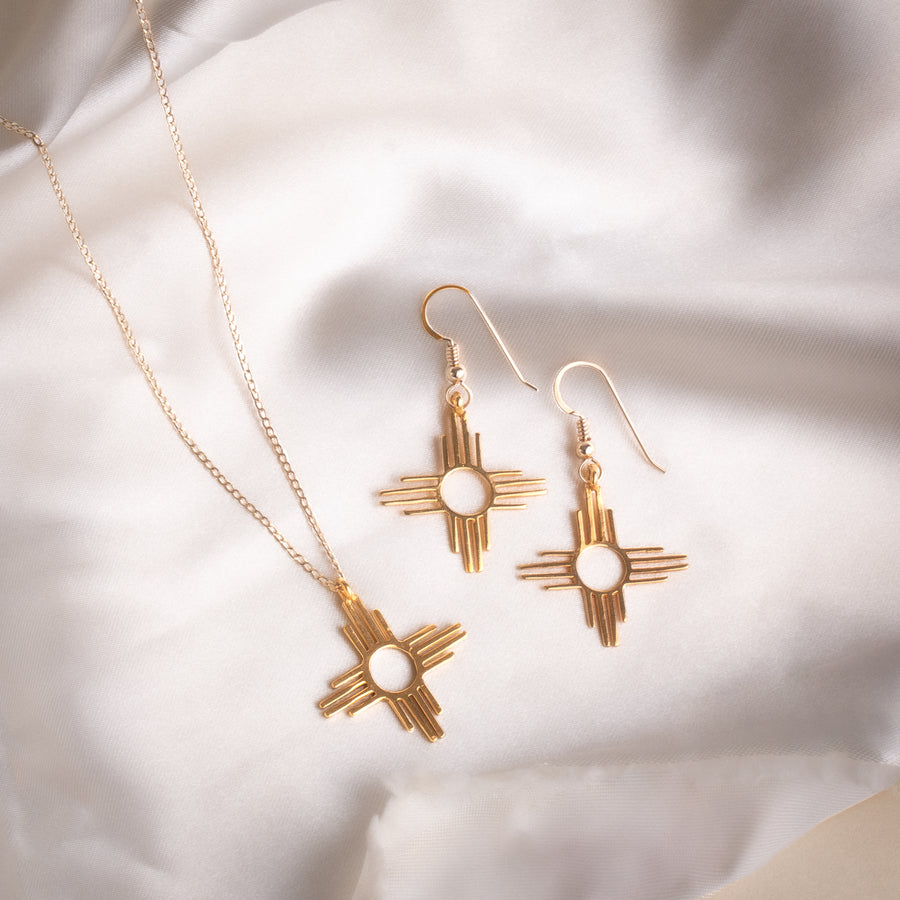
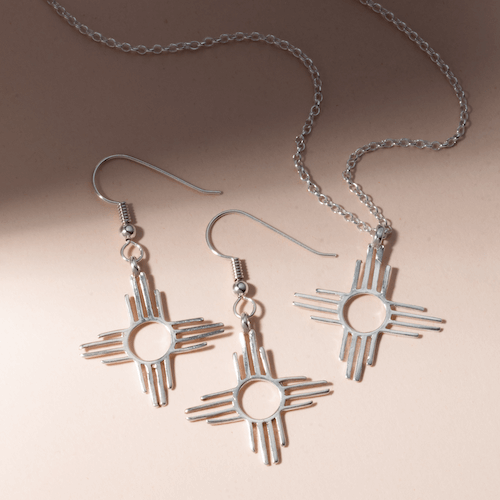
Our squash blossoms come in two kinds, and each listing tells you which. Some are T.Skies house designs by Mateo James: the Granada Grande, the Corn Blossom and the Sun Blossom Zia squash necklace. We don’t call these Navajo or Native American. The Sun Blossom belongs to our Enchantment line, which was designed in collaboration with the late Peter Pino, then Governor of the Pueblo of Zia. T.Skies uses the Zia sun symbol with permission from the Pueblo of Zia. Others are by named artists. Philbert Secatero, a Navajo silversmith whose hallmarked work we carry, made the Turquoise Squash Blossom and the Sterling Silver Navajo Naja Necklace, and both listings carry his name. To read a maker’s mark on a piece you already own, see our guide to Native American hallmarks.
Wearing it well
Add the naja to the strand length before you choose. Wear it against a plain neckline, with the jacket open. Layer shorter and simpler strands above it, never a second naja beside it. Pick a weight you’ll wear often, and check the naja loop from time to time. Buy it with the maker’s name on the receipt. When you’re ready, browse our squash blossom collection or the full range of necklaces.
Related reading
- The squash blossom necklace and the naja
- The naja: the crescent of Southwest jewelry
- The evolution of a squash blossom necklace
- The Naja, by Ungelbah Dávila-Shivers
- The Moorish influence on Southwest jewelry
- How to choose a turquoise necklace
Frequently asked questions
How long should a squash blossom necklace be?
Add the naja’s height to the strand length. On most people a 16- to 20-inch strand puts the naja near the collarbone or upper chest, and 24 inches or more puts it lower and clears a shirt collar. Our squash blossoms run from a 16-inch strand with an extender to a 28-inch strand with a 3½-inch naja (T.Skies listings).
Can you layer a squash blossom necklace?
Yes. A 1920s photograph shows a Navajo woman wearing “two squash blossom necklaces” at once (Frank, Indian Silver Jewelry of the Southwest, p. 9), and another shows a Navajo smith with a long naja strand and “other, shorter strands of beads” (Adair, The Navajo and Pueblo Silversmiths, p. 23). Keep one naja and put simpler, shorter strands above it.
Can men wear a squash blossom necklace?
Yes. Early photographs show Hopi and Navajo men wearing najas (Frank, p. 7; Adair, p. 23). The New Mexico Secretary of State notes it is “traditionally worn by both male and female,” and the Diné writer Ungelbah Dávila-Shivers writes that najas are “proudly worn by men and women” (The Naja, T.Skies, 2021).
Why is it called a squash blossom?
Adair gives the Navajo word for the bead, “literally translated,” as “bead which spreads out,” and thinks it “highly probable” that the English name “was coined by a white man, who, upon asking a Navajo what the bead represented, was told a squash-blossom” (The Navajo and Pueblo Silversmiths, p. 44). Our squash blossom guide covers the pomegranate origin of the form.
How do I care for a squash blossom necklace?
Check the loop that holds the naja, which is “the heaviest part of the piece” and shows wear first (Lund, Indian Jewelry: Fact and Fantasy, p. 122). Clean the silver with a rouge cloth rather than dips, store it flat or hanging, and keep lotion and perfume off the turquoise.
From the Library: Franciscan Fathers, An Ethnologic Dictionary of the Navaho Language (1910)
1910 primary source. Anything described as current here describes 1910, not today.
Writing in 1910, the Franciscan Fathers described what Navajo men wore at the neck:
“About their necks they wear strands of beads, either of coral, turquoise, or red, white and black stones and shells, or heavy necklaces of silver beads, and other ornaments of their own make.”
— Franciscan Fathers (1910), p. 464 [1]
Of the women, the Franciscan Fathers (1910) added:
“Beside their bead necklaces, which are like those of the men, they wear a number of silver bracelets, rings, etc.”
— Franciscan Fathers (1910), p. 465 [1]
Sources
- Larry Frank with Millard J. Holbrook II. Indian Silver Jewelry of the Southwest, 1868–1930. 1978, pp. 7, 9.
- John Adair. The Navajo and Pueblo Silversmiths. 1944, pp. 23, 44–45.
- Marsha Mayer Lund. Indian Jewelry: Fact and Fantasy. 1976, pp. 42, 44, 122.
- William A. Turnbaugh and Sarah Peabody Turnbaugh. Indian Jewelry of the American Southwest. Schiffer, n.d., “Care of Jewelry.”
- New Mexico Secretary of State. “State Necklace.” sos.nm.gov/about-new-mexico/state-necklace (accessed September 23, 2026).
- Ungelbah Dávila-Shivers. “The Naja.” T.Skies Journal, April 14, 2021.
- T.Skies product listings for our squash blossom and naja necklaces (lengths and measurements, accessed September 23, 2026).
- Franciscan Fathers. An Ethnologic Dictionary of the Navaho Language. Saint Michaels, Arizona: The Franciscan Fathers, 1910. Public domain (U.S. publication before 1931). Cited by printed page. Statements describe conditions as of 1910.