



Native American Symbols and Their Meanings: What the Sources Actually Say

Search for "Native American symbols and meanings" and you'll find neat lists: the bear means strength, the arrow means protection, the spiral means life's journey. Most of those lists don't say where the meanings come from. This guide does. For each symbol, we give what a named book, scholar or Native writer actually recorded, with the page, and for which people. Where we couldn't find a source, we say so instead of filling the gap. If you're shopping, you can browse the Native American jewelry we carry as you read.
First: who speaks for a symbol
A note on meaning. "Native American" is a blanket term. It covers many nations, each with its own beliefs and its own ways. Within one nation, a design can mean one thing to a clan or family and something different, or nothing at all, to another. Some meanings are sacred and aren't ours to repeat, so what you read here is a part, never the whole. We don't speak for any Nation, and nothing on this page is any tribe's official teaching. If you belong to a tribal nation and what you've been taught differs from what you read here, follow your own family and speak with your own tribal leaders. You can read more about how we handle teachings.
Why so many "symbol meanings" are recent
Paula Baxter's Encyclopedia of Native American Jewelry puts it bluntly: "Non-Indians were responsible for the intentional invention and enlargement of 'Indian' symbols; for example, industrial stamps using obvious images such as arrows, feathers, and thunderbirds." She traces the habit to the souvenir trade: "This trend is best exemplified by the invention of 'keys' to the meaning of 'Indian' symbols, such as those published in postcard form by various traders and souvenir manufacturers." Many of the symbol charts you'll find online are descendants of those postcards.
The timing is on record. Marsha Mayer Lund places the change in the years when the Fred Harvey Company began ordering light, cheap jewelry for tourists. To make the thin pieces sell, she writes, traders "introduced their smiths to new stamps which looked more 'Indian' to the tourist buyers." Among them she names arrows, rain clouds and thunderbirds. Margery Bedinger, citing Mera, says traders persuaded Navajo smiths to use arrow designs "perhaps as early as 1890." For the Harvey story, see The Fred Harvey Era.
That's only half the story, and the other half matters. Lund adds that many Navajo smiths went on to use the new designs on their own jewelry and on pieces they made for other Native customers. Baxter writes that "many artists built upon invented conventions and adapted them to suit their own aesthetic purposes." A design that started as a trader's stamp can take on real meaning for the person who makes it or wears it. What it can't do is carry one fixed meaning that holds for every nation. That's the claim to be wary of when it comes printed on a card.
A name isn't always a meaning
Some familiar names describe what a design looks like, not what it stands for. The squash blossom necklace is the best-known case. Lund records that "the Navajo word for the ornament simply means 'bead which spread out.'" The rings Larry Frank and Millard Holbrook show as "butterfly" rings got the name because "the shape resembles that of the butterfly." Neither name is a statement of belief. We cover the necklace in The Squash Blossom Necklace & the Naja.
Symbol by symbol: what the sources record
Each entry says who recorded the meaning and for which people. When a book gives a meaning for one nation, it belongs to that nation, not to "Native Americans" in general.
Thunderbird
The thunderbird carries real meanings, and they differ by region. Baxter describes Plains peoples who "respected a similar force, causing thunder, lightning, and life-giving rain," and a Northwest Coast thunderbird that "was revered as the creator of the world and all natural elements."
The Southwest thunderbird stamped on so much silver has a documented commercial history. Baxter writes that Herman Schweizer, the Fred Harvey Company's Indian arts buyer, "viewed a pictograph of a thunderbird at the Abo ruins" in New Mexico and had it made into a company logo. The company, Baxter writes, "eventually copyrighted its version." Once jewelry-supply companies began selling thunderbird stamping dies, the design spread. Baxter sums up the meaning that grew around it: "The general tourist connotation hails the thunderbird's role in generating abundant harvests, and as a harbinger of good luck." In her words that's a tourist connotation, not a nation's teaching.
Arrow
Baxter gives the arrow both sides. "The depiction of arrows and arrowheads on jewelry is a tribute to the importance of arrows as a material culture form," she writes, but "historic and contemporary tourist jewelry frequently contains arrows or arrowheads that are devoid of any spiritual context." One arrow variant has a known origin. She calls a lightning bolt tipped with an arrow point "a tourist-era addition that also carried the specious meaning of 'swiftness.'"
You'll often read that an arrow pointing left means protection or warding off evil. We looked for a source for that in our reference library and didn't find one, so we don't repeat it.
Bear and bear paw
Baxter describes the bear as an animal "considered to be a powerful life force by virtually all indigenous peoples in North America," one "meant to be approached with respect." The meanings are specific, though: "The Haida characterize the bear as a symbol of motherhood." In Southwest jewelry, the bear paw is "most often seen as a clan emblem or hallmark sign." And the meaning most lists give it? "A popular, but probably nonauthentic, meaning assigned to the visual representation of the bear paw is that of inner strength."
When a bear does carry meaning in a piece, it's often the maker's own. Baxter notes that the jeweler Jesse Monongye, whose heritage is Navajo and Hopi, uses the bear as a trademark design motif, and that "this animal's spiritual nature is important to the artist." That's the best way to read any symbol: through the person who made it. Our field guide to the bear and bear paw in Southwest jewelry goes further, and so does our older post on bears in the Southwest.
The heartline
The heartline is a line drawn on the body of an animal figure. Baxter writes that it comes from fetish carving and has since become a convention in jewelry: "A line, often irregular or jagged, is drawn on the body to represent the mystical force of the animal's breath from its heart." That is her description of the convention. What a particular carved animal means belongs to its carver's tradition, and we don't go further than that.
Cross and dragonfly
Not every cross on old Southwest silver is a Christian cross. In 1883 the Army surgeon Washington Matthews reported that "the cross is much worn by the Navajos, among whom, I understand, it is not intended to represent the 'Cross of Christ,' but is a symbol of the morning star." Note his "I understand": it's one observer's report. Another cross has two bars and a heart-shaped end. Frank and Holbrook write that it is "also found in Plains Indian jewelry" and is "thought to represent a stylized dragonfly." Bedinger adds that at many pueblos, "notably Zuni and Acoma, the cross is called a dragonfly."
Turtle
The turtle shows why one meaning can't fit every nation. Baxter records that "in the creation legends of the eastern Woodlands peoples, the turtle dove into primeval waters to retrieve mud for the making of the earth," while "when depicted in designs from the Southwest, turtles are water symbols." Her conclusion fits every symbol on this page: "The use of the turtle on jewelry is meaningful according to its maker's heritage."
Feathers and the eagle
Baxter writes that feathers "have been given a symbolic connotation of freedom and flight," and she is frank about who gave it: feathers "are associated—by non-natives—with overall Native American values and beliefs." Of the eagle, she says that "in decorative use, the eagle follows the conventions of the artist's cultural group." The popular line that the eagle carries prayers to the Creator is a religious claim. We couldn't source it for jewelry, and it isn't ours to explain.
Wolf
Symbol lists call the wolf a sign of loyalty and family. Baxter's entry is plainer: "the wolf is not a common motif for jewelry, but it does appear on some twentieth-century pieces." We found no source for the loyalty reading.
The naja
The crescent at the bottom of a squash blossom necklace is often called a protective amulet. The sources speak to where it came from, not what it means. In 1954 Clara Lee Tanner described the crescent pendant that hung from Navajo bridles as "very possibly the source of the 'naja'" and said it "may have been the survivor of the old world charm against the 'Evil Eye.'" Note her "very possibly" and "may have been." On meaning, Lund found "no concrete evidence that they place any symbolic significance in it at all." The Diné writer Ungelbah Dávila-Shivers gives the Diné view directly: "While Diné don't consider the Naja to have any spiritual or symbolic significance in their culture and religion, they have always been held in high esteem as a form of wealth and bravery, proudly worn by men and women." Read her full piece, The Naja, and our field guide to the naja crescent.
The Zia sun symbol
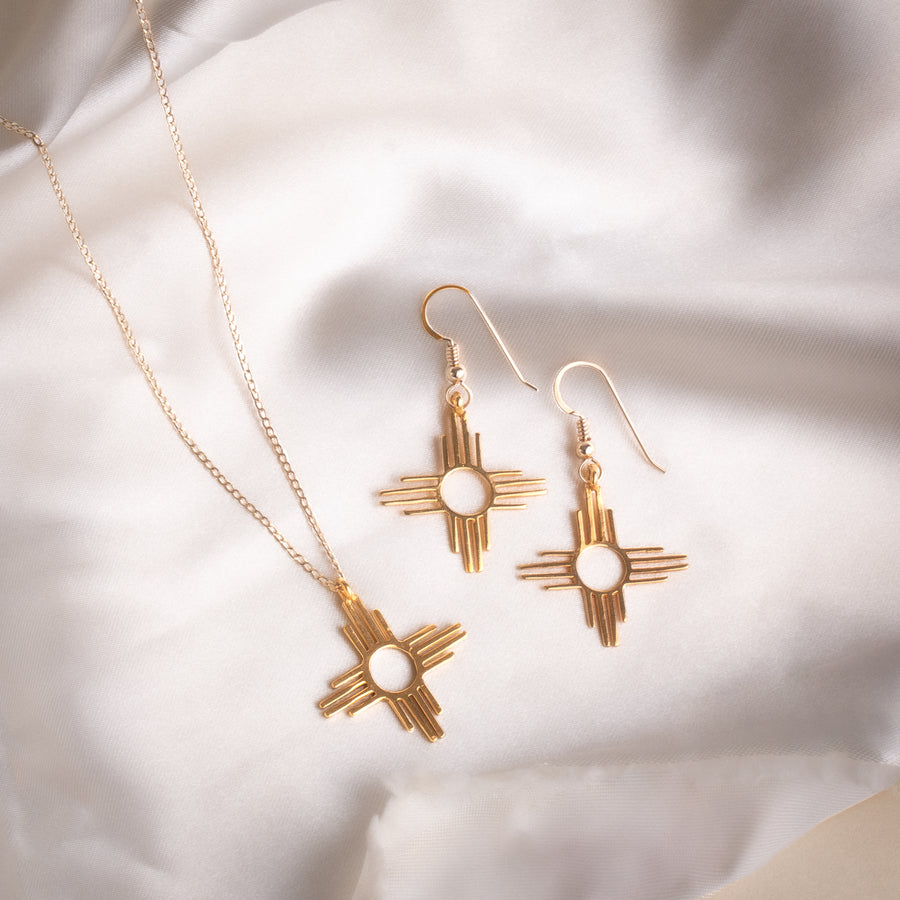
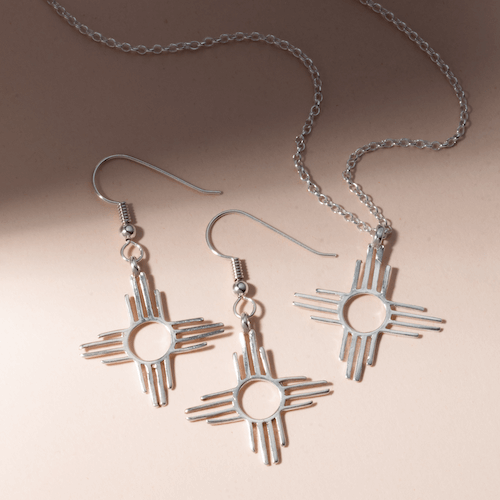
The Zia sun belongs to the Pueblo of Zia. It isn't a Navajo symbol, and it isn't a generic "Native American" one. The Pueblo describes it in its own words: "The Zia Sun Symbol holds significant cultural meaning for our community, representing harmony and the interconnectedness of the four directions, the four seasons, the four stages of life, and the four parts of the day." T.Skies uses the Zia sun symbol with permission from the Pueblo of Zia. We tell more of its story in our guide to the Zia symbol.
Snakes, waterbirds, hogans and more
Several symbols have their own field guides, each built from sources. The snake is a contested motif. The historical record shows some Navajo smiths refusing to make it while others did. See snakes in Southwest jewelry. We also have guides to the waterbird in Hopi overlay, the hogan and the horned toad, and posts on circles and numbers.
Meanings we couldn't source
These show up on many symbol lists, including the two older versions of this post. We searched our reference library of nearly 60 books and period reports on Southwest jewelry, silver, turquoise and ethnology and found no source we could cite for them, so we leave them out:
- The hummingbird as a symbol of endurance or joy.
- The spiral as the journey of life, as it's described for jewelry.
- A left-pointing arrow as protection or warding off evil.
- The wolf as loyalty, the butterfly as transformation, the bear as healing.
- Turquoise as "protection," or blue and green turquoise carrying different spiritual meanings.
- Sterling silver as "the strength of the mountains."
That doesn't mean no one holds these ideas. It means we can't show you who does, and a meaning with no source is exactly the kind that used to be printed on a trader's postcard.
What we don't publish
Some symbols and figures are sacred to the nations they come from, including ceremonial figures and designs taken from sandpaintings. We don't explain them here, we don't put them in our house designs, and we don't sell imitations of them. Our Native artists may use these symbols in their own work, and that is between them and their tribal leaders. When a meaning is held within a tradition or a family, we point you to the artists and communities themselves.
Buying a piece for its symbol
If a symbol matters to you, ask the person who made the piece. Many Native artists put their own meaning into their marks. Baxter notes that artists "may deliberately mark their jewelry with some token of this relationship, often by a hallmark, such as an animal track or symbol, a sun symbol, or other form of descriptive mark." Our Native American hallmarks library documents the marks we've been able to verify.
Who made a piece is also a legal question. The Indian Arts and Crafts Board describes the Indian Arts and Crafts Act of 1990 as "a truth-in-marketing law." Under it, "it is illegal to offer or display for sale, or sell, any art or craft product in a manner that falsely suggests it is Indian produced, an Indian product, or the product of a particular Indian Tribe." A symbol on a piece tells you nothing about who made it. Many pieces in our shop are T.Skies house designs by Mateo James, and we don't call those Native-made. Our guide to buying authentic Native American jewelry covers what to ask a seller, and how to tell Navajo, Zuni and Hopi styles apart will help you read what you're looking at. When you're ready, browse the Native American jewelry we carry.
The short version
- Symbol meanings differ by nation, clan and family. No single chart speaks for all of them.
- Many popular "meanings" were made up by non-Native traders and souvenir makers. Some trade stamps may go back as far as 1890.
- Some design names, like squash blossom and butterfly, describe a shape, not a belief.
- Where a source gives a meaning, it gives it for a specific people, like the turtle as a water symbol in the Southwest or the bear as motherhood for the Haida.
- The Zia sun belongs to the Pueblo of Zia, and T.Skies uses it with the Pueblo's permission.
Frequently Asked Questions
What do Native American symbols mean?
It depends on the nation, and often on the clan or family. Many symbol meanings in circulation were invented by non-Natives. Baxter traces them to "keys" to "Indian" symbols "published in postcard form by various traders and souvenir manufacturers" (Baxter, 2000, p. xlii). For a meaning you can trust, ask the maker of the piece.
Does the bear symbol mean strength?
That's the most common claim, and Baxter doubts it: "A popular, but probably nonauthentic, meaning assigned to the visual representation of the bear paw is that of inner strength." In Southwest jewelry, she writes, the bear paw is "most often seen as a clan emblem or hallmark sign" (Baxter, 2000, pp. 11–12).
What does the thunderbird mean in Southwest jewelry?
The thunderbird carries meanings among Plains and Northwest Coast peoples. The stamped Southwest version spread through the Fred Harvey Company, which made a thunderbird pictograph at the Abo ruins into its logo and "eventually copyrighted its version." The luck-and-harvest meaning attached to it is, in Baxter's words, a "general tourist connotation" (Baxter, 2000, pp. 173–174).
What does an arrow pointing left mean?
We couldn't find a source for the popular claim that it means protection. Baxter writes that tourist jewelry "frequently contains arrows or arrowheads that are devoid of any spiritual context," and calls the "swiftness" meaning given to the arrow-tipped lightning bolt "specious" (Baxter, 2000, pp. 6, 99).
What does the Zia symbol mean?
In the Pueblo of Zia's own words, it represents "harmony and the interconnectedness of the four directions, the four seasons, the four stages of life, and the four parts of the day" (Pueblo of Zia, letter to T.Skies, 2025). It is a Zia symbol, not a Navajo one, and T.Skies uses it with permission from the Pueblo of Zia.
From the Library: Bedinger on whether Navajo silver designs are symbolic
1973 primary source. Anything described as current here describes 1973, not today.
According to Bedinger (1973, p. 111), by the early 1970s some shopkeepers who knew little about Native people had invented "meanings" for stamped designs, and some even printed folders listing designs such as arrows, swastikas, thunderbirds and crosses with their supposed meanings. She regarded this as adding to the misinformation about Native people. [1]
Bedinger (1973, p. 111) drew a line between sacred and everyday art: Navajo sandpaintings used symbols to express religious concepts and had to be made exactly according to tradition, but she wrote that the everyday art of silverworking was wholly different. (This is an outside scholar's 1973 reading; the Diné are the authority on their own beliefs.) [1]
Bedinger (1973) explained why a design's name is not the same as a meaning:
“Designs may be named sun, moon, raindrop, whirling logs, as we may speak of a diamond, fret, or step design. This does not mean that the artist was trying to express the idea of the sun, but only that the design is round as the sun is round.”
— Bedinger (1973), p. 112 [1]
Bedinger (1973) recorded one Navajo smith's own answer:
“As one smith remarked succinctly: "They don't mean nothing; just pretty."”
— Bedinger (1973), p. 112 [1]
According to Bedinger (1973, p. 112), the anthropologist John Adair showed a piece of copper stamped with various designs to five Navajo silversmiths and asked what the designs were; all five laughed, and no design was given the same name by all five. Two designs drew similar answers because they resembled sandpainting designs, but Adair was satisfied that they carried no religious significance when used on silver. [1]
From the Library: Adair, The Navajo and Pueblo Silversmiths (1944)
1944 primary source. Anything described as current here describes 1944, not today.
In an outside observer's record (the nations are the authority on their own customs and beliefs), Adair (1944) concluded from his late-1930s fieldwork:
“Apparently the designs which the Navajo smiths stamp on silver are not symbolic.”
— Adair (1944), p. 101 [2]
Of the curio dealers' printed folders that gave swastikas, thunderbirds, arrows and horses on Navajo silver definite meanings, Adair (1944) wrote:
“This is sales promotion rather than fact.”
— Adair (1944), p. 104 [2]
From the Library: June, Fred Harvey Jewelry 1900–1955 (2013)
2013 primary source. Anything described as current here describes 2013, not today.
According to June (2013, p. 72), many of the so-called Harvey symbols were invented in the early Harvey period, after 1900, and eventually settled into a fixed palette shared by all souvenir makers, whose brochures and pamphlets were so alike that they evidently copied from one another; who invented the symbols, he wrote, may never be known. [3]
Writing in 2013, June compared the makers' printed lists:
“Interestingly, all manufacturer symbol lists are printed in much the same order, and often use exactly the same drawings and phrases.”
— June (2013), p. 72 [3]
June, writing in 2013, counted the standard set:
“A group of forty-four "Harvey symbols" became the basic assortment for silver Indian souvenir jewelry.”
— June (2013), p. 75 [3]
June (2013, p. 75) found it odd to credit the palette to Harvey at all, since every symbol pamphlet then known to him had been printed by souvenir makers and no comparable Harvey company leaflet turned up in his study; the Silver Products company, also known as Silver Arrow, later enlarged the set by about 40% in a color pamphlet of its own. [3]
From the Library: Tanner, Navajo Silver Craft (1954)
1954 primary source. Anything described as current here describes 1954, not today.
Tanner (1954) suggested a non-symbolic source for many Navajo stamp designs:
“there is also a likely influence on several types of Navajo silver, including conchas, from the stamp patterns of Mexican leather work.”
— Tanner (1954), p. 28 [4]
According to Tanner (1954, p. 29), Navajo smiths used fewer design elements on a single piece before the demands of white buyers were felt; afterward one bracelet might carry several stamped motifs at once. [4]
Writing in 1954, Tanner gave one scholar's view of symbolism in silver:
“there is no symbolism to the designs which appear in Indian silver.”
— Tanner (1954), p. 33 [4]
Tanner (1954, p. 33) traced silver designs to Spanish leather stamps, to the straight lines the tools produced, and to suggestions from white traders, and called the squash blossom a pomegranate design despite fertility readings. In her view, a smith might name a pattern without the name carrying any symbolism. [4]
Field Notes by Mateo James
I notice the sources on this page differ. Tanner (1954) argued that the designs in Navajo silver carried no fixed symbolism, tracing them to Spanish leather stamps, the tools, and traders’ suggestions. Other sources on this page record meanings given by makers and their communities. Hers was one scholar’s view in 1954, and I show both.
Sources
- Baxter, Paula A., with Allison Bird-Romero. Encyclopedia of Native American Jewelry. Phoenix: Oryx Press, 2000. pp. xlii–xliii, 5–6, 10–12, 32, 48, 54, 68–69, 99, 110, 173–174, 183, 189.
- Bedinger, Margery. Indian Silver: Navajo and Pueblo Jewelers. Albuquerque: University of New Mexico Press, 1973. pp. 101, 182.
- Dávila-Shivers, Ungelbah. "The Naja." T.Skies Journal, tskies.com/blogs/news/the-naja.
- Frank, Larry, with Millard J. Holbrook II. Indian Silver Jewelry of the Southwest, 1868–1930. 1978. pp. 111, 201.
- Indian Arts and Crafts Board, U.S. Department of the Interior. Indian Arts and Crafts Act consumer brochure (GPO). p. 2.
- Lund, Marsha Mayer. Indian Jewelry: Fact and Fantasy. Paladin Press, 1976. pp. 39, 42, 84.
- Matthews, Washington. "Navajo Silversmiths." Second Annual Report of the Bureau of Ethnology. Washington: Government Printing Office, 1883. p. 178.
- Pueblo of Zia. Letter to Turquoise Skies Inc., September 19, 2025.
- Bedinger, Margery. Indian Silver: Navajo and Pueblo Jewelers. Albuquerque: University of New Mexico Press, 1973. Cited by printed page. Statements describe conditions as of 1973.
- Adair, John. The Navajo and Pueblo Silversmiths. The Civilization of the American Indian Series. Norman: University of Oklahoma Press, 1944. Cited by printed page. Statements describe conditions as of 1944.
- June, Dennis. Fred Harvey Jewelry 1900–1955. Atglen, PA: Schiffer Publishing, 2013. Cited by printed page. Statements describe conditions as of 2013.
- Tanner, Clara Lee. “Navajo Silver Craft.” Arizona Highways 30, no. 8 (August 1954): 16–33. Cited by printed page. Statements describe conditions as of 1954.


