


Two Types of Navajo Silver Cast Work
In this video George Francis a master Navajo Jewelry silversmith explains a little about Navajo silver jewelry cast work.
There are two types sand cast and tufa cast.
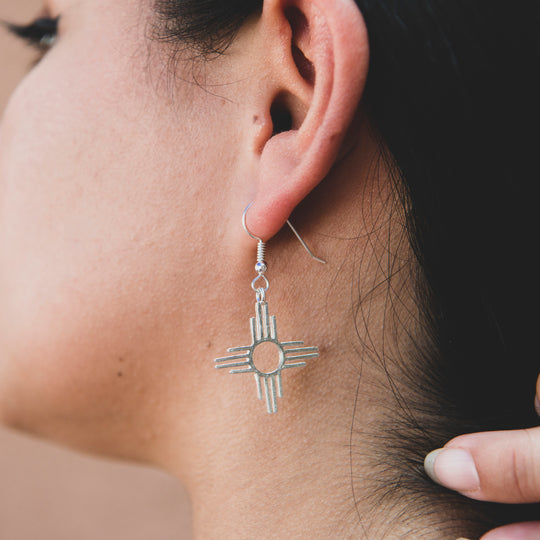
Cast work involves different types, and there are Navajo silversmiths. We have two types that a lot of people use. Cast work can be done with wax, lost wax casting, but in the old days we learned to do it with sand casting. I’ll show you an example of a cast. This cast here is in sandstone. It’s an Naja (squash Blossom) cast. A lot of people now, instead of going out to make the sandstone cast, they find products like Tufa, which is volcanic ash, and they use it more. It’s just as quick and just as efficient.
In these castings you look for the proper stone: texture, fineness, firmness. Those are the things you’re looking for because, especially if you’re doing detailed castings, you want to have very good, firm stones. At that point you want to have very good, firm stones, but be able to still do your work. With ash being very fine, you can do that detailed work. With Sandstone the texture is granular and more difficult to do much more detailed work.
Sand cast work – How long would it take you?
In Sandstone? If you could do it… Carving out the design takes quite an amount of time. It just depends. If you have the time, it’s about 1 to 3 days. For this example it took me one morning. We’re talking an hour, maybe, to get this design. It’s very simple and nothing to work at. In Tufa it took me maybe the same amount of time, about an hour. These little lines you see are basically there to chase the air out of there as it fills in. Of course, you have to have a back plate on everything that you do. This is the side I want done and this will cover that, and that is the flat side. So that’s how that works.
If it was a detailed design it could take more than one day, definitely. I’ve seen some people that can take up to 3 or 4 days to complete their work. That’s just the part of the design that they cast and pour it. Then they have to clean that again. That might take another day or two, depending on how much time they can allow to give it. Usually they don’t get paid what they’re really worth, but they do a good job.
Navajo Cast Work – How many castings can you get out of one cast?
In a Sandstone cast, including Tufa, you can get anywhere from one to up to eight or nine casts before either the cast breaks or pieces of it break off. Then it’s not of any value to the artist. It’s too much work trying to correct it.
From the Library: Adair, The Navajo and Pueblo Silversmiths (1944)
1944 primary source. Anything described as current here describes 1944, not today.
Grey Moustache, a Navajo smith of the 1880s, told Adair (1944) about the earliest molds:
“The first Navajo smiths used rock for casting. The rock wasn't soft and powdery like that we use now but was hard, and darker in color.”
— Adair (1944), p. 8 [1]
Adair (1944) agreed:
“Almost any fine-grained sandstone that could be found in the region was used.”
— Adair (1944), p. 13 [1]
As of 1944, Adair (1944) compared the two stones:
“The pumiceous rock that Grey Moustache found near Sunrise Springs is quite rare, occurring in fine grain in only a few places on the reservation.”
— Adair (1944), p. 13 [1]
And on the trade-off, in Adair (1944):
“While it takes a much longer time to carve the design out of hard rock, the mold can stand much greater temperatures and lasts indefinitely.”
— Adair (1944), p. 13 [1]
According to Adair (1944, p. 39), cast bracelets were made by pouring molten metal into a rock mold carved approximately into the shape of the finished bracelet. [1]
Writing in 1944, Adair contrasted the wrought bracelet with the cast one:
“In the former, the bracelet is a solid band with straight parallel sides and an unbroken surface, whereas in the cast bracelet, the surface is broken up into curvilinear bars separated by spaces, and the sides of the bracelet are not straight.”
— Adair (1944), p. 39 [1]
Adair (1944) dated the form from museum pieces:
“Cast bracelets date back to about 1875, which is the approximate date of the oldest cast bracelets in the collection of the Laboratory of Anthropology”
— Adair (1944), p. 39 [1]
Watching Tom Burnsides cast a ketoh in 1938, Adair (1944) noted what the casting stone really was:
“This rock, which is erroneously called sandstone, is tuff, a volcanic ash similar to pumice”
— Adair (1944), p. 63 [1]
According to Adair (1944, p. 64), after carving the design Tom cut a pouring channel into the mold and four very shallow grooves from the corners of the design to the corners of the stone, so that air could escape as the silver ran in. [1]
Adair (1944) recorded why the mold was warmed before the pour:
“Tom set the mold near the forge so the rocks would heat, for, as he explained to me, if they are cold when the silver is poured in, it will cool too rapidly and crack.”
— Adair (1944), p. 65 [1]
And Adair (1944) described a tell-tale of the cast surface:
“The under side of all cast pieces is pitted with minute holes.”
— Adair (1944), p. 66 [1]
Adair (1944) recorded the Zuni caster Juan Deleosa's experience with mold stones:
“While it is much more difficult to carve the mold out of hard rock, once the mold is made, it will last indefinitely, whereas the tuff mold will crack after less than a dozen pourings.”
— Adair (1944), p. 150 [1]
According to Adair (1944, p. 150), Juan learned casting from a Navajo but, not having seen him grease the stone, had his first casts stick to the stone. [1]
From the Library: Lund, Indian Jewelry: Fact and Fantasy (1976)
1976 primary source. Anything described as current here describes 1976, not today.
Lund (1976) on centrifugal (lost-wax) casting, which some buyers of her day distrusted:
“The dirty words in this process should be Rubber Molds, not centrifugal casting.”
— Lund (1976), p. 130 [2]
According to Lund (1976, p. 130), a smith casting one piece burned out the wax and broke the investment mold, so the piece could not be repeated, while manufacturers made rubber molds of a model and cast as many copies as they liked; seeing two identical pieces was the giveaway. [2]
Lund (1976, p. 131) added that a machine-cast copy lacked the tiny mold perforations and file scratches found on the back of hand-cast work; its back was smooth, melted and streaked, like hard candy poured onto a marble slab. [2]
From the Library: Baxter, Encyclopedia of Native American Jewelry (2000)
2000 primary source. Anything described as current here describes 2000, not today.
Baxter (2000) dated the start of sandcasting:
“Navajo and Pueblo smiths began sandcasting silver around 1875, and the technique continues to be vital to the present day.”
— Baxter (2000), p. 30 [3]
According to Baxter (2000, p. 29), smiths usually used two-part tufa molds to shape a piece on both sides, while the back of a sandcast piece is flat and may show small dents from its removal; because the molds often had to be broken open to free the metal, only a few pieces could be made from any one mold. [3]
Baxter (2000) placed lost-wax casting late in Native silverwork:
“However, it is a technique that came late (mid-twentieth century) to native jewelers, who had relied more on sandcasting and tufa casting.”
— Baxter (2000), p. 102 [3]
Baxter (2000) added how it was learned:
“Native jewelers, especially fine art studio jewelers, learn the lost-wax process through art-school training or during apprenticeship to non-native jewelers.”
— Baxter (2000), p. 102 [3]
From the Library: Matthews, Navajo Silversmiths (1883)
1883 primary source. Anything described as current here describes 1883, not today.

Plate XVIII of Matthews' report shows a crucible and two of these sandstone molds.
The earliest description in our library of Navajo stone molds is Matthews' 1883 report. The molds he saw were cut to cast ingots that were then hammered into shape:
“The moulds in which they cast their ingots, cut in soft sandstone with a home-made chisel, are so easily formed that the smith leaves them behind when he moves his residence. Each mould is cut approximately in the shape of the article which is to be wrought out of the ingot cast in it, and it is greased with suet before the metal is poured in.”
— Matthews (1883), p. 173 [4]
Matthews (1883) described the crucibles the metal was melted in:
“Crucibles are made by the more careful smiths of clay, baked hard, and they are nearly the same shape as those used by our metallurgists, having three-cornered edges and rounded bottoms. They are usually about two inches in every dimension.”
— Matthews (1883), p. 173 [4]
Some smiths, he added in 1883, did without a made crucible:
“Some smiths, instead of making crucibles, melt their metal in suitable fragments of Pueblo pottery, which may be picked up around ruins in many localities throughout the Navajo country or purchased from the Pueblo Indians.”
— Matthews (1883), p. 173 [4]
The earliest account of Navajo casting in our library is Matthews' 1883 report. For a powder charger, two smiths at Fort Wingate began by casting:
“Having cut in sandstone rock (Fig. 2, Pl. XVIII) the necessary grooves for molds and greased the same, they melted two Mexican dollars—one for the bowl or receptacle, and one for the handle—and poured each one into its appropriate mold.”
— Matthews (1883), p. 176 [4]
The casting was only the first step; Matthews (1883) went on:
“The ingot cast for the receptacle was beaten into a plate (triangular in shape, with obtuse corners), of a size which the smith guessed would be large enough for his purpose.”
— Matthews (1883), p. 176 [4]
From the Library: Tanner, Navajo Silver Craft (1954)
1954 primary source. Anything described as current here describes 1954, not today.
Tanner (1954, p. 27) counted casting and hammering as the earliest methods of Navajo silverwork, and both were still popular in 1954. [5]
Describing casting as it was done in 1954, Tanner wrote of the work after the pour:
“many hours of tedious labor follow in the finishing of the piece, for rough edges must be cut away”
— Tanner (1954), p. 27 [5]
Sources
- Adair, John. The Navajo and Pueblo Silversmiths. The Civilization of the American Indian Series. Norman: University of Oklahoma Press, 1944. Cited by printed page. Statements describe conditions as of 1944.
- Lund, Marsha Mayer. Indian Jewelry: Fact and Fantasy. Boulder, CO: Paladin Press, 1976. Cited by printed page. Statements describe conditions as of 1976.
- Baxter, Paula A., with Allison Bird-Romero. Encyclopedia of Native American Jewelry: A Guide to History, People, and Terms. Phoenix: Oryx Press, 2000. Cited by printed page. Statements describe conditions as of 2000.
- Matthews, Washington. “Navajo Silversmiths.” In Second Annual Report of the Bureau of Ethnology to the Secretary of the Smithsonian Institution, 1880–81, pp. 167–178, plates XVI–XX. Washington: Government Printing Office, 1883. Cited by printed page. Statements describe conditions as of 1883.
- Tanner, Clara Lee. “Navajo Silver Craft.” Arizona Highways 30, no. 8 (August 1954): 16–33. Cited by printed page. Statements describe conditions as of 1954.