



Roger Tsabetsaye — Zuni Silversmith
b. 1941, Zuni Pueblo. The Zuni jeweler whose work doesn't look Zuni — on purpose.
Say "Zuni jewelry" and most people picture the tradition Roger Tsabetsaye's own sister mastered: tight needlepoint and petit-point, dozens of small stones set in careful clusters. Roger went the other way. He came through the Santa Fe Indian School just before it became the Institute of American Indian Arts, spent three summers at the Southwest Indian Art Project in Tucson, and went on to make Zuni work that looks like almost no one else's — sculptural, raised, modern. In a family that held the tradition, he chose to break from it.
The Smith
He was born in 1941 at Zuni Pueblo. Jewelry was already in the household — his sister, Edith Tsabetsaye, who became internationally known for her fine Zuni needlepoint, learned silversmithing and lapidary from their parents as a girl. He spent 1960–61 at the Santa Fe Indian School, just before it became the Institute of American Indian Arts. After high school he was accepted through a talent search into the Southwest Indian Art Project at the University of Arizona in Tucson. In his own account, "Joe Herrera, Charles and Otellie Loloma, and others were going to be the teachers," and he spent "a total of three summers" there. His first year he took jewelry-making, and in his words Charles Loloma "chased me out of his class, because coming from Zuni I knew some lapidary, and he thought I insulted him because I said that isn't the way to cut stone" (Bahti 2007, p. 177). [1] Dealers who handle his work say plainly it "doesn't look like typical Zuni jewelry."
He was a painter, too — his early modernist work was surveyed decades later in the Smithsonian-cataloged exhibition Action/Abstraction Redefined, a look back at Native modernism of the 1940s through 1970s.
The Work
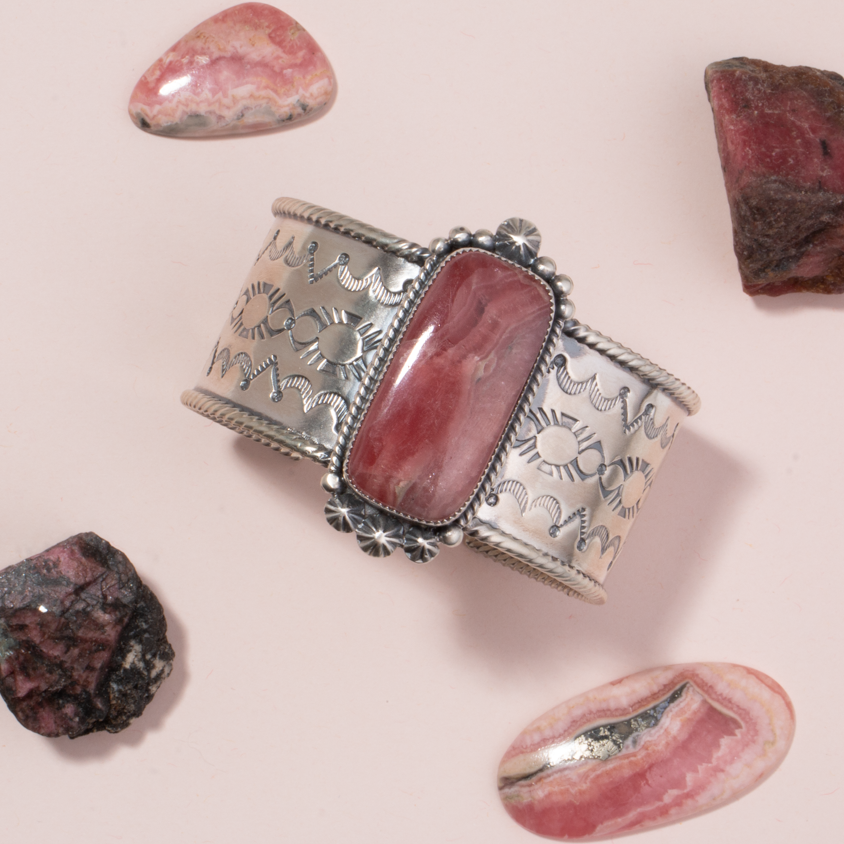
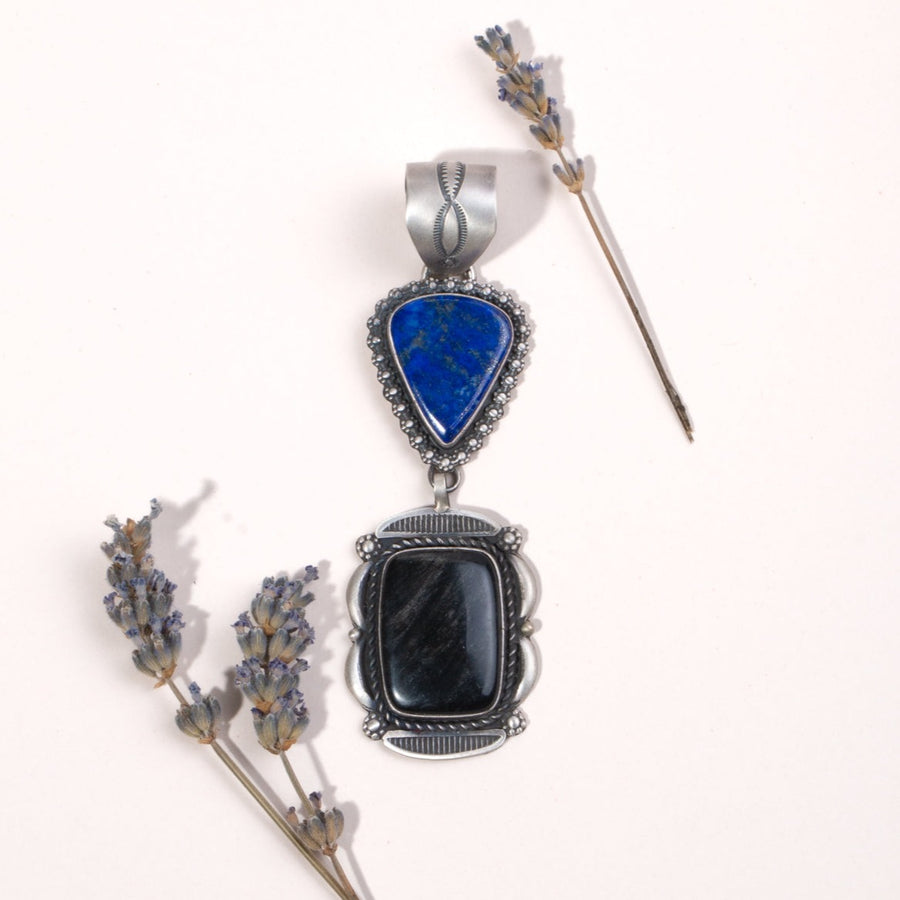
Tsabetsaye's signature is raised inlay — stones and shaped metal set proud of the surface rather than ground flush, so the piece reads as a small sculpture rather than a smooth field. He works in both silver and gold, setting turquoise, coral, and lapis, and the whole sensibility is closer to Loloma's dimensional, non-traditional approach than to the flatter clusterwork most associated with his pueblo. It's Zuni by hand and heritage, modernist by training.
The Standing
Around 1968 Tsabetsaye was named Artist of the Year by the Indian Arts and Crafts Board of the U.S. Department of the Interior — a national recognition, and an early one, coming only about six years after he first picked up the craft. A silver coffee pot he made in 1965 is held today in the Smithsonian's National Museum of the American Indian, acquired originally by the Indian Arts and Crafts Board and transferred to the museum in 2000. He carried Zuni work to national art events with the Zuni Craftsmen Cooperative Association, one of the pueblo's historic artisan cooperatives.
Know more about Roger? Contact T.Skies.
- Bahti, Mark. Silver + Stone: Profiles of American Indian Jewelers.
- Roger Tsabetsaye — IAIA "Action/Abstraction Redefined" (Smithsonian-cataloged exhibition)
- Edith Tsabetsaye biography (sister) — Waddell Gallery
- Smithsonian National Museum of the American Indian — 1965 silver coffee pot, collections record (object NMAI_274153)
- Roger Tsabetsaye Zuni silver ring — Shiprock Santa Fe
From the Library: Bahti, Silver + Stone: Profiles of American Indian Jewelers (2007)
2007 primary source. Anything described as current here describes 2007, not today.
According to Bahti (2007, p. 176), Tsabetsaye graduated from the Albuquerque Indian School in 1960 and then transferred to the Santa Fe Indian School (1960-61), just before it became the Institute of American Indian Arts, where artist and educator Geronima Montoya was his teacher. [1]
According to Bahti (2007, p. 177), Tsabetsaye spent three summers at the Southwest Indian Art Project at the University of Arizona in Tucson, where Charles and Otellie Loloma were among the teachers; he recalled that in his first year Charles Loloma chased him out of the jewelry class after Tsabetsaye, who knew some lapidary from Zuni, told him that was not the way to cut stone. [1]
According to Bahti (2007, p. 177), Tsabetsaye attended the Rochester Institute of Technology School of American Craftsmen in New York from 1963 to 1965 on scholarship money left over from the Southwest Indian Art Project, studying silversmithing, mostly planished work. [1]
According to Bahti (2007, p. 177), after returning from New York Tsabetsaye had a new hallmark stamp made: an eagle fan with talons. [1]
According to Bahti (2007, p. 177), President Johnson gave one of Tsabetsaye's silver necklaces to Queen Juliana of the Netherlands, and examples of his jewelry are in the Smithsonian. [1]
From the Library: Baxter, Encyclopedia of Native American Jewelry (2000)
2000 primary source. Anything described as current here describes 2000, not today.
In her 2000 entry on his sister, Baxter wrote:
“From a family of noted silversmiths, including her famous brother Roger (a painter, educator, and designer), Edith Tsabetsaye is self-taught.”
— Baxter (2000), p. 181 [2]
From the Library: Schaaf, American Indian Jewelry I (2003)
2003 primary source. Anything described as current here describes 2003, not today.
Schaaf (2003, p. 327) named Roger Tsabetsaye and Fred Bowannie as the teachers of the Zuni cluster jeweler Elanda Wyaco, active from 1968. [3]
From the Library: Bassman and Bassman, Zuni Jewelry (2006)
2006 primary source. Anything described as current here describes 2006, not today.
Bassman and Bassman (2006, p. 15) pictured three rings he made in 1991, two of inlay and one of channel inlay, each of turquoise, coral and lapis lazuli. [4]
Field Notes by Mateo James
Other accounts, including an earlier version of this page, place Roger among the first students at the Institute of American Indian Arts and his study with Loloma there. In his own account to Bahti (2007, pp. 176-177), he attended the Santa Fe Indian School in 1960-61, just before it became IAIA, and met Loloma at the Southwest Indian Art Project in Tucson. This page follows his telling.
Our biography says Roger studied jewelry under Charles Loloma at the Institute of American Indian Arts. In his own account to Bahti (2007), Roger places his time with Loloma at the Southwest Indian Art Project summer program at the University of Arizona in Tucson, and dates his Santa Fe Indian School year to 1960-61, just before it became IAIA. Because this is Roger's own telling, I treat it as the stronger source on where he met Loloma.
Our page says Roger's sister Edith learned silversmithing and lapidary from their parents as a girl. Baxter (2000) placed her in a family of noted silversmiths but called her self-taught. The two accounts differ on how Edith learned, so I show both.
Sources
- Bahti, Mark. Silver + Stone: Profiles of American Indian Jewelers. Tucson: Rio Nuevo Publishers, 2007. Cited by printed page. Statements describe conditions as of 2007.
- Baxter, Paula A., with Allison Bird-Romero. Encyclopedia of Native American Jewelry: A Guide to History, People, and Terms. Phoenix: Oryx Press, 2000. Cited by printed page. Statements describe conditions as of 2000.
- Schaaf, Gregory, with Angie Yan Schaaf. American Indian Jewelry I: 1,200 Artist Biographies, ca. 1800-present. American Indian Art Series, Vol. 5. Santa Fe: CIAC Press, 2003. Cited by printed page. Statements describe conditions as of 2003.
- Bassman, Theda, and Michael Bassman. Zuni Jewelry. Revised and Expanded 3rd Edition. Photographs by Gene Balzer. Atglen, Pennsylvania: Schiffer Publishing, 2006 (first published 1992). Cited by printed page. Statements describe conditions as of 2006.
This profile is maintained in support of Native American silversmiths and compiled from published references. See something inaccurate, or want to add to it? Contact us.