



McGinness Turquoise: A Grass Valley Claim Under Two Spellings
Part of the Turquoise Mines field guides and The Southwest Jewelry Guide.
You will see it sold as McGinnis. Every source we hold that names its owner spells him McGinness: the state survey, Branson’s text, the Lowrys and the oral histories. Branson’s 1975 book carries both on the same page: “MC GINNIS MINE” in the heading, “The McGinness Mine” in the text beneath it. [2] Both names mean the same small claim in Lander County, Nevada, also called the Gem mine. [1], [2], [3]
Where it is
The Nevada Bureau of Mines placed it in 1968:
“The McGinness or Gem mine (no. 30, pl. 1) is 10 line miles northeast of Austin near the center of sec. 17, T. 20 N., R. 45 E.”
— Morrissey (1968), p. 21 [1]
Line miles are measured in a straight line. The Lowrys give “about fifteen miles northeast of Austin,” at an elevation of over 7,500 feet. [3] A miner who knew the owner put it “about 15 miles from Austin to the east on the other side of this mountain range.” [4]
It sits in Grass Valley, among a cluster of small diggings. Bruce Woods, who worked the Godber Burnham claims, described the hillside to Ryan and Chambless:
“Of the old Grass Valley Mines the one with the biggest connection was the McGinness. McGinness is toward the top, and then there’s Little Blue Bird around the corner and Green Tree down at the bottom.”
— Ryan & Chambless (2020), p. 192 [4]
The state report agrees on the neighbor: the Green Tree, or Cold Day, mine lies half a mile north of the McGinness. [1]
The geology
Morrissey describes three parallel zones of broken, re-cemented rock, each about two feet wide, cutting through chert and siliceous shale. The workings in 1968 were an adit, an open stope and several small prospect pits. [1]
Who held it
The books agree on 1930 and on the two men involved, but not on the order of events. Morrissey: Frank Schmidtlein discovered the deposit in 1930 “and subsequently sold it to George McGinness” of Oakland, California, “who worked the property for a number of years.” At one time it was leased to Allen Russel. [1] The Lowrys put the sale itself in 1930:
“In 1930, Frank Schmidtlein sold the claims to George McGinness, who mined and marketed its turquoise.”
— Lowry (2010), pp. 235–236 [3]
The man Ryan and Chambless interviewed remembered McGinness as the county commissioner when he was in school, “always prospecting,” and dated his mining, with an “I think,” to the late 1930s through about 1950 or 1955. [4]
Clyde Wright of Fallon, who also leased the Godber Burnham, “first mined turquoise at the McGinness Mine in 1970.” [4] The same interviewee recalled that Wright and Les Hornback held claims on that hill in the 1970s, and that Wright “might have leased that McGinness or he may have bought it.” [4] The books leave that open, and so do we.
How much, and how good
Not much. Branson called it a mine that “has not been a large producer.” [2] The state report is more precise:
“The bulk of the turquoise produced at the McGinness mine has been of only fair quality. Some of it has been rated good, and a quantity has been rated as high-grade ore. Total production of the mine is estimated at about $40,000.”
— Morrissey (1968), p. 21 [1]
That estimate dates from 1968.
Natural or treated
Branson’s own plate came with a disclosure: “Most of the stones in the photograph have surface pits and fissures that have been filled.” [2] So ask how each McGinness stone was treated. For what our labels mean, see What Do These Confusing Turquoise Terms Mean?
In the jewelry
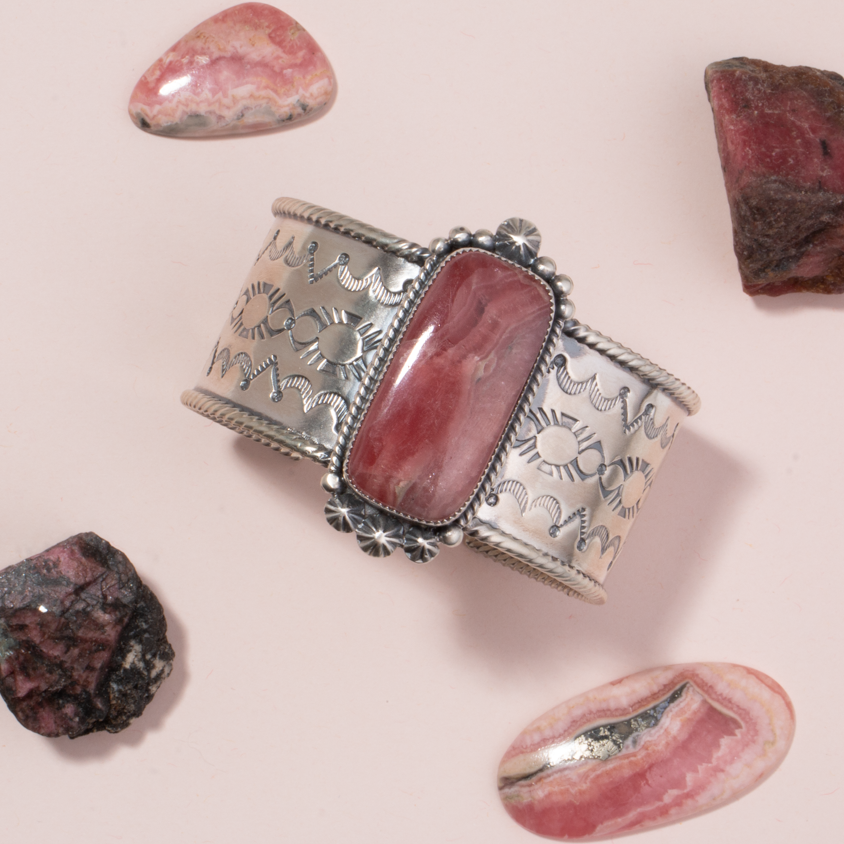
Theda Bassman’s 1997 book pictures a concha belt “with traditional Navajo stamp and repoussé work with stones of McGinnis turquoise. Made by Perry Shorty.” [5] Read more about Perry Shorty.
What the record doesn’t hold
The Lowrys wrote the plain truth of it:
“Unfortunately, there are many turquoise mines that have become known by a miner’s name, but over time there is actually little information that has been collected about the miner or the marketing of the turquoise from the mine.”
— Lowry (2010), p. 236 [3]
Our books say nothing about the mine after the 1970s, and nothing about whether anyone works it now.
Field Notes by Mateo James
Forty thousand dollars in total production, mostly fair stone. Yet a man who mined those hills still called it the one with the biggest connection. A claim this small is known through a handful of people: the man who found it, the man who bought it, the man who leased it after. When a stone is sold under this name, the name is the beginning of its history, not the end. Ask which spelling the seller uses, and why.
How this page is sourced. Printed works are cited by page and describe conditions as of their dates. If you know better, contact us.
Sources
- Morrissey, Frank R. Turquoise Deposits of Nevada. Nevada Bureau of Mines Report 17. Reno: Mackay School of Mines, University of Nevada, 1968, p. 21. Statements describe conditions as of 1968.
- Branson, Oscar T. Turquoise: The Gem of the Centuries. Santa Fe: Treasure Chest Publications, 1975, p. 25. Statements describe conditions as of 1975.
- Lowry, Joe Dan, and Joe P. Lowry. Turquoise: The World Story of a Fascinating Gemstone. Layton, UT: Gibbs Smith, 2010, pp. 235–236. Statements describe conditions as of 2010.
- Ryan, Mike, II, and Philip Chambless. Turquoise in America, Part Two: 1910–1990. Callais Press, 2020, pp. 116, 190, 192.
- Bassman, Theda. The Beauty of Navajo Jewelry. Photography by Gene Balzer. Walnut, California: Kiva Publishing, 1997, p. 8.