
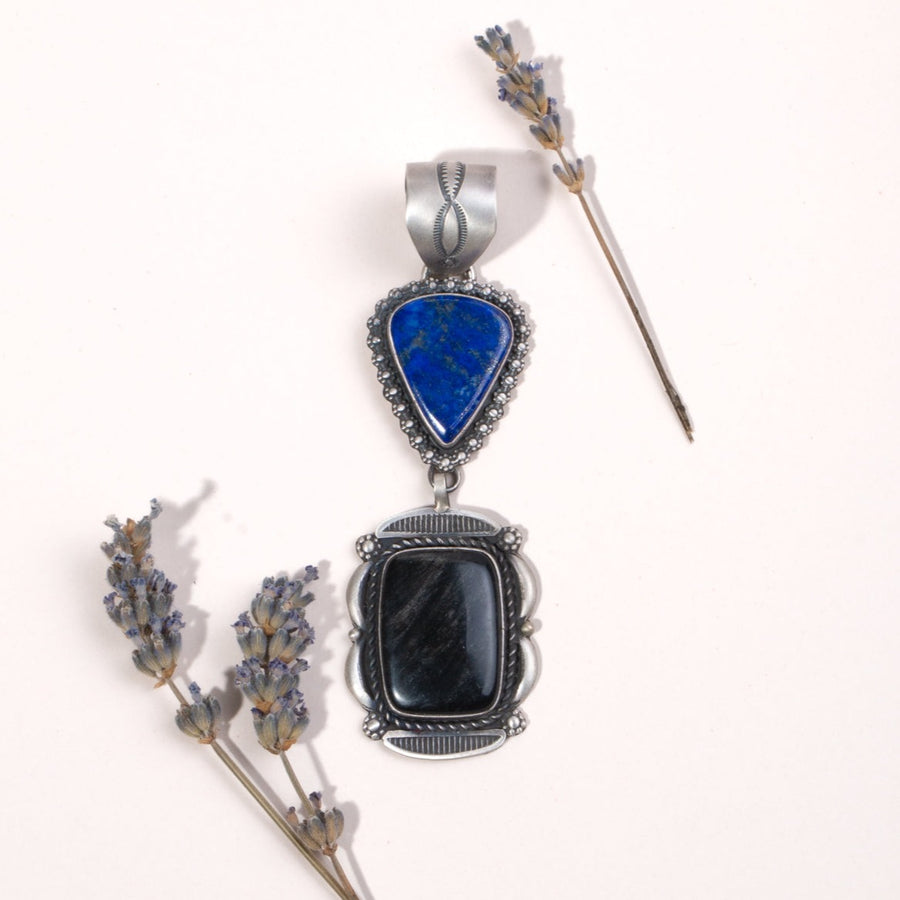


New Mexico Turquoise Jewelry: The Four Historic Mining Districts

New Mexico’s claim on turquoise rests on two things: how much was mined here, and how long ago the mining started. In 1915 the mineralogist Joseph E. Pogue put it plainly: “New Mexico has produced a greater quantity of turquois than any other State.” Four districts did the work: the Cerrillos Hills near Santa Fe, the Burro Mountains and the Little Hachita Mountains in Grant County, and the Jarilla Hills in Otero County. Each has its own geology, its own history and its own look. This guide takes them one at a time, then covers what that history means when you shop for turquoise jewelry today.
Why New Mexico matters in the story of turquoise
All four districts were mined long before anyone filed a claim. Pogue: “At all four localities the deposits were worked by the aborigines and those near Cerrillos under Spanish rule also. The prehistoric excavations at the last named locality are of great extent.” Modern prospectors in the 1870s through the 1890s mostly found their mines by finding the ancient ones first. Chambless and Ryan, who wrote the history of what they call the Great American Turquoise Rush, describe the pattern at Hachita in a line that fits the whole state: prospectors “following reports of prehistoric turquoise mines made the first claims.”
So when you hold a New Mexico stone, you are holding the product of the same hills, and in some cases the same pits, that supplied turquoise to the Ancestral Puebloan world. The map of every district, New Mexico and beyond, is at the turquoise mines of the Southwest.
Cerrillos: the great prehistoric mine
The Cerrillos Hills sit about twenty miles south-southwest of Santa Fe. Pogue called them “the most important deposits of turquois in the United States, from the point of view of their history and past production.” Two places carried most of the work. One was Turquoise Hill, where the modern American Turquois Company ran its mines in the 1890s. The other was Mount Chalchihuitl, a low knob near the center of the hills. By Pogue’s time it was abandoned, and it is the one that made Cerrillos famous.
“Mount Chalchihuitl,” Pogue wrote, “is the site of the most extensive prehistoric mining operations known on the American continent.” Citing measurements the geologist D. B. Sterrett made in 1911, Pogue gives the main pit as “about 130 feet deep and 200 feet across.” Earlier visitors described trees growing out of the waste piles, which gave them a way to judge the pit’s age. “Many stone hammers… and other primitive implements have been found in the debris of the ancient workings.” Pogue concluded that the greater part of it was dug before the Spanish arrived, and that Cerrillos “must have supplied much of the turquois which was so widely used in pre-Spanish times, not only in the Southwest but in Mexico as well.”
Modern science has since tested that idea on real artifacts. Researchers have compared turquoise from Pueblo Bonito at Chaco Canyon with a database of known deposits using hydrogen and copper isotopes. Chambless and Ryan report that “of 29 artifacts sampled, 13 were linked to turquoise deposits at Cerrillos and the Jarilla Mountains of New Mexico and Villa Grove, Colorado.” Cerrillos was one of Chaco’s sources, not its only one.
The written history is thinner. Pogue records that in the sixteenth century the Tano people guarded the Cerrillos workings (p. 53).
As for the stone itself, Pogue describes Cerrillos color as ranging “from green through greenish-blue to fine sky-blue.” Much of it is matrix, “marred by streaks of limonite… and inclusions of quartz or rock,” but “the best quality is equal to the Persian stones.”
The “Tiffany” name
One Cerrillos claim became known as the “Tiffany mine,” and Pogue reported that it was “reputed to have produced a higher proportion of high-grade gem material than any other deposit in the United States.” The name has travelled far since then, so it is worth knowing what it means. Chambless and Ryan: “Tiffany and Co. bought a lot of turquoise during The Great American Turquoise Rush, but neither he nor his company ever owned a claim or operated a mine.” Miners attached the name because it sold. When you see “Tiffany” on a turquoise label, read it as a story about marketing, not a statement about who dug the stone.
The Burro Mountains (Tyrone): the famous blue
The second great district lies in Grant County, near Silver City in the southwest corner of the state. It also goes by Tyrone, the name of the copper town that grew up there; Chambless and Ryan title their chapter “Burro Mountains (Tyrone).” They also report that the Mimbreño Mogollon culture, A.D. 850–1350, “were reported to have mined turquoise in the Burro Mountains.” For more on that culture, see mining the West: the Mogollon.
The modern story is mostly the Azure mine, opened in 1891. Pogue: it “has been operated in modern times more extensively than any other turquois mine in this country, and its stones are the equal of the Persian gems.” In 1893 miners broke into the “Elizabeth pocket,” “which produced more high-grade turquois than any single deposit on record.” The most prized color, in Pogue’s words, was “a slightly translucent, deep-blue.” The Azure company stood behind it, too: “The cut gems of good quality are marked on the under side with a circle and guaranteed to retain their color.”
One piece of Burro Mountains lore needs a correction. Older accounts, Pogue’s included, credit John E. Coleman, “Turquoise John,” with rediscovering the old workings in the 1870s. Chambless and Ryan point out that the claim he is said to have filed then “was not located and recorded until 1890,” and they call the story “the myth of Turquoise John.”
By 1915 Pogue already described the Burro Mountains deposits as “formerly of importance but now largely exhausted.” Keep that in mind when the name appears on a label.
Hachita: great promise, great disappointment
The Little Hachita Mountains, also called the Little Hatchet Mountains, sit in the far south of Grant County. “Hachita is the Spanish word for ‘little hatchet,’” Chambless and Ryan explain, and they sum up the district, together with Jarilla, as “locations of great promise and great disappointment.” Pogue records that the region “was considerably exploited for turquois by the prehistoric Indians.” In modern times it was worked between 1885 and 1888, “at first for gold,” and was not seriously developed until 1908 and 1909.
The Hachita stone Pogue describes is mostly blue. On the claim at the top of the district’s Turquoise Mountain, Pogue describes it as ranging “in color from dark sky-blue through greenish-blue to pale-blue,” and “the principal yield has been high-grade matrix including some good cameo material.” At the Cameo claim, some was carved into cameos, with the yellowish-gray to brownish wall rock left as the background. Quality was uneven from claim to claim. At the Aztec claim, “much of the product is rather soft and pale, and some fades on exposure.” The district in depth, claim by claim: Hachita turquoise field guide.
Jarilla: the Orogrande mines
The Jarillas are, in Pogue’s phrase, “a low range of hills that rise out of a wilderness of sand” in Otero County, about fifty miles north-northeast of El Paso. William E. Hidden, a prospector who had already discovered the mineral hiddenite, found turquoise there in 1892 and recognized the old pits for what they were. Chambless and Ryan cite research dating those diggings to “between A.D. 1150 and 1400.” Jarilla is also one of the sources named in the Chaco isotope study above.
The modern mines never lived up to their start. Around 1898 the De Meules property produced “some fine stones,” but Pogue noted that “the material first obtained faded” and that by 1915 “the deposits are not now productive.” More on the district and its prehistoric workings: Jarilla Mountains turquoise field guide.
Buying New Mexico turquoise today
Three things follow from this history.
- A New Mexico mine name is a claim, so ask for it in writing. The Indian Arts and Crafts Board advises a written receipt listing the “name of the mine from which the turquoise was extracted” and “whether the turquoise is natural, stabilized, or treated.” New Mexico’s own Indian Arts and Crafts Sales Act “requires the seller to disclose in writing the type of materials used.”
- Old names get borrowed. The “Tiffany” story shows how a famous name ends up on stones it has nothing to do with. The Lowrys, of the Turquoise Museum in Albuquerque, give the rule that covers every classic mine: “If the consumer wants to buy a turquoise from a Classic Mine, then he or she needs to get a written guarantee of the mine source from the miner and salesperson.”
- Know which state most turquoise comes from now. “The most commonly marketed American turquoise is from the Sleeping Beauty and Kingman mines in Arizona” (IACB). New Mexico’s districts carry the deepest history, but the federal brochure names two Arizona mines as the most common source. See Kingman vs. Sleeping Beauty turquoise.
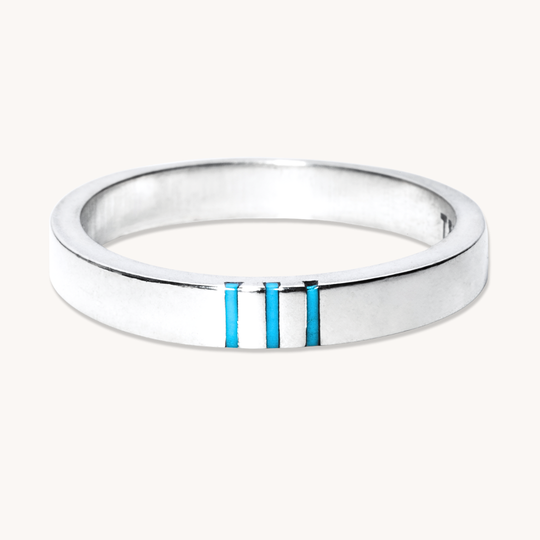
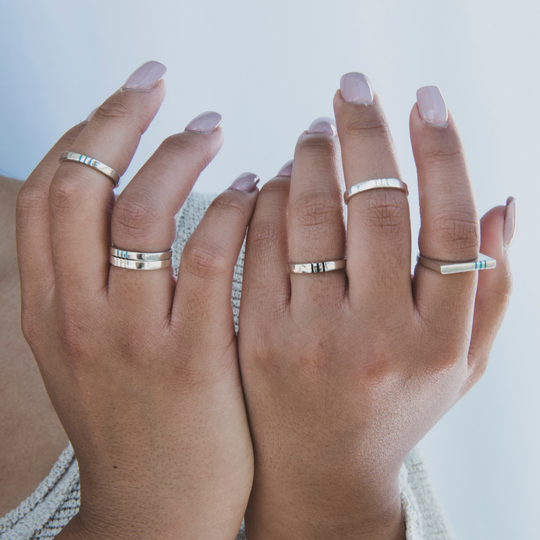
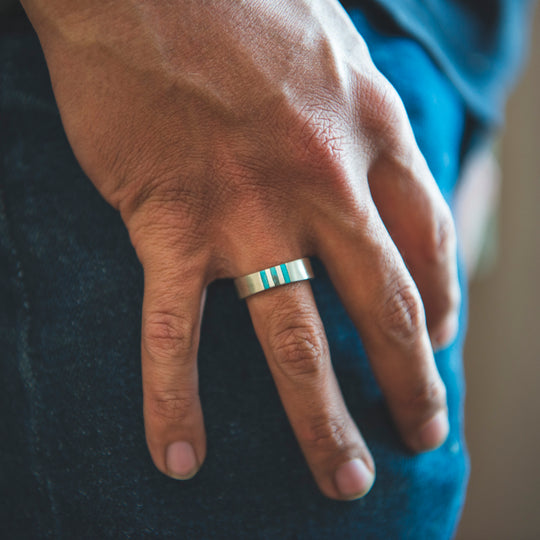
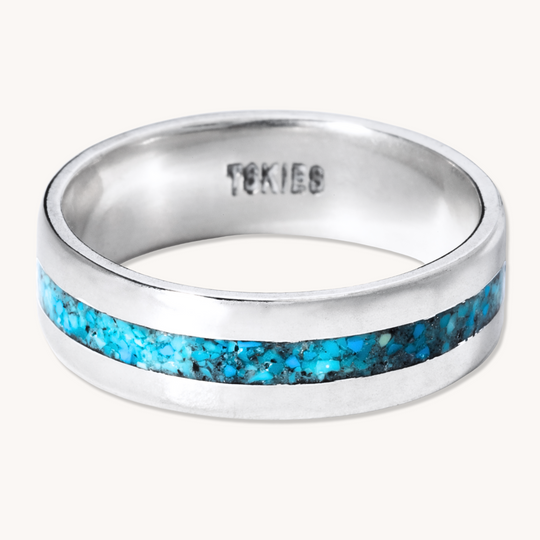
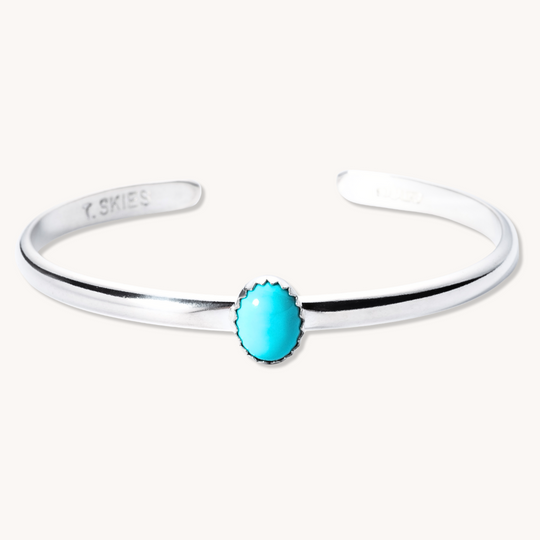
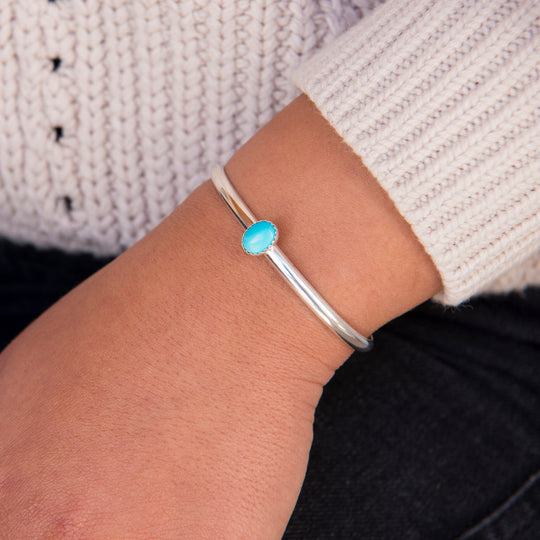
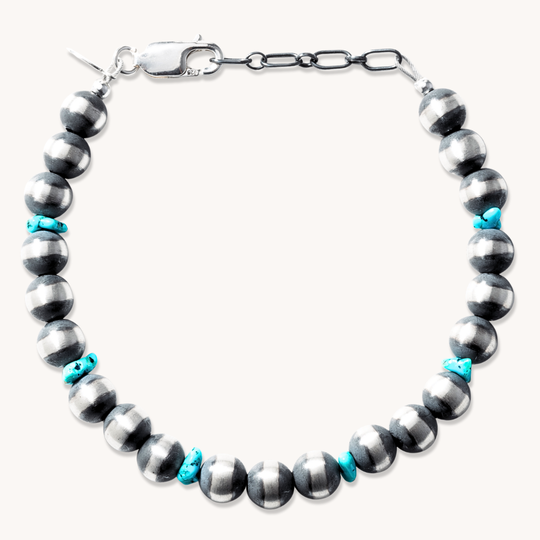
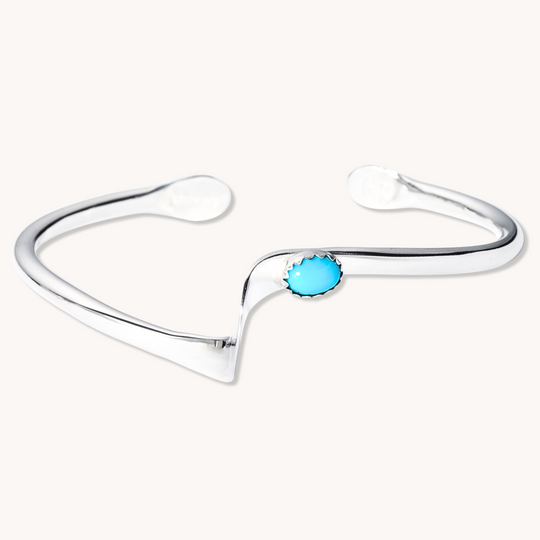
Whatever the source, the qualities that decide a stone’s worth are the same: treatment, mine, color, clarity and matrix. They are scored one by one in how much turquoise is worth. When you’re ready to look, browse turquoise set in sterling silver and ask us about any stone’s mine and treatment.
Related reading
Frequently asked questions
Where is turquoise mined in New Mexico?
Historically, in four districts: “the Cerrillos Hills of Santa Fe County, the Burro Mountains and the Little Hachita Mountains of Grant County, and the Jarilla Hills of Otero County” (Pogue, The Turquois, 1915, p. 52). All four were mined in prehistoric times before modern claims were filed (p. 52).
What is Cerrillos turquoise?
Turquoise from the Cerrillos Hills south of Santa Fe. Its Mount Chalchihuitl pit is “the site of the most extensive prehistoric mining operations known on the American continent” (Pogue, p. 52). Its color runs “from green through greenish-blue to fine sky-blue,” and “the best quality is equal to the Persian stones” (p. 54).
Is Tyrone turquoise the same as Burro Mountains turquoise?
Yes. Tyrone is the copper town in the Burro Mountains near Silver City, and the historians Chambless and Ryan title their chapter on the district “Burro Mountains (Tyrone)” (Turquoise in America, p. 73). Its best-known mine, the Azure, was famous for “a slightly translucent, deep-blue” (Pogue, p. 56).
Did Tiffany & Co. own a turquoise mine in New Mexico?
No. “Tiffany and Co. bought a lot of turquoise during The Great American Turquoise Rush, but neither he nor his company ever owned a claim or operated a mine” (Chambless and Ryan, Turquoise in America, p. 45). Mines used the Tiffany name because it helped sell stone.
What color is Hachita turquoise?
Mostly blue, in the claims Pogue described. He gives it “from dark sky-blue through greenish-blue to pale-blue,” with a principal yield of “high-grade matrix including some good cameo material” (The Turquois, p. 57).
From the Library: Pogue, The Turquois (1915)
1915 primary source. Anything described as current here describes 1915, not today.
Pogue generalized the pattern in 1915:
“It is a striking circumstance that in America there are no turquois deposits of importance that do not exhibit signs of prehistoric exploitation.”
— Pogue (1915), p. 104
Writing in 1915, Pogue summarized how the word was used in the Southwest:
“A term either identical with or corresponding closely to chalchihuitl has long been used by the Indians of the Southwest to designate the turquois and the turquois alone.”
— Pogue (1915), p. 109
According to Pogue (1915, p. 107), the mineralogist Blake argued in 1858 that because the Navajo called the green turquoise they prized chalchihuitl, the word meant the same thing in ancient Mexico, and he proposed that New Mexico's green turquoise be called chalchihuitl.
Pogue (1915, p. 108) cautioned that a shared name does not prove a shared stone: the word was used both in the Southwest and in ancient Mexico, but that does not mean it named the same mineral in both places.
On the Aztec chalchihuitl itself, Pogue's 1915 conclusion was:
“The historical evidence favors its identification as jade; the ethnologic evidence presents some points in favor of green turquois. The total evidence weighs for jade.”
— Pogue (1915), p. 109
On the Spanish period at Cerrillos, Pogue (1915) noted that Jones
“found in the archives at Santa Fe the record of a chalchihuitl (turquois) grant bearing the date 1763. Evidently, then, at that time the excavation was again worked,”
— Pogue (1915), p. 53
Pogue (1915) on how the modern Cerrillos company came together:
“In 1889 the Muniz claim, one of the most important in the district, was located by F. Muniz, a Mexican. Other claims were located in 1891. The following year the combined holdings were purchased by the American Turquois Co., which proved very successful in their operation.”
— Pogue (1915), p. 53
As of 1915, Pogue reported the Cerrillos output:
“The total yield from the holdings of the American Turquois Co., coming chiefly from the “Tiffany mine,” is said to exceed $2,000,000 in value.”
— Pogue (1915), p. 55
For the Azure mine in the Burro Mountains, Pogue (1915) gave:
“The total value of its output is stated to have been between $2,000,000 and $4,000,000.”
— Pogue (1915), p. 55
Pogue (1915) recorded, as tradition, a story tied to the Pueblo uprising of 1680:
“There is a well-known tradition that in that year a large section of Mount Chalchihuitl fell in from the undermining of the mass by the Indians, killing a considerable number, and that this accident brought to head the discontent and was the immediate cause of the uprising.”
— Pogue (1915), p. 53
In a footnote, Pogue (1915) gave Bandelier's dissent:
“He thinks that there was no mining undertaken by the Spaniards until after 1725 and that there was very little enforced labor.”
— Pogue (1915), p. 53
From the Library: Kunz, Natal Stones: Birth Stones, Sentiments and Superstitions Associated with Precious Stones (1909)
1909 primary source. Anything described as current here describes 1909, not today.
Describing the turquoise Tiffany & Co. kept in stock, Kunz (1909) wrote:
“Sky blue, from Persia. Fine sky blue and robin’s-egg blue, from New Mexico.”
— Kunz (1909), p. 40 [2]
According to Kunz (1909, p. 29), the same Tiffany booklet's list of state stones named turquoise first among New Mexico's gems, ahead of garnet, obsidian, peridot and rock crystal. [2]
From the Library: Tanner, Navajo Silver Craft (1954)
1954 primary source. Anything described as current here describes 1954, not today.
Writing in 1954, Tanner noted that the old source was still producing:
“Much good turquoise has come from and still is produced at Los Cerrillos mine, near Santa Fe, New Mexico.”
— Tanner (1954), p. 33 [3]
Sources
- Joseph E. Pogue. The Turquois (Memoirs of the National Academy of Sciences, vol. XII). 1915, pp. 52–58.
- Philip Chambless & Mike Ryan II. Turquoise in America: The Great American Turquoise Rush 1890–1910 (Part 1). Callais Press, 2021, pp. 29, 45, 73, 103, 111.
- Joe Dan Lowry & Joe P. Lowry. Turquoise: The World Story of a Fascinating Gemstone. 2010, p. 231.
- U.S. Department of the Interior, Indian Arts and Crafts Board, with Joe Dan Lowry (Turquoise Museum). Indian Arts and Crafts Act turquoise consumer brochure (GPO gpo58769), n.d., pp. 1–2.
- Pogue, Joseph E. The Turquois: A Study of Its History, Mineralogy, Geology, Ethnology, Archaeology, Mythology, Folklore, and Technology. Memoirs of the National Academy of Sciences, Vol. XII, Part II, Third Memoir. Washington, 1915. Public domain. Cited by printed page. Statements describe conditions as of 1915.
- Kunz, George Frederick. Natal Stones: Birth Stones, Sentiments and Superstitions Associated with Precious Stones. 26th ed. New York: Tiffany & Co., [c. 1923]. Lists copyright 1909 by Tiffany & Co. Cited by printed page. Statements describe conditions as of 1909.
- Tanner, Clara Lee. “Navajo Silver Craft.” Arizona Highways 30, no. 8 (August 1954): 16–33. Cited by printed page. Statements describe conditions as of 1954.