Is Reconstituted Turquoise Real Turquoise?
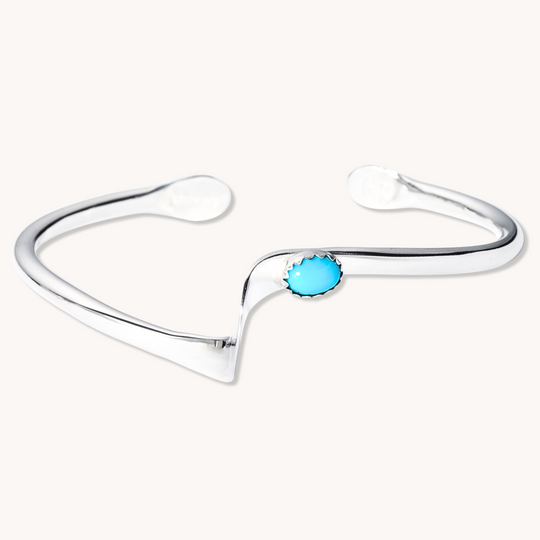
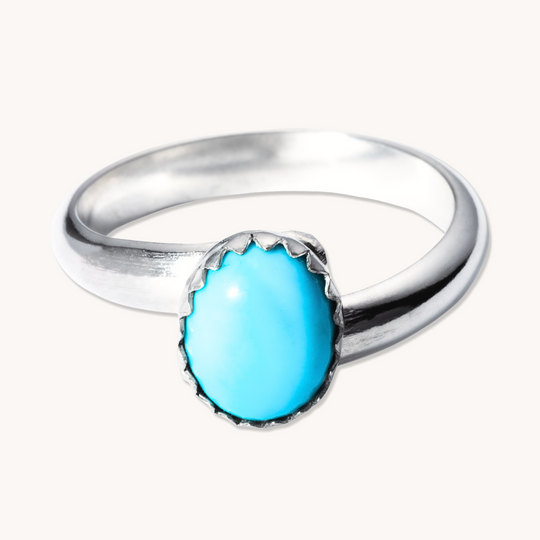
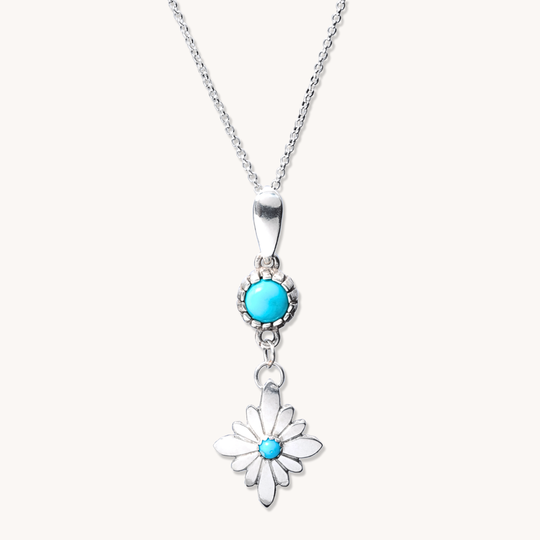
At first glance, this looks like natural turquoise. But in reality this is reconstituted turquoise. It might have some real turquoise mixed in it during the making of it, but it is not considered natural. This type of turquoise is very common in the market, and it is also one of the most confusing things that turquoise collectors come across.
Natural stones are formed in the earth over thousands of years and were formed in a very different way. Although we at Turquoise Skies do not feel it is ethical to call it real or genuine, these stones can technically be called “Turquoise” because the manufacturer actually uses a small amount of real turquoise in the composition. A very rough low-grade version of turquoise in the form of chalk is crushed into dust and mixed with plastics, dyes, and resins to form the compound known as reconstituted turquoise. Using machines and special techniques, the factories can create matrix looking patterns such as the spider web to make the finished product look more natural. Reconstituted turquoise also has a plastic look and feel to it.
Our mission here at Turquoise skies is to promote real natural turquoise and educate anyone who is interested in keeping the industry pure and quality. I recently had an interested customer contact our website with pictures of a set of turquoise stones that looked very similar to the stones in the picture above. She was asking if it was Number 8 Turquoise. This spider web matrix style that this stone displays was actually created to look like the spider web that is found on natural stones like the ones from the number 8 mine.
My name is Shep, and I am one of the owners of Turquoise Skies. I want you to feel confident when shopping for turquoise. I feel this is a common problem that buyers run into when shopping for turquoise. I decided to go to my local arts and crafts store and buy a set of this reconstituted turquoise. A set of 4 stones in silver plated housing cost $7.99 before tax.

Purchased this reconstituted turquoise from art supply store for $7.99. See label
Here is a picture of the stones, and as you can see on the tag, it is marked appropriately as reconstituted turquoise. Reconstituted material has to be disclosed for what it is; the FTC Jewelry Guides treat filler-and-binder products as needing a clear qualifier (16 CFR §23.25(d)). If you are buying from a seller or artist that does not have labels on their pieces then you must ask the correct question. Do not ask if the stone is turquoise because technically it is. The question you want to ask is “Is this a natural turquoise stone or reconstituted?”
I hope this helps. Thanks again for supporting natural turquoise!
Keep it Real
Mateo James
From the T.Skies gallery: browse our turquoise jewelry collection.
From the Library: Lowry, Turquoise Unearthed: An Illustrated Guide (2002)
2002 primary source. Anything described as current here describes 2002, not today.
Lowry (2002) defined the process:
“Reconstituted, in which chips or fragments are pulverized, and the resulting powder is mixed with epoxy to form hard cakes or blocks that can be cut into "stones."”
— Lowry (2002), p. 38 [1]
According to Lowry (2002, p. 34), it is even possible to reproduce spiderweb matrix patterns in both stabilized and reconstituted turquoise. [1]
Lowry (2002) on price:
“Treating low-grade turquoise may make it more attractive and salable, but it is not worth as much as a natural, unadulterated gemstone and should be priced accordingly.”
— Lowry (2002), p. 38 [1]
From the Library: Jacka, Navajo Jewelry: A Legacy of Silver and Stone (1995)
1995 primary source. Anything described as current here describes 1995, not today.
Lois Essary Jacka, writing in 1995, after describing reconstituted turquoise as tiny chips epoxied together under high pressure:
“This treatment is also permanent, but reconstituted turquoise is not considered as good as stabilized.”
— Jacka (1995), p. 84 [2]
From the Library: Lund, Indian Jewelry: Fact and Fantasy (1976)
1976 primary source. Anything described as current here describes 1976, not today.
Lund (1976) described reconstituted turquoise as it was sold in 1976:
“In actuality it is the "sausage" of all treatment processes, since left over bits and fragments are ground into powder, mixed with an epoxy binder and then molded into cakes or stones.”
— Lund (1976), p. 146 [3]
From the Library: Tanner, Navajo Silver Craft (1954)
1954 primary source. Anything described as current here describes 1954, not today.
Reconstituted stone is older than it may seem. Tanner (1954, p. 33) already described “reconstructed” turquoise as one of the most recent fakes: poor-quality turquoise pulverized, dyed and put back together again, which she said the casual eye could not detect. [4]
Field Notes by Mateo James
How we use these words. At T.Skies we sort turquoise into three groups. Natural turquoise is as it comes out of the earth, with nothing added except the water or mineral oil used while cutting. Treated turquoise has something added, and we label it stabilized (clear resin that locks in the stone's own color and integrity), enhanced (dyed, hardened, or both), or stabilized enhanced. Upcycled and manufactured material (composite, chip inlay, reconstituted, block) is made from turquoise pieces or powder bound together, and it is its own category. Jacka (1995) and Lund (1976), quoted above, call reconstitution a treatment. In our terms reconstituted material is upcycled and manufactured, its own group, because it is re-formed from turquoise powder rather than being a single treated stone. Whatever the label, a treated stone should be disclosed as treated: the FTC Jewelry Guides (16 CFR §23.24) require it whenever a treatment isn't permanent, needs special care, or significantly affects the stone's value.
Sources
- Lowry, Joe Dan, and Joe P. Lowry. Turquoise Unearthed: An Illustrated Guide. Photography by Mark Nohl. Tucson, AZ: Rio Nuevo Publishers, 2002. Cited by printed page. Statements describe conditions as of 2002.
- Jacka, Lois Essary. Navajo Jewelry: A Legacy of Silver and Stone. Photographs by Jerry Jacka. Flagstaff: Northland Publishing, 1995. Cited by printed page. Statements describe conditions as of 1995.
- Lund, Marsha Mayer. Indian Jewelry: Fact and Fantasy. Boulder, CO: Paladin Press, 1976. Cited by printed page. Statements describe conditions as of 1976.
- Tanner, Clara Lee. “Navajo Silver Craft.” Arizona Highways 30, no. 8 (August 1954): 16–33. Cited by printed page. Statements describe conditions as of 1954.