


The Significance of Turquoise in Native American Culture
Throughout the arid world, native and aboriginal peoples held turquoise in high regard. Ancient Egyptians entombed their Pharaohs with turquoise-studded jewelry, and the Persians associated the mineral with victory and holiness.

Smiling Acoma Dancer Wearing Turquoise Jewelry
Native American silversmiths and lapidaries across the Southwest have carried turquoise work forward for generations, and their style and quality are known around the world.

Gobuguoy. Hopi. Walpi pueblo. Arizona. ca. 1900
The most well known turquoise jewelers, the Navajo and the Zuni, have distinct jeweling styles and ideas associated with the mineral. The original Native American silver smith, a Navajo, learned to work silver and iron, from Mexicans hired by a Trading Post owner in the late 19th Century. Modern jewelers still use many of these early methods.
The Navajo, Atsidi Sani, taught others of his tribe, and the Navajos, a people known for their adaptability, soon dominated the silver and turquoise jewelry craft. Important Navajo styles include the “Naja,” “Heishi” necklaces, Squash blossom necklaces, and turquoise inlay rings. In addition, as the outside world culture became more accessible, many Navajo artisans took to producing turquoise jewelry with styles borrowed from other cultures. Traditional Navajo turquoise jewelry usually contains more turquoise than silver, using large stones and focusing on the natural quality of the turquoise used to make it.

Navajo turquoise squash blossom necklace with naja

Zuni turquoise inlay Sunface bracelet
Zuni turquoise art varies from that of the Navajos, in that they more often carved turquoise into amulets and used it to decorated idyllic limestone figures. They also carved the stones into shapes suitable to make jewelry adorned with mosaics.
Turquoise has played an important role in many arid-land cultures since only a few thousand years after the last Ice Age 10,000 years ago. The Native Americans, relative newcomers to turquoise crafting, brought to life the beauty of many turquoise pieces in the southwest. Their especially stunning turquoise caught the eye of traders and merchants who took it to distant localities throughout the southwest, Central America, and even to South America. The adaptability of tribes, like the Navajos, who quickly learned from the Mexicans the art of the silver smith, brought the Native Americans to become the most productive, skilled turquoise artisans of the jewelry world. Their products serve as symbolic messengers of the Native American ideals and ways.N27
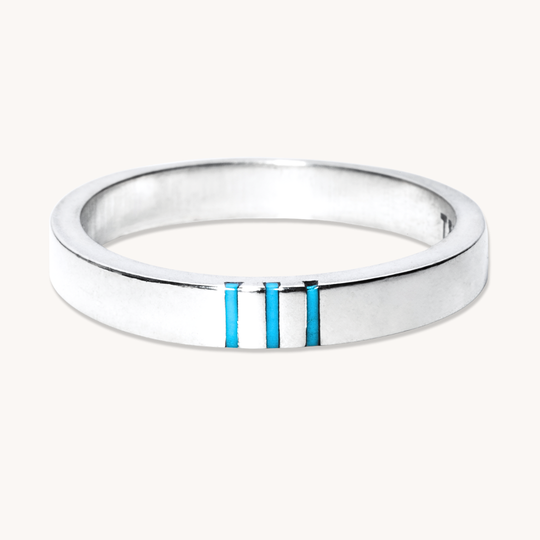
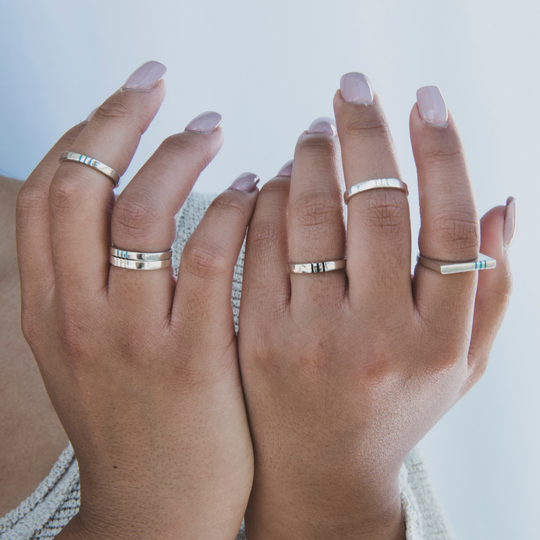
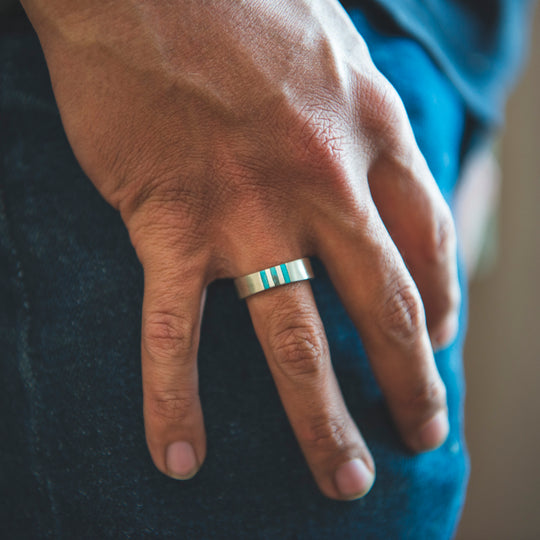
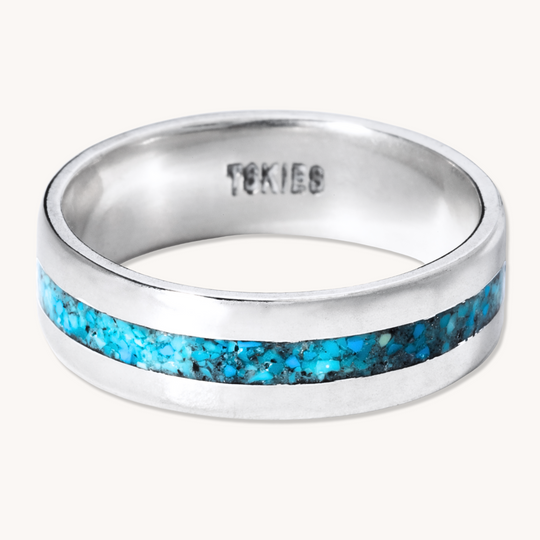
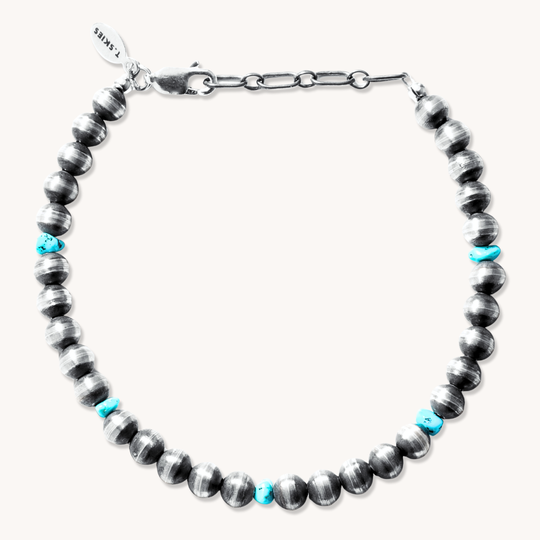
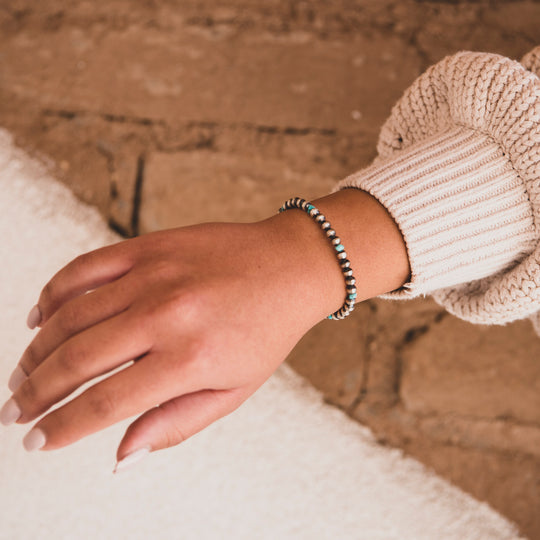
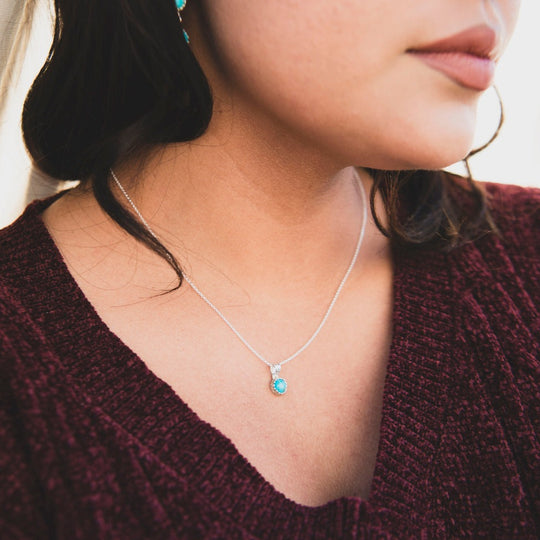
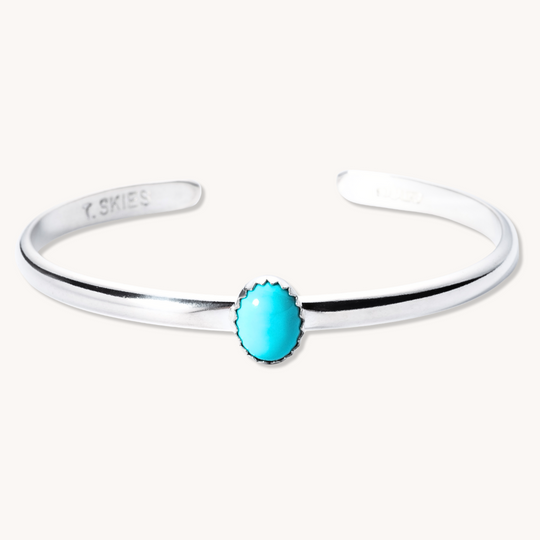
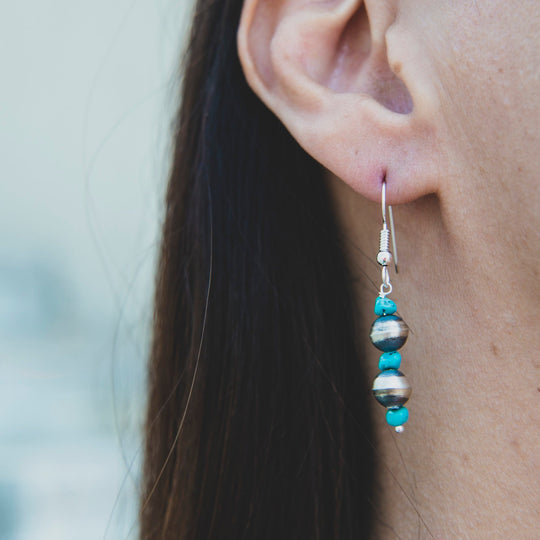
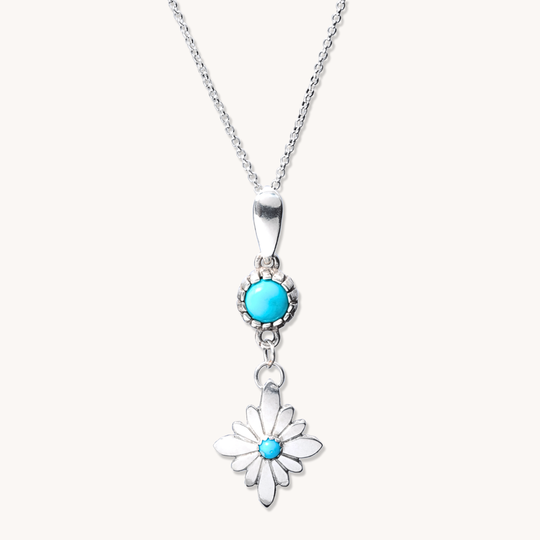
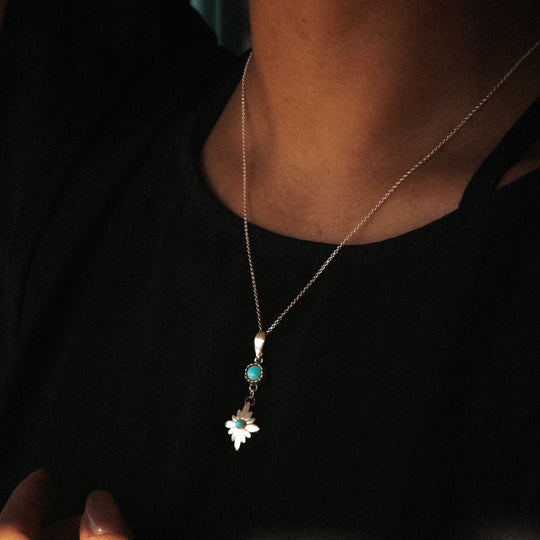
From the T.Skies gallery: browse our turquoise jewelry collection.
Turquoise around the world
Turquoise was used when decorating the Taj Mahal and when crafting King Tut’s death mask. Ancient Persians wore it as protection against unnatural death. The Aztecs inlaid it in skulls, statues and shields. It has been used as a holy stone, for protection, as a symbol of wisdom, immortality, as well as being prized by rich and poor alike for its beautiful blue color. Although turquoise has been used and valued in all corners of the world for centuries, it is probably most associated with Native Americans of the Southwest. The gem is important to Native Americans for many reasons. For starters, it has an important place in many Native American stories.
What Pogue recorded in 1915
1915 primary source. Anything described as current here describes 1915, not today.
These are outside observers’ records from over a century ago; the nations themselves are the authority on their own beliefs.
Turquoise appears in Diné and Hopi sacred stories. Those stories belong to the nations that tell them, and we don’t retell them here.
Citing John G. Bourke’s 1887–88 study of Apache medicine men, Pogue wrote in 1915:
“Amongst the Apache a small turquois bead affixed to a gun or a bow made the weapon shoot accurately.”
— Pogue (1915), p. 125
Pogue (1915), again following Bourke, continued:
“The gem, moreover, had some relation to the bringing of rain, and could always be found at the end of a rainbow after a storm by diligently searching in the damp earth.”
— Pogue (1915), p. 125
From the Library: Bassman, The Beauty of Navajo Jewelry (1997)
1997 primary source. Anything described as current here describes 1997, not today.
Writing in 1997, Bassman recorded a belief about turquoise:
“The sacred stone of all Native American people of the Southwest, turquoise has a spiritual healing significance. It is said to keep the person who is wearing it from harm.”
— Bassman (1997), p. 6 [2]
From the Library: Khazeni, Sky Blue Stone (2014)
2014 primary source. Anything described as current here describes 2014, not today.
Reporting beliefs recorded by outside observers, Khazeni (2014, p. 131) wrote that the Navajo used turquoise as currency and in their ceremonies and chants, attributing talismanic power to it and regarding it as a bringer of good luck. [3]
Khazeni (2014) recorded Navajo beliefs tying the stone to rain and wind:
“Navajo threw the stone, which they believed to bring rain, into rivers as tribute to the rain god. They said that the wind blew because it was searching for turquoise.”
— Khazeni (2014), p. 131 [3]
Khazeni (2014), drawing on outside observers' records, noted the stone's value among the Zuni:
“Among the Zuni, a single blue turquoise bead was worth several horses.”
— Khazeni (2014), p. 130 [3]
From the Library: Lowry, Turquoise Unearthed: An Illustrated Guide (2002)
2002 primary source. Anything described as current here describes 2002, not today.
According to Lowry (2002, p. 15), the Zuni and the peoples of the Rio Grande pueblos associate blue turquoise with Father Sky and green turquoise with Mother Earth. [4]
Lowry (2002) on Zuni fetishes:
“Early Zuni fetishes were made of turquoise, or at least had turquoise eyes, mouths, or attachments to enhance their power.”
— Lowry (2002), p. 15 [4]
According to Lowry (2002, p. 15), Zuni and Hopi katsina dancers wear turquoise necklaces, and powdered turquoise is a common offering accompanying a prayer. [4]
Lowry (2002) recorded a Navajo belief:
“The Navajos believe turquoise jewelry will bring good fortune to the wearer and curry favor with the Ye'lis, beings who mediate between mortals and the spirit world.”
— Lowry (2002), p. 15 [4]
Lowry (2002) on Apache use:
“Apache hunters and warriors once attached bits of turquoise to their bows to make arrows fly straight and true, and wore turquoise as protection against enemies.”
— Lowry (2002), p. 15 [4]
From the Library: Jacka, Navajo Jewelry: A Legacy of Silver and Stone (1995)
1995 primary source. Anything described as current here describes 1995, not today.
Lois Essary Jacka, writing in 1995:
“To the Navajo, turquoise is a sacred stone, a gift from the gods.”
— Jacka (1995), p. 78 [5]
She continued, in 1995:
“Their legends refer to turquoise time and again, and it is used ceremonially as well as for decorative purposes.”
— Jacka (1995), p. 80 [5]
Lois Essary Jacka, writing in 1995:
“Colors are assigned to the parts of the sky in each of the Four Directions: East is white and, continuing sunwise, South is blue, West is yellow, and North is black.”
— Jacka (1995), p. 99 [5]
From the Library: Tanner, Navajo Silver Craft (1954)
1954 primary source. Anything described as current here describes 1954, not today.
Tanner (1954, p. 33) wrote that green was natively a color symbolizing stagnant water, though a green stone did not itself stand for it, and green might be favored for everyday wear. Blue turquoise, she wrote, was required for ritual purposes. [6]
According to Tanner (1954, p. 25), the Navajo inherited shell and turquoise from the Pueblo peoples of the Southwest, both as material and in legend. Through more than fifteen hundred years the Pueblo peoples used these materials largely for personal adornment, occasionally for ceremonial objects. [6]
Sources
- Pogue, Joseph E. The Turquois: A Study of Its History, Mineralogy, Geology, Ethnology, Archaeology, Mythology, Folklore, and Technology. Memoirs of the National Academy of Sciences, Vol. XII, Part II, Third Memoir. Washington, 1915. Public domain. Cited by printed page. Statements describe conditions as of 1915.
- Bassman, Theda. The Beauty of Navajo Jewelry. Photography by Gene Balzer. Walnut, California: Kiva Publishing, 1997. Cited by printed page. Statements describe conditions as of 1997.
- Khazeni, Arash. Sky Blue Stone: The Turquoise Trade in World History. The California World History Library 20. Berkeley: University of California Press, 2014. Cited by printed page. Statements describe conditions as of 2014.
- Lowry, Joe Dan, and Joe P. Lowry. Turquoise Unearthed: An Illustrated Guide. Photography by Mark Nohl. Tucson, AZ: Rio Nuevo Publishers, 2002. Cited by printed page. Statements describe conditions as of 2002.
- Jacka, Lois Essary. Navajo Jewelry: A Legacy of Silver and Stone. Photographs by Jerry Jacka. Flagstaff: Northland Publishing, 1995. Cited by printed page. Statements describe conditions as of 1995.
- Tanner, Clara Lee. “Navajo Silver Craft.” Arizona Highways 30, no. 8 (August 1954): 16–33. Cited by printed page. Statements describe conditions as of 1954.