



Sunshine Reeves — Navajo/Diné Silversmith & His Mark

Sunshine Reeves's hallmark as photographed on a piece in the T.Skies gallery: his name, SUNSHINE REEVES, stamped in block capitals inside the band (further stamped text on this ring is too worn to read). Transcription: SUNSHINE REEVES. © Turquoise Skies Inc.

A coral ring by Sunshine Reeves, photographed in the T.Skies gallery. © Turquoise Skies Inc.
Daniel "Sunshine" Reeves. Twin Lakes, New Mexico. Diné. Ten to twenty stamps on a single cuff — every one a separate blow.
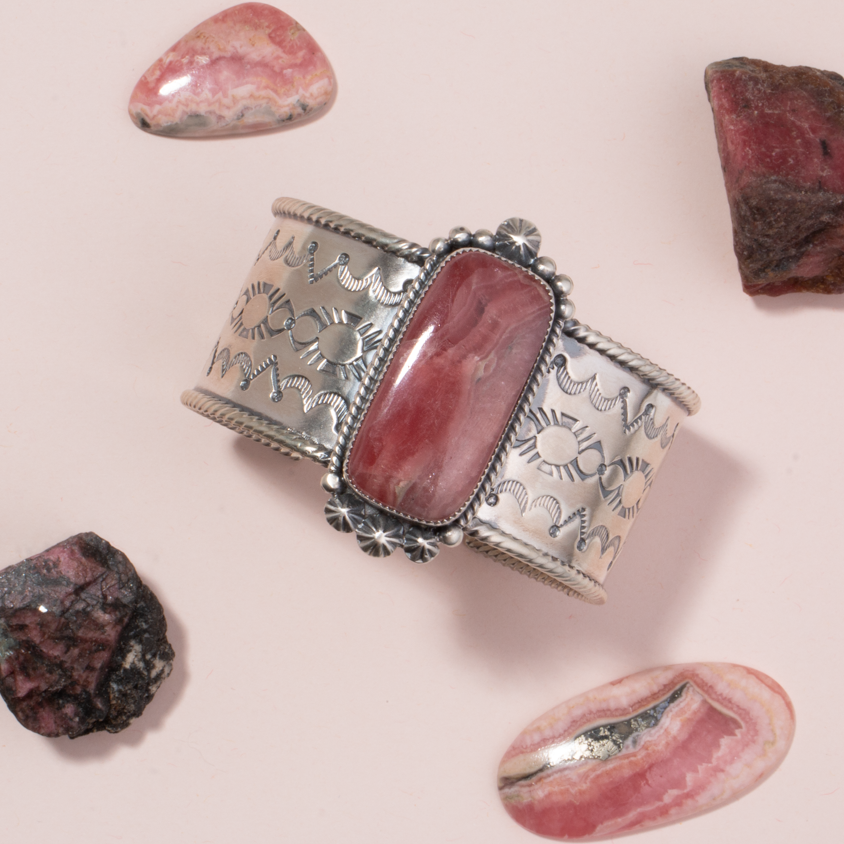
Pick up a Sunshine Reeves cuff and the first thing you register is the density of it. Where many stampers place a handful of marks, Reeves may work ten to twenty different handmade stamps into a single piece — each one a distinct die, each strike a separate hammer blow placed by eye. It starts, always, as a flat sheet of sterling: no casting, no shortcuts. He hand-stamps it, forms it, saws the channels around every stone by hand. "Most people have no idea," he's said, "how complex the process is to create these unique art forms." He is, by wide agreement, one of the living masters of traditional Navajo stampwork.
The Smith
The nickname came early — family gave him "Sunshine" as a boy for his light-colored hair. He was born in Twin Lakes, New Mexico, in 1966, into a family of accomplished silversmiths, and learned the craft at twenty-four from his older brothers, Gary Reeves and David Reeves, both respected artists in their own right. He's been at the bench as a professional since the late 1980s, and his range runs far past jewelry — bracelets and belt buckles, yes, but also silver boxes, knives, bowls, candle holders, even kerosene lanterns, all raised and stamped from flat silver.
The Work
Reeves's signature is that stamp density, worked around stone. His recurring marks read like weather and sky — lightning-and-rain patterns, stars, shooting stars — framed with what the trade calls "flanks," the side-stamping that borders a center stone, and finished with fine hand-sawn bezels and applied silver overlay. He favors high-grade turquoise, Kingman and Royston among his stones, set so the stampwork carries the eye around the piece. The whole effect is unmistakably his; collectors know it on sight, and his following reaches well past the Southwest — into Japan, Korea, and Europe.
The Mark
He signs his work "SUNSHINE REEVES" — the full name struck into the silver.
The Standing
In 1997, Pardue writes, his "eight-piece silver coffee set won Best of Show at Indian Market in Santa Fe, where over 1500 entries were submitted for judging. The following year at the same event, he won Best of Classification in Jewelry" (Pardue 2007, pp. 68, 70). [2] Schaaf lists a 1997 Best of Show among his awards at the Inter-tribal Indian Ceremonial in Gallup (Schaaf 2003, p. 270). [1] His work has been shown at the Heard Museum and the Peabody Museum at Harvard.
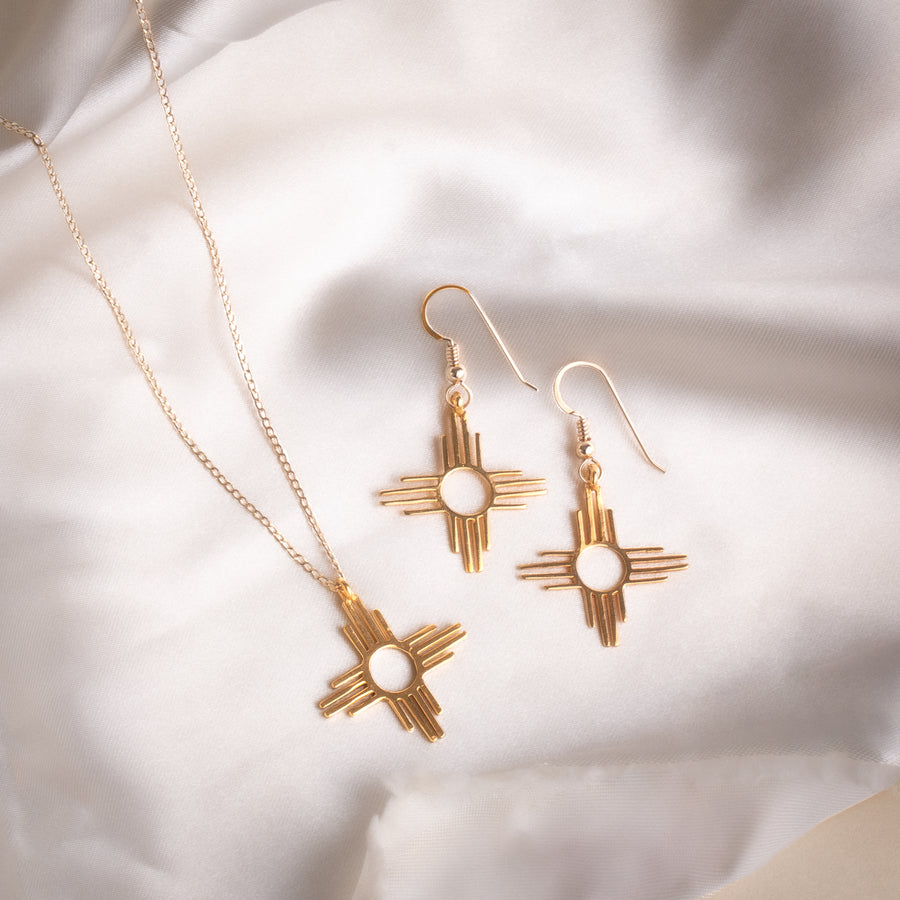
See his work in motion: T.Skies walked through a full Sunshine Reeves Kingman water-web set — the fine hand-sawn bezels, the lightning-and-rain stamping, the flanks — on a Friday Statement Jewelry show.
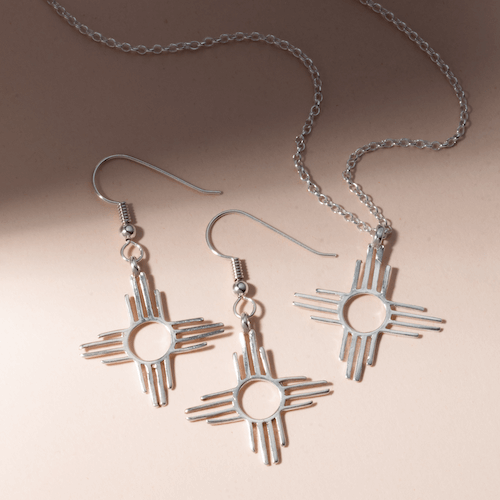
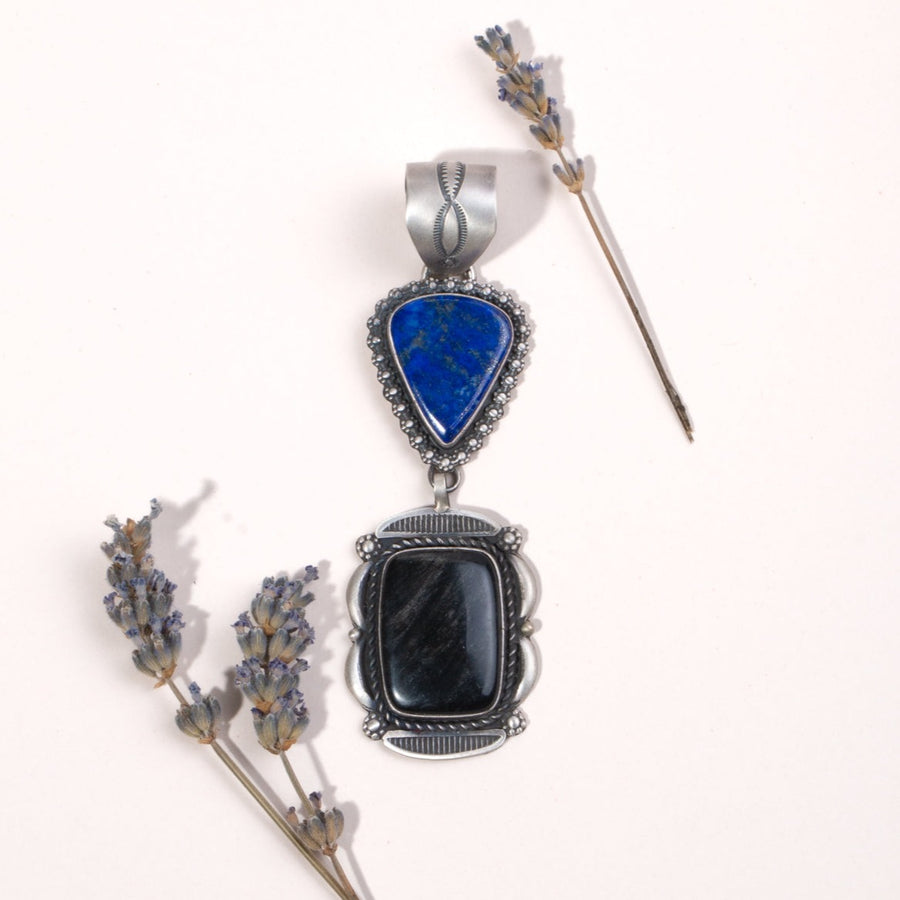
Work by Sunshine Reeves on T.Skies
From the T.Skies YouTube channel.
Know more about Sunshine? Contact T.Skies.
- Bahti, Mark. Silver + Stone + Pardue, Diana F. Contemporary Southwestern Jewelry.
- Sunshine Reeves: Master Silversmith of the Navajo Tradition — Santa Fe Sun Handmade
- Sunshine Reeves — Garland's
- Native American Jewelry Hallmarks (SUNSHINE REEVES) — Durango Silver Company
From the Library: Schaaf, American Indian Jewelry I (2003)
2003 primary source. Anything described as current here describes 2003, not today.
Schaaf (2003) entered him as
“Sunshine Reeves (Daniel Reeves), (stamps D. Reeves or Sunshine Reeves)”
— Schaaf (2003), p. 270 [1]
Schaaf (2003, p. 270) recorded Sunshine Reeves as Navajo, born in 1966 and active from about 1991 in traditional and contemporary heavy silver, taught by his older brothers, showing at Indian Market from 1992, with Best of Show in 1997 and a Best in Category in 2002 at the Inter-tribal Indian Ceremonial in Gallup. [1]
Field Notes by Mateo James
I notice the sources place his 1997 Best of Show at different shows. This page has it at Santa Fe Indian Market, while Schaaf's 2003 register lists it among his awards from the Inter-tribal Indian Ceremonial in Gallup. I show both as printed.
Sources
- Schaaf, Gregory, with Angie Yan Schaaf. American Indian Jewelry I: 1,200 Artist Biographies, ca. 1800-present. American Indian Art Series, Vol. 5. Santa Fe: CIAC Press, 2003. Cited by printed page. Statements describe conditions as of 2003.
- Pardue, Diana F., with the Heard Museum. Contemporary Southwestern Jewelry. Photography by Craig Smith. Layton, UT: Gibbs Smith, 2007. Cited by printed page. Statements describe conditions as of 2007.
This profile is maintained in support of Native American silversmiths and compiled from published references. See something inaccurate, or want to add to it? Contact us.