



Preston Monongye — Hopi-Adopted Silversmith Hallmark

Hallmark documented in: Hougart (Hallmarks), Schaaf (1200 Bios), Hougart (100 Collectible), Dubin (North American Indian Jewelry), Dubin (Glittering World), Wright (Hopi Silver), Rosnek (Skystone & Silver). Rendered from the documented mark, not a photograph.
Preston Monongye — Silversmith
Preston Monongye (1927–1987; Mission/Hopi-adopted) was active primarily from the 1960s until his death in 1987. Working mostly in silver with some gold, he produced tufa castings, fabricated jewelry, and hollowware. Throughout his long career he also worked as an accomplished wood carver and painter before turning to silver design, winning numerous awards for his "new Indian art" designs.
Monongye was adopted by the Monongye family in Hopi. His uncle Gene Pooyouma was one of his early teachers. He worked for Tanner's Indian Arts and Crafts Center in Gallup before moving to Phoenix in 1972. Monongye was one of the major innovators of modern Indian jewelry design; Hougart notes: "Like Loloma, the 'Monongye style' is widely imitated." He was a master of tufa casting, preferring silver while collaborating with others on inlay and stonework. He perfected his tufa casting skills after consulting with master caster Sedalia F. Lovato. Stone and inlay collaborators included Jim Harrison, Lee Yazzie, and his son Jesse Monongya. He taught silversmithing at the Phoenix Indian Center in the mid-1970s.
Some overlay work was produced in the early 1960s. His son Jesse Monongya became a multiple award-winning jeweler in his own right.
Beware of fake Preston Monongye marks — Hougart explicitly documents fake marks in circulation.
The Marks
"Preston Monongye (1927-1987; Mission/Hopi-adopted). Active 1960s-1987. Mostly silver, some gold. Tufa castings; fabricated jewelry; hollowware. [...] Marks: p (may have a shaped line below, likely the lower edge of the stamp itself); P (early 1950s; angular stamp above, half moon below with 12 rays; sometimes the angular stamps are missing); PM (1960s-1987; usually on cast work); Peyote bird with a P between the tail and the [body]"
— Hougart, Bille. Native American and Southwestern Silver Hallmarks, 5th ed. (2022).
Multiple marks across periods: a simple P (early); PM (1960s–1987, most common on cast work); a peyote bird image mark. Fake marks are documented in circulation — authentication requires careful research.
References
- Hougart, Bille. Native American and Southwestern Silver Hallmarks, 5th ed. Washington, DC: BilleHougartBooks, 2022.
Know more about Preston Monongye or the modernist Hopi-adopted silversmithing tradition? Contact T.Skies.
From the Library: Branson, Turquoise: The Gem of the Centuries (1975)
1975 primary source. Anything described as current here describes 1975, not today.
According to Branson (1975, p. 7), one bracelet combined designer-silversmith Preston Monongye's work with the lapidary art of Lee A. Yazzie, set in turquoise, coral, jet and shell over inlaid spider web turquoise.
From the Library: Bedinger, Indian Silver (1973)
1973 primary source. Anything described as current here describes 1973, not today.
Writing in 1973, Bedinger described how Monongye's shop divided the work:
“This division of labor has developed to the point that top designers such as Hopi Preston Monongye regularly employ craftsmen exceptionally skilled in a certain technique to make parts of their creations.”
— Bedinger (1973), p. 198 [2]
Bedinger (1973) drew the comparison that explains why one name goes on such a piece:
“But the designer is credited with the article, as an architect is credited with the building he designs.”
— Bedinger (1973), p. 198 [2]
According to Bedinger (1973, p. 188), Monongye was among the first smiths to follow Charles Loloma into gold, part of the group that entered solid gold pieces in the Arizona and New Mexico Indian shows in 1968. [2]
From the Library: Turnbaugh, Indian Jewelry of the American Southwest (2007)
2007 primary source. Anything described as current here describes 2007, not today.
Turnbaugh (2007, p. 63, caption) illustrated a Hopi silver overlay collar as an early example of Preston Monongye's work, with a complexly wrought chain, highly domed overlay plates and a textured matte black background, and noted that many of his more recent pieces combined different techniques and materials in a style beyond traditional Hopi silversmithing bounds. [3]
As of the late 1980s, Turnbaugh (2007, p. 62) named Charles Loloma and Preston Monongye among the pioneering artists leading contemporary Hopi artisans into inlay, cast silver and gold. [3]
According to Turnbaugh (2007, p. 71), the term "new Indian" jewelry was coined by Monongye in a June 1972 article in Arizona Highways. The Turnbaughs counted him and Charles Loloma, both Hopi, among the first Native silversmiths to go beyond the established boundaries of their traditional tribal styles from the late 1960s and early 1970s on. [3]
From the Library: Wright, Hopi Silver (2003)
2003 primary source. Anything described as current here describes 2003, not today.
According to Wright (2003, p. 64), Monongye, of California Indian descent, was adopted by a Hopi family as a small child and grew up in Hotevilla, and he first learned silversmithing from a relative, Gene Nuvahoioma, in the late 1930s, making jewelry in the style of that period. [4]
According to Wright (2003, p. 64), he became very proficient in overlay before moving to a modern style in silver and gold, combining multiple techniques with inlays of shell and many kinds of stone, and intricate casting often combined with overlay. [4]
According to Wright (2003, p. 85), Jim Nutima, of the Reed clan, began in 1971, learned at the Institute of American Indian Art in Santa Fe, and also worked with Preston Monongye. [4]
Wright (2003, p. 90) lists Manuel Hoyungwa of Hotevilla, who began in 1975, as having worked with his maternal uncle, Preston Monongye, and also studied at the Institute of American Indian Art. [4]
According to Wright (2003, p. 91), Chalmers Day started in a Manpower class in Phoenix taught by Preston Monongye in 1976 and then worked for him. [4]
According to Wright (2003, p. 77), Preston Monongye, of the Greasewood clan at Hotevilla, began silverwork in 1939; he used his first mark from 1950 to 1955, later used a Peyote Rain Bird mark on some pieces, and after 1965 used his initials on his cast work. He also worked in gold. [4]
From the Library: Bassman, The Beauty of Hopi Jewelry (1993)
1993 primary source. Anything described as current here describes 1993, not today.
According to Bassman (1993, p. 2), Preston Monongye was born a Mission Indian and adopted by a Hopi family when he was seven; he learned the Hopi language and silversmithing from his uncle, David Monongye, and had a unique style of casting, with designs that differed from earlier Hopi work. [5]
Bassman (1993, p. 11) pictured four cast bracelets Preston Monongye made in the 1970s: one with variscite, one with four Bisbee turquoise stones, one with Chinese turquoise, coral and lapis lazuli, and one with two coral stones. [5]
Bassman (1993) pictured one of his pieces:
“Cross with Bisbee turquoise made in 1970 by Preston Monongye.”
— Bassman (1993), p. 39 [5]
From the Library: Ryan & Chambless, Turquoise in America Part Two: 1910–1990 (2020)
2020 primary source. Anything described as current here describes 2020, not today.
Ryan & Chambless (2020) quote Preston Monongye's June 1972 Arizona Highways article, "The New Indian Jewelry Art of the Southwest":
“When you are buying this jewelry, remember that the method is old but the jewelry is new.”
— Ryan & Chambless (2020), p. 170 [6]
Ryan & Chambless (2020, p. 315) picture a Preston Monongye Kokopelli bolo set with Lone Mountain turquoise that was later reworked by Jesse Monongya and carries both men's hallmarks. [6]
From the Library: Stacey, Turquoise Blue Book and Indian Jewelry Digest (1975)
1975 primary source. Anything described as current here describes 1975, not today.
Preston Monongye, in his own words in the 1975 Turquoise Blue Book, on his casting method:
“Personally, I still use the traditional method of honing down tufa stone, which is a volcanic ash, and carving a negative mold. My design is in negative form and I pour to get a positive.”
— Stacey (1975), p. 75 [7]
Monongye (1975) on the war years:
“Turquoise was scarce and very expensive, so petrified wood was used because it was readily available and the Indian could find it on the reservation. Cutting was difficult in those days.”
— Stacey (1975), p. 73 [7]
On gold, Monongye wrote in 1975:
“Charles Loloma, Kenneth Begay and I have done much work in solid gold. In the last four years we have introduced it into competitions.”
— Stacey (1975), p. 76 [7]
And on the gold itself, as of 1975:
“Most of the gold used by the Indian artists is 14kt. gold.”
— Stacey (1975), p. 76 [7]
From the Library: Manley, Collecting Southwestern Indian Arts & Crafts (1979)
1979 primary source. Anything described as current here describes 1979, not today.
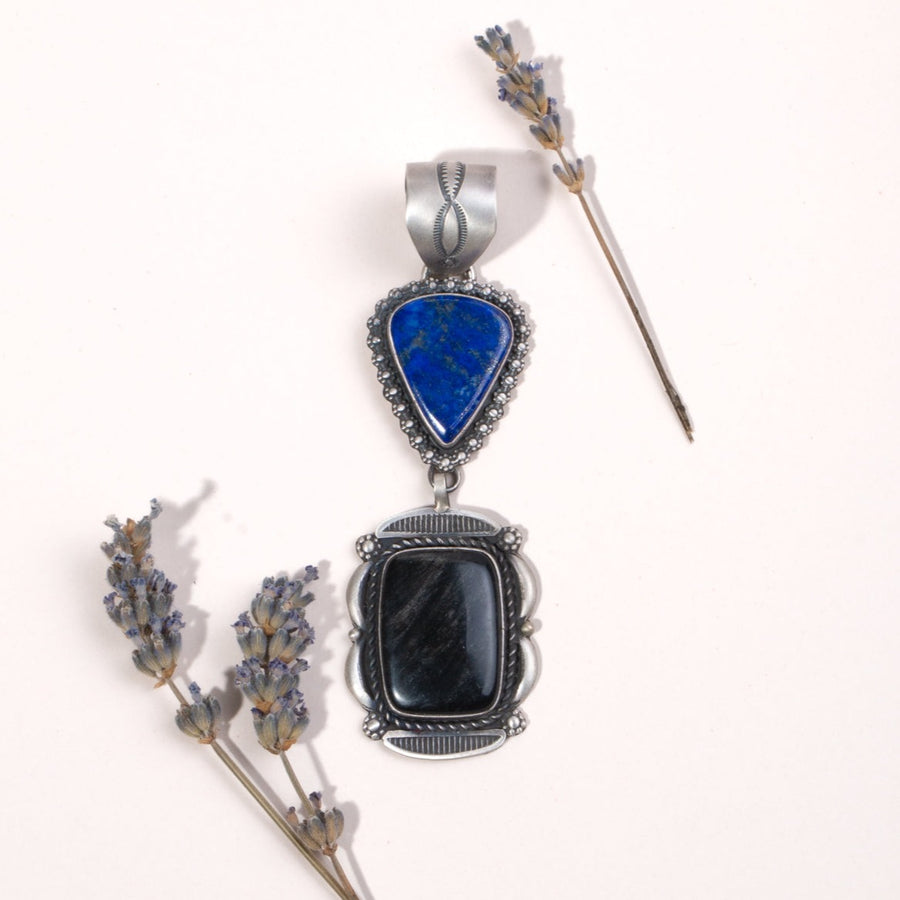
A 1979 caption in Ray Manley's Collecting Southwestern Indian Arts & Crafts described one of Monongye's large pendants:
“Preston Monongye made this massive pendant of sandcast silver set with a mosaic of gold-filled Morenci turquoise, coral, jet, ironwood, and mother-of-pearl. The bear claws were once part of an old necklace.”
— Manley (1979), p. 37 [8]
From the Library: Jacka, Navajo Jewelry: A Legacy of Silver and Stone (1995)
1995 primary source. Anything described as current here describes 1995, not today.
Lois Essary Jacka, writing in 1995:
“Another renowned jeweler of that era was of Mission Indian and Mexican descent, but was raised as a Hopi.”
— Jacka (1995), p. 33 [9]
Jacka (1995) on his students:
“Many of today's Navajo jewelers learned their skills under Preston's tutelage, including his son, Jesse, whose mother was Navajo.”
— Jacka (1995), p. 33 [9]
From the Library: Baxter, Encyclopedia of Native American Jewelry (2000)
2000 primary source. Anything described as current here describes 2000, not today.
Baxter (2000) credited him with a gold technique:
“Preston Monongye (1927-1987) experimented with the use of gold in the reticulation process, thus pioneering another aspect of technical innovation.”
— Baxter (2000), p. 62 [10]
Baxter (2000) recorded his path to the bench:
“He served in World War II and in Korea, finally turning to art full-time in the mid-1960s.”
— Baxter (2000), p. 110 [10]
According to Baxter (2000, p. 110), Monongye attended Haskell Indian Junior College in Lawrence, Kansas, and Occidental College in Los Angeles. [10]
Baxter (2000) wrote of his techniques:
“Monongye’s first love was Hopi overlay, but he also worked with tufa casting and the addition of mosaic inlay.”
— Baxter (2000), p. 111 [10]
From the Library: Dubin, North American Indian Jewelry and Adornment (1999)
1999 primary source. Anything described as current here describes 1999, not today.
Dubin (1999, p. 538) has Monongye apprenticed at nine to his uncle, the Hopi silversmith Gene Pooyouma, helping melt the Mexican pesos and American coins that Southwestern smiths then worked in. She credits the trader Roman Hubbell with encouraging him when he took up jewelry after World War II. [11]
Dubin (1999, p. 538) reports that Joe Tanner described Monongye as a "great warehouse of ideas," and that, although he was skilled at fine stone inlay, he "preferred to concentrate on metalwork, and have the stones set by others." [11]
Field Notes by Mateo James
Hougart, whom this page follows, names Preston's early teacher as his uncle Gene Pooyouma. Wright (2003, p. 64) names him as a relative, Gene Nuvahoioma, and dates the lessons to the late 1930s, well before the 1960s start this page gives for his main career. Hopi names are often spelled several ways, so this may be one man, but I show both spellings as printed.
This page already shows that Hougart and Wright name different early teachers. Bassman, writing in 1993, names a third: his uncle, David Monongye. The books may be naming different relatives who taught him at different times, so I show each as printed.
The 1979 caption in Ray Manley's book calls this pendant sandcast silver. In his own 1975 words quoted above, Monongye described carving his molds in tufa stone. I have shown both as printed.
Sources
- Branson, Oscar T. Turquoise: The Gem of the Centuries. Santa Fe: Treasure Chest Publications, 1975. Cited by printed page. Statements describe conditions as of 1975.
- Bedinger, Margery. Indian Silver: Navajo and Pueblo Jewelers. Albuquerque: University of New Mexico Press, 1973. Cited by printed page. Statements describe conditions as of 1973.
- Turnbaugh, William A., and Sarah Peabody Turnbaugh. Indian Jewelry of the American Southwest. Foreword by Barry M. Goldwater. Atglen, PA: Schiffer Publishing, 2007 (copyright 1996 and 2007; first published 1988). ISBN 0-7643-2577-9. Cited by printed page. Statements describe conditions as of 2007.
- Wright, Margaret Nickelson. Hopi Silver: The History and Hallmarks of Hopi Silversmithing. Revised edition. Albuquerque: University of New Mexico Press, 2003. Originally published by Northland Publishing. Cited by printed page. Statements describe conditions as of 2003.
- Bassman, Theda. The Beauty of Hopi Jewelry. Photography by Gene Balzer. Walnut, California: Kiva Publishing, 1993. Cited by printed page. Statements describe conditions as of 1993.
- Ryan, Mike, II, and Philip Chambless. Turquoise in America, Part Two: 1910–1990. Callais Press, 2020. Cited by printed page. Statements describe conditions as of 2020.
- Stacey, Joseph, ed. Turquoise Blue Book and Indian Jewelry Digest. Arizona Highways Collectors Series. Phoenix: Arizona Highways (Arizona Department of Transportation), 1975. Cited by printed page. Statements describe conditions as of 1975.
- Manley, Ray. Ray Manley's Collecting Southwestern Indian Arts & Crafts. Text by Clara Lee Tanner and others; photography by Naurice Koonce, Ray Manley and Alan Manley. Tucson: Ray Manley Photography, 1979. Includes Clara Lee Tanner, "Southwest Indian Silverwork," pp. 39–41. Cited by printed page. Statements describe conditions as of 1979.
- Jacka, Lois Essary. Navajo Jewelry: A Legacy of Silver and Stone. Photographs by Jerry Jacka. Flagstaff: Northland Publishing, 1995. Cited by printed page. Statements describe conditions as of 1995.
- Baxter, Paula A., with Allison Bird-Romero. Encyclopedia of Native American Jewelry: A Guide to History, People, and Terms. Phoenix: Oryx Press, 2000. Cited by printed page. Statements describe conditions as of 2000.
- Dubin, Lois Sherr. North American Indian Jewelry and Adornment: From Prehistory to the Present. Original photography by Togashi, Paul Jones, and others. New York: Harry N. Abrams, 1999. Cited by printed page. Statements describe conditions as of 1999.
This profile is maintained in support of Native American silversmiths and compiled from published references. See something inaccurate, or want to add to it? Contact us.