



Jesse Monongya — Navajo/Hopi Silversmith & His Mark
Jesse Lee Monongya, 1952–2024. The man who put the night sky inside a bear.
Jesse Monongya learned the night sky before he ever learned silver. Raised by Navajo relatives in the Chuska Mountains near Two Grey Hills — in a traditional hogan, by a grandmother who taught him the prayers, the four sacred colors, and the constellations — he carried those lessons to a bench he wouldn't find until he was a grown man. When he did, they came out as his signature: a bear form with a whole starfield inlaid into its body, coral sunsets shading down into lapis nights. The imagery was his own biography, set in stone.
The Mark
Monongya signed his work "MONONGYA," stamped into the metal in a stylized block hand (documented signature at Adobe Gallery). One thing collectors should know, because the trade record itself preserves it: his father, the tufa-casting master Preston Monongye, spelled the family name Monongye — Jesse deliberately changed his own to Monongya. Both spellings ran in print during their lifetimes. It's not an error to correct; it's two men, two hands, two marks.
The Smith
He was born August 13, 1952, in Phoenix, and separated young from his birth family — raised, with a brother and sister, by adoptive Navajo relatives. As a child he did not know his father was Preston Monongye, one of the most celebrated Native jewelers of the century. He graduated Fort Wingate High School, worked heavy equipment, and served in the U.S. Marine Corps in Vietnam. He met his father for the first time at about twenty-one.
Even then, jewelry didn't come at once. By his own account, he started after a dream in which his birth mother appeared and told him he would become a famous jeweler — "it was like a lightning bolt hit me." From 1975 to 1977 he apprenticed at Preston's Paradise Valley studio, and their split of labor tells you exactly what Jesse became: Preston did the metalwork, Jesse did the stone inlay. He sharpened the lapidary side by watching Lee Yazzie — Preston's other great inlay collaborator — and worked in view of Charles Loloma and Dennis Edaakie. His first independent piece, a bear pendant, won Best of Jewelry at the 1977 Hopi Marketplace in Flagstaff. The bear became his life's motif.
He served as Artist in Residence at the Heard Museum (1986–87) and on the U.S. Indian Arts and Crafts Board. He died August 6, 2024, at seventy-one.
The Work
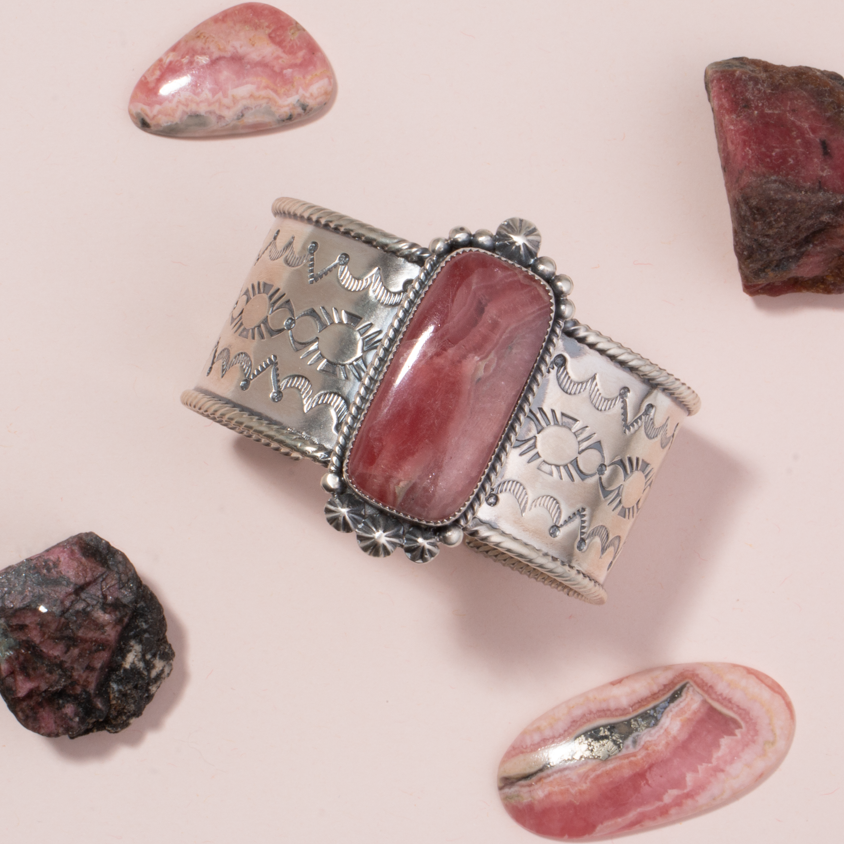
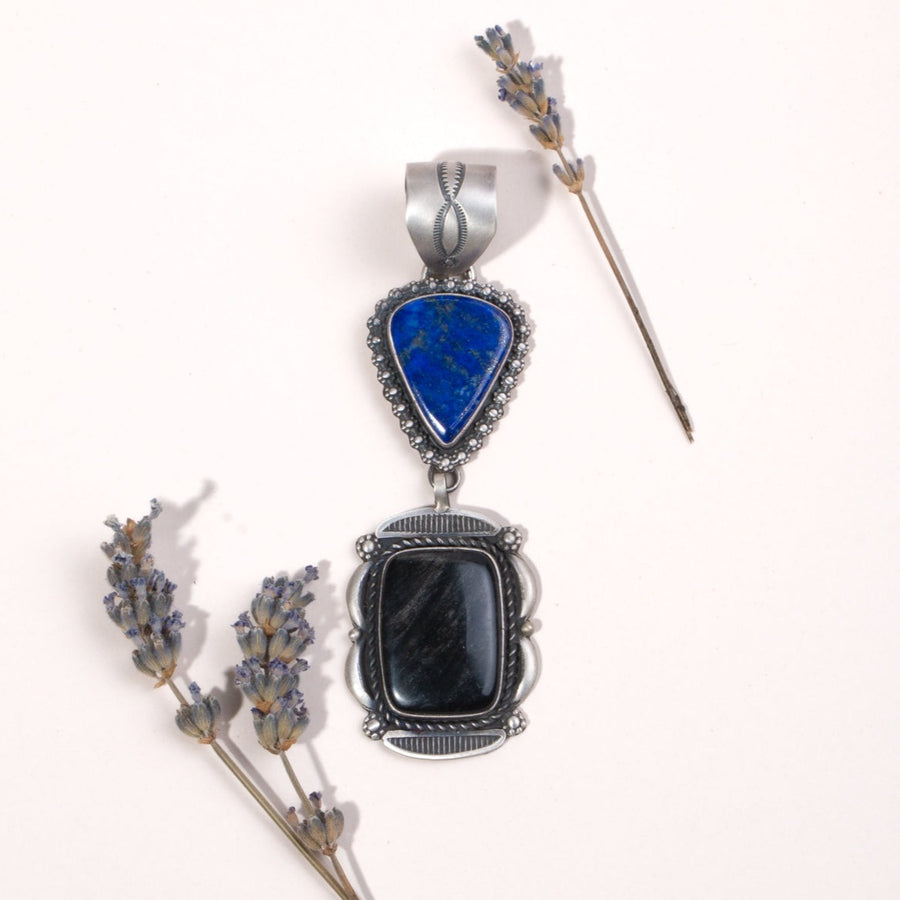
Monongya worked stone-to-stone inlay — precision-cut stones set directly against one another, no channel walls of metal between them, so the color runs together like paint. Dealers call it "painterly," and the description is earned: a single piece moves from coral through turquoise into a jet-black sky studded with opal moons and lapis stars, the whole scene set into 14k or 18k gold. His material bench was deep — Acoma jet, sugilite, coral, turquoise, lapis, opal, malachite, shell, fossilized ivory, and in later ranger sets, diamonds.
He was plain about where the work came from. "When I first started making jewelry," he said, "I reached back to my grandmother's teachings about the prayers and the four sacred colors… I would dream the colors, and I would wake up in the middle of the night and draw it out." The night-sky bear isn't a style he picked. It's the hogan he was raised in.
Some of his bear-and-landscape pieces incorporate Yei figures, and a documented three-generation family piece — Preston, Jesse, and Jesse's son Bo — depicts a Long Hair Katsina. We name these as the jewelry-trade record does, and leave their sacred meaning to the Hopi and Diné people and to the artists' own words.
The Standing
Monongya's work is held at the Heard Museum, the Smithsonian's National Museum of the American Indian, the Denver Art Museum, the Museum of Northern Arizona, Cooper Hewitt, and the Museum of Modern Art, among others. He took Best of Division at Santa Fe Indian Market in 1992 and 1994 (the years both major sources agree on), among many other awards across four decades of shows. His work is the subject of a dedicated monograph — Lois Sherr Dubin's Jesse Monongya: Opal Bears and Lapis Skies (Hudson Hills, 2002), 175 color plates — and the tradition continues in his son Bo Monongye.
Know more about Jesse? Contact T.Skies.
From the Library: Bassman, The Beauty of Navajo Jewelry (1997)
1997 primary source. Anything described as current here describes 1997, not today.
Bassman (1997, p. 19) pictured a silver bracelet with gold overlay and inlay of lapis lazuli, dolomite, malachite, spiny oyster shell, angel and oxblood coral and turquoise, credited to Jesse Monongye, the spelling the book uses. [1]
Bassman (1997, p. 50) pictured a 14-karat gold mosaic inlay bola tie and belt buckle by Jesse Monongye (her spelling), each with an overlaid eagle on the reverse. [1]
Bassman (1997) described what the inlay shows:
“They depict the evening sky in Monument Valley. The dotted lines represent Highway 66.”
— Bassman (1997), p. 50 [1]
Bassman (1997, p. 53) pictured four inlaid rings made by Jesse Monongye (her spelling): one in 14-karat gold and three in sterling silver with a coral stone, a sun face or a round turquoise set in 14-karat gold. [1]
Bassman (1997, p. 48) pictured a 14-karat gold reversible pendant by Jesse Monongye (her spelling) with a Corn Maiden Kachina on one side and a Monument Valley galaxy of sugilite, Australian opal, lapis lazuli and coral on the other. [1]
Bassman (1997) recorded the pendant's award:
“This won First Prize, Best in Category, and Best in Class at the Gallup Inter-Tribal Indian Ceremonial in Gallup, New Mexico in 1993.”
— Bassman (1997), p. 48 [1]
From the Library: Ryan & Chambless, Turquoise in America Part Two: 1910–1990 (2020)
2020 primary source. Anything described as current here describes 2020, not today.
Ryan & Chambless (2020, p. 315) picture a Kokopelli bolo by Preston Monongye, set with Lone Mountain turquoise, that Jesse Monongya reworked; it carries both hallmarks. [2]
From the Library: Jacka, Navajo Jewelry: A Legacy of Silver and Stone (1995)
1995 primary source. Anything described as current here describes 1995, not today.
Jesse Monongya (spelled Monongye in Jacka's 1995 book), a man once ejected from a high school silversmithing class for impatience, on finishing:
“You need to have really smooth curves, leave not one single scratch.”
— Jacka (1995), p. 75 [3]
According to Jacka (1995, p. 53), Monongya made a crown-shaped bracelet as a tribute to Charles Loloma, "the King of the Jewelers," and put designs on the undersides of his bracelets to honor Loloma as the originator of that innovation. [3]
These are an outside writer’s records from 1995 and the artists’ own words as she recorded them; the Diné themselves are the authority on their own beliefs and practices.
Monongya told Jacka in 1995 how his grandmother, a weaver, worked from the center of her loom, and how he works the same way:
“I begin my inlay in the center, and design the piece as I work, choosing colors as I go.”
— Jacka (1995), p. 99 [3]
And on the night sky, in his words as she recorded them in 1995:
“My grandmother always said that you don't point your finger at a shooting star. You point at it with your thumb and let it fall into your hand.”
— Jacka (1995), p. 113 [3]
From the Library: Baxter, Encyclopedia of Native American Jewelry (2000)
2000 primary source. Anything described as current here describes 2000, not today.
Baxter (2000), who spelled the family name Monongye, dated the partnership:
“Father and son worked together from 1974 to 1978”
— Baxter (2000), p. 109 [11]
Baxter (2000) described his lapidary tools:
“Monongye’s sophisticated inlay designs are highly regarded, and he makes innovative use of delicate tools, including dental and diamond-drilling equipment to do his painstaking lapidary work.”
— Baxter (2000), p. 110 [11]
According to Baxter (2000, p. 110), father and son were the subject of an exhibition at the Southwest Museum in California in 1976. [11]
From the Library: Tryk, Santa Fe Indian Market (1993)
1993 primary source. Anything described as current here describes 1993, not today.
Writing in 1993 (and spelling the name Monongye), Tryk captioned his bracelets:
“Inlay work reaches new heights in these "astro" bracelets by Jesse Monongye, Navajo-Hopi.”
— Tryk (1993), p. 81 [12]
From the Library: Schaaf, American Indian Jewelry I (2003)
2003 primary source. Anything described as current here describes 2003, not today.
Schaaf (2003, p. 172) named Preston Monongye and Jessie Monongya as the teachers of the Navajo mosaic jeweler Jim Harrison, born in 1952. [13]
Schaaf (2003) recorded that from 1979 he
“uses joined initials with surname JMONONGYE”
— Schaaf (2003), p. 236 [13]
Schaaf (2003, p. 236) recorded Jessie (Jesse) Monongya as Navajo, born about 1952, of Two Grey Hills and Scottsdale, a son of Ida Mae Lee and Preston Monongye, taught by his father, a Marine Corps veteran, Artist in Residence at the Heard Museum in 1986, with his work in the U.S. Department of the Interior Museum, the Heard Museum, the Museum of Man in San Diego, the Denver Art Museum, the Cooper-Hewitt Museum and the Museum of Northern Arizona. [13]
Schaaf (2003) wrote that he
“is respected as one of the finest jewelers in the history of American Indian art”
— Schaaf (2003), p. 237 [13]
Schaaf (2003, p. 246) recorded that the Navajo jeweler Gibson Nez credited Jessie Monongya and Ben Nighthorse as his greatest influences. [13]
Field Notes by Mateo James
Our page dates Jesse's years at his father's studio from 1975 to 1977. Baxter's 2000 encyclopedia, which spells the name Monongye, has father and son working together from 1974 to 1978. I show both ranges as printed.
I notice the books describe his signature differently. This page records a block-letter MONONGYA, while Schaaf's 2003 entry says his earlier work carried a special design and that from 1979 he used joined initials with the surname, spelled JMONONGYE. Both spellings appear on his work, so I show each as printed.
Sources
- Bassman, Theda. The Beauty of Navajo Jewelry. Photography by Gene Balzer. Walnut, California: Kiva Publishing, 1997. Cited by printed page. Statements describe conditions as of 1997.
- Ryan, Mike, II, and Philip Chambless. Turquoise in America, Part Two: 1910–1990. Callais Press, 2020. Cited by printed page. Statements describe conditions as of 2020.
- Jacka, Lois Essary. Navajo Jewelry: A Legacy of Silver and Stone. Photographs by Jerry Jacka. Flagstaff: Northland Publishing, 1995. Cited by printed page. Statements describe conditions as of 1995.
- Pardue, Diana F. Contemporary Southwestern Jewelry + Bahti, Mark. Silver + Stone: Profiles of American Indian Jewelers.
- Dubin, Lois Sherr. Jesse Monongya: Opal Bears and Lapis Skies. Hudson Hills Press, 2002.
- Remembering Jesse Monongye (1952–2024) — Art Jewelry Forum, by Diana F. Pardue (Heard Museum curator)
- Jesse Monongya biography — Medicine Man Gallery
- Jesse Monongya — Mahnaz Collection
- Jesse Monongya — Craft in America (PBS)
- Jesse Monongye (signature image) — Adobe Gallery
- Baxter, Paula A., with Allison Bird-Romero. Encyclopedia of Native American Jewelry: A Guide to History, People, and Terms. Phoenix: Oryx Press, 2000. Cited by printed page. Statements describe conditions as of 2000.
- Tryk, Sheila. Santa Fe Indian Market: Showcase of Native American Art. Photography by Mark Nohl; introduction by Allan Houser. Santa Fe, NM: Tierra Publications, in cooperation with SWAIA (Southwestern Association on Indian Affairs), 1993. Cited by printed page. Statements describe conditions as of 1993.
- Schaaf, Gregory, with Angie Yan Schaaf. American Indian Jewelry I: 1,200 Artist Biographies, ca. 1800-present. American Indian Art Series, Vol. 5. Santa Fe: CIAC Press, 2003. Cited by printed page. Statements describe conditions as of 2003.
This profile is maintained in support of Native American silversmiths and compiled from published references. See something inaccurate, or want to add to it? Contact us.