



Gene Jackson — Navajo/Diné Silversmith

Gene Jackson — Navajo Silversmith
Gene Jackson (1933–; Navajo) has been active since the 1980s, working in stamp work and shadowbox. He collaborates with his wife Martha Jackson. He is the brother of Dan A. Jackson (1944–2022; Navajo) — a more widely documented Navajo silversmith who was active since the 1960s in traditional, nugget sets, modern, shadowbox, and channel inlay work. Jennifer Curtis is Dan A. Jackson's granddaughter.
The Jackson family marks share the JACKSON surname stamp across multiple family members, making the family name a recognizable lineage mark in Navajo silversmithing.
The Mark
"Gene Jackson (1933–; Navajo). Active since 1980s. Stamp work; shadowbox. Collaborates with his wife Martha Jackson. [Brother of] Dan A. Jackson. Marks: JACKSON (inside a hogan); Gene Jackson (script)"
— Hougart, Bille. Native American and Southwestern Silver Hallmarks, 5th ed. (2022).
Marks: JACKSON inside a hogan-shaped cartouche, and Gene Jackson in script form. The hogan cartouche is a distinctive Navajo cultural motif — the hogan is the traditional dwelling, and its use as a hallmark frame is documented in Hougart for multiple makers. The script full-name form is the second primary mark.
Family Links
- Brother of Dan A. Jackson (1944–2022; Navajo) — marks: JACKSON; D. A. JACKSON
- Collaborator: Martha Jackson (Navajo) — wife and co-collaborator
- Related: E. Jackson (Navajo) — marks E J; E. JACKSON (separate family member)
References
- Hougart, Bille. Native American and Southwestern Silver Hallmarks, 5th ed. Washington, DC: BilleHougartBooks, 2022.
Know more about Gene Jackson or the Jackson family Navajo silversmithing tradition? Contact T.Skies.
From the Library: Bahti, Silver + Stone: Profiles of American Indian Jewelers (2007)
2007 primary source. Anything described as current here describes 2007, not today.
According to Bahti (2007, p. 57), Gene Jackson was born in Jeddito, Arizona, to Bernice Charlie and John Nez Begay, born to the Towering House clan and born for the Bitterwater clan; his four brothers, Dan, Benson, Johnny and Henry, all worked silver. [1]
According to Bahti (2007, p. 57), Gene's father was also a silversmith who did mostly traditional file-and-chisel work in the oldest Navajo manner, drawing his own wire and hammering his sheet from ingot. [1]
Gene Jackson told Bahti (2007) he learned by watching his father and, when his father was away, picking the lock on his tool box with baling wire:
“Then my dad would get mad and ask who had been foolin' around with his tools.”
— Bahti (2007), p. 58 [1]
According to Bahti (2007, p. 58), after serving in the Army Gene attended Navajo Community College to re-learn silversmithing, and his wife Martha learned the craft from him after they married. [1]
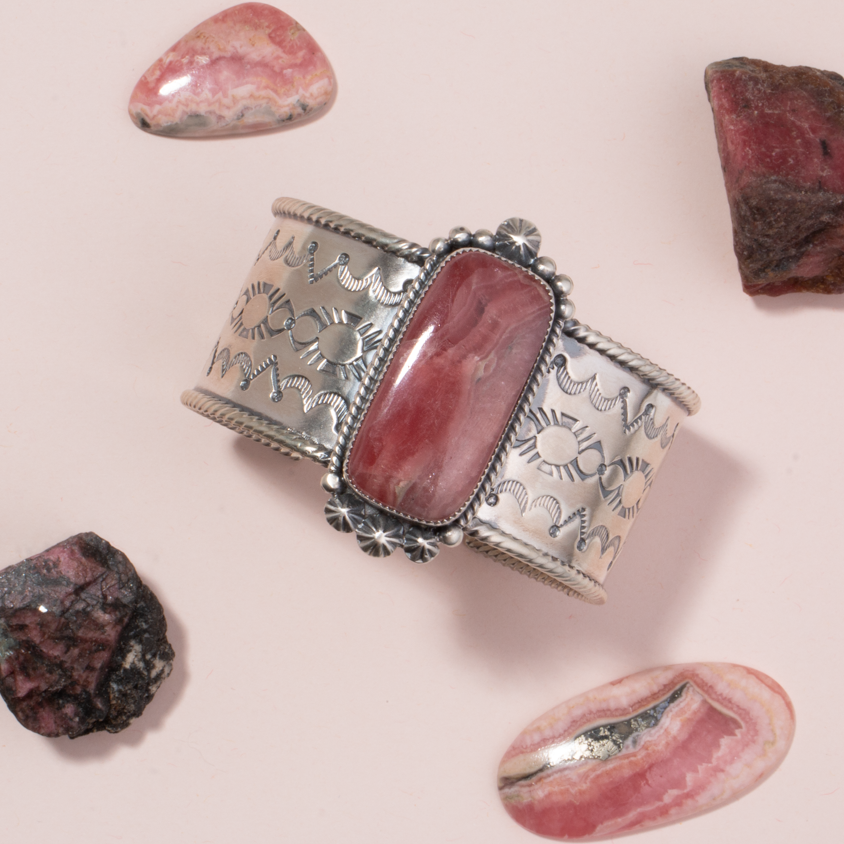
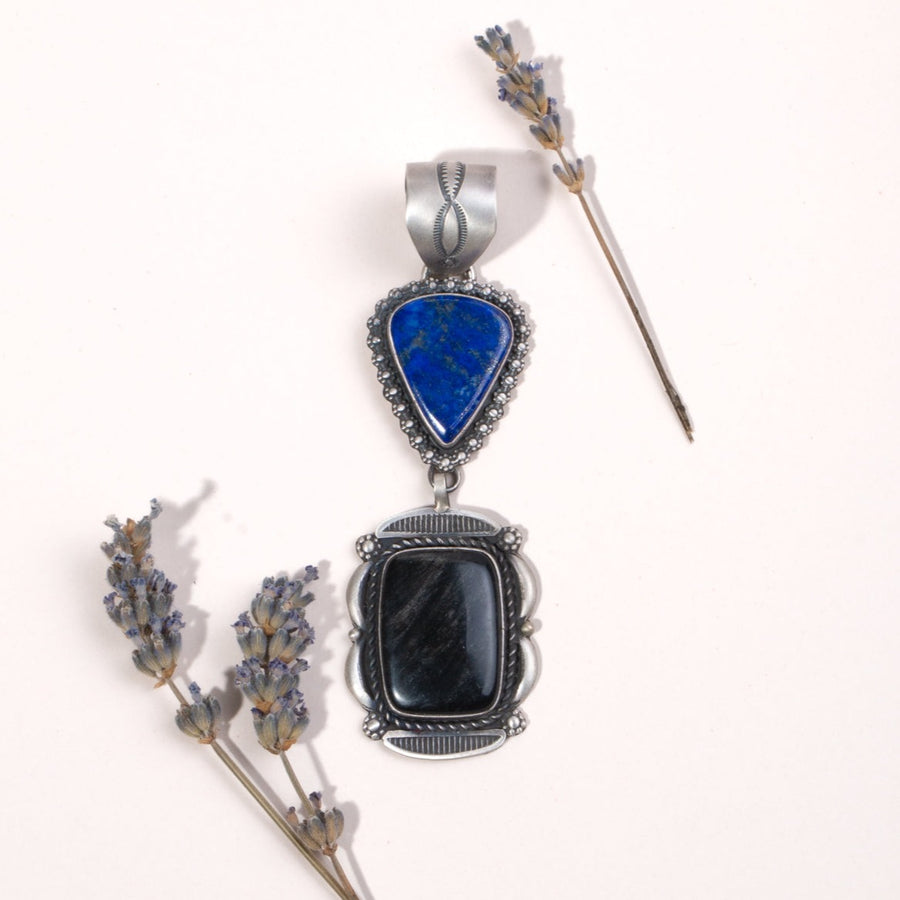
According to Bahti (2007, p. 59), as of 2007 Martha and Gene were best known for hollowware and shadowbox styles with stamped or chiseled surfaces, set with stones ranging from top-quality Morenci, Blue Gem, Chinese, Royston and Sleeping Beauty turquoise to lapis lazuli, coral, carnelian and even meteorite; they sometimes set a stone on the inside of a bracelet, a 'hidden beauty' style pioneered by Charles Loloma. [1]
According to Bahti (2007, p. 59), the Jacksons' eldest son, Tommy Jackson (born 1958), learned from his parents and was making jewelry full-time as of 2007. [1]
From the Library: Schaaf, American Indian Jewelry I (2003)
2003 primary source. Anything described as current here describes 2003, not today.
Schaaf (2003, p. 189) named the Navajo jeweler Tommy Jackson, born in 1958, as a son of Gene and Martha Jackson. [2]
Field Notes by Mateo James
Our page gives Gene Jackson's birth year simply as 1933, from Hougart. Bahti (2007, p. 57) says the records disagree, placing it anywhere from 1930 to 1933, and that 1933 is the year the Social Security Administration picked and Gene accepted. I also notice our 'active since the 1980s' sits oddly beside Gene's own account of learning from his father as a boy; his interview in Bahti is the stronger source on his own life.
Sources
- Bahti, Mark. Silver + Stone: Profiles of American Indian Jewelers. Tucson: Rio Nuevo Publishers, 2007. Cited by printed page. Statements describe conditions as of 2007.
- Schaaf, Gregory, with Angie Yan Schaaf. American Indian Jewelry I: 1,200 Artist Biographies, ca. 1800-present. American Indian Art Series, Vol. 5. Santa Fe: CIAC Press, 2003. Cited by printed page. Statements describe conditions as of 2003.
This profile is maintained in support of Native American silversmiths and compiled from published references. See something inaccurate, or want to add to it? Contact us.
Name card shown; hallmark photo to come.