



Edison Cummings — Navajo/Diné Silversmith & His Mark
b. 1962, White Cone, Arizona. The man who kept an eighth-grade promise.
In the eighth grade, on a class trip from the Navajo Nation to the Institute of American Indian Arts in Santa Fe, Edison Cummings decided he would be an artist — and told himself he'd be back in four years. He was. That's the thing to know about Cummings: almost nothing in his work was handed down. Most of the smiths in this directory learned at a family bench. He built his own path — through school, through a gallery back room — and came out with a range wider than nearly any Native metalsmith working.
The Smith
He was born in 1962 in White Cone, on the Navajo Nation, and drawn first to painting — his early spark was the Navajo painter Jim Abeita. He graduated Holbrook High in 1981, moved to Santa Fe, and enrolled at IAIA as promised, shifting from painting into three-dimensional art and earning a degree in it. At Arizona State University, pursuing art education, a required metal-stretching class caught him — and became the foundation of everything after.
His real jewelry apprenticeship was a job. From 1990 he spent five years at White Hogan, the respected Scottsdale gallery, fabricating jewelry, objects, and flatware by hand. There he developed the technique he calls his own — "stretching the metal," working silver up into raised, sculptural forms. He studied the modern masters — Charles Loloma, Preston Monongye, Kenneth Begay — but studied them; none of them taught him.
The Work
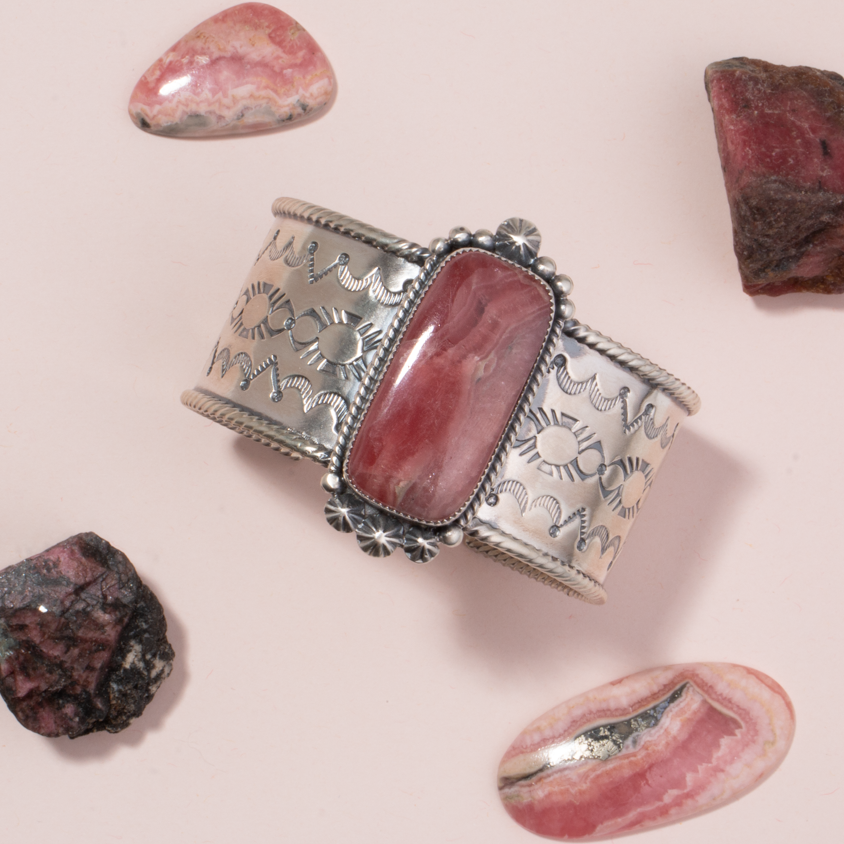
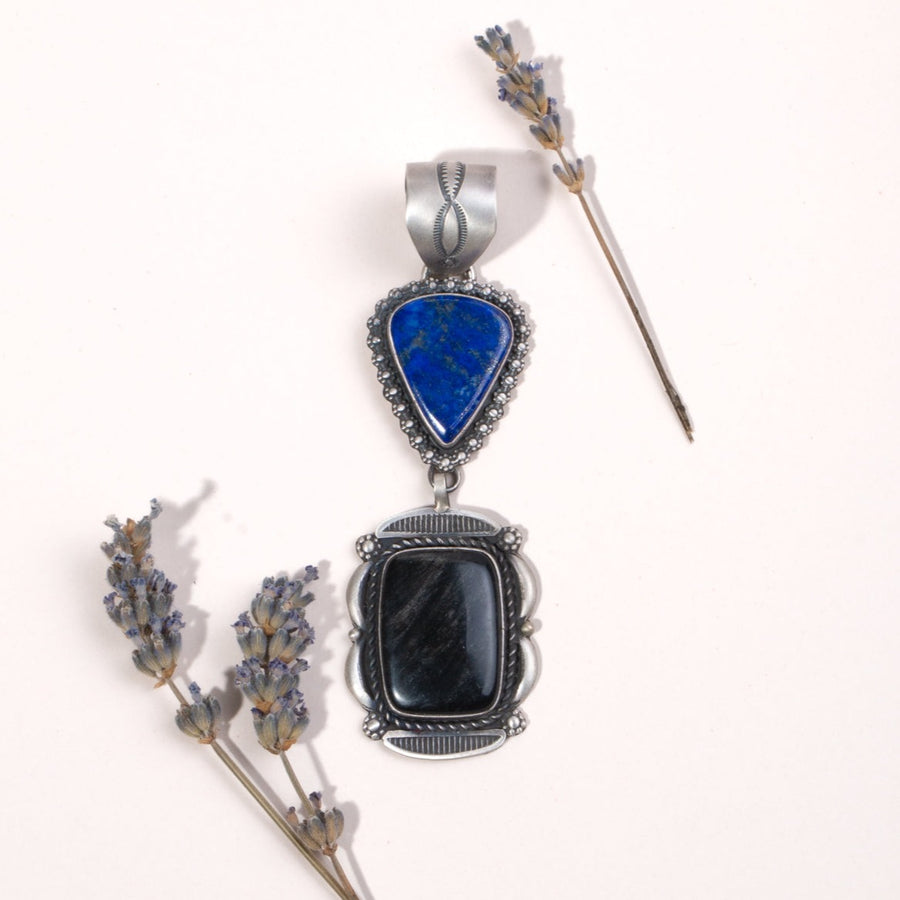
Cummings runs an unusually wide bench: repoussé, chiseling, inlay, stamping, appliqué, bezel-set stonework, and tufa casting — the old Navajo method of carving a design into a split block of soft volcanic stone and pouring molten silver into the hollow, so that no two castings come out quite alike. One dealer put it plainly: browse his catalog piece by piece and you might not believe it's all one artist. His raised bracelets get compared to Loloma's inlay heights, but the curator Diana Pardue drew the real distinction — Cummings' training as a silversmith first led him to set bezel-mounted stones into his wood and stone work, "a feature," she wrote, "that distinguishes his work from that of other jewelers."
He sets Kingman, Bisbee, Royston, and natural spiderweb turquoise, coral, jet, and fossilized ivory into silver and gold — and then goes further than most jewelers ever do: silver teapots (a signature), coffee pots, flatware, purses, boxes. A Pittsburgh critic once wrote that he finds his forms "in sources as diverse as architectural lines or the shapes of discarded metal along a highway." That's the range in a sentence.
The Standing
Cummings won a gold award the first time he ever competed, and hasn't slowed: 1st in Jewelry at Santa Fe Indian Market (2014), Best of Division there in 2024, and 1st Place, Bracelets, at the Heard Museum (2025) for a piece built around 1970s Royston turquoise. In 2004 the Heard Museum chose him to design the trophy it gives its Outstanding Supporters each year. His work is documented in Gregory Schaaf's American Indian Jewelry: 1800 Artists and discussed by Diana Pardue in Contemporary Southwestern Jewelry.
Know more about Edison? Contact T.Skies.
- Pardue, Diana F. Contemporary Southwestern Jewelry + Bahti, Mark. Silver + Stone: Profiles of American Indian Jewelers.
- Schaaf, Gregory. American Indian Jewelry: 1800 Artists.
- Edison Cummings — Mahnaz Collection
- Edison Cummings — Martha Struever Gallery
- Edison Cummings biography — Bischoff's Gallery
- What in the World is Tufa? — Turquoise & Tufa / Nusantara Collection
From the Library: Baxter, Encyclopedia of Native American Jewelry (2000)
2000 primary source. Anything described as current here describes 2000, not today.
Baxter (2000, p. 151) named Edison Cummings (Navajo), with Anthony Lovato of Santo Domingo, among the contemporary artists who had used reticulation, a fire-textured silver surface, to give their pieces an updated, avant-garde look. [1]
From the Library: Schaaf, American Indian Jewelry I (2003)
2003 primary source. Anything described as current here describes 2003, not today.
Schaaf (2003) described how Edison Cummings signed his work:
“signs with buffalo head symbol followed by EC; E. Cummings, first used in 1999; no hallmark used prior to 1997”
— Schaaf (2003), p. 126 [2]
Schaaf (2003, p. 126) listed third prizes in the miscellaneous category at Indian Market in 1998, 1999 and 2000, and his inclusion in the 2002 exhibitions Jewels of the Southwest in Santa Fe and Changing Hands at the American Craft Museum in New York. [2]
Schaaf's 2003 hallmark index lists him under EC with one other maker:
“EC (Evelyn Chavez, Edison Cummings)”
— Schaaf (2003), p. 99 [2]
Sources
- Baxter, Paula A., with Allison Bird-Romero. Encyclopedia of Native American Jewelry: A Guide to History, People, and Terms. Phoenix: Oryx Press, 2000. Cited by printed page. Statements describe conditions as of 2000.
- Schaaf, Gregory, with Angie Yan Schaaf. American Indian Jewelry I: 1,200 Artist Biographies, ca. 1800-present. American Indian Art Series, Vol. 5. Santa Fe: CIAC Press, 2003. Cited by printed page. Statements describe conditions as of 2003.
This profile is maintained in support of Native American silversmiths and compiled from published references. See something inaccurate, or want to add to it? Contact us.