



Bernard Dawahoya — Hopi Silversmith & His Hallmarks
Snow Clan, Shungopavi. 1937–2011.
Some silversmiths are known by a light touch. Bernard Dawahoya was known for the opposite — heavier-gauge silver than nearly anyone else working in overlay, cut clean and matted crisp, so that his work has a weight and a boldness you can feel in the hand before you ever read the mark. He was, in the words of hallmark scholars Pat and Kim Messier, "one of the most prominent silversmiths of his generation."
The Marks
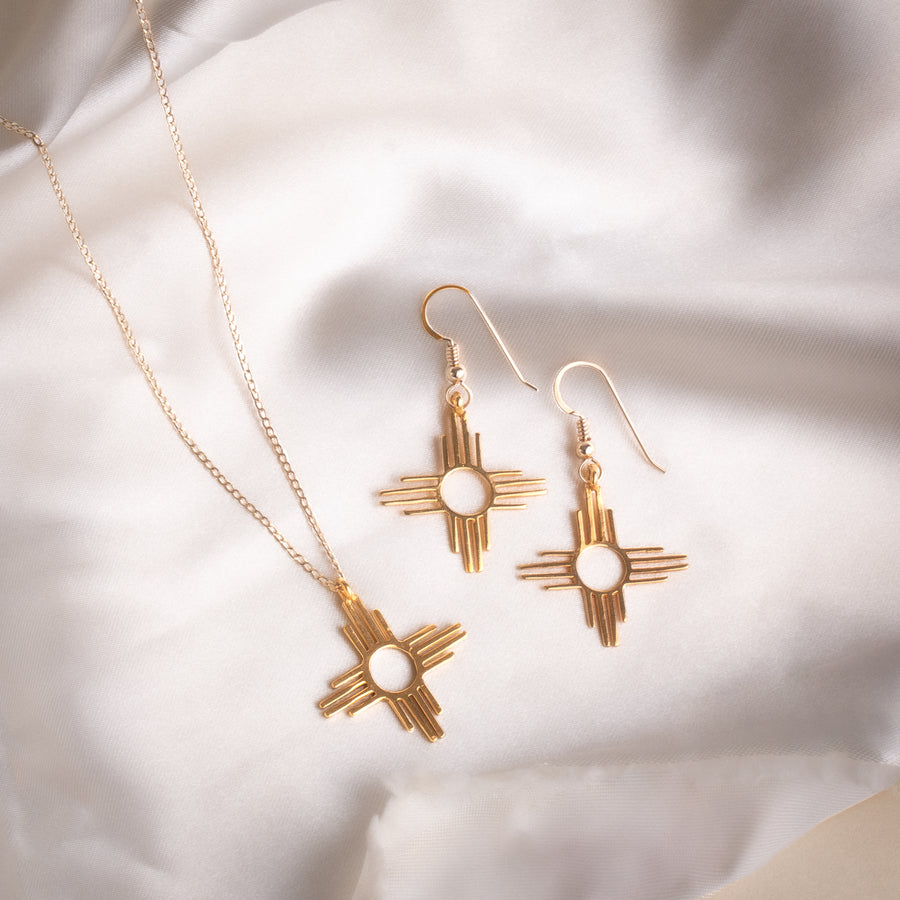
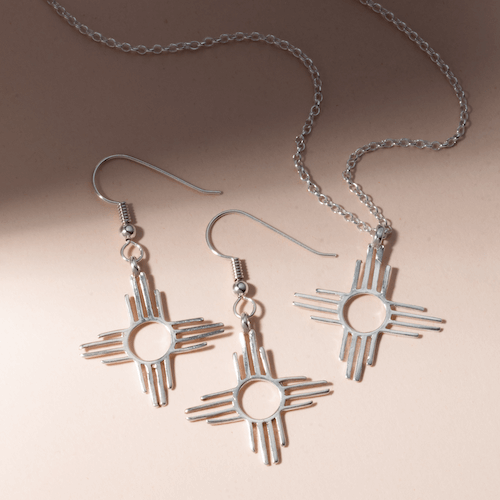
Dawahoya's personal hallmark is a snow cloud — a fitting stamp for a man of the Snow Clan. Look for it on his independent work from Second Mesa.
There's a second mark collectors need to know: during the years he worked with Wayne and Emory Sekaquaptewa's operation, his pieces often carry the shared "Hopicrafts" shop hallmark rather than his personal snow cloud. So an early Dawahoya piece may be signed by the shop, not the man — an important distinction when you're identifying his hand.
The Smith
He was born in 1937 [1] in Shungopavi, on Second Mesa. Baxter records his Hopi name as Masaqueva (Wings of the Sun) (Baxter 2000, p. 43). He belonged to the Snow Clan. Silver came to him early: he learned from his grandfather and from his uncles, Sidney Sekakuku and Washington Talayumptewa, beginning at about the age of seven, and later studied through the Hopi Silvercraft Cooperative Guild — the teaching co-op founded in 1949 by Paul Saufkie, Fred Kabotie, and returning Hopi veterans [2] to help Hopi smiths learn the craft and market their work.
He spent years at the Sekaquaptewa brothers' Hopi Enterprise in Phoenix, later moving with the shop toward Kykotsmovi, and in 1960 he came home to open his own Dawa's Crafts Shop on Second Mesa. From there he showed at arts and craft fairs for the rest of his life — his first blue ribbon came in 1971 — and worked in silver almost until the end. He died on April 17, 2011.
Silver was only part of it. Dawahoya was also a weaver, a painter, a katsina-doll carver, a leatherworker, and a natural storyteller, known for narrating the meaning behind his own designs to the people who collected them.
The Work
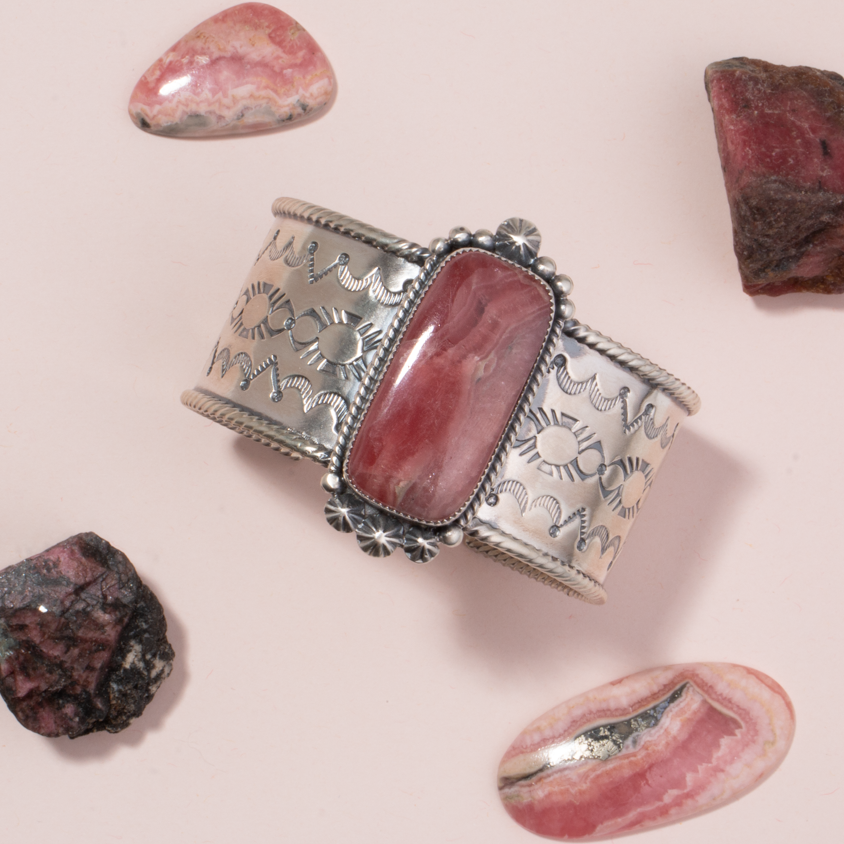
Dawahoya was a master of Hopi overlay — the technique where a design is hand-sawn from one sheet of silver and soldered over a second, the background then oxidized dark and textured. What set his apart was the metal itself: he favored a heavier gauge than most overlay artists, and his matting in the negative space was unusually precise. His designs, the Messiers wrote, were "bold and elegant; his cuts were crisp and precise."
His motifs read like a catalog of the Southwest: eagles and roadrunners, Kokopelli, corn plants and spiders, the badger paw, and figures long carried in Hopi trade silver — the Crow Mother, the Snake Dancer, the Mudheads. He also worked the Man in the Maze, a motif adapted from the Tohono O'odham emergence story and widely shared across Southwestern silver. Beyond flatwork he raised silver vessels in the squat, generous shape of Sikyátki pottery, and set turquoise from the Sleeping Beauty, Kingman, and Spider mines.
(We name these figures as they appear in his silver — as generations of collectors and museums have — and leave their ceremonial meaning to the Hopi people and to the artist's own words.)
The Standing
In 1989 Dawahoya was named an Arizona Living Treasure. [1] His work is held in permanent collections including the Peabody Museum at Harvard and the Mint Museum, with pieces recorded at the Smithsonian's National Museum of the American Indian. Mark Bahti, in Silver + Stone, credits him as a teacher of the next generation — writing that “roughly thirty Hopi silversmiths, many of them quite famous, began as his students” (p. 40). [1]
Know more about Bernard? Contact T.Skies.
From the Library: Bahti, Silver + Stone: Profiles of American Indian Jewelers (2007)
2007 primary source. Anything described as current here describes 2007, not today.
According to Bahti (2007, p. 40), roughly thirty Hopi silversmiths, many of them quite famous, began as Dawahoya's students. [1]
Speaking to Bahti (2007), Bernard Dawahoya recalled going as a boy to work for his uncles Sidney Secakuku and Washington Talayumptewa:
“I watched the sheep while they worked the silver. Later I was the motor for the grinder”
— Bahti (2007), p. 40 [1]
On the coin silver the men worked, Dawahoya told Bahti (2007) about a trip to sell in Winslow:
“When we got there we tied coins on to the track and waited for the train. It flattened out the coins real good”
— Bahti (2007), p. 40 [1]
According to Bahti (2007, p. 42), among the better-known students from the shop he opened in 1960 were Glenn Lucas, Weaver Selina and Phillip Honanie. [1]
Asked by Bahti (2007) where his designs came from, Dawahoya said:
“Mostly I pick up my designs from broken potteries”
— Bahti (2007), p. 43 [1]
From the Library: Wright, Hopi Silver (2003)
2003 primary source. Anything described as current here describes 2003, not today.
According to Wright (2003, p. 46), Wayne and Emory Sekaquaptewa hired Bernard Dawahoya as a silversmith for their Phoenix business, Hopi Enterprise, which moved to Kykotsmovi and became Hopicrafts. [2]
According to Wright (2003, p. 44), the Hopi Silvercraft Guild was formed in 1949 with the help of the Indian Arts and Crafts Board and the Hopi agency. [2]
According to Wright (2003, p. 55), Dawahoya got his first training from an old-time smith, Washington Talayumptewa, and an uncle, Sidney Sekakuku, which gave him a grounding in metalwork that let him handle silver in many ways rather than only cutting out and soldering designs. [2]
According to Wright (2003, p. 55), though influenced by his work with Hopicrafts, his style remained his own: he used Hohokam figures, the Hopi maze and other petroglyphs, pahos (prayer feathers) and stylized rain symbols, and was also known for his silver bowls. [2]
Wright (2003, p. 86) lists Alvin Sosolde, a Pima smith who began in 1972, as having learned from Bernard Dawahoya. [2]
According to Wright (2003, p. 87), Lauren Koinva, who began in 1973 at Shungopavi, learned from Bernard Dawahoya, and Loren Sakeva Qumawunu was working for him in 1973. [2]
Wright (2003, p. 89) lists his brother Bueford Dawahoya (also spelled Beauford and Beuford), of the Snow clan at Shungopavi, as beginning in the 1960s and working first with Bernard; his mark is labelled 'Snow Cloud 1990s'. [2]
According to Wright (2003, p. 93), his nephew Steward Tewawina Dacawyma of Shungopavi began in 1976 after learning at the Guild. [2]
Wright (2003, p. 94) records that Jesse Josytewa, of the Snow clan at Shungopavi, began in 1982 after learning from Bernard Dawahoya. [2]
According to Wright (2003, p. 81), Bernard Dawahoya (spelled Dawakoya in the listing) began silverwork in 1956; after training with his uncles and at the Guild Shop he worked for Hopicrafts from its Phoenix opening, moved with it to Kykotsmovi and helped instruct its smiths, and then worked for himself. His mark is labelled 'Snow Cloud'. [2]
From the Library: Stacey, Turquoise Blue Book and Indian Jewelry Digest (1975)
1975 primary source. Anything described as current here describes 1975, not today.
Jerry D. Jacka, writing in the 1975 Turquoise Blue Book:
“Bernard is a member of the Snow Clan and uses his clan sign, the Hopi Snow Cloud symbol, as his hallmark.”
— Stacey (1975), p. 79 [3]
Jacka (1975) on his shop:
“Bernard Dawahoya and his wife, Alice, now own and operate Dawa's Arts and Crafts in Shongopovi. Bernard, who has also won many ribbons for his jewelry, has expanded his one-man operation to a shop which now employs nine Hopi silversmiths.”
— Stacey (1975), p. 79 [3]
From the Library: Schiffer, Indian Jewelry on the Market (1996)
1996 primary source. Anything described as current here describes 1996, not today.
In 1996 Schiffer pictured a Dawahoya piece on the market:
“A reversible Hopi pendant by Bernard Dawahoya, and a large five-medallion Hopi sunface necklace, both of fine overlay silver technique.”
— Schiffer (1996), p. 17 [10]
From the Library: Baxter, Encyclopedia of Native American Jewelry (2000)
2000 primary source. Anything described as current here describes 2000, not today.
Baxter (2000, p. 43) gave Bernard Dawahoya's birth date as April 4, 1937, and recorded that his interest in silversmithing began in 1956. [11]
Baxter (2000) recorded a change in his later work:
“In the 1990s, Dawahoya became more experimental and innovative in the combination of materials, forms, and a contemporary “look.””
— Baxter (2000), p. 43 [11]
From the Library: Schaaf, American Indian Jewelry I (2003)
2003 primary source. Anything described as current here describes 2003, not today.
Schaaf (2003, p. 131) listed Jesse Josytewa, Loren Sakeva Qumawanu, Lauren Koinva, Alvin Sosolde, Jason Takala and Weaver Selina as his students, and named his uncles Washington Talayumptewa and Sidney Sekakuku as his teachers. [12]
Bernard Dawahoya told Schaaf (2003, p. 131) that he began at about fifteen, when his uncles caught him playing with their tools while he was working at Sidney Sekakuku's sheep camp. [12]
Schaaf (2003, p. 198) named Bernard Dawahoya as the teacher of the Hopi overlay smith Jesse Josytewa, and (p. 191) wrote that Eldon James started at Hopicrafts in Phoenix along with Bernard Dawahoya and Peter Sheldon. [12]
Schaaf (2003, p. 267) named Bernard Dawahoya as the teacher of the Hopi overlay smith Loren Sakeva Qumawanu, active from about 1973, who in turn taught his brother Darrell Sakeva. [12]
Schaaf (2003, p. 285) named Hopicrafts and Bernard Dawahoya among the teachers of the Hopi overlay smith Weaver Selina, and (p. 284) wrote that the Sekaquaptewa brothers hired Bernard Dawahoya and Eldon James as silversmiths at Hopicrafts. [12]
Field Notes by Mateo James
Some published biographies give 1935 for Bernard's birth, and an earlier version of this page gave 1998 for his Arizona Living Treasure honor. Bahti's 2007 profile, which Bernard reviewed himself, gives 1937 (p. 40) and 1989 (p. 43), and this page follows it.
Our page gives 1935 for Bernard's birth and 1998 for his Arizona Living Treasure honor, but Bahti's 2007 profile says 1937 and 1989. Bernard reviewed Bahti's profile himself, and the 1989 date comes in his own telling, so I read Bahti as the stronger source here. I've kept both until another record settles it.
An earlier version of this page said the Guild was founded in 1958. Wright dates its formation to 1949, the year the first veterans' class graduated, and Hougart (2022, p. 277) also calls Paul Saufkie a co-founder in 1949. No book I have supports 1958, so I have corrected it to 1949.
Bahti's 2007 profile, which this page follows, calls both of Bernard's first teachers his uncles. Wright (2003, p. 55) names the same two men but calls Washington Talayumptewa an old-time smith and only Sidney Sekakuku an uncle. I note the difference and show both.
I notice the books give different ages for his start. This page, following Baxter, has him learning from about the age of seven, while Schaaf's 2003 entry quotes him recalling that he was about fifteen, at his uncle Sidney Sekakuku's sheep camp. I show both as printed.
Sources
- Bahti, Mark. Silver + Stone: Profiles of American Indian Jewelers. Tucson: Rio Nuevo Publishers, 2007. Cited by printed page. Statements describe conditions as of 2007.
- Wright, Margaret Nickelson. Hopi Silver: The History and Hallmarks of Hopi Silversmithing. Revised edition. Albuquerque: University of New Mexico Press, 2003. Originally published by Northland Publishing. Cited by printed page. Statements describe conditions as of 2003.
- Stacey, Joseph, ed. Turquoise Blue Book and Indian Jewelry Digest. Arizona Highways Collectors Series. Phoenix: Arizona Highways (Arizona Department of Transportation), 1975. Cited by printed page. Statements describe conditions as of 1975.
- Hougart, Bille. Native American and Southwestern Silver Hallmarks, 5th ed. Washington, DC: BilleHougartBooks, 2022.
- Messier, Pat & Kim. Reassessing Hallmarks of Native Southwest Jewelry (2014).
- Bernard Dawahoya — Eddie Basha Collection
- Dawahoya (1935–2011) Biography — Medicine Man Gallery
- Snow Cloud: Silverwork by Bernard Dawahoya — Shiprock Santa Fe
- Bernard Dawahoya — Wikipedia (cross-referenced to Smithsonian/NMAI, academic press)
- Schiffer, Peter N. Indian Jewelry on the Market. Text and photography by Peter N. Schiffer. Atglen, PA: Schiffer Publishing Ltd., 1996. Cited by printed page. Statements describe conditions as of 1996.
- Baxter, Paula A., with Allison Bird-Romero. Encyclopedia of Native American Jewelry: A Guide to History, People, and Terms. Phoenix: Oryx Press, 2000. Cited by printed page. Statements describe conditions as of 2000.
- Schaaf, Gregory, with Angie Yan Schaaf. American Indian Jewelry I: 1,200 Artist Biographies, ca. 1800-present. American Indian Art Series, Vol. 5. Santa Fe: CIAC Press, 2003. Cited by printed page. Statements describe conditions as of 2003.
This profile is maintained in support of Native American silversmiths and compiled from published references. See something inaccurate, or want to add to it? Contact us.