



How to Tell if Turquoise is Real or Fake

Authenticity is not just a chemical property; it is a sacred dialogue between the earth’s ancient history and the maker’s steady hand. You feel the pull of the desert sky captured in a stone, yet that spiritual connection often falters under the weight of doubt. It's a common fear to worry about wasting your resources on dyed plastic or factory-made imitations that lack a soul. You might find yourself lost in a sea of technical terms like "stabilized" or "reconstituted" while trying to navigate online marketplaces that feel cold and disconnected from the craft.
Understanding how to tell if turquoise is real or fake is the first step in becoming a true steward of this heritage. We believe jewelry should be a vessel of meaning, not just an accessory. You deserve the confidence to identify genuine treasures through sensory wisdom and the quiet guidance of artisan knowledge. We'll explore non-destructive testing and visual cues that reveal the stone's true origin. By the end, you'll have the power to choose sterling silver turquoise rings and bracelets with a clear heart, knowing you've found a trustworthy path to authentic beauty.
Key Takeaways
- Earth’s deep veins: understand the rare mineral composition of genuine turquoise and why its formation process cannot be replicated by plastic.
- The faces of deception: identify common impostors like howlite and magnesite that often hide behind layers of artificial dye.
- Sensory wisdom: learn how to tell if turquoise is real or fake by observing its response to temperature and its natural, grounding weight.
- Actionable testing: use the Mohs scale and the hot needle test to distinguish between resilient mineral and melting resins.
- Artisan signatures: find peace of mind by recognizing the stamps of heritage and sterling silver hallmarks that accompany authentic jewelry.
The Soul of the Sky Stone: Understanding Real Turquoise
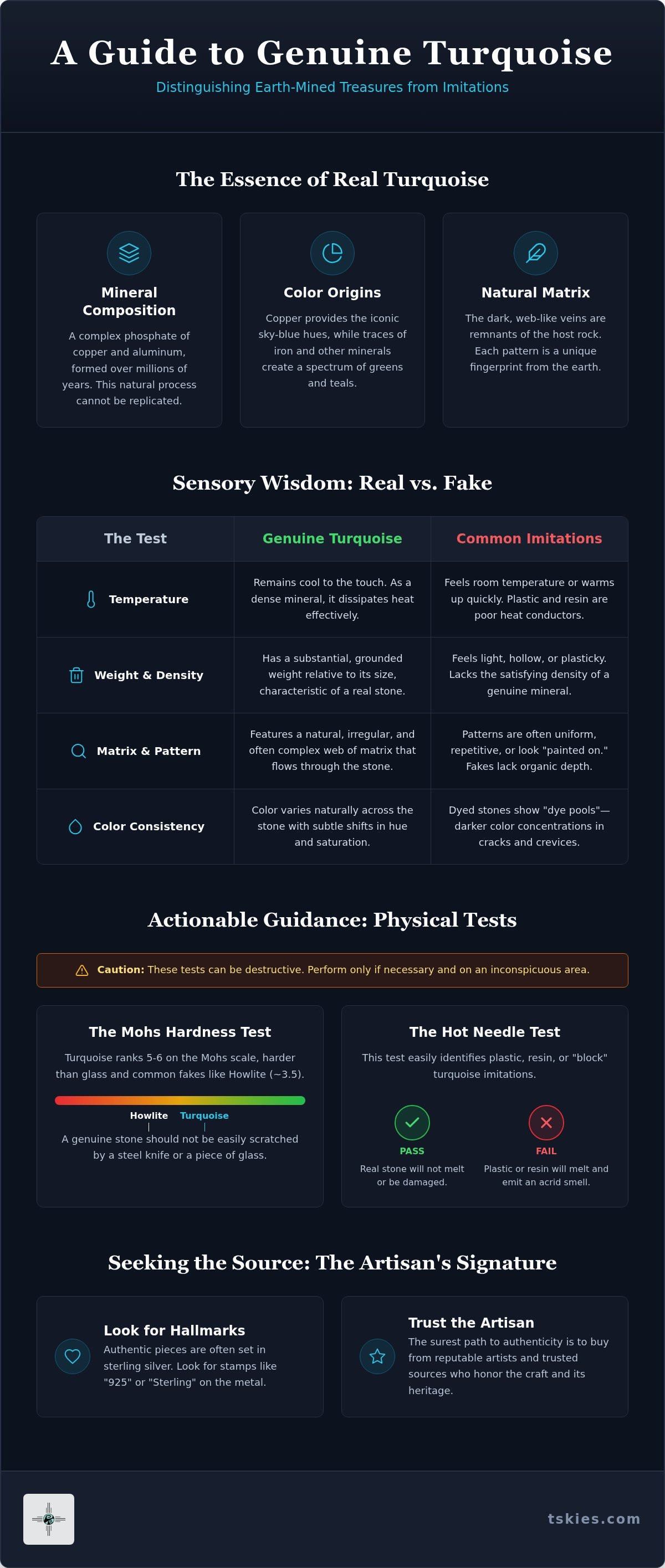
Turquoise is a silent witness to the passage of time. It is a rare gift pulled from the earth's deep, arid veins. This stone is a complex phosphate mineral of copper and aluminum, born from a slow, elemental dance. For millions of years, mineral-rich water seeped through rock, leaving behind a legacy of color. This patient interaction creates what we call the "Sky Stone." It is a vessel of heritage. It is an ancestral connection. Today, the market is crowded with "block" turquoise and plastic imitations that mimic the appearance but lack the spirit. Learning Understanding Real Turquoise is the first step in honoring the craft. When you seek to know how to tell if turquoise is real or fake, you are looking for the thumbprint of nature itself.
The Mineral Birth of a Treasure
The palette of the high desert is written in the stone’s own chemistry. Copper provides the striking blue hues that mirror the midday sky. Iron and aluminum introduce the mossy greens and earthy teals of the landscape. Scientifically, turquoise is a cryptocrystalline mineral formed in arid regions where the soil is rich and the rain is rare. It possesses a natural porosity, a quality that allows it to breathe and interact with its environment. This microscopic texture is vital for authenticity. A genuine stone has a physical history. It has a weight that feels grounded. It has a texture that feels like the earth, not a smooth, sterile countertop. Plastic cannot breathe. It cannot change. It remains stagnant and hollow.
Why Authenticity Matters to the Spirit
To wear a piece of genuine turquoise is to carry a story of the Southwest. It is more than a simple adornment; it is a connection to the land and the hands that shaped it. Fake stones lack the vibrant energy and the enduring longevity of genuine earth-mined turquoise. A plastic bead has no song. A dyed rock has no lineage. Choosing authentic turquoise jewelry ensures you are participating in a legacy that spans generations. It is about respect for the artisan and the elements. Knowing how to tell if turquoise is real or fake protects the integrity of the culture and the soul of your collection. Real turquoise grows with you. It absorbs the stories of your life, deepening in character as the years pass by. This connection is something a mass-produced imitation can never offer.
The Faces of Deception: Common Turquoise Imitations
Shadows often dance where light is strongest. In the vibrant market of the Southwest, many stones pretend to be something they aren't. They mimic the sky but lack the weight of the earth. Understanding how to tell if turquoise is real or fake requires a discerning eye for these common impostors. Most imitations aren't born of mineral veins; they're born in factories. They use clever trade names to veil their true nature. These names often sound exotic, yet they hide a hollow core. Choosing handcrafted Native American jewelry ensures you're holding a fragment of the earth, not a factory's imitation.
Dyed Howlite and Magnesite: The Great Impostors
Howlite and magnesite are the most frequent actors in this play. Naturally white or grey, these minerals feature a dark, web-like matrix that closely resembles genuine turquoise. Because they're porous and soft, they absorb blue dye with ease. To spot the deception, look closely at the cracks. You'll often find "dye pools" where the color has settled more deeply into the crevices. If you see tiny white spots where the dye failed to penetrate, you're likely looking at a masquerading mineral. Howlite is significantly softer than the real thing. It yields too easily to the world, whereas a genuine stone holds its ground.
Block Turquoise and Synthetic Resins
Mass production has introduced "block" turquoise to the world. This material is not a stone at all. It is a mixture of plastic, resin, and pigment. It's the fast fashion of the jewelry world. To understand the physical nature of these materials, one must look toward Visual and Tactile Authenticity Tests. Plastic lacks the thermal conductivity of a mineral. It feels warm to the touch almost immediately. Real turquoise maintains a persistent, grounding chill. Nature never repeats itself exactly. If you notice a "too-perfect" pattern that appears identical across multiple rings or bracelets, it's a sign of a mold, not a mountain.
Reconstituted turquoise is another common shadow. It's created by taking turquoise dust and tiny scraps, then gluing them together with epoxy. While it contains traces of the original mineral, the soul has been lost in the process. It's a mosaic of leftovers held together by chemicals. Knowing how to tell if turquoise is real or fake means recognizing that a stone's value lies in its unbroken history. Authentic turquoise is a story told in a single, solid piece. It's a legacy that deserves to be honored in its purest form.
Sensory Wisdom: Visual and Tactile Authenticity Tests
You don't have to break a stone to hear its story. Many collectors hesitate, fearing they must scratch or burn their treasures to find the truth. Sensory wisdom allows you to listen with your hands and eyes. This is the gentlest way of how to tell if turquoise is real or fake. Real mineral has a thermal memory. It holds the chill of the earth's deep veins. Plastic warms in seconds. Hold the piece to your cheek. If it stays cool, it's likely stone. Feel the heft. Resin is airy and light. Genuine turquoise has a satisfying mineral density. It feels anchored. Its luster is waxy, almost like a candle's surface, never the oily, mirror-like shine of synthetic polymers. A genuine stone absorbs light with a quiet dignity, reflecting a sub-vitreous glow that feels ancient and grounded.
The Visual Language of the Matrix
The matrix is the stone's autobiography. It is the host rock where the turquoise grew. In authentic pieces, the matrix often feels slightly recessed. It is uneven. It has a life of its own. Nature is rarely smooth. Painted imitations look superficial. The lines sit on top of the surface, lacking depth and soul. High-grade specimens often feature a spiderweb matrix: a delicate, intricate network of thin lines that dance across the blue. This pattern is born of nature's chaos. It is nearly impossible for a machine to replicate such organic grace. Look for the tiny irregularities. Look for the way the stone and host rock meet with a jagged, honest transition.
Tactile Truth: Temperature and Texture
Trust your fingertips. Run them over the surface. You should feel the subtle grain of the mineral. It is not perfectly slick. For those seeking a deeper confirmation, the Tooth Test offers a quiet revelation. Gently tap the stone against your front tooth. A dull thud suggests the hollow ring of plastic. A sharp, crystalline click reveals the presence of a true mineral. When paired with high-quality sterling silver, the balance is unmistakable. The metal and stone should feel like one intentional unit. The weight should be distributed with a sense of purpose. This sensory connection is the most reliable method for how to tell if turquoise is real or fake without causing harm to the piece you love. Your body knows the difference between a gift from the earth and a product of the factory.
Actionable Guidance: The Scratch and Needle Tests
Sometimes, sensory intuition needs the weight of physical proof. When the heart and eyes remain uncertain, a deeper investigation becomes necessary. These tests are the final gatekeepers in your journey of how to tell if turquoise is real or fake. They require a steady hand and a spirit of reverence. You must treat the piece as a vessel of heritage, even while seeking its truth. Always perform these checks on an inconspicuous area. The back of a stone or a hidden edge near the bezel is best. This preserves the visual story of the work while revealing its core identity. Respect for the artisan's labor is just as vital as the search for mineral truth.
The Scratch Test: Measuring Mineral Strength
Nature grants every mineral a specific resilience. Genuine turquoise ranks between 5 and 6 on the Mohs hardness scale. It is firm. It is enduring. In contrast, common impostors like howlite and magnesite are much softer, typically ranking around 3.5. To perform this test, use a clean steel needle. Find a hidden spot on the stone. Press firmly but carefully. If the needle glides without leaving a mark, the stone possesses the strength of a true mineral. If it scratches easily, leaving a powdery trail like chalk on a board, you have likely found a softer, dyed substitute. This simple measure of mineral strength is a powerful tool for those who value authenticity in their Native American jewelry.
The Hot Needle and Acetone Checks
Chemical and thermal tests act as a last resort. They are used when you suspect the presence of resins or artificial pigments. For the Hot Needle Test, heat a pin until it glows with a soft light. Touch it to a hidden point on the stone. Genuine mineral will not yield. It will remain silent. However, if the material is plastic or resin, the needle will sink. You will notice an acrid, chemical smell. It is the scent of a factory, not the earth. Be extremely cautious near the setting. High heat can damage the bond between the stone and its silver cradle.
The Acetone Test reveals the hidden layers of surface dyes. Dip a cotton swab in nail polish remover. Gently rub the back of the stone. If the swab comes away stained with blue or green, the color is a mask. It is a surface treatment designed to deceive. Authentic turquoise holds its color deep within its crystal structure. It does not wash away with a solvent. Understanding how to tell if turquoise is real or fake through these physical methods provides a final, undeniable clarity. It ensures that your connection to the Southwest remains pure and honest.
Seeking the Source: The Artisan’s Signature of Authenticity
The physical tests are complete. You have listened to the stone's weight and felt its cool, mineral breath. Yet, a gem does not exist in isolation. It lives within a cradle of metal, shaped by the hands of a maker. Beyond the physical tests, knowing how to tell if turquoise is real or fake often comes down to the integrity of the setting. A genuine gift from the earth deserves a home of equal value. Authentic turquoise is almost always paired with high-quality sterling silver. It is never set in flimsy, "silver-tone" base metals that lack a soul. When you look at a piece, you are looking at a dialogue between metal and mineral. This connection is the final hallmark of a true treasure.
The Connection Between Metal and Stone
Navajo silversmiths treat each stone with a deep, quiet reverence. They do not use generic, pre-made settings. Instead, they craft custom bezels that hug the unique contours of the turquoise. This is particularly evident in handcrafted turquoise bracelets, where the weight of the sterling silver balances the spirit of the stone. Look for the hallmarks of the craft. A genuine piece will often bear the ".925" stamp, signaling its purity. You should also find the artisan's unique signature or hallmark. Mass-produced jewelry often uses thin, flimsy metal that feels hollow. It is a shell without a heart. In contrast, an authentic piece feels substantial. It carries the history of the tools that shaped it and the lineage of the person who held it.
Finding a Trusted Steward of Tradition
Transparency is the language of a reputable jeweler. A trusted steward of these traditions will know the story of the stone. They can tell you its origin. They know if it was pulled from the veins of the Kingman mine or the depths of the Royston mine. This knowledge is a vital part of how to tell if turquoise is real or fake. If a seller cannot name the source, the stone may be a nameless factory imitation. Seek out those who share heritage stories rather than just low prices. A true piece of jewelry is an investment in a living tradition, not just a simple transaction.
Reputable sources often provide a certificate of authenticity or a direct link to the artisan. This document is a promise. It is a bridge between the earth and your collection. Ultimately, a real stone is a piece of the sky you can hold in your palm. It is a fragment of the Southwest's enduring spirit. When you choose a piece that honors its origin, you are not just buying an accessory. You are becoming a guardian of a story that began millions of years ago. Choose with intention. Choose a stone that sings of the mountains and the hands that brought it to light.
Honoring the Legacy of the Sky Stone
The journey to find a true piece of the earth is one of patience and presence. You now possess the sensory wisdom to feel the chill of a genuine stone and the weight of its mineral history. Nature’s irregularities are not flaws. They are signatures of millions of years of formation. By mastering how to tell if turquoise is real or fake, you protect the sanctity of the craft and the heritage of the Southwest. True value lies in the deep connection between the maker and the material.
When you choose pieces handcrafted by local artisans, you invest in a living tradition. Look for the grounding weight of sterling silver. Seek the transparency of the mine's origin. These intentional details ensure your jewelry remains a vessel of meaning rather than a mass-produced imitation. Adorn your soul with authentic handcrafted turquoise jewelry. Every piece we offer honors authentic Southwest heritage through genuine earth-mined stones and quality metalwork. Walk forward with the confidence to choose beauty as real as the desert sky.
Frequently Asked Questions
Does real turquoise change color over time?
Yes, real turquoise is a living mineral that breathes and evolves. Because it's porous, the stone absorbs natural oils from your skin and the environment over many years. This interaction often shifts the hue from a bright sky blue to a deeper, soulful green. This change is not a flaw. It's a testament to the stone's authenticity and its shared history with the wearer. It marks the passage of time.
What is the difference between natural and stabilized turquoise?
Natural turquoise remains exactly as it was pulled from the earth. It is rare and often more fragile than treated stones. Stabilized turquoise has been infused with a clear epoxy or resin under pressure. This process hardens the stone and prevents it from changing color. Both can be genuine minerals, but knowing the difference is key to understanding how to tell if turquoise is real or fake and appreciating the stone's true value.
How can I tell if my turquoise is dyed howlite?
Look closely at the veins or matrix of the stone. Dyed howlite often shows "dye pools" where the pigment has settled more heavily into the crevices. If you see tiny white spots where the color didn't reach, it's likely an impostor. You can also perform a scratch test on a hidden area. Howlite is much softer than turquoise, ranking at a 3.5 on the Mohs scale compared to the 5 or 6 of a real mineral.
Is 'reconstituted' turquoise considered real?
Reconstituted turquoise is not considered a genuine gemstone. It is created by grinding up tiny scraps and dust, then mixing them with plastic resins and dyes to form a solid block. While it contains traces of mineral matter, the spirit and structure of the earth have been lost. It is a factory product designed for mass consumption. Authentic jewelry deserves a stone that remains whole and unbroken by industrial processes.
Why is some real turquoise so much more expensive than others?
Value is determined by rarity, hardness, and the specific story of the mine. Stones from legendary locations like the Bisbee or Lander Blue mines are exceptionally rare and highly sought after by collectors. The clarity of the blue and the intricacy of the matrix also play a role. High grade, natural turquoise that requires no stabilization is a rare gift. It commands a higher price because it represents the pinnacle of mineral beauty.
Can I use the 'burn test' on a turquoise ring without ruining it?
You should never subject an entire piece of jewelry to an open flame. Instead, use a heated needle on a very small, inconspicuous area like the back of the stone. If the material is plastic, it will melt and release an acrid smell. Real stone will remain unaffected. This careful approach is essential for how to tell if turquoise is real or fake without damaging the artisan's delicate sterling silver setting or the bond of the bezel.
What does the 'matrix' tell me about the stone's authenticity?
The matrix is the host rock where the turquoise grew. In a genuine stone, this matrix is often slightly recessed or irregular to the touch. It feels like a part of the earth. If the matrix looks like it was painted onto the surface or feels perfectly smooth like the rest of the stone, it's likely a synthetic imitation. Nature is beautifully chaotic. Its patterns are never perfectly symmetrical or repeating.
Is turquoise from different mines always the same color?
Every mine has a unique chemical signature. The presence of copper creates the iconic sky blue hues, while iron and aluminum introduce deeper greens and teals. A stone from the Royston mine might feature a stunning array of emerald and brown, while a Kingman stone is often recognized for its bright, clear blue. These variations are the thumbprints of the landscape. They allow collectors to trace a stone back to its original home.


