



The Sacred Song of Turquoise Jewelry: A Guide to Authentic Heritage

A piece of authentic turquoise jewelry is far more than a decorative accessory. It's a fragment of the sky's memory held by the earth. A living dialogue between the soil, the silversmith, and the soul. You've likely felt the pull of that vibrant blue. A color that seems to pulse with its own ancient heartbeat. Yet, the modern market is often crowded with silent imitations and plasticized stones. This leaves many seekers feeling disconnected. It's hard to know if the spirit of the maker is truly present in the metal.
We understand that desire for truth. You're looking for a story, not just a product. You deserve to know that your investment supports traditional craftsmanship and honors ancestral heritage. This guide will reveal the profound artistry and cultural history behind genuine, handcrafted pieces. We'll share the secrets to identifying authentic materials while navigating the complex world of modern pricing. From the legal protections of the Indian Arts and Crafts Act to the nuances of natural mines, you'll gain the clarity needed to choose a piece that resonates with your spirit.
Key Takeaways
- Understand the 7,000-year legacy of the "Sky Stone" and its sacred role as a bridge between the celestial and terrestrial worlds.
- Learn how to identify high-grade turquoise jewelry by deciphering the natural matrix patterns and vibrant color spectrums unique to specific mines.
- Recognize the hallmarks of authentic Navajo silversmithing, from intricate stampwork to the soulful precision of traditional repoussé.
- Discover how to curate your personal collection by choosing pieces like rings and bracelets that balance daily wear with profound artistic expression.
- See how your choice to support local artisans preserves ancestral traditions and protects the future of handcrafted heritage.
The Eternal Song of Turquoise Jewelry: More Than a Stone
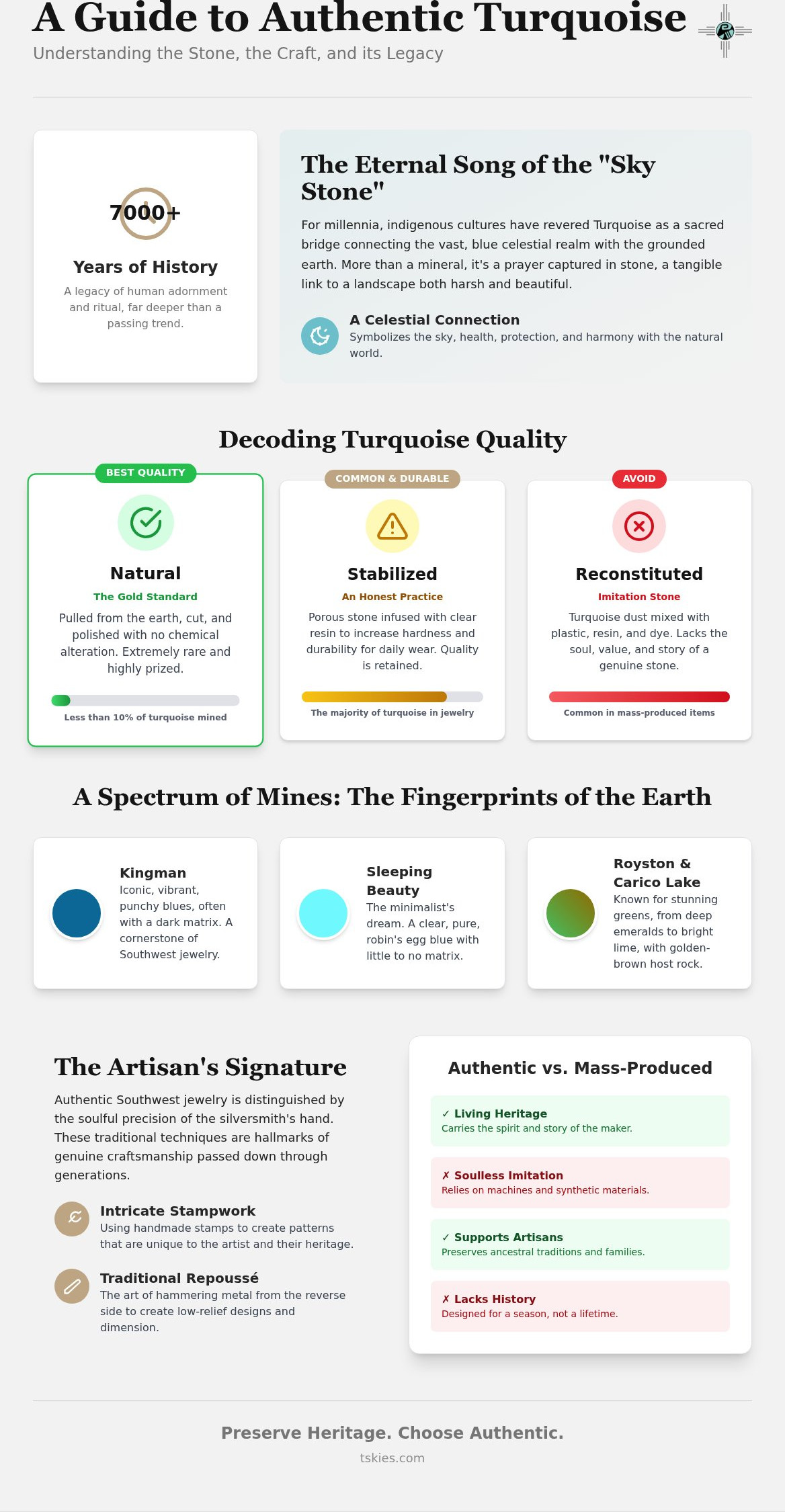
Turquoise is not merely a mineral. It's a prayer captured in stone. For millennia, indigenous cultures have revered Turquoise as the "Sky Stone." It serves as a sacred bridge. It connects the vast, blue celestial realm with the grounded, red earth beneath our feet. This isn't just about aesthetics. It's about a 7,000-year history of human adornment and ritual. From ancient burial sites to modern ceremonies, this stone has remained the heartbeat of Southwest jewelry traditions. It pulses with a rhythm that mass-produced fashion can't hope to replicate.
When you choose a piece of turquoise jewelry, you aren't just buying an accessory. You're becoming part of a story. Most modern items are designed for a season. They're hollow. Authentic pieces, however, are vessels of meaning. They carry the breath of the maker and the silence of the desert mines. They are tangible links to a landscape that is both harsh and beautiful. They represent a commitment to something deeper than a passing trend.
The Cultural Legacy of the Sky Stone
In ancestral Southwest cultures, turquoise was never just a rock. It was a catalyst for health and protection. It mirrored the flowing of water in a parched land. It signaled the presence of life. For the Navajo and other Pueblo peoples, the stone held the power to guard the traveler and bless the home. Its presence in a home or on a person was a sign of harmony with the natural world. Turquoise is a living mineral that breathes with the skin, shifting its hue as it absorbs the life and environment of its wearer. It evolves. It ages with you. It remembers your journey.
Why Authenticity Matters in Modern Adornment
Intentionality carries weight. When an artisan sits at a bench to shape sterling silver around a hand-cut stone, they're pouring their spirit into the work. This creates a "living heritage." Mass production relies on machines and synthetic imitations. It lacks a soul. It lacks the tactile history of the human hand. By choosing authentic turquoise jewelry, you step into the role of a steward. You aren't just a consumer. You're a protector of traditional artistry. You ensure that the silversmith's song continues for another generation. Every stamp on the metal is a signature of survival. Every stone is a piece of the earth's own heart.
Understanding the Stone: Colors, Mines, and Quality
The colors of turquoise jewelry are as varied as the landscapes that birthed them. One stone may capture the piercing clarity of a high-altitude noon. Another holds the deep, mossy secrets of a shaded canyon. This spectrum is a result of copper, aluminum, and phosphorus mingling in the earth's crust over millions of years. The host rock, known as the matrix, often remains intertwined with the mineral. This creates the coveted "spiderweb" patterns. These dark veins are the stone's fingerprints. They're a map of the very mountain where the turquoise was formed.
Finding your piece is an intuitive process. We often call these "spirit stones." It's about a physical resonance. You might feel a pull toward a specific shade or a particular pattern of matrix. This connection is what transforms a simple purchase into a lifelong companion. It's a silent dialogue between your energy and the ancient memory of the earth.
Natural, Stabilized, and Reconstituted: The Truth About Quality
Natural turquoise is the gold standard of the artisanal world. It's pulled from the earth, cut, and polished without any chemical intervention. It's rare. It's estimated that less than 10% of all turquoise mined is hard enough to be used in its natural state. You can learn more about the deep Turquoise History and Lore to understand why these untreated stones are so prized. Stabilized turquoise is also common. In this process, clear resin is pressured into the stone to make it durable enough for daily wear in rings. It's an honest practice when disclosed. However, you should be wary of "reconstituted" stones. These are often just chalk dust and plastic masquerading as genuine minerals. They lack the soul and the story of the earth.
Famous Mines of the Southwest
Every mine has a personality. Kingman Turquoise is perhaps the most iconic. It's known for its vibrant, punchy blues and rich history in the Southwest. Sleeping Beauty turquoise is the minimalist's dream. It offers a clear, robin's egg blue without any matrix at all. Then there are the greens. Mines like Royston and Carico Lake produce stones with stunning emerald and lime hues, often featuring golden or brown host rock. These variations allow for a deeply personal expression of style. If you are ready to find a piece that speaks to your journey, consider our selection of authentic turquoise jewelry.
The Silversmith’s Hand: Crafting Authentic Southwest Style
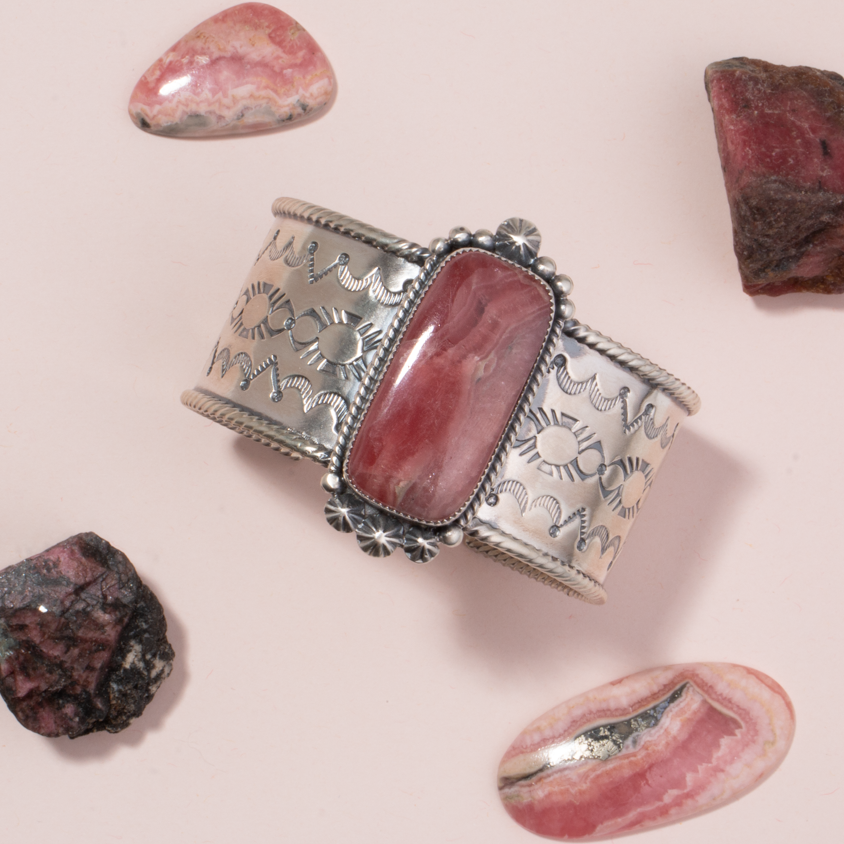
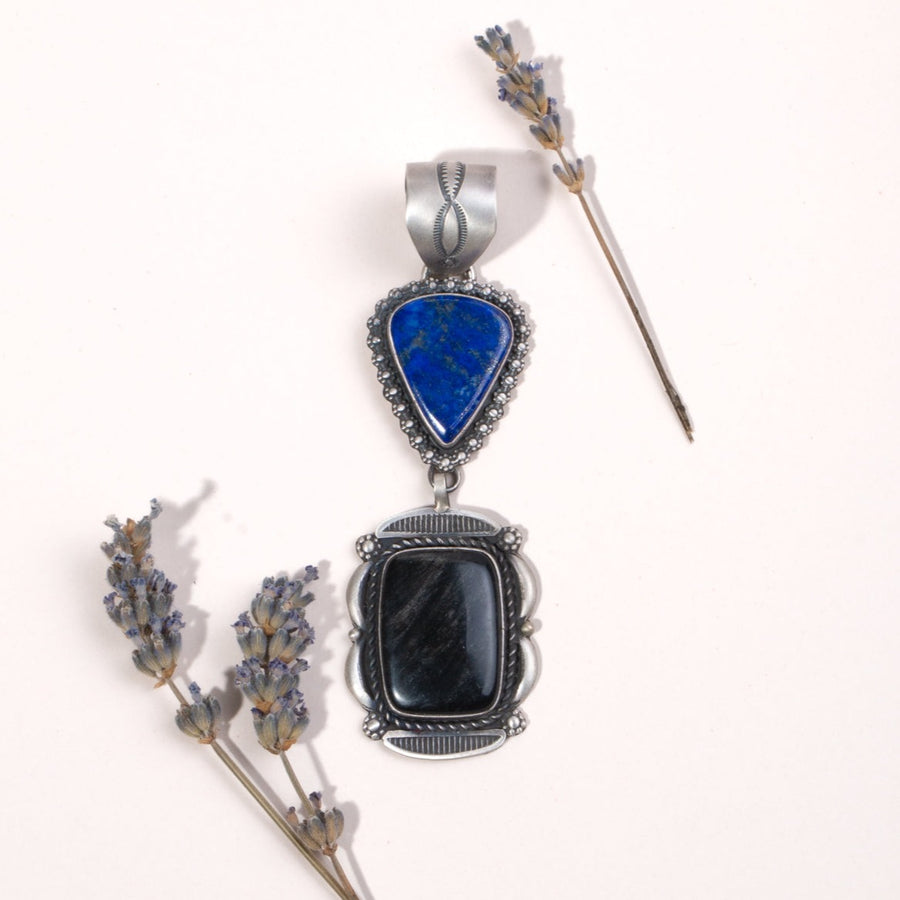
In the quiet of the studio, the air smells of fire and flux. It's a space where heritage meets metal. Here, 925 sterling silver isn't just a material. It's the canvas for every story told through turquoise jewelry. The silver serves as a grounding element. It balances the ethereal blue of the stone with the weight of the earth. Authentic Southwest style is defined by the silversmith's hand. You can feel it in the texture. You can see it in the way light catches the deep grooves of hand-cut stampwork or the elegant curves of repoussé. These techniques require more than skill. They require a connection to the ancestors who first mastered the flame.
Identifying quality begins with the marks left behind. On the reverse of a fine piece, you should find the "sterling" or "925" stamp. More importantly, look for the artisan's hallmark. This is a personal signature. It's a stamp of pride that links the wearer directly to the maker's lineage. It transforms a physical object into a documented piece of history.
The Art of Navajo Silversmithing
The journey began in the mid-19th century. Early Navajo silversmiths transformed silver coins and found metal into sacred adornment. This craft has evolved, but its heart remains unchanged. Consider the "Navajo Pearl." These aren't gems from the sea. They are hand-bench beads of silver, each one soldered and polished by hand. They represent a timeless elegance. Handcrafted silver possesses a soul. It carries the microscopic imperfections of a human touch. Machine-stamped pieces are cold. They are identical. They lack the breath of the maker. To truly appreciate the craft, one must look into the turquoise history and lore that continues to inspire these modern masters.
Artisan vs. Mass-Produced: How to Tell the Difference
Distinguishing between generic "Southwest-style" and "Authentic Artisan" work requires a keen eye. Look closely at the stampwork. In an artisan piece, you'll find slight variations in depth and spacing. These are the signatures of a hammer and a steady hand. Mass-produced items are too perfect. They feel hollow. Check the weight of your turquoise jewelry. Authentic sterling silver has a substantial, grounding feel on the skin. It shouldn't feel like tin. Finally, examine the bezel. This is the silver rim holding the stone. An artisan-made bezel is hand-fitted with precision. It hugs the unique contours of the turquoise. It doesn't just hold the stone; it honors it. These details are the difference between a fashion accessory and a legacy.
A Guide to Curating Your Turquoise Collection
Building a collection is an intentional act of storytelling. It's not about accumulation. It's about resonance. When you select a piece of turquoise jewelry, you're choosing a companion for your journey. A ring for daily wear should feel like a second skin. It needs a low profile and a comfortable band to move through your day with ease. In contrast, a statement ring serves as a focal point for ritual or celebration. It demands attention. It holds space. It becomes an anchor for your personal energy. Turquoise bracelets act as fluid earth art for the wrist. They move with you, their weight a constant, grounding reminder of the soil. Layering necklaces allows you to play with light and shadow. You can mix delicate strands of beads with heavy pendants to create a narrative that is uniquely yours. Finally, earrings frame the face with the colors of the horizon. They bring the clarity of the sky to your own expression. They catch the light and reflect the spirit of the high desert.
The Significance of the Zia Symbol
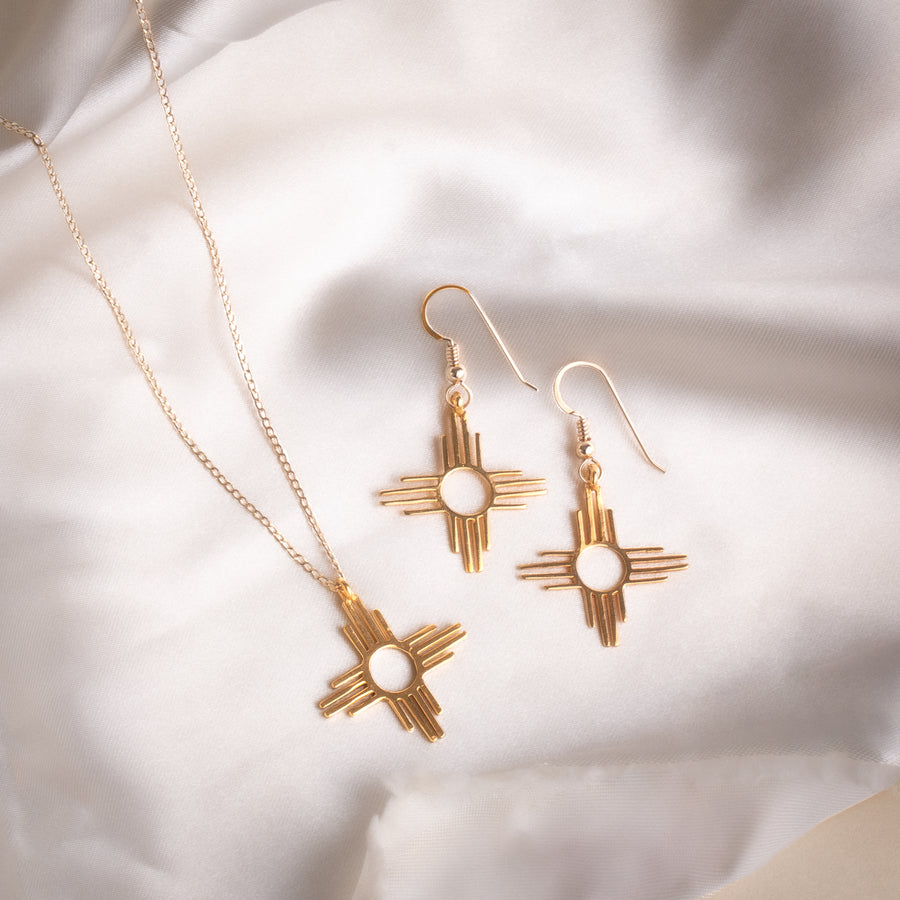
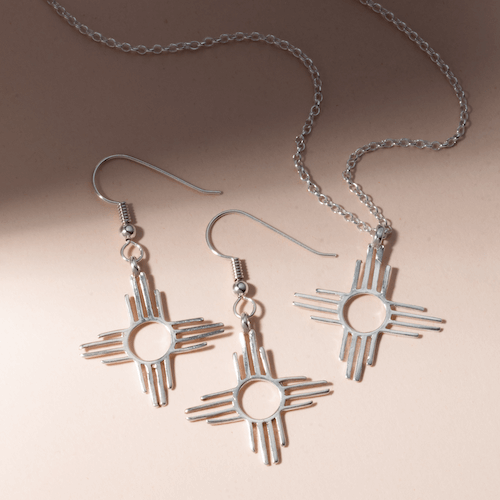
The Zia symbol is a pillar of Southwest identity. It's a sacred geometry of four. Four directions. Four seasons. Four stages of life: childhood, youth, adulthood, and old age. Each arm of the sun represents a commitment to balance and harmony. When you wear one of our Zia Pendants, you're carrying a reminder of this ancient wisdom. It's a symbol of the sun's life-giving power and the interconnectedness of all things. It teaches us to remain centered while reaching out to the world. It isn't just a design. It's a philosophy rendered in sterling silver. It acts as a compass for the modern soul, pointing toward a life lived with intention.
Styling Turquoise for the Modern Soul
Authentic pieces transition effortlessly between worlds. You don't need a traditional wardrobe to honor these traditions. A bold turquoise cuff looks striking against a minimalist black dress or a simple white linen shirt. It provides a soulful counterpoint to modern, sharp lines. The "Southwest Stack" is a favorite way to wear bracelets. You combine different textures, widths, and stones to create a rhythmic, sensory effect on the arm. Mix heavy stampwork with delicate wirework. For evening elegance, choose a single, high-grade piece of turquoise jewelry to serve as your centerpiece. Let the stone speak for itself. It doesn't need to shout to be heard. Its quiet confidence is enough to transform an entire look. If you're looking for a custom piece to anchor your collection, explore our Custom Jewelry Design services to create something truly one of a kind.
Every piece of turquoise jewelry you wear is a silent declaration of your values. It's an act of conscious adornment. When you choose an artisan-made piece, you aren't just buying silver and stone. You're participating in the survival of a culture. Imported imitations are often hollow. They lack a name. They lack a story. In contrast, every T.Skies Jewelry piece supports the continuation of traditional Navajo silversmithing. It ensures that the knowledge of the hammer and the flame is passed to the next generation. This is the difference between a temporary accessory and a living heirloom. These pieces are designed to outlast us. They carry our stories into the future, becoming vessels of memory for those who come after. They are the artifacts of tomorrow.
The ethical impact is profound. Under the Indian Arts and Crafts Act of 1990, it's illegal to falsely suggest a product is Native American produced. This truth-in-advertising law protects the integrity of the craft. A first-time violation for a business can result in a fine of up to $1,000,000. By demanding authenticity, you protect the artisans. You protect the heritage. You become a cultural steward. You ensure that the "Sky Stone" remains a symbol of truth rather than a commodity for mass production. It's a commitment to honoring ancestral traditions with every purchase.
Authentic jewelry requires a gentle touch. To maintain the radiant glow of 925 sterling silver, use a soft polishing cloth. Avoid harsh chemical dips. Natural turquoise is porous. It breathes. It should never be submerged in chemicals or placed in ultrasonic cleaners. These processes can strip the stone of its natural luster or alter its color over time. Storing your pieces in a cool, dry place prevents tarnish. It protects the stones from the fading effects of prolonged, direct sunlight. Treat your jewelry with the same reverence the artisan felt while creating it. It will reward you with a lifetime of beauty. Proper care ensures the stone's spirit remains vibrant for decades.
The T.Skies Jewelry Promise: A Dialogue with Tradition
We are more than makers. We are mentors and stewards. Our promise at T.Skies Jewelry is to honor ancestral practices while inviting the modern seeker into the story. We believe the crafting process is elemental. It's sensory. We invite you to participate through our custom jewelry design experiences. Together, we can create a piece that is uniquely yours, filled with purpose and inspired by the landscape. This is a journey of discovery. It's a shared heritage that we are honored to protect. Explore our collection of authentic turquoise jewelry and find your spirit stone.
Honor the Sky, Ground Your Spirit
You now understand the profound narrative held within every vein of matrix. Choosing turquoise jewelry is an act of connection. It's a choice to value the human hand over the machine. You've learned to look for the hallmarks of truth. You know how to distinguish the vibrancy of natural mines from the silence of synthetic imitations. Every piece you select becomes a chapter in your own story. It's a dialogue between the artisan's heritage and your personal journey. This isn't just about fashion; it's about preserving a living heartbeat.
T.Skies Jewelry honors this sacred bond. We offer pieces featuring hand-stamped artisan hallmarks and authentic 925 sterling silver. Our focus remains on ethically sourced natural stones that carry the spirit of the Southwest. Your choice to support traditional craftsmanship ensures these stories continue. Adorn your soul with authentic handcrafted turquoise jewelry. Let your collection be a reflection of your values. Wear your heritage with pride. The earth has waited millions of years to share this song with you. It's time to listen.
Frequently Asked Questions
How can I tell if my turquoise jewelry is real or fake?
Real stone feels cool to the touch and has a distinct weight. Fake pieces often feel like warm plastic or are unnaturally uniform in color. Look for an artisan's hallmark and a "925" stamp on the silver. Under the Indian Arts and Crafts Act of 1990, sellers must be truthful about Native American origins. If the price for turquoise jewelry seems suspiciously low, it's likely stabilized chalk or a polymer imitation masquerading as stone.
Does authentic turquoise jewelry always have a matrix?
Not every authentic stone requires a matrix to be genuine. While spiderweb patterns are highly prized, stones from the Sleeping Beauty mine are famous for their clear, robin's egg blue appearance. The absence of host rock doesn't signal a fake. It simply reflects the specific geological conditions of the mine. Whether clear or webbed, the stone's value depends on its natural hardness, its vibrancy, and the soul of the artisan who shaped it.
What is the difference between Navajo and Zuni turquoise jewelry?
The distinction lies in the relationship between stone and silver. Navajo artists are masters of metalwork, using bold stampwork and repoussé to frame larger stones. Zuni artisans are renowned for their lapidary skills. They specialize in needlepoint, petit point, and intricate stone-to-stone inlay. While Navajo work celebrates the silver's weight and texture, Zuni work focuses on the precision of the cut stones fitting together like a sacred mosaic. Both traditions represent profound cultural heritage.
How should I clean my turquoise and sterling silver jewelry?
Use a dedicated silver polishing cloth for the metal parts. Never submerge your turquoise jewelry in liquid cleaners or ultrasonic machines. These can strip the natural oils from the stone or cause it to change color unexpectedly. If the silver is heavily tarnished, use a damp cloth with mild soap, but avoid the stone entirely. Dry the piece immediately with a soft, lint-free cloth to maintain its radiant glow and protect the delicate setting.
Why is some turquoise jewelry much more expensive than others?
Value is driven by rarity and the maker's hand. Natural, untreated stones from closed mines are significantly more expensive than stabilized material. High-grade turquoise has seen substantial price increases over the last decade due to mine closures and scarcity. Additionally, a piece handcrafted by a master silversmith with a recognized hallmark carries the weight of their lineage and skill. This transforms the jewelry into a valuable family heirloom rather than a simple, mass-produced accessory.
Is it okay to wear turquoise jewelry every day?
Daily wear is a beautiful way to bond with your stone. However, turquoise is a porous mineral that requires care. Protect it from perfumes, hairsprays, and household chemicals that can seep into the surface. If you wear a ring every day, ensure the stone is stabilized for added durability. Bracelets and necklaces are generally safer for constant use. Always remove your pieces before swimming or heavy physical labor to protect the silver settings and stones.
What does the Zia symbol mean in Southwest jewelry?
The Zia symbol represents the sun and the sacred number four. It honors the four directions, the four seasons, the four times of day, and the four stages of life. In Southwest jewelry, it serves as a pillar of identity and a reminder of balance. Wearing a Zia pendant is an invitation to live in harmony with the earth. It's a philosophy rendered in sterling silver, acting as a spiritual compass for the soul.
Can turquoise change color over time?
Yes, turquoise is a living mineral that can evolve. Because it's porous, it can absorb skin oils, lotions, or moisture over years of wear. This often results in a shift toward a deeper green or a darker blue. Many collectors value this transition, seeing it as a record of the wearer's life. To minimize change, wipe your jewelry with a clean cloth after each use to remove surface oils and any environmental residues from the day.


