



Richard Chavez — San Felipe Pueblo Lapidary & His Marks

Hallmark of Richard Chavez (San Felipe Pueblo).
Hallmark documented in: Hougart, Schaaf (1200 Bios), Dubin (Glittering World).
b. 1949, San Felipe Pueblo. The architect who traded blueprints for stone.
Richard Chavez builds jewelry the way an architect builds a room: nothing extra, every line deliberate, the whole thing balanced so precisely it looks inevitable. He is one of the great minimalists of Southwestern jewelry — and, fittingly, he trained as an architect before he ever became a full-time jeweler.
The Marks
Chavez signs his work with a maker's mark identifying him and his San Felipe Pueblo affiliation (recorded by dealers as "Richard Ch").
The Smith
He was born in 1949 at San Felipe Pueblo, one of the more traditional Pueblo communities along the Rio Grande. His grandfather taught him the old skills first — heishi, and the stringing of turquoise necklaces — and as a young man he made Olivella-shell heishi to help pay his way. But his path ran through the drafting table before it ran through the workbench.
Chavez trained as an architectural draftsman, studied at the University of New Mexico's School of Architecture, and in the early 1970s worked for architect Harvey S. Hoshour — himself trained under the Bauhaus master Ludwig Mies van der Rohe — even assisting on the design of Albuquerque's Indian Pueblo Cultural Center. When cheap imported heishi undercut his shell work, he taught himself silver and lapidary instead. In 1976, just nineteen credit-hours short of his architecture degree, he left school to make jewelry full time.
That decision has held for nearly fifty years. Today he works alongside his son Jared Chavez as Chavez Studio — Richard on the lapidary, Jared on the metal — a genuine two-generation collaboration that began with a shared necklace in 2011.
The Work
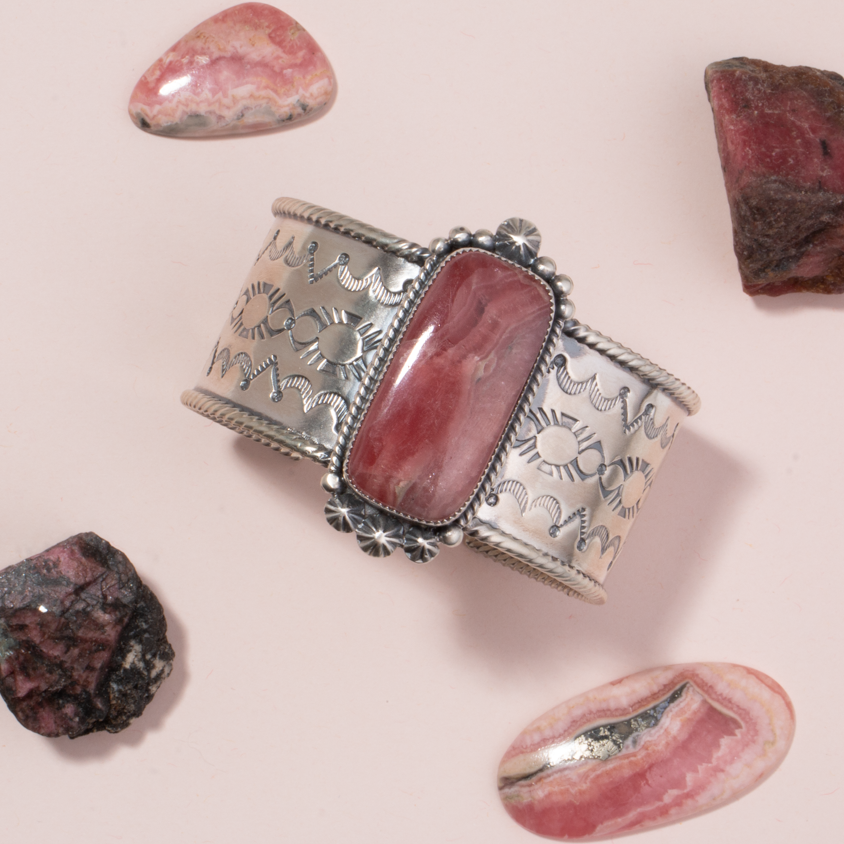
Chavez is a master of precision channel inlay. He does every step himself — the sketch, the stone selection, the cutting and grinding, the setting — fitting stone against stone so tightly the seams nearly vanish. Dealers describe the result as "practically seamless," a puzzle you can't quite see the joints of.
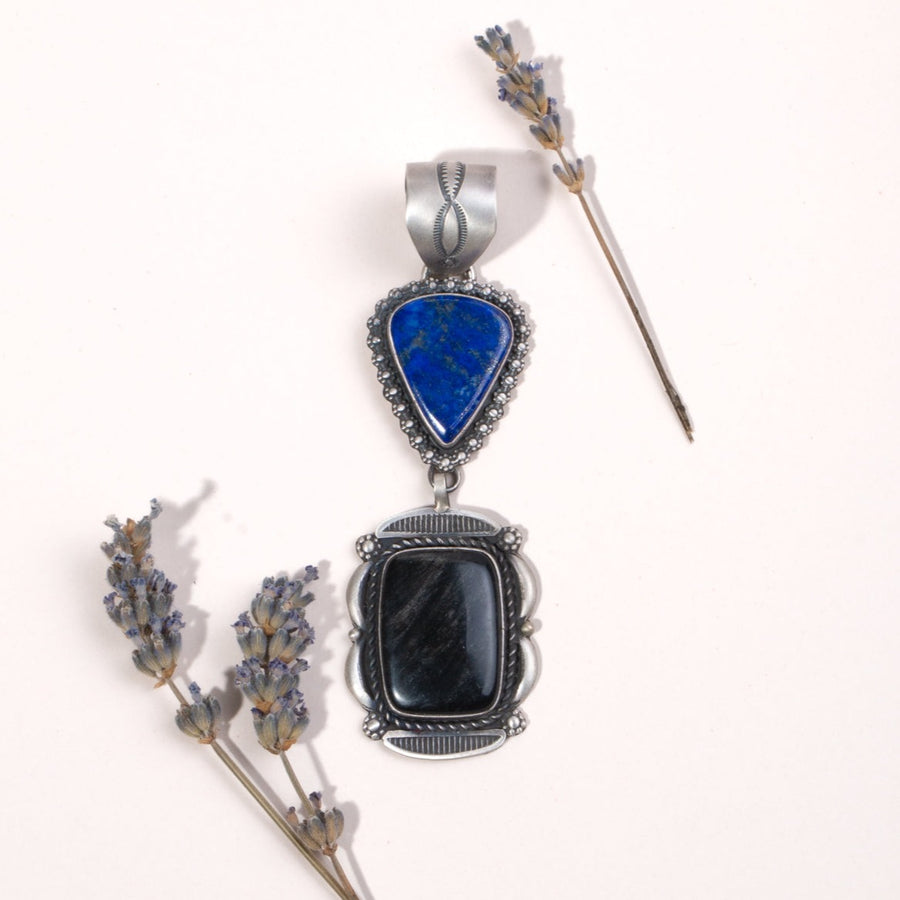
The architecture never left him. Every piece still begins as a carefully drawn diagram; his forms are clean, geometric, and quiet, in the spirit of Mies van der Rohe's "less is more." He moved early beyond turquoise-and-silver into unexpected stones — black jade, Siberian green jade, opal, tiger eye, fossilized ivory, lapis, sugilite, richly colored agates — often set in gold, with turquoise used as an accent rather than the star. He acknowledges the Hopi master Charles Loloma as a guiding influence on his generation.
His jewelry is deliberately non-representational — abstract, stone-driven, free of figures. As his gallery puts it, that choice keeps faith with the belief system of his San Felipe community. It's a value shaping an aesthetic, and we'll leave it there, as he does.
The Standing
Chavez arrived fully formed: Best of Show at the Eight Northern Pueblos show in 1976, his very first competition; a first-place ribbon at Santa Fe Indian Market in 1977; a SWAIA Fellowship in 1981. By 1990 he had stopped entering juried shows altogether, saying he no longer needed the validation. In 2018 the Heard Museum in Phoenix gave him the first career retrospective of his forty-plus years — "Symmetry in Stone: The Jewelry of Richard I. Chavez," with a companion book by curator Diana F. Pardue — and in 2024 his work appeared in R & Company's "Objects: USA" in New York.
Know more about Richard? Contact T.Skies.
- Pardue, Diana F. Contemporary Southwestern Jewelry + Symmetry in Stone: The Jewelry of Richard I. Chavez (Heard Museum, ISBN 9780934351935).
- Bahti, Mark. Silver + Stone: Profiles of American Indian Jewelers. Rio Nuevo Publishers.
- Richard Chavez Biography — Medicine Man Gallery
- Richard Chavez (San Felipe Pueblo, b. 1949) — Mahnaz Collection
- Richard Chavez, Master Jeweler — Shiprock Santa Fe
- Heard Museum — "Symmetry in Stone" retrospective
From the Library: Tryk, Santa Fe Indian Market (1993)
1993 primary source. Anything described as current here describes 1993, not today.
Writing in 1993, Tryk (1993, p. 58) counted Richard Chavez, San Felipe, among the younger artists and wrote that he had developed a unique and elegant style in just a few short years. [1]
From the Library: Schaaf, American Indian Jewelry I (2003)
2003 primary source. Anything described as current here describes 2003, not today.
Schaaf (2003, p. 112), who entered him as Richard I. Chavez, recorded him as born in 1949 and living at Algodones, New Mexico, as of 2003, with a Best of Division at Indian Market in 1978 and Best of Class and Best of Division there in 1989, and his work in the 2002 exhibitions Jewels of the Southwest in Santa Fe and Changing Hands at the American Craft Museum in New York. [2]
Schaaf (2003) recorded how his son began:
“At the age of ten, Jared Chavez began making jewelry beside his father, Richard Chavez.”
— Schaaf (2003), p. 112 [2]
From the Library: Dubin, North American Indian Jewelry and Adornment (1999)
1999 primary source. Anything described as current here describes 1999, not today.
Dubin (1999, p. 526) traced his main design influences to his architectural studies, the paintings of Joan Miró and Josef Albers, and Scandinavian jewelry. [3]
Sources
- Tryk, Sheila. Santa Fe Indian Market: Showcase of Native American Art. Photography by Mark Nohl; introduction by Allan Houser. Santa Fe, NM: Tierra Publications, in cooperation with SWAIA (Southwestern Association on Indian Affairs), 1993. Cited by printed page. Statements describe conditions as of 1993.
- Schaaf, Gregory, with Angie Yan Schaaf. American Indian Jewelry I: 1,200 Artist Biographies, ca. 1800-present. American Indian Art Series, Vol. 5. Santa Fe: CIAC Press, 2003. Cited by printed page. Statements describe conditions as of 2003.
- Dubin, Lois Sherr. North American Indian Jewelry and Adornment: From Prehistory to the Present. Original photography by Togashi, Paul Jones, and others. New York: Harry N. Abrams, 1999. Cited by printed page. Statements describe conditions as of 1999.
This profile is maintained in support of Native American silversmiths and compiled from published references. See something inaccurate, or want to add to it? Contact us.