



Morris Robinson — Pioneering Hopi Silversmith Before Overlay

Hopi (Third Mesa) · b. 1901 (per Hougart) – d. 1984 or 1987 · Active 1924 to the 1960s
The marks
Morris Robinson's hallmark is the letter H — H for Hopi — combined with a snake symbol. Hougart documents at least two different snake stamps; the oldest has nine vertical bars and a four-rattle tail. On small items the snake may be dropped and only the H stamped — or the H may be missing and only the snake appears. Both Wright and Hougart date the mark's first use to about 1931, Hougart citing Monthan (1975) for the date.
Collector's caution — read before you attribute. Two traps here. First, the snake is not a clan signature: Robinson's clan was Lizard, and Wright's hallmark index files his mark under "Snake & H" — the snake is a design element paired with the Hopi identifier, not a literal clan mark. Don't reason backward from the stamp to the clan, or from a lizard motif to Robinson. Second, Hougart explicitly illustrates a faked Morris Robinson mark alongside the genuine one — a distinction few smiths earn, and a sign his name carried real market value. A lone H on a small piece is thin evidence by itself; check any piece that matters against the mark facsimiles in Hougart and Wright before you pay for the name.
Hopi silver before overlay
Say "Hopi silver" today and most people picture overlay — the crisp, cut-silhouette style formalized in the late 1930s and 1940s with the Museum of Northern Arizona's backing. Morris Robinson had already been a working silversmith for some fifteen years by then. His career is what Hopi silver looked like before the famous project — and Hougart calls him plainly "a pioneering Hopi silversmith."
Born at Oraibi, he moved to Bacavi when that Third Mesa village was established. In 1924 he was living in Phoenix with his cousin Grant Jenkins, and there learned the rudiments of silverwork; before Jenkins died in 1934 or 1935, Wright records, he had helped at least two Hopi men — Robinson and Randall Honwisioma — become full-time silversmiths. Robinson's path was the commercial shop circuit: Skiles Indian Store in Phoenix in the 1930s, then Vaughn's Curio Store and Fred Wilson's Indian Trading Post, and in later years other Phoenix and Scottsdale shops — Hougart adds Harry Sakyesva's Sakyesva Jewelry and the McCormick Indian Arts and Crafts Center. By 1939 he appears in Whiting's Hopi crafts survey among fourteen active smiths, alongside Paul Saufkie and Honwisioma.
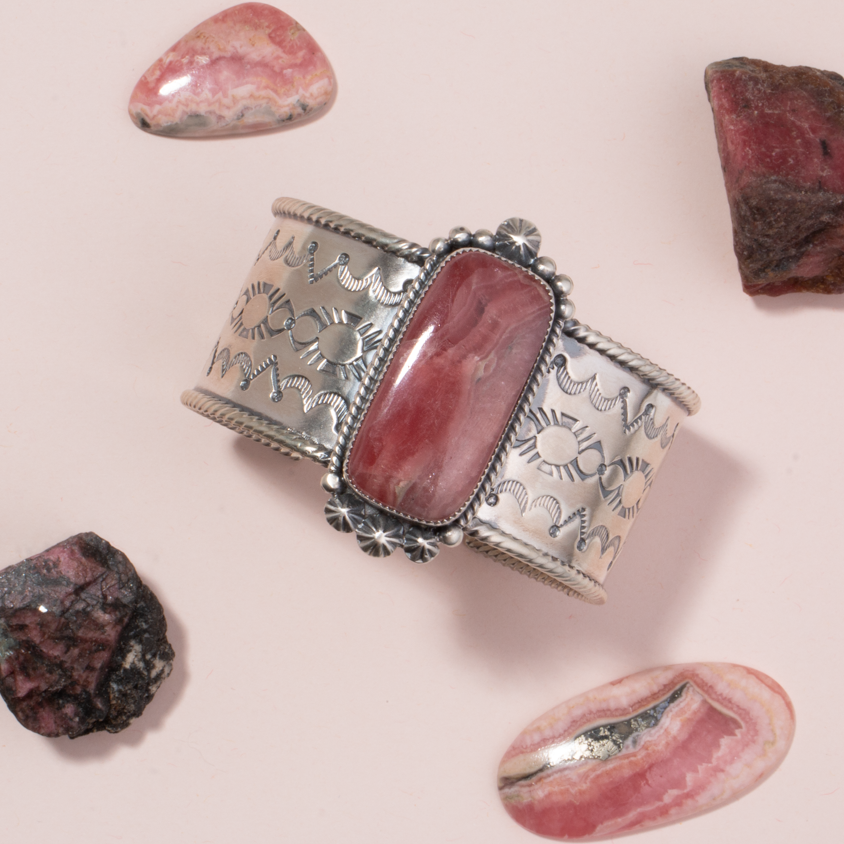
The work itself started plain: bracelets from a strip of silver, set with turquoise, stamped designs at the ends. From there he grew into most of the silvercrafting techniques and made, in Wright's words, any form of silver that would sell — candlesticks, bowls, all types of jewelry. The bowls carry his best story: he'd take a large circle of 14-gauge silver and hammer it gradually into shape over an old cannonball, a simple stamped border at first, the decoration growing more intricate over the years. He cut his own dies and tempered only their outer "shell" — tempered too hard, he explained, they turn brittle and break off under the hammer.
He wasn't a holdout against overlay, either. Wright records that by December 1941 Robinson had become interested in the emerging overlay-style designs — the same moment Saufkie and Honwisioma were working in the new style — and he later used chisel and stamp work as embellishments on overlay pieces. Younger smiths sought him out: Charles Loloma, working in Phoenix, brought his jewelry to Robinson for advice and criticism. Robinson retired in the 1960s and went home to Bacavi to help his brother, still doing some cast work. His dates carry one honest asterisk: Hougart gives 1901–1984, while both editions of Wright say he died in 1987 — the references disagree, and we won't pretend otherwise. Silver set with his turquoise from 1950–1960, including cast buckles, is held by the Museum of Northern Arizona.
References
- Wright, Margaret. Hopi Silver: The History and Hallmarks of Hopi Silversmithing — biography, hallmark table, and 1939/1941 Whiting survey citations (Plateau 12, p. 7; Whiting 4:7, 12).
- Hougart, Bille. Native American and Southwestern Silver Hallmarks, 5th ed. (2022) — Morris Robinson entry, shop entries (Vaughn's Curio Store, Fred Wilson's Indian Trading Post), genuine and faked mark illustrations; hallmark date per Monthan (1975).
- Wright, Margaret Nickelson. Hopi Silver: The History and Hallmarks of Hopi Silversmithing. Revised edition. Albuquerque: University of New Mexico Press, 2003. Originally published by Northland Publishing. Cited by printed page. Statements describe conditions as of 2003.
- Bassman, Theda. The Beauty of Hopi Jewelry. Photography by Gene Balzer. Walnut, California: Kiva Publishing, 1993. Cited by printed page. Statements describe conditions as of 1993.
- Schaaf, Gregory, with Angie Yan Schaaf. American Indian Jewelry I: 1,200 Artist Biographies, ca. 1800-present. American Indian Art Series, Vol. 5. Santa Fe: CIAC Press, 2003. Cited by printed page. Statements describe conditions as of 2003.
From the Library: Wright, Hopi Silver (2003)
2003 primary source. Anything described as current here describes 2003, not today.
According to Wright (2003, p. 127), Morris Robinson is one of sixteen working Hopi silversmiths on the 1939 list Wright reprints from Plateau 12; he does not appear on John Adair's 1938 list, which Wright also reprints. [1]
From the Library: Bassman, The Beauty of Hopi Jewelry (1993)
1993 primary source. Anything described as current here describes 1993, not today.
Bassman (1993) pictured a belt buckle from his working years:
“Oval with three turquoise stones made in 1951 by Morris Robinson.”
— Bassman (1993), p. 45 [2]
From the Library: Schaaf, American Indian Jewelry I (2003)
2003 primary source. Anything described as current here describes 2003, not today.
Schaaf (2003) recorded his hallmark:
“(hallmark - snake, H for Hopi, 1931-87)”
— Schaaf (2003), p. 272 [3]
Schaaf (2003, p. 272) recorded Morris Robinson as Hopi, active from about 1924 to 1987, living at Oraibi, Bacavi and Phoenix, a brother of Bula Robinson, Susie Robinson Secakuku and Joseph Robinson and the father of Brian Robinson, with his work in the Heard Museum. [3]
Schaaf (2003) wrote:
“He became perhaps the first Indian master goldsmith in the Southwest.”
— Schaaf (2003), p. 272 [3]
Schaaf (2003) added:
“He reportedly was an uncle of Charles Loloma, his famous younger neighbor who lived across the road in Hotevilla.”
— Schaaf (2003), p. 272 [3]
Schaaf (2003) wrote:
“Alph credited his style to the influence of his respected uncle, Morris Robinson, one of the most important jewelers of the early 20th century.”
— Schaaf (2003), p. 282 [3]
Field Notes by Mateo James
Field Notes by Mateo James: Our page places Robinson among fourteen active smiths in Whiting's 1939 survey. The 1939 list Wright reprints from the Museum of Northern Arizona's Plateau names sixteen smiths, Robinson among them. These may be two different lists, so I show both counts.
This profile is maintained in support of Native American silversmiths and compiled from published references. See something inaccurate, or want to add to it? Contact us.
Name card shown; hallmark photo to come. © Turquoise Skies Inc.