



McKee A Platero

Hallmark documented in: Hougart, Schaaf (1200 Bios). Rendered from the documented mark, not a photograph.
Overview
McKee A Platero (born 1957) is a Navajo metalsmith working multiple styles, classic or modernistic — casting, stamp work, spikes and futuristic themes.
He is the son of Kee and Ella Platero and the uncle of Tammy Nelson; none of the three has a directory page yet, and his entry states no relation to the other Plateros in this directory, so we record none. His documented marks: three dots; three stars; M P plus dots or stars; NAV and three dots; and Mckee Platero in etched script — a footnote adds that the initials and stars are sometimes on the front of a piece.
Collector's caution: McKee's M P initials mark collides with another documented Platero — Hougart's adjacent entry for Maria Platero (wife of Joey Platero) records her marks as M P too. On the initials alone the two cannot be told apart; read the dots, stars and the work itself alongside the letters.
The Mark
"McKee A Platero (1957-; Navajo). Metalsmith; multiple styles; classic or modernistic; casting; stamp work; spikes; futuristic themes. Uncle of Tammy Nelson. Son of Kee and Ella Platero. Marks: Three dots; three stars; M P (plus dots or stars); NAV and three dots; Mckee Platero (etched script). [footnote 36: Sometimes the initials and stars are on the front]"
— Hougart, Bille. Native American and Southwestern Silver Hallmarks, 5th ed. (2022).
The mark as documented in Hougart's hallmark reference: Three dots; three stars; M P (plus dots or stars); NAV and three dots; Mckee Platero (etched script) — a footnote adds the initials and stars are sometimes on the front.
References
- Hougart, Bille. Native American and Southwestern Silver Hallmarks, 5th ed. Washington, DC: BilleHougartBooks, 2022.
- Jacka, Lois Essary. Navajo Jewelry: A Legacy of Silver and Stone. Photographs by Jerry Jacka. Flagstaff: Northland Publishing, 1995. Cited by printed page. Statements describe conditions as of 1995.
- Schaaf, Gregory, with Angie Yan Schaaf. American Indian Jewelry I: 1,200 Artist Biographies, ca. 1800-present. American Indian Art Series, Vol. 5. Santa Fe: CIAC Press, 2003. Cited by printed page. Statements describe conditions as of 2003.
- Dubin, Lois Sherr. North American Indian Jewelry and Adornment: From Prehistory to the Present. Original photography by Togashi, Paul Jones, and others. New York: Harry N. Abrams, 1999. Cited by printed page. Statements describe conditions as of 1999.
Know more about this artist? Contact T.Skies.
From the Library: Jacka, Navajo Jewelry: A Legacy of Silver and Stone (1995)
1995 primary source. Anything described as current here describes 1995, not today.
A 1995 caption in Jacka's book:
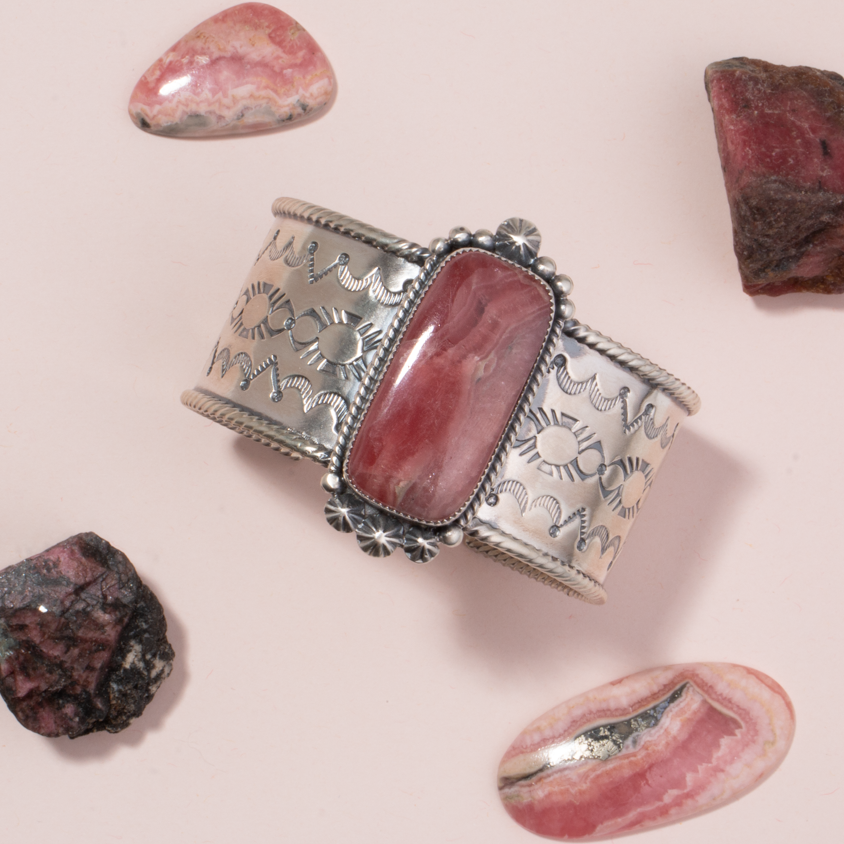
“This silverwork by McKee Platero, which resembles that of the early 1900s, includes a tobacco flask, two bracelets, and three pins. It is decorated with repoussé and stampwork, two of the earliest decorative techniques used by Navajo silversmiths.”
— Jacka (1995), p. 26 [1]
McKee Platero told Jacka (1995, p. 59) that he made all his own stamps and most of his tools, and had always hammered and drawn out his silver himself. [1]
From the Library: Schaaf, American Indian Jewelry I (2003)
2003 primary source. Anything described as current here describes 2003, not today.
Schaaf (2003, p. 256) recorded McKee Platero as Navajo, stamping three dots, working in traditional, contemporary and classic revival jewelry in silver, gold, red brass and iron as well as paintings, with murals commissioned for the Thunderbird Inn and his work in the British Museum in London. [2]
Schaaf (2003) quoted Cirillo calling him
“one of the most technically proficient and imaginative silversmiths”
— Schaaf (2003), p. 256 [2]
From the Library: Dubin, North American Indian Jewelry and Adornment (1999)
1999 primary source. Anything described as current here describes 1999, not today.
Dubin (1999, p. 521) described McKee Platero as technically proficient and highly imaginative, casting all his own silver from ingots and blending tradition with whimsy and occasional social commentary. [3]
This profile is maintained in support of Native American silversmiths and compiled from published references. See something inaccurate, or want to add to it? Contact us.